
BuddhistCatholicContemplativeEvangelicalGeneral ChristianHinduJewishLatter-day SaintMuslimNew VisionsProgressive Christian
Beliefs
- Buddhist
- Catholic
- Contemplative
- Evangelical
- General Christian
- Hindu
- Jewish
- Latter-day Saint
- More Voices
- Muslim
- New Visions
- Pagan
- Progressive Christian
Topics
- Religion News
- Food and Religion
- Sports and Religion
- Religious Art
- Religious Music and Entertainment
- Religious Events
- History and Religion
- Style and Religion
- Politics and Religion
- Women in Religion
- Recreation Outdoors and Religion
- Business Finance and Religion
- Careers Workplace and Religion
- Education and Religion
- Family Parenting and Religion
- Health Fitness and Religion
- Home and Religion
- Relationships and Religion
- Technology and Religion
- Travel and Religion
Columnists
- Buddhist Columnists
- Business Finance and Religion Columnists
- Careers Workplace and Religion Columnists
- Catholic Columnists
- Contemplative Columnists
- Education and Religion Columnists
- Evangelists Columnists
- Family Parenting and Religion Columnists
- General Christian Columnists
- Health Fitness and Religion Columnists
- Hindu Columnists
- History and Religion Columnists
- Home and Religion Columnists
- Jewish Columnists
- More Voices Columnists
- Latter Day Columnists
- Muslim Columnists
- New Visions Columnists
- Nonreligious Columnists
- Pagan Columnists
- Politics and Religion Columnists
- Progressive Columnists
- Recreation Outdoors and Religion Columnists
- Relationships and Religion Columnists
- Religion News Columnists
- Religious Art Columnists
- Religious Events Columnists
- Religious Music and Entertainment Columnists
- Sports and Religion Columnists
- Style and Religion Columnists
- Technology and Religion Columnists
- Travel and Religion Columnists
- Women in Religion Columnists
Resource Library
- 2026 Calendar
- Library of World Religions
- The 100 Most Holy Places on Earth
- Patheos Answers
- Podcasts
- Videos
- Faith Leaders Database
- Anglican Episcopalian
- Bahai
- Baptist
- Buddhism
- Christianity
- Confucianism
- Eastern Orthodoxy
- Hinduism
- Holiness and Pentecostal
- ISKCON
- Islam
- Judaism
- Lutheran
- Methodist
- The Church of Jesus Christ of Latter-day Saints
- New Age
- Paganism
- Presbytarian and Reformed
- Protestantism
- Religion Behind the Scenes
- Roman Catholic
- Scientology
- Shia Islam
- Sikhism
- Sufism
- Sunni Islam
- Taoism
- Zen
- See all religions
Research Tools
 Ad-Free & Subscriber Log-In Subscription Support
Ad-Free & Subscriber Log-In Subscription Support
Follow Patheos 

- Trending:
- Forgiveness
- |
- Marriage
- |
- Consciousness
- |
- Death Penalty
- |
- Election
- |
- Halloween

- HOME
- Me and the Blog
- Defining Pagan
- Rituals & Holidays
- All Posts
- Blogroll
- Publications
- FREE NEWSLETTER
- Home
- Pagan
- The 5 Most Important Books in the Modern Witchcraft Revival
The 5 Most Important Books in the Modern Witchcraft Revival
Last updated on: September 27, 2017 at 6:14 pm by Jason Mankey
The 5 Most Important Books in the Modern Witchcraft Revival 2017-09-27T18:14:48-06:00 Jason Mankey
Patheos Explore the world's faith through different perspectives on religion and spirituality! Patheos has the views of the prevalent religions and spiritualities of the world.
We’ve always been a people of the books (or the library), so it should come as no surprise that Modern Witchcraft has been shaped to some degree by the written word. Magickal people have always been captivated by books, even illiterate 17th and 18th Century cunningfolk were said to keep a few titles on their shelves just to impress their customers. But some books are more important than others, and I’d argue that the five played an outside role in the Witchcraft Revival of the 20th Century.
Before we begin, it’s important to point out that there are a lot of differing opinions on when Modern Witchcraft began (or if Witchcraft ever truly went away), but for the purposes of this article we are going to place the beginnings of the Modern Craft between 1935 and 1951. 1951 is when Gerald Gardner became the first, modern, public Witch (meaning he self-identified that way). He was allegedly initiated into a Witchcraft tradition in 1939, and since that implies that it predated him I’ve moved the goal posts back a few years. In addition, I think it’s likely that other people during that time frame were practicing something that would later be identified as Witchcraft.

“The Golden Bough” by J.M.W. Turner . From WikiMedai. (This is better than looking at a book cover.)
THE GOLDEN BOUGH
BY SIR JAMES FRAZER Originally published in 1890, revised and expanded in 1900 and then again 1906-1915
It’s doubtful that most of us have read the entire Golden Bough (the third edition was 12 volumes long, and if you have read all of it congratulations!), but we’ve certainly all been influenced by it. Frazer’s greatest contribution to Modern Witchcraft was the “dying and resurrecting god” a theory generally discredited by scholars today, but one that still resonates with a lot of people.
Frazer’s central thesis in The Golden Bough was that all of the gods who died in antiquity were gods of vegetation and fertility, dying during the Earth’s barren periods and then returning with the year’s first new growth. Frazer believed that this was taken a step further in human cities, with (human and mortal) Divine Kings representing this vegetation god, with that king dying or being sacrificed to bring fertility back to the Earth. Much of Frazer’s motivation for writing The Golden Bough was due to his dislike of Christianity, as the book links Jesus to ancient pagan gods, with the implication that Jesus is just as silly as Dionysus, Osiris, and Baldur. (The idea of Jesus as a dying and resurrecting god and a shadow of other pagan deities is an idea has never quite gone away, and has spawned a cottage industry.)
Every time a group of Witch’s celebrates the sacrifice of The Horned God at Samhain (or Lammas or the Autumn Equinox) they are paying homage to the ideas of Frazer. While Frazer’s theory has not aged well, it’s very powerful poetically, and is easy enough to sync up with the Wheel of the Year and the eight sabbats of Witchcraft. Frazer was an atheist and would most likely have been horrified to find that his ideas were adopted to some degree by a bunch of Modern Pagans.
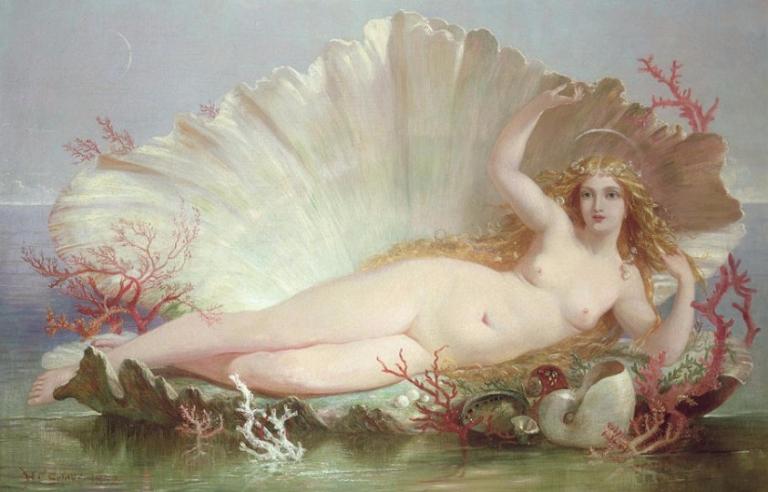
“The Birth of Venus” by Henry Courtney Selous. From WikiMedia.
THE SEA PRIESTESS
by Dion Fortune Originally published in 1938
Dion Fortune didn’t invent the Goddess, but I think she went a long way in shaping how many Witches (and just Pagans in general) talk about her. I’ll be the first to admit that The Sea Priestess is far from a perfect book. It’s 300 pages long and only about 50 of those pages are really all that interesting, but OH THOSE 50 PAGES! When Fortune gets away from her silly protagonist and into the magical working of her tale things go from meh to great and much of the power in that working comes directly from how Fortune’s ritual unfolds and how the Goddess is described.
About twenty years before Doreen Valiente articulated the “Universal Goddess” prevalent in many types of Witchcraft today (“Listen to the words of the Great Mother, who was of old also called Artemis; Astarte; Diana; Melusine; Aphrodite; Cerridwen; Dana; Arianrhod; Isis; Bride; and by many other names . . .”), Fortune did so, and nearly as poetically. In the passage below she ties
“I am the soundless, boundless, bitter sea;
All things in the end shall come to me.
Mine is the kingdom of Persephone,
The inner earth, where lead the pathways three.
Who drinks the waters of that hidden well
Shall see the things whereof he dare not tell-
Shall tread the shadowy path that leads to me-
Diana of the Ways and Hecate,
Selene of the Moon, Persephone.”
Just peaking through The Sea Priestess for this article has reminded me of just how powerful and amazing her prose can be when writing about the Goddess. Summing up the Lady of the Moon Fortune writes:
“But likewise in the souls of men a flowing and an ebbing of the tides of life, which no one knoweth save the wise; and over these tides the Great Goddess presides under her aspect of the Moon. She comes from the sea as the evening star, and the magnetic waters of earth rise in flood. She sinks as Persephone in the western ocean and the waters flow back into the inner earth and become still in the grate lake of darkness wherein are the moon and stars reflected. Whoso is still as the dark underworld lake of Persephone sees the tides of the Unseen moving therein, and knoweth all things. Therefore is Luna called the giver of visions.”
When staring my Wiccan journey in the early 90’s such passages would have felt right at home in the multitude of Llewellyn books I was consuming at the time.
Fortune’s influence goes further than just verbalizing the idea of an all-encompassing universal Goddess, the main working written about in The Sea Priestess reads like an early version of the ceremony known as drawing down the moon. The book’s secondary protagonist, the comically named Le Fey Morgan, calls the Goddess into her in the book’s most inspiring chapter, and does so while expressing the idea of gender polarity-an idea that was commonplace in early Witchcraft.
“Out of my hands he takes his destiny
Touch of my hands confers polarity
These are the moon tides, these belong to me-
Hera in heaven, on Earth, Persephone;
Levanah of the tides, and Hecate.
Diana of the Moon, Star of the Sea,
Isis Unveiled, and Ea, Binah, Ge!”
I’ve written before about The Sea Priestess, but the more I study the mysteries of the Craft, the more I see the influence of Dion Fortune.
THE WHITE GODDESS
by Robert Graves Originally published in 1948
The White Goddess is one of those seminal Pagan building blocks that I find nearly impossible to read. Though it sort of reads as history, it’s secondary title shines a little more light on its actual contents: “a Historical Grammar of Poetic Myth.” It’s those last words that truly sum up The White Goddess, it’s not so much a journey through history, but a journey through a new mythology, one that’s practically poetic when boiled down to its component parts. When asked about the writing of The White Goddess Graves always expressed the idea that his pen was being pushed by a higher power, and not some sort of academic quest for absolute historical truth.
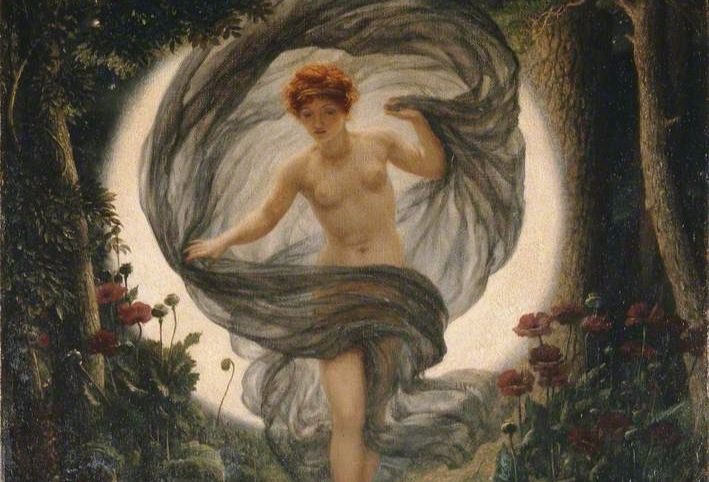
“The Vision of Endymion” by John Poynter. From WikiMedia.
Hidden in the pages of The White Goddess is an idea central to many forms of Witchcraft: The Triple Goddess, the Goddess as Maiden, Mother, and Crone. Even Witches and Pagans who have never heard of Graves or his book are familiar with his greatest mythological creation, and he did create a new myth. In the Ancient World there were Maiden goddesses, and Mother goddesses, and Crone goddesses (and Warrior goddesses and lots of other goddess), but they were never really three in one. When a Goddess was expressed in triplicate (or more) it was generally to show off her many attributes, not that she had three phases of life as a prt of herself that made up whole.
But Graves’ idea just makes so much sense that it’s hard not to adopt, and find beauty in. When I celebrate the Wheel of the Year and see The Goddess as going through stages on a yearly journey I’m using the ideas of Graves. They are just too good of a fit not to use, and have been in use in Witchcraft since at least the 1960’s. (The rituals of Robert Cochrane were hugely influenced by The White Goddess.)
If Maiden, Mother, and Crone in One weren’t enough, Graves also took the influence of Frazer one step further in the creation of the Oak King/Holly King myth. In ancient mythology there are warriors who battle, but not warriors who magically survive death, disappear for six months, and then reclaim their thrones in an annual cycle. Bits of the myth appear in various places (parts of The Mabinogian come to mind) but it’s not the entire story most of know today, it’s bits and pieces, and Graves put them together to create a new myth. There are some writers who think Graves is the most important and influential Witch and Pagan writer of them all, and while I disagree, I do acknowledge that he was highly influential.
This article is ridiculously long, to help loading times on your mobile device it’s continued at the link below.
Previous Post

September 14, 2017
8 Ways to Celebrate the Autumn Equinox/Mabon
Next Post
September 27, 2017 These Things Aren't All True: Falsehoods in the Pagan Community
Browse Our Archives
Select a Category Editorializing Gateways to Paganism Guest Posts Holiday Histories Led Zeppelin News and Views Occult Pagan Pagan TV Club Paganism polytheism Ramble On Reviews Ritual Strange Days Uncategorized
Select a Month August 2026 March 2026 February 2026 November 2025 September 2025 August 2025 April 2025 August 2024 April 2024 February 2024 December 2023 October 2023 August 2023 June 2023 May 2023 January 2023 October 2022 August 2022 July 2022 June 2022 May 2022 April 2022 March 2022 February 2022 January 2022 December 2021 November 2021 October 2021 September 2021 August 2021 July 2021 June 2021 April 2021 March 2021 February 2021 January 2021 December 2020 November 2020 October 2020 August 2020 July 2020 June 2020 May 2020 April 2020 March 2020 February 2020 January 2020 December 2019 November 2019 October 2019 September 2019 August 2019 July 2019 June 2019 May 2019 April 2019 March 2019 February 2019 January 2019 December 2018 November 2018 October 2018 September 2018 August 2018 July 2018 June 2018 May 2018 April 2018 March 2018 February 2018 January 2018 December 2017 November 2017 October 2017 September 2017 August 2017 July 2017 June 2017 May 2017 April 2017 March 2017 February 2017 January 2017 December 2016 November 2016 October 2016 September 2016 August 2016 July 2016 June 2016 May 2016 April 2016 March 2016 February 2016 January 2016 December 2015 November 2015 October 2015 September 2015 August 2015 July 2015 June 2015 May 2015 April 2015 March 2015 February 2015 January 2015 December 2014 November 2014 October 2014 September 2014 August 2014 July 2014 June 2014 May 2014 April 2014 March 2014 February 2014 January 2014 December 2013 November 2013 October 2013 September 2013 August 2013 July 2013 June 2013 May 2013 April 2013 March 2013 February 2013 January 2013 December 2012 November 2012 October 2012 September 2012 August 2012 July 2012 June 2012 April 2012 October 2011 September 2011 August 2011
Follow Us!
TAKE THE
Religious Wisdom Quiz
What material was used to make Moses' basket waterproof?
Select your answer to see how you score.
Tar and pitch Camel hide Linen and clay Palm leaves
Related posts from Raise the Horns

What Makes a Good Ritualist? No Idea

Witchcraft Remembrances & Appreciation at Samhaintide

Raymond Buckland & The Big Blue Book

TRENDING AT PATHEOS Pagan

Janie Learns the Way of the Cross: A...
Teaching children about Jesus' Passion can be challenging. Many parents and educators...

Looking For Good Catholic Writing - October 2026
He alone extends the heavens, and he walks upon the waves of...

In "Irreplaceable," our book on vocation and technology, Trevor Sutton and I...

I was strolling through the top floor of the brand new Parthenon...

What Does Gêvâh Mean For Kimberley Guifoyle &...
This week, a lot of the news is focused on Kimberly Guilfoyle....

INNER CIRCLE: Profound Mystery (Of Christ In All...
Ephesians 5:31-32 “For this reason, a man will leave his father and...
view all Pagan blogs
Ad-Free & Subscriber Log-In Subscription Support
- About Us
- 2026 Calendar
- Videos
- Podcasts
- Library of World Religions
- Faith In Media Tracker
- Advertise With Us
- Write for Us
- Privacy Policy
- Terms of Service
- Do Not Sell My Data
- Contact Us
- Radiant Digital
- Manage Newsletter Subscriptions
- Unsubscribe From Notifications
- Sitemap
Copyright 2008-2026, Patheos. All rights reserved.
Subscription Support Ad-Free & Subscriber Log-In
Follow Patheos