
BuddhistCatholicContemplativeEvangelicalGeneral ChristianHinduJewishLatter-day SaintMuslimNew VisionsProgressive Christian
Beliefs
- Buddhist
- Catholic
- Contemplative
- Evangelical
- General Christian
- Hindu
- Jewish
- Latter-day Saint
- More Voices
- Muslim
- New Visions
- Pagan
- Progressive Christian
Topics
- Religion News
- Food and Religion
- Sports and Religion
- Religious Art
- Religious Music and Entertainment
- Religious Events
- History and Religion
- Style and Religion
- Politics and Religion
- Women in Religion
- Recreation Outdoors and Religion
- Business Finance and Religion
- Careers Workplace and Religion
- Education and Religion
- Family Parenting and Religion
- Health Fitness and Religion
- Home and Religion
- Relationships and Religion
- Technology and Religion
- Travel and Religion
Columnists
- Buddhist Columnists
- Business Finance and Religion Columnists
- Careers Workplace and Religion Columnists
- Catholic Columnists
- Contemplative Columnists
- Education and Religion Columnists
- Evangelists Columnists
- Family Parenting and Religion Columnists
- General Christian Columnists
- Health Fitness and Religion Columnists
- Hindu Columnists
- History and Religion Columnists
- Home and Religion Columnists
- Jewish Columnists
- More Voices Columnists
- Latter Day Columnists
- Muslim Columnists
- New Visions Columnists
- Nonreligious Columnists
- Pagan Columnists
- Politics and Religion Columnists
- Progressive Columnists
- Recreation Outdoors and Religion Columnists
- Relationships and Religion Columnists
- Religion News Columnists
- Religious Art Columnists
- Religious Events Columnists
- Religious Music and Entertainment Columnists
- Sports and Religion Columnists
- Style and Religion Columnists
- Technology and Religion Columnists
- Travel and Religion Columnists
- Women in Religion Columnists
Resource Library
- 2026 Calendar
- Library of World Religions
- The 100 Most Holy Places on Earth
- Patheos Answers
- Podcasts
- Videos
- Faith Leaders Database
- Anglican Episcopalian
- Bahai
- Baptist
- Buddhism
- Christianity
- Confucianism
- Eastern Orthodoxy
- Hinduism
- Holiness and Pentecostal
- ISKCON
- Islam
- Judaism
- Lutheran
- Methodist
- The Church of Jesus Christ of Latter-day Saints
- New Age
- Paganism
- Presbytarian and Reformed
- Protestantism
- Religion Behind the Scenes
- Roman Catholic
- Scientology
- Shia Islam
- Sikhism
- Sufism
- Sunni Islam
- Taoism
- Zen
- See all religions
Research Tools
 Ad-Free & Subscriber Log-In Subscription Support
Follow Patheos 

- Trending:
- Advent
- |
- Forgiveness
- |
- Thanksgiving
- |
- Election
- |
- Seasonal Holidays
- |
- Marriage

- HOME
- Me and the Blog
- Defining Pagan
- Rituals & Holidays
- All Posts
- Blogroll
- Publications
- FREE NEWSLETTER
- Home
- Pagan
- Magick & Deity are Two of the Foundations of Modern Paganism
Magick & Deity are Two of the Foundations of Modern Paganism
Last updated on: June 4, 2017 at 10:43 pm by Jason Mankey
Magick & Deity are Two of the Foundations of Modern Paganism 2017-06-04T22:43:07-06:00 Jason Mankey
Patheos Explore the world's faith through different perspectives on religion and spirituality! Patheos has the views of the prevalent religions and spiritualities of the world.
I believe the Pagan Umbrella is a big place and there’s plenty of room inside of it for a plethora of ideas, cosmologies, and world views. My own practice of Wiccan-Witchcraft holds a similar space. Wicca is probably best defined by its ritual practices and not any specific theology, but even with that caveat there are a lot of things that have always been a part of most Wiccan practices. One of the most obvious is magick, something that’s hard to escape from in most Wicca 101 books.
There are competing theories on when the Modern Pagan movement truly came of age, but almost all early Modern Paganisms contained two rather noticeable traits: belief in magick and/or deity. In many ways Modern Paganism was built on a foundation of magick and deity, and while it’s certainly fine not to believe in those things, openly mocking or dismissing them is sort of like throwing the baby out with the bathwater. It’s insulting to those who believe, and it shows very little appreciation for those who helped create our modern community. Certainly there are ways to express a non-magickal worldview while showing those who possess one a bit of respect. (And let me add that any attempt to “change” Modern Paganism by removing deity and/or magick from the equation strikes me as extremely offensive.)
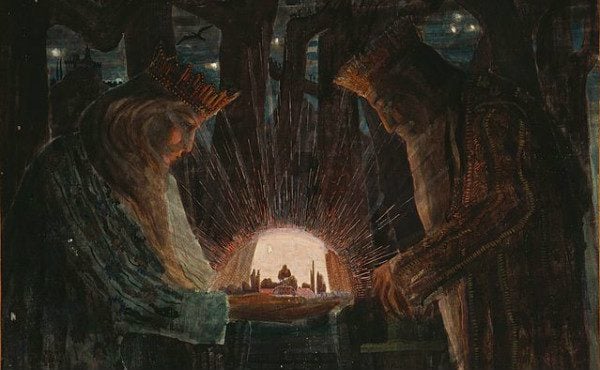
“Fairy Tale” by Mikalojus Konstantinas Ciurlionis, 1909. From WikiMedia.
Most Humanistic Pagans that I know are extremely respectful to those of us who believe in magick and the gods, and their rituals are often very much like my own. Energy is sometimes raised, rites honoring the seasons often look like magick to me, and very often the language of polytheism is used in ritual. The gods can certainly be metaphors (if that’s one’s belief), and magick can be looked at as a mode of thinking instead of an occult science, those things are no threat to my beliefs or anyone else’s. However, magick and deity are most certainly a part of our history, and have been from the very start.
Gerald Gardner and Witchcraft Today in 1954
In my opinion the most probable “start date” for Modern Paganism involves Gerald Gardner, who was the first public adherent (and/or creator) of a long-lasting spiritual tradition associated with the Pagan movement. There are several dates one could use to mark this particular “Pagan start,” ranging from Gardner’s alleged initiation in 1939, to his public coming out as a Witch in 1951, to the publication of his first non-fiction book on Witchcraft in 1954. For this article we aer going to start in 1954, because it offers me a chance to easily quote Gardner.
“Being initiated into the witch cult does not give a witch supernatural powers as I reckon them, but instructions are given, in rather veiled terms, in processes which develop various clairvoyant and other powers, in those who naturally possess them slightly. If they have none they can create none. Some of these powers are akin to magnetism, mesmerism and suggestion, and depend on the possibility of forming a sort of human battery, as it were, of combined human wills working together to influence persons or events at a distance . . ..
. . . . .If these arts were more generally practised nowadays, we should call most of them spiritualism, mesmerism, suggestion, E.S.P., Yoga or perhaps Christian Science; to a witch it is all MAGIC, and magic is the art of getting results.” -Gerald Gardner Witchcraft Today, page 15.
Gardner mentioning magic so early in his book isn’t a anomaly either, he uses the word over 100 times in the text! The magic written about here is seen as a natural thing by Gardner, but most certainly encompasses things that most of us would consider supernatural or the occult. Mentioning people as a “human battery” is certainly similar to how I’ve encountered magick in a ritual circle over the last twenty years.
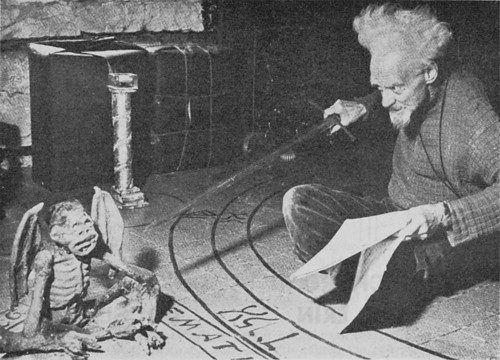
Release the flying monkeys!
Gardner’s Witchcraft is by his very definition magick as most of us think of it today:
“What are they then? They are the people who call themselves the Wica, the ‘wise people’, who practise the age-old rites and who have, along with much superstition and herbal knowledge, preserved an occult teaching and working processes which they themselves think to be magic or witchcraft.” -Gerald Gardner, Witchcraft Today, page 66.
In this passage Witch-magick is also an occult teaching and working process, which suggests that at least some aspects of it can be taught.
Perhaps my favorite passages about magick in Witchcraft Today occur towards the end of the book. In these passages Gardner admits that his witches don’t know exactly how magick works, only that it does. (See, no dogma!) But make no mistake the practice as Gardner describes is certainly magickal, because it can be performed over a great distance if one has the proper materials (in this instance something that belonged to the person magick is being used for/against):
Now what is this Power? If you ask them they say it is Magic; if you ask them what they mean by Magic, they say they don’t know but that it is something that works.
Witches were taught that magic was contagious, that what you did to a material object which had formed part of a man’s body, or had been in close contact with it, and had absorbed its aura, could have some effect on that person, even at a distance; ‘forming the link’, they called it. -Gerald Gardner, Witchcraft Today, pages 99 & 101 respectively.
Witchcraft Today also spends a lot of time on the god and goddess of the Witch-Cult. The word “goddess” for instance comes up over fifty times in the text, and that’s not including variations such as the “Great Mother.” (“God” as in a male god occurs with similar frequency.) Gardner’s goddess is described as the “queen of all the magics” in a snippet from what would become better known as The Charge of the Goddess (page 24 if you are keeping score at home).
Directly before that snippet from The Charge, Gardner states that the goddess of the witch cult “is obviously the Great Mother,” a deity that “rules spring pleasure, feasting and all the delights of a later time with other goddesses and has a special affinity with the moon.” Here Gardner makes the cult about a specific deity while leaving the door open for other deities.
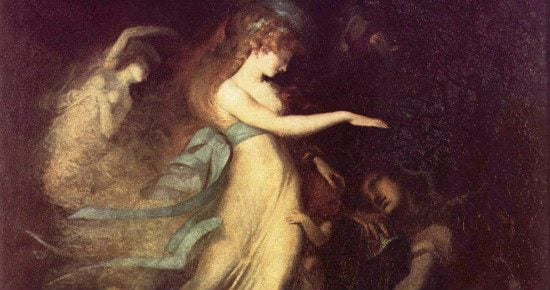
“Prince Arthur and the Faerie Queen” by Henry Fuseli. From WikiMedia
The Goddess and God of Witchcraft can also be experienced, about this Gardner writes:
“By acting the part of the goddess the priestess is thought to be in communion with her; so the priest, acting as the god, becomes at one with him in his aspect of Death, the Consoler, the Comforter, the bringer of a happy after-life and regeneration. The initiate in undergoing the god’s experiences becomes a witch.
Witches quite realise that this communion does not occur every time one assumes the goddess position, but they very soon realise that by doing so they begin to receive thrills which are apt to grow more and more intense when the trance comes on. They KNOW! It is no use saying: ‘This is only suggestion, or the subconscious mind.’ They reply: ‘We quite agree; suggestion or the subconscious mind are simply some of the tools which we use to help to open the Door. . . . . . .’
. . . . . It is the old case of: ‘Unless you experience it yourself you will never believe. When you have experienced it, you don’t believe, you KNOW.’ And, when you have once known the goddess, does anything else really matter? To attain this state there are many roads, and dancing is perhaps the easiest; the calls and chants help, the attitude of the other members is of the greatest assistance – but the true secret is within oneself, and also to some extent in one’s partner or assistant in the art, and it is not a thing that can be forced.” -Gerald Gardner, Witchcraft Today, pages 94-95.
It’s possible to suggest that the priestess and priest “in communion” with the goddess and god are being tricked by their subconscious, but Gardner seems to dismiss this by suggesting that the subconscious is a tool that can be used to open a doorway to deity. The “true secret” being within oneself might again suggest something a little less otherworldly, but adding “one’s partner or assistant in the art” implies something divine or magickal (how else would they link up?). Within Gardner’s writings it’s easy to see a both a magickal and spiritual worldview, and it’s one still found in most Witchcrafts today.
Feraferia is Founded in 1967
Want something a little later than Gardner and a little bit closer to home (if you are an American)? Look no further than Feraferia a tradition officially in corporate as a church by Fred Adams and Lady Svetlana in 1967. Feraferia’s origins go back a little bit further than 1967, as Adams began putting together the cosmology found in Feraferia a decade before, he also started the ritual group the Fellowship of Hesperides in 1959.

Some of Fred’s artwork from “Celebrate Wildness.” Go read the interview linked to here for more of it!
In an interview for this website with Jo Carson (President of the Feraferia Board of Directors, and author of Celebrate Wildness) talked about Fred Adams’s journey into Paganism:
“Feraferia germinated in Southern California in 1956, when Fred Adams had a profound vision of the Goddess. He wasn’t expecting it at all. He was walking across the campus of LA City College, and suddenly he had this sensation throughout his body that the Goddess is the most essential nature of the universe. He was really excited by this. He’d been reading books about ancient matriarchies and witches and Greek mystery religions, but he really wasn’t expecting anything like that to happen to him.
The experience was thrilling, so Fred told his friends about it. He wanted other people to be able to experience something like what he had experienced . . . . So he got some of his friends together and they formed the Hesperides Fellowship. Hesperides is a word for paradise. They did a lot of the same kinds of things that Feraferia still does. They formed a communal household, and tried to live in an ideal way, going out into the wilderness to tune in to nature and the Goddess.”
Feraferia began with a spiritual moment, a vision of the Goddess*, but that’s only the beginning when it comes to Feraferia’s relationship with what some might call “supernatural entities.” In Celebrate Wildness Carson explains the role of the fay in the natural world and in the Feraferian world view:
“Next we explore the role of the fay, the Faerie Folk, who have become so distant now from our urban cultures as to seem almost fantasy beings. Every indigenous culture still knows them, however, and we can too. These real beings inhabit the hills, the trees, the rocks, the caves, and are the conscious essence of the natural world. Where did they come from and what do they have to tell us? How can we play and dance with them? Why are they so important?” -Jo Carson, Celebrate Wildness, page 19.”
According to Carson magick in Feraferia is different than in other Pagan traditions (like Wicca), but when reading her take on it I can’t help but think of how magickal its sounds to me:
“It is not like Wicca, or ceremonial magic per se, although Fred told me he thought of himself as a ceremonial magician. We don’t do spells or call up demons. We’re more oriented to the biomes and the land, planting and celebrating it. We use trance and song to call on the faerie folk, and we use the magic of blessings, enchantment, and dedications in things like healing work and empowering our wilderness charms. We mark sun, moon and star risings and settings on our henges, and travel to the stars in trance. We certainly use the magic of eros, and that can be profound. It almost goes without saying that we talk to trees, but also to landforms and land spirits too.” -Jo Carson (taken from our conversation in 2015)
The exact start date of Modern Paganism, might be up for debate, but not the presence of magick and deity in its origins. We don’t all have to agree on the reality of such things, but we can’t deny that they were there at the start.
*I’m not sure just how Adams’s conceived of his Goddess, and many of the myths involving goddesses in Feraferia read like metaphors relating to the change of the seasons. In the instance quoted here, Adams obviously had some sort of profound spiritual experience, and whether that moment was an actual Goddess talking to him or the Earth its self is immaterial to me. If it walks like deity, talks like deity, and quacks like a deity . . . . . .
Previous Post

May 26, 2017
8 Pagan Things to Do in the Summertime
Next Post

June 7, 2017 Failed Blog Posts: Notes From the Cutting Room Floor
Browse Our Archives
Select a Category Editorializing Gateways to Paganism Guest Posts Holiday Histories Led Zeppelin News and Views Occult Pagan Pagan TV Club Paganism polytheism Ramble On Reviews Ritual Strange Days Uncategorized
Select a Month August 2026 March 2026 February 2026 November 2025 September 2025 August 2025 April 2025 August 2024 April 2024 February 2024 December 2023 October 2023 August 2023 June 2023 May 2023 January 2023 October 2022 August 2022 July 2022 June 2022 May 2022 April 2022 March 2022 February 2022 January 2022 December 2021 November 2021 October 2021 September 2021 August 2021 July 2021 June 2021 April 2021 March 2021 February 2021 January 2021 December 2020 November 2020 October 2020 August 2020 July 2020 June 2020 May 2020 April 2020 March 2020 February 2020 January 2020 December 2019 November 2019 October 2019 September 2019 August 2019 July 2019 June 2019 May 2019 April 2019 March 2019 February 2019 January 2019 December 2018 November 2018 October 2018 September 2018 August 2018 July 2018 June 2018 May 2018 April 2018 March 2018 February 2018 January 2018 December 2017 November 2017 October 2017 September 2017 August 2017 July 2017 June 2017 May 2017 April 2017 March 2017 February 2017 January 2017 December 2016 November 2016 October 2016 September 2016 August 2016 July 2016 June 2016 May 2016 April 2016 March 2016 February 2016 January 2016 December 2015 November 2015 October 2015 September 2015 August 2015 July 2015 June 2015 May 2015 April 2015 March 2015 February 2015 January 2015 December 2014 November 2014 October 2014 September 2014 August 2014 July 2014 June 2014 May 2014 April 2014 March 2014 February 2014 January 2014 December 2013 November 2013 October 2013 September 2013 August 2013 July 2013 June 2013 May 2013 April 2013 March 2013 February 2013 January 2013 December 2012 November 2012 October 2012 September 2012 August 2012 July 2012 June 2012 April 2012 October 2011 September 2011 August 2011
Follow Us!
TAKE THE
Religious Wisdom Quiz
How long did David reign as king?
Select your answer to see how you score.
25 years 33 years 40 years 50 years
Related posts from Raise the Horns
What Makes a Good Ritualist? No Idea

Witchcraft Remembrances & Appreciation at Samhaintide
Raymond Buckland & The Big Blue Book
TRENDING AT PATHEOS Pagan

Will Islam become the world's biggest religion by 2035? Congo will replace...

The resilience of the Christian faith in the english speaking world of...

An Advent Calendar, and a Tree full of...
I've spent the weekend deeply invested in internet drama about a $150...

How to Have Financial Transparency in Marriage
Despite the fact that financial issues and money problems are the number...
The Healing Power of Forgiveness in Marriage
Learning how to give and accept apologies are essential ingredients of a...

The West's Christian Moral Inheritance: A Legacy Denied
Whether we like it or not, our environment matters, shaping us both...
view all Pagan blogs
Ad-Free & Subscriber Log-In Subscription Support
- About Us
- 2026 Calendar
- Videos
- Podcasts
- Library of World Religions
- Faith In Media Tracker
- Advertise With Us
- Write for Us
- Privacy Policy
- Terms of Service
- Do Not Sell My Data
- Contact Us
- Radiant Digital
- Manage Newsletter Subscriptions
- Unsubscribe From Notifications
- Sitemap
Copyright 2008-2026, Patheos. All rights reserved.
Subscription Support Ad-Free & Subscriber Log-In
Follow Patheos