
BuddhistCatholicContemplativeEvangelicalGeneral ChristianHinduJewishLatter-day SaintMuslimNew VisionsProgressive Christian
Beliefs
- Buddhist
- Catholic
- Contemplative
- Evangelical
- General Christian
- Hindu
- Jewish
- Latter-day Saint
- More Voices
- Muslim
- New Visions
- Pagan
- Progressive Christian
Topics
- Religion News
- Food and Religion
- Sports and Religion
- Religious Art
- Religious Music and Entertainment
- Religious Events
- History and Religion
- Style and Religion
- Politics and Religion
- Women in Religion
- Recreation Outdoors and Religion
- Business Finance and Religion
- Careers Workplace and Religion
- Education and Religion
- Family Parenting and Religion
- Health Fitness and Religion
- Home and Religion
- Relationships and Religion
- Technology and Religion
- Travel and Religion
Columnists
- Buddhist Columnists
- Business Finance and Religion Columnists
- Careers Workplace and Religion Columnists
- Catholic Columnists
- Contemplative Columnists
- Education and Religion Columnists
- Evangelists Columnists
- Family Parenting and Religion Columnists
- General Christian Columnists
- Health Fitness and Religion Columnists
- Hindu Columnists
- History and Religion Columnists
- Home and Religion Columnists
- Jewish Columnists
- More Voices Columnists
- Latter Day Columnists
- Muslim Columnists
- New Visions Columnists
- Nonreligious Columnists
- Pagan Columnists
- Politics and Religion Columnists
- Progressive Columnists
- Recreation Outdoors and Religion Columnists
- Relationships and Religion Columnists
- Religion News Columnists
- Religious Art Columnists
- Religious Events Columnists
- Religious Music and Entertainment Columnists
- Sports and Religion Columnists
- Style and Religion Columnists
- Technology and Religion Columnists
- Travel and Religion Columnists
- Women in Religion Columnists
Resource Library
- 2026 Calendar
- Library of World Religions
- The 100 Most Holy Places on Earth
- Patheos Answers
- Podcasts
- Videos
- Faith Leaders Database
- Anglican Episcopalian
- Bahai
- Baptist
- Buddhism
- Christianity
- Confucianism
- Eastern Orthodoxy
- Hinduism
- Holiness and Pentecostal
- ISKCON
- Islam
- Judaism
- Lutheran
- Methodist
- The Church of Jesus Christ of Latter-day Saints
- New Age
- Paganism
- Presbytarian and Reformed
- Protestantism
- Religion Behind the Scenes
- Roman Catholic
- Scientology
- Shia Islam
- Sikhism
- Sufism
- Sunni Islam
- Taoism
- Zen
- See all religions
Research Tools
 Ad-Free & Subscriber Log-In Subscription Support
Ad-Free & Subscriber Log-In Subscription Support
Follow Patheos 

- Trending:
- Forgiveness
- |
- Marriage
- |
- Consciousness
- |
- Death Penalty
- |
- Election
- |
- Halloween

- HOME
- Me and the Blog
- Defining Pagan
- Rituals & Holidays
- All Posts
- Blogroll
- Publications
- FREE NEWSLETTER
- Home
- Pagan
- Lessons Learned While Teaching “Wicca 101”
Lessons Learned While Teaching “Wicca 101”
Last updated on: August 4, 2017 at 9:48 am by Jason Mankey
Lessons Learned While Teaching “Wicca 101” 2017-08-04T09:48:25-06:00 Jason Mankey
Patheos Explore the world's faith through different perspectives on religion and spirituality! Patheos has the views of the prevalent religions and spiritualities of the world.
Last September the owners of my local Witch-shop asked me if I would be interested in teaching a Wicca 101 type class at their store. I replied with a very casual “maybe” and after some long discussions with my wife decided to give it a shot. In many ways I’ve been learning just as much as my students, though probably for different reasons.
This is the second time I’ve done a Wicca 101 class, and in many respects it’s been much harder the second time around. My first go at a Wicca 101 class was about fifteen years ago, back when I thought I knew everything and really knew nothing. That class was so much easier to teach because I found myself repeating the standard claptrap I’d read in dozens of books, a spiel that no longer works for me in a lot of ways.
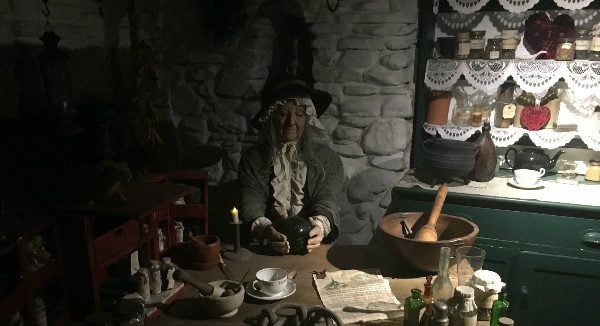
The village witch at the Museum of Magic and Witchcraft in Boscastle England.
The landscape of Pagan Studies (which in many ways has mostly focused on Wiccan-Witchcraft) has changed considerably since those days, and I just find myself armed with far more knowledge today than I did back then. Today I can identify certain bits of ritual and confidently state where they came from and how old they might be. I certainly didn’t think Wicca was a 2000 year old tradition when I taught that first class, but I did think many of the concepts utilized in Wicca were (and I was really wrong about some of them).
WICCAN THEOLOGY (OR NOT)
During my first foray into teaching Wicca I spoke often of “The Wiccan Goddess” as if She were a universal in every ritual circle. This Great Goddess was the goddess of everything and could be easily summed up in the idea of Maiden/Mother Crone, an idea I thought was ancient at the time. The truth of “The Goddess” is far more complex and is not so easily simplified.
Certainly there are many Wiccans who honor The Lady, and see her as Maiden, Mother, and Crone. This kind of language is often found in my own coven and is certainly familiar to most of us, but it’s also problematic for several reasons. Triple goddesses existed in the ancient world, but they were goddesses in triplicate (or more) to explain their many attributes. It wasn’t a division based on age.
In the Ancient World there were Maiden goddesses, Mother goddesses, and Crone goddesses, but they were never really the same Goddess. Maiden/Mother/Crone as three parts of a whole is relatively modern idea, arising from Robert Graves’ 1948 book The White Goddess and should be honestly explained as such. (There are a few instances in the Ancient World where the idea comes close to being articulated, but it was towards the end of the pagan era.)
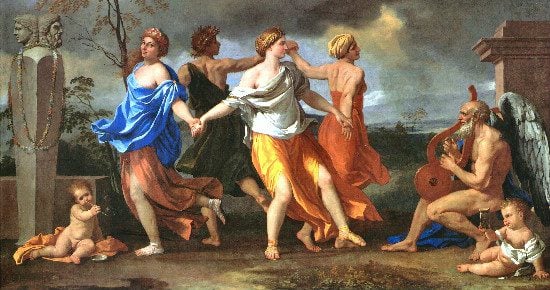
I’m not uncomfortable with the idea of Maiden/Mother/Crone and I think it makes for a lovely metaphor, but I also find it extremely limiting. It just doesn’t adequately capture the complexity of womanhood, and it tends to center on childbirth and issues of virginity; pregnancy is not the goal of every woman, and I think the Goddess should express that. It also doesn’t take into account trans-women and people who don’t identify with any gender at all. (For a far greater exploration of these issues pick up Lasara Firefox Allen’s amazing book Jailbreaking the Goddess.)
Wicca is also a spirituality that doesn’t require a particular belief in deity. It’s possible to be an Atheist-Wiccan or a hardcore Polytheist-Wiccan, with both interpretations of the divine being seen as valid in the circle. As for me I reside somewhere in the mushy middle, acknowledging a plethora of deities and experiencing many of them as separate and unique entities, while also believing that they might be related or connected in some sort of way. I just don’t know, and I’m not arrogant enough at this point in my life to think that I know or explain my understanding of the divine as the only way or “the Wiccan way .”
While I’m pretty good at talking about the Horned God as an idea and a deity, I’m also cognizant of the fact that people honor that figure in a variety of ways. For some “horned god” might just be a way of grouping several deities together that many think are related, reserving worship or reverence for particular and specific gods such as Pan or Cernunnos. Are Wiccans polytheists? Neo-Platonists? How about duotheists? Probably depends on who you are talking to, and maybe even what day.
Many Wiccans also spend a lot of time talking about The Lord and The Lady, which is again something I do myself. But Lord and Lady were originally titles, not the name of a specific, universal Witch goddess and god. Lord and Lady were placeholders for names that couldn’t be said aloud in front of the uninitiated.
The end result is that individual deities might just be metaphors, or perhaps certain types of energy, or maybe very specific self-aware figures. So it’s kind of up to each individual Witch to decide for themselves how they perceive the divine. That makes teaching challenging because some folks just want a straight answer, and it’s certainly all so much easier to teach if there’s just one specific understanding of deity.
HOW WE “DO” IS TOUGH TO VERBALIZE
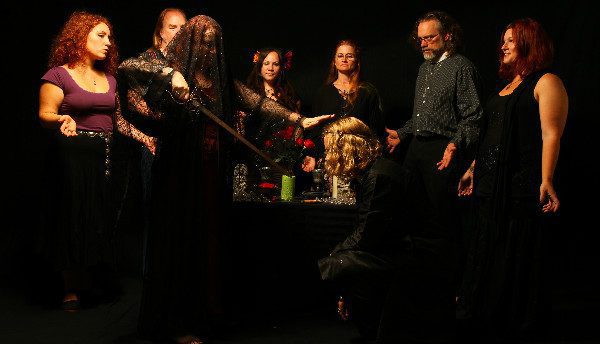
Wicca is mostly about practice and most specifically how we practice. When I call the quarters I know what I’m visualizing in my head and reaching out to with my spirit (and/or heart), but that doesn’t mean it’s always easily explained. So much of Wiccan practice is personal, and my view of something (see deity above) is just one interpretation of several.
I’m not teaching a class in order to turn it into a coven or to further my interpretation of Wicca, so it’s important to me that my Wednesday night crew does not, strictly speaking, become a ritual group. Sure I try and encourage everyone to do things from time to time. We’ve called the quarters together and cast some circles, but I’ve never felt as if we were all standing fully between the worlds and ready to experience life-changing ritual after such exercises. And many times they’ve felt like exercises, not surprising since we have a lot of beginners and people who haven’t practiced in several years.
I’ll also never quite know what’s going on in the heads of my students. Are they drawing from the same sort of places I am, or are they reaching out to something else, or perhaps they are finding nothing at all? I know when someone in my coven has cast a good circle because there are certain energies associated with that process. Those energies are hard to feel in a small space inside a bookstore with people I’ve only so far really encountered in class.
But the challenges presented in class have also, so far, made me a better Witch. They’ve encouraged me to see with as many eyes as possible and to offer as many interpretations as I’m able. Wicca has always provided its adherents with a great ritual structure, I can teach that, but it’s up to each individual Witch to fill in whatever blank spaces they may find.
Previous Post
May 13, 2017
The Anatomy of a Bro-Witch
Next Post

May 26, 2017 8 Pagan Things to Do in the Summertime
Browse Our Archives
Select a Category Editorializing Gateways to Paganism Guest Posts Holiday Histories Led Zeppelin News and Views Occult Pagan Pagan TV Club Paganism polytheism Ramble On Reviews Ritual Strange Days Uncategorized
Select a Month August 2026 March 2026 February 2026 November 2025 September 2025 August 2025 April 2025 August 2024 April 2024 February 2024 December 2023 October 2023 August 2023 June 2023 May 2023 January 2023 October 2022 August 2022 July 2022 June 2022 May 2022 April 2022 March 2022 February 2022 January 2022 December 2021 November 2021 October 2021 September 2021 August 2021 July 2021 June 2021 April 2021 March 2021 February 2021 January 2021 December 2020 November 2020 October 2020 August 2020 July 2020 June 2020 May 2020 April 2020 March 2020 February 2020 January 2020 December 2019 November 2019 October 2019 September 2019 August 2019 July 2019 June 2019 May 2019 April 2019 March 2019 February 2019 January 2019 December 2018 November 2018 October 2018 September 2018 August 2018 July 2018 June 2018 May 2018 April 2018 March 2018 February 2018 January 2018 December 2017 November 2017 October 2017 September 2017 August 2017 July 2017 June 2017 May 2017 April 2017 March 2017 February 2017 January 2017 December 2016 November 2016 October 2016 September 2016 August 2016 July 2016 June 2016 May 2016 April 2016 March 2016 February 2016 January 2016 December 2015 November 2015 October 2015 September 2015 August 2015 July 2015 June 2015 May 2015 April 2015 March 2015 February 2015 January 2015 December 2014 November 2014 October 2014 September 2014 August 2014 July 2014 June 2014 May 2014 April 2014 March 2014 February 2014 January 2014 December 2013 November 2013 October 2013 September 2013 August 2013 July 2013 June 2013 May 2013 April 2013 March 2013 February 2013 January 2013 December 2012 November 2012 October 2012 September 2012 August 2012 July 2012 June 2012 April 2012 October 2011 September 2011 August 2011
Follow Us!
TAKE THE
Religious Wisdom Quiz
Who wrote the Book of Acts?
Select your answer to see how you score.
Luke Mark Peter Paul
Related posts from Raise the Horns

What Makes a Good Ritualist? No Idea

Witchcraft Remembrances & Appreciation at Samhaintide

Raymond Buckland & The Big Blue Book

TRENDING AT PATHEOS Pagan

Janie Learns the Way of the Cross: A...
Teaching children about Jesus' Passion can be challenging. Many parents and educators...

Looking For Good Catholic Writing - October 2026
He alone extends the heavens, and he walks upon the waves of...

In "Irreplaceable," our book on vocation and technology, Trevor Sutton and I...

I was strolling through the top floor of the brand new Parthenon...

What Does Gêvâh Mean For Kimberley Guifoyle &...
This week, a lot of the news is focused on Kimberly Guilfoyle....

INNER CIRCLE: Profound Mystery (Of Christ In All...
Ephesians 5:31-32 “For this reason, a man will leave his father and...
view all Pagan blogs
Ad-Free & Subscriber Log-In Subscription Support
- About Us
- 2026 Calendar
- Videos
- Podcasts
- Library of World Religions
- Faith In Media Tracker
- Advertise With Us
- Write for Us
- Privacy Policy
- Terms of Service
- Do Not Sell My Data
- Contact Us
- Radiant Digital
- Manage Newsletter Subscriptions
- Unsubscribe From Notifications
- Sitemap
Copyright 2008-2026, Patheos. All rights reserved.
Subscription Support Ad-Free & Subscriber Log-In
Follow Patheos