
BuddhistCatholicContemplativeEvangelicalGeneral ChristianHinduJewishLatter-day SaintMuslimNew VisionsProgressive Christian
Beliefs
- Buddhist
- Catholic
- Contemplative
- Evangelical
- General Christian
- Hindu
- Jewish
- Latter-day Saint
- More Voices
- Muslim
- New Visions
- Pagan
- Progressive Christian
Topics
- Religion News
- Food and Religion
- Sports and Religion
- Religious Art
- Religious Music and Entertainment
- Religious Events
- History and Religion
- Style and Religion
- Politics and Religion
- Women in Religion
- Recreation Outdoors and Religion
- Business Finance and Religion
- Careers Workplace and Religion
- Education and Religion
- Family Parenting and Religion
- Health Fitness and Religion
- Home and Religion
- Relationships and Religion
- Technology and Religion
- Travel and Religion
Columnists
- Buddhist Columnists
- Business Finance and Religion Columnists
- Careers Workplace and Religion Columnists
- Catholic Columnists
- Contemplative Columnists
- Education and Religion Columnists
- Evangelists Columnists
- Family Parenting and Religion Columnists
- General Christian Columnists
- Health Fitness and Religion Columnists
- Hindu Columnists
- History and Religion Columnists
- Home and Religion Columnists
- Jewish Columnists
- More Voices Columnists
- Latter Day Columnists
- Muslim Columnists
- New Visions Columnists
- Nonreligious Columnists
- Pagan Columnists
- Politics and Religion Columnists
- Progressive Columnists
- Recreation Outdoors and Religion Columnists
- Relationships and Religion Columnists
- Religion News Columnists
- Religious Art Columnists
- Religious Events Columnists
- Religious Music and Entertainment Columnists
- Sports and Religion Columnists
- Style and Religion Columnists
- Technology and Religion Columnists
- Travel and Religion Columnists
- Women in Religion Columnists
Resource Library
- 2026 Calendar
- Library of World Religions
- The 100 Most Holy Places on Earth
- Patheos Answers
- Podcasts
- Videos
- Faith Leaders Database
- Anglican Episcopalian
- Bahai
- Baptist
- Buddhism
- Christianity
- Confucianism
- Eastern Orthodoxy
- Hinduism
- Holiness and Pentecostal
- ISKCON
- Islam
- Judaism
- Lutheran
- Methodist
- The Church of Jesus Christ of Latter-day Saints
- New Age
- Paganism
- Presbytarian and Reformed
- Protestantism
- Religion Behind the Scenes
- Roman Catholic
- Scientology
- Shia Islam
- Sikhism
- Sufism
- Sunni Islam
- Taoism
- Zen
- See all religions
Research Tools
 Ad-Free & Subscriber Log-In Subscription Support
Ad-Free & Subscriber Log-In Subscription Support
Follow Patheos 

- Trending:
- Forgiveness
- |
- Marriage
- |
- Consciousness
- |
- Death Penalty
- |
- Election
- |
- Halloween

- HOME
- Me and the Blog
- Defining Pagan
- Rituals & Holidays
- All Posts
- Blogroll
- Publications
- FREE NEWSLETTER
- Home
- Pagan
- What Exactly Is Wicca?
What Exactly Is Wicca?
Last updated on: May 31, 2017 at 1:05 pm by Jason Mankey
What Exactly Is Wicca? 2017-05-31T13:05:49-06:00 Jason Mankey
Patheos Explore the world's faith through different perspectives on religion and spirituality! Patheos has the views of the prevalent religions and spiritualities of the world.
The phrase “I know it when I see it” might have been coined just for Wicca. I know Wicca when I see it or practice it, but it’s something I have trouble defining. Unlike the word Witchcraft, which can have multiple meanings and often depends on context, Wicca is generally thought of as a being more specific. For many people Wicca is a religion or spirituality, and that’s certainly the case for me, but it’s also not one of those things in the traditional sense.
Christianity is generally defined by a belief in Jesus as the son of (the Jewish) God, or perhaps an adherence to the teachings of the man Jesus. Those are very specific things, and require certain ways of thinking. Wicca by contrast doesn’t require a belief in the teachings of any one specific individual, or the adherence to any one particular deity. Going either further afield one can be an atheist Wicca, a Neo-Platonist Wiccan, and a polytheistic Wiccan. I’ve met all three in my life, along with virtually every layer in between.
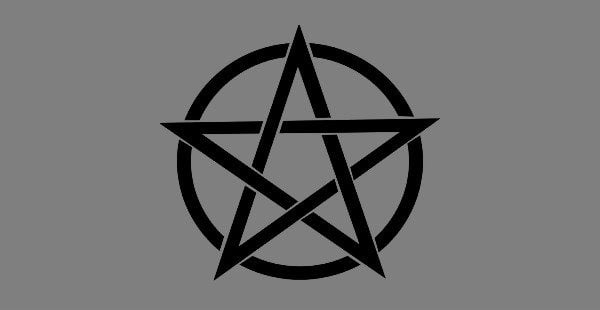
Unlike other “faiths” Wicca is not really about theology, and there’s no litmus test for belief. What defines Wicca are its practices, it’s about how we do things not about how we believe. This is really different from other belief systems, and as a result the word Wicca is hard to precisely shoe-horn into a dictionary. Take this definition of Wicca from the Oxford English Dictionary:
“A form of modern paganism, especially a tradition founded in England in the mid 20th century and claiming its origins in pre-Christian religions.”
That definition is so lacking in any information that it could easily be linked to traditions like Spiritual Druidry, which is also a form of Modern Paganism founded in England in the mid 20th Century. Sadly the Oxford Dictionary feels like it hasn’t been updated in awhile, for while Wicca draws inspiration from pre-Christian religions, most practitioners have abandoned the “unbroken chain back to pagan antiquity” stuff that was common forty years ago.
The Merrian-Webster definition is a little more up to date, and a bit more specific, but not much:
“a religion influenced by pre-Christian beliefs and practices of western Europe that affirms the existence of supernatural power (as magic) and of both male and female deities who inhere in nature and that emphasizes ritual observance of seasonal and life cycles.”
Yes my practice was influenced by pre-Christian ideas and I certainly believe in magick along with gods and goddesses, and I also practice seasonal observances. But again, those things could apply to a whole host of Modern Pagan traditions that don’t think of themselves as Wiccan or even Witch-like. And then there are Wiccan covens who don’t worship or honor any male deities, along with practitioners who don’t believe in deities as generally defined. Wiccan practices and ideas have also arisen from a large variety of sources. In this day and age they are certainly not all from “western Europe” and I know lots of Wiccans who work with Egyptian and Middle Eastern deities, while believing things that come from Asia and the Americas.
I realize that dictionaries are designed to offer quick and easily digested definitions, but easy has never worked with Wicca. What truly makes my practice different from that of a lot of my Druid and Re-constructionist friends is just how I practice and use language during ritual. Wicca is a tradition best defined by its practices and use of language, not so much by the beliefs of its adherents.
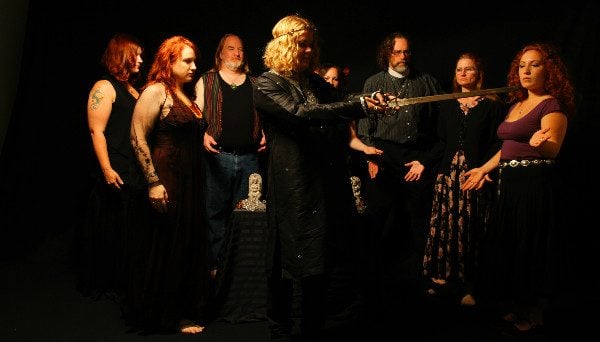
Wiccan Ritual.
So what makes a ritual Wiccan? I think it’s the following elements:
–Casting a circle that: signifies sacred space, protects the people within it, and stores energy until it’s ready to be released. The use of the circle in this way is rather unique to Wicca. While all sorts of magickal traditions have called for ritual circles over the centuries, I’m not familiar with any that use it as both a shield and as a battery to store energy. That last part is especially unique.
–Calling the four energies of Air, Fire, Water, and Earth. There are no hard and fast rules as to what exactly those energies are (or will be) when called. Some people do it to acknowledge the four traditional cardinal points, others are calling directly to angelic beings, and others to elemental energies. What’s important here is that it’s generally done.
–The use of something approximating the language of polytheism. This is a tough one, as there are many Wiccans who believe that “all goddesses are one Goddess” or use language to that affect. But if I was a casual bystander and was simply listening to a Wiccan ritual with calls to “Goddess and God” and a recitation of The Charge of the Goddess (Listen to the words of the Great Mother who was of old called: Artemis; Astarte; Diana; Melusine; Aphrodite; Cerridwen; Dana; Arianrhod; Isis; Bride; and by many other names”) I’d probably think of those participating in that ritual as polytheists even if that’s not how they define themselves.
–The raising of energy. Many of the things I do in ritual involve the raising of energy. When my coven calls to the quarters or casts a circle we are requesting that a certain type of energy be present. Ritual activities such as chanting, dancing, or toning result in energy being produced. Often that energy is directed towards a specific idea or goal, in that moment energy becomes magick.
Celebration and ritual that honors and acknowledges the Earth and the turn of the seasons. We might not call of our sabbats by the same name (Lammas, Lughnassa, Lughnasadh), but nearly all Wiccans celebrate or acknowledge them. The sabbats that make up the Wheel of the Year aren’t unique to Wicca, but are an important part of it. Most Wiccan ritual also acknowledges the sacredness of the Earth, though not all Wiccans are environmentalists or even good stewards of the Earth.
The use of certain specific tools and ritual implements. One doesn’t need an athame to practice Wicca, but it’s a tool unique to the practice. The use of spell-books goes back hundreds if not thousands of years but the term Book of Shadows for such a book is rather modern. I’m not sure that tools are needed for effective ritual, but there are a set of tools associated with Wicca that are most certainly a part of the tradition.
Touching the divine. One of the things I’ve always most valued about my Wiccan experience is that there’s never been any barrier between myself and the divine. In my own practice the divine refers to “the gods,” and lots of them. In our house we worship Pan, Aphrodite, Cernunnos, Ariadne, Dionysus, Brigit, and Persephone and many more, but never every Wiccan’s spiritual experience is centered on deity . There are many who find the divine within nature, or in more abstract ways. Wicca offers a framework that allows us to tap into what we hold most sacred, and we all experience it a little bit differently, and that’s OK.
While Wicca is often thought of as a fertility religion due to its focus on the Wheel of the Year and the fertility of the Earth, I tend to think of it as the rebirth of magickal religion. There have been lots of magickal orders over the centuries (the most famous being the Order of the Golden Dawn) but Wicca took that magickal framework and added a healthy amount of spirituality. In the Golden Dawn one could be Jewish, Christian, or Pagan, because its religiosity was not very well defined. There are Wiccans who harbor positive feelings about Jesus, but I don’t know many Wiccans who are also practicing Methodists. Wicca also has holidays (the sabbats) and esbats (full moon celebrations) that are absent from most magickal orders.
What we today call Wicca was originally an initiation-only tradition, but over the years it has evolved to become more open and accessible. The definition of a word is more about a how it’s used in the here and now, and not about how it was used forty years ago, which is why I feel comfortable writing about “Wicca” in a way removed from it’s initiation-only roots. (It does go without saying that many specific traditions still require an initiation to be counted among their ranks.)
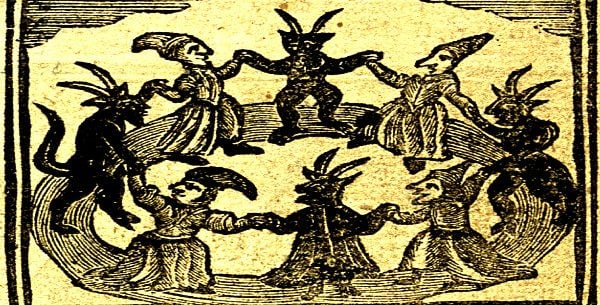
My coven looks just like this!
Wicca A Synonym For Witchcraft?
The first public person that we might today call a Wiccan was a retired English civil-servant named Gerald Gardner (1884-1964); and he identified as a witch. He practiced witchcraft and was a part of what he called the “witch-cult.” He did mention “the Wica” as a group of people within witchcraft, but it was not a term he used for the practice. In the years following his death the term “Wicca” began to be used to describe the spiritual system he first publicly articulated.
For many Wiccans the terms Witchcraft and Wicca are synonymous, but that does not mean that all witches are Wiccans. There are lots of people who identify as a witch whose practices are very different from those of Wicca. I like to describe myself as a Wiccan-Witch, which indicates that I practice a certain type of Witchcraft of the Wiccan variety.
What Wicca Is Not
Any “Wiccan” group that uses a ritual structure that doesn’t include the circle, quarters, calls to deity, and ignores the sabbats might be a Pagan group but it is most certainly not a Wiccan one. There’s no such thing as “congregationalist Wicca” and Wiccans don’t sit on pews with their collective attention focused only on one individual.
Wiccan ritual is almost always interactive. Wiccan circles and covens worship and celebrate together, and while there are often certain people “in charge” of a rite, ritual is never a passive activity. Wiccans do stuff, and they do it together.
Wicca is not a cult, there is no “King of the Witches” or any one particular person in charge. Covens are autonomous and operate independently of each other, even within the same tradition. And I’d be wary of anyone setting themselves up to be the grand poo-bah of several covens and/or circles. All within Wicca are Priests and Priestesses regardless of whether or not they lead rituals.
Wicca’s Ambiguity is Part of It’s Appeal
I have practiced Wicca with people who all held different ideas on the nature of deity. I have practiced it with folks who all honored different goddesses and gods in their personal practice. I have raised energy in Wiccan circles with people who don’t believe in magick, and raised energy in those same circles with some of the most talented magicians I’ve ever met. Not once did any of us ask the other to take some form of litmus test to determine who were “the real Wiccans.” It was enough to simply agree on how to proceed with a ritual.
Because of it’s openness Wicca has become a home for a variety of different cosmologies and beliefs. What most Wiccans share is a deep belief that their rituals “work.” Wicca provides me with a framework to participate in ecstatic and community building rituals, while strengthening my ties to the deities that I honor in my practice.
Previous Post
March 14, 2017
Just How "Silent" Should a Witch Be?
Next Post

March 26, 2017 The Web That is Woven Between the Light and the Darkness
Browse Our Archives
Select a Category Editorializing Gateways to Paganism Guest Posts Holiday Histories Led Zeppelin News and Views Occult Pagan Pagan TV Club Paganism polytheism Ramble On Reviews Ritual Strange Days Uncategorized
Select a Month August 2026 March 2026 February 2026 November 2025 September 2025 August 2025 April 2025 August 2024 April 2024 February 2024 December 2023 October 2023 August 2023 June 2023 May 2023 January 2023 October 2022 August 2022 July 2022 June 2022 May 2022 April 2022 March 2022 February 2022 January 2022 December 2021 November 2021 October 2021 September 2021 August 2021 July 2021 June 2021 April 2021 March 2021 February 2021 January 2021 December 2020 November 2020 October 2020 August 2020 July 2020 June 2020 May 2020 April 2020 March 2020 February 2020 January 2020 December 2019 November 2019 October 2019 September 2019 August 2019 July 2019 June 2019 May 2019 April 2019 March 2019 February 2019 January 2019 December 2018 November 2018 October 2018 September 2018 August 2018 July 2018 June 2018 May 2018 April 2018 March 2018 February 2018 January 2018 December 2017 November 2017 October 2017 September 2017 August 2017 July 2017 June 2017 May 2017 April 2017 March 2017 February 2017 January 2017 December 2016 November 2016 October 2016 September 2016 August 2016 July 2016 June 2016 May 2016 April 2016 March 2016 February 2016 January 2016 December 2015 November 2015 October 2015 September 2015 August 2015 July 2015 June 2015 May 2015 April 2015 March 2015 February 2015 January 2015 December 2014 November 2014 October 2014 September 2014 August 2014 July 2014 June 2014 May 2014 April 2014 March 2014 February 2014 January 2014 December 2013 November 2013 October 2013 September 2013 August 2013 July 2013 June 2013 May 2013 April 2013 March 2013 February 2013 January 2013 December 2012 November 2012 October 2012 September 2012 August 2012 July 2012 June 2012 April 2012 October 2011 September 2011 August 2011
Follow Us!
TAKE THE
Religious Wisdom Quiz
What does "Nazareth" mean?
Select your answer to see how you score.
Star Gift Light Branch
Related posts from Raise the Horns

What Makes a Good Ritualist? No Idea

Witchcraft Remembrances & Appreciation at Samhaintide

Raymond Buckland & The Big Blue Book

TRENDING AT PATHEOS Pagan

The First Eucharistic Controversy: Christ’s Real Presence
For Catholics, the Eucharist is the source and summit of the Christian...

How to Make a Decision When You Can't...
Main point: It’s much more valuable to stay close to God so...

Archdiocese Hosts Military Marriage Retreat in Germany
RASTATT, Germany — The transient military lifestyle, with its frequent deployments and...

Nearly every morning, I make the drive to Detroit with my high-school-age...

The Real AI Story Is Adoption Without Trust
Artificial intelligence has crossed a political threshold. It is no longer a...

A new article, written by Jeff Lindsay and Gale L. Pooley,...
view all Pagan blogs
Ad-Free & Subscriber Log-In Subscription Support
- About Us
- 2026 Calendar
- Videos
- Podcasts
- Library of World Religions
- Faith In Media Tracker
- Advertise With Us
- Write for Us
- Privacy Policy
- Terms of Service
- Do Not Sell My Data
- Contact Us
- Radiant Digital
- Manage Newsletter Subscriptions
- Unsubscribe From Notifications
- Sitemap
Copyright 2008-2026, Patheos. All rights reserved.
Subscription Support Ad-Free & Subscriber Log-In
Follow Patheos