
BuddhistCatholicContemplativeEvangelicalGeneral ChristianHinduJewishLatter-day SaintMuslimNew VisionsProgressive Christian
Beliefs
- Buddhist
- Catholic
- Contemplative
- Evangelical
- General Christian
- Hindu
- Jewish
- Latter-day Saint
- More Voices
- Muslim
- New Visions
- Pagan
- Progressive Christian
Topics
- Religion News
- Food and Religion
- Sports and Religion
- Religious Art
- Religious Music and Entertainment
- Religious Events
- History and Religion
- Style and Religion
- Politics and Religion
- Women in Religion
- Recreation Outdoors and Religion
- Business Finance and Religion
- Careers Workplace and Religion
- Education and Religion
- Family Parenting and Religion
- Health Fitness and Religion
- Home and Religion
- Relationships and Religion
- Technology and Religion
- Travel and Religion
Columnists
- Buddhist Columnists
- Business Finance and Religion Columnists
- Careers Workplace and Religion Columnists
- Catholic Columnists
- Contemplative Columnists
- Education and Religion Columnists
- Evangelists Columnists
- Family Parenting and Religion Columnists
- General Christian Columnists
- Health Fitness and Religion Columnists
- Hindu Columnists
- History and Religion Columnists
- Home and Religion Columnists
- Jewish Columnists
- More Voices Columnists
- Latter Day Columnists
- Muslim Columnists
- New Visions Columnists
- Nonreligious Columnists
- Pagan Columnists
- Politics and Religion Columnists
- Progressive Columnists
- Recreation Outdoors and Religion Columnists
- Relationships and Religion Columnists
- Religion News Columnists
- Religious Art Columnists
- Religious Events Columnists
- Religious Music and Entertainment Columnists
- Sports and Religion Columnists
- Style and Religion Columnists
- Technology and Religion Columnists
- Travel and Religion Columnists
- Women in Religion Columnists
Resource Library
- 2026 Calendar
- Library of World Religions
- The 100 Most Holy Places on Earth
- Patheos Answers
- Podcasts
- Videos
- Faith Leaders Database
- Anglican Episcopalian
- Bahai
- Baptist
- Buddhism
- Christianity
- Confucianism
- Eastern Orthodoxy
- Hinduism
- Holiness and Pentecostal
- ISKCON
- Islam
- Judaism
- Lutheran
- Methodist
- The Church of Jesus Christ of Latter-day Saints
- New Age
- Paganism
- Presbytarian and Reformed
- Protestantism
- Religion Behind the Scenes
- Roman Catholic
- Scientology
- Shia Islam
- Sikhism
- Sufism
- Sunni Islam
- Taoism
- Zen
- See all religions
Research Tools
 Ad-Free & Subscriber Log-In Subscription Support
Ad-Free & Subscriber Log-In Subscription Support
Follow Patheos 

- Trending:
- Forgiveness
- |
- Marriage
- |
- Consciousness
- |
- Death Penalty
- |
- Election
- |
- Halloween

- HOME
- Me and the Blog
- Defining Pagan
- Rituals & Holidays
- All Posts
- Blogroll
- Publications
- FREE NEWSLETTER
- Home
- Pagan
- Witchcraft Before Wicca: Three Important Magickal Books
Witchcraft Before Wicca: Three Important Magickal Books
Last updated on: January 24, 2020 at 4:08 pm by Jason Mankey
Witchcraft Before Wicca: Three Important Magickal Books 2020-01-24T16:08:30-07:00 Jason Mankey
Patheos Explore the world's faith through different perspectives on religion and spirituality! Patheos has the views of the prevalent religions and spiritualities of the world.
Modern Witchcraft is sometimes referred to as a religion of the books, and even if that’s an overstatement, there’s no denying that the magickal community likes to read. The popularity of Paganism (and by extension Modern Witchcraft and Wicca) is due in large part to books. Until recently it could be difficult to meet other magickal folk, but by the 1960’s books on magick, the occult, and even Witchcraft were generally easily available at bookstores and local libraries.
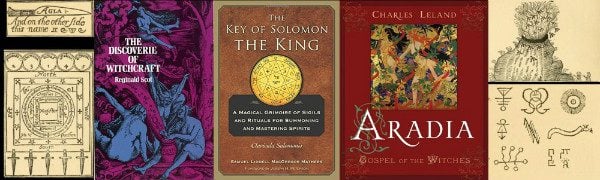
But even before the modern occult revival, books played an important role in the spreading of magickal information. Contrary to what a lot of people believe, many cunning-folk were literate and used magickal books much like we do today. They purchased spell books and put them to use, the popularity of cunning-craft and Conjure up until the early twentieth century was due in large part to the number of books available detailing the practice.
What follows are profiles of three magickal books that have influenced the modern practice of Witchcraft. One of them did so by inadvertently becoming the first grimoire in English, while the last two helped provide many Witch traditions with theology, a magickal system, and some of their most sacred rituals and liturgies. Some of the material here is from my book, The Witch’s Book of Shadows (published by Llewellyn in January of 2017), and some of it is material I wrote for that book which ended up on the cutting room floor.
This post is divided up into three pages primarily because of its length. This is a 4000 plus word article, so there’s a lot of material here.
SCOT’S DISCOVERIE OF WITCHCRAFT
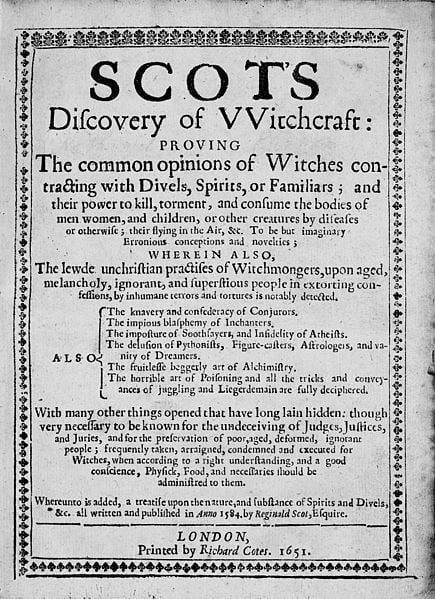
An edition of “Discovery” from 1651.
One of history’s most important and influential magickal texts was meant to be a repudiation of Witchcraft and not an endorsement, but it’s funny how things work out sometimes. Published in 1584 Reginald Scot’s Discoverie of Witchcraft contained so much information that it can probably be labeled as the first magickal grimoire in the English language. Scot’s intention was to discredit magick, superstition, and Catholicism; instead he published a magickal reference book that would be treasured and utilized right up until the end of 19th Century. The Discoverie is said to be what Shakespeare used when crafting his Witches in Macbeth.
Scot’s book was full of magickal spells and formulations and by including them he hoped to prove that magick was silly and the province of the uneducated. What Scot didn’t count on was the appetite for magickal books in Britain at the end of the Sixteenth Century. Most of his readers simply skipped the pages debunking magick and went right for the spellwork. Scot did such a tremendous job of documenting magickal practices that the last third of his book truly reads like a grimoire.
One of Scot’s primary source materials was a hand written grimoire entitled The Secret of Secrets that had previously been used by two English cunning-men. Like most magickal books of the period The Secret of Secrets was “invented and demised for the augmentation and maintenance of their living, for the edifieng of the poore, and for the propagating and inlarging of Gods glorie.” (1) Not surprisingly much of The Secret of Secrets was a hand-annotated version of The Key of Solomon. A third edition of Scot’s book published in 1665 included even more magickal material, this time an anonymously written chapter entitled “Discourse on Devils and Spirits.”
The popularity of Discoverie over the centuries can probably be attributed to a few things. The first is the sheer and diverse amount of magickal materials contained within it. There are spells and formula for finding buried treasure, trapping spirits and demons, working with angels, and predicting the future. For anyone looking to profit from magick, Scot provided a way in. The book is also full of reference drawings, resulting in a book that looked quite magickal for the time. The book’s name is also rather provocative, perhaps appealing more to believers in magick than skeptics.
Until I began researching the history of English magick I had never heard of Discoverie before. It was rather influential for its time, but it doesn’t hold up particularly well today. Part of that is due to the skeptical nature of the early chapters, but there’s also a lot of superfluous material. I prefer my grimoires without juggling instructions for instance.
The biggest problem with Discoverie today is that it’s extremely hard to read. No one has ever updated the book into Modern English, and much of the material reads like it needs to be translated. It takes a few seconds to process some of the antiquated spellings in Discoverie too; for instance, son is spelled sonne and Saturday is spelled saturdaie. That would be easy enough if such odd-spellings were rare, instead there are dozens on every page.
“Faust & Mephisto” from WikiMedia.
A Few Spells from Scot’s Discoverie of Witchcraft
Despite the challenges that come with reading Scot many of the spells he transcribes are fun in an Elizabethan sort of way. To spare you from having to turn fier into fire I’ve taken the liberty of updating much of Scot’s language in the following spells. I’ve kept the Jesus, angels, and Jehovah stuff to provide a better feel for what spellwork was like at the end of Sixteenth Century.
To Know of Treasure Hidden in the Earth
On a piece of paper write the following charters on a Saturday in the hour of the rising moon and lay it where you think treasure might be hidden. If there’s treasure on that spot the paper will burn. These are the characters:
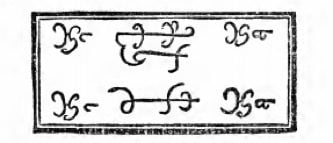
(Spells to find buried treasure were very popular in Europe and North America for centuries. This is one of the simpler spells for finding buried treasure, many of the more elaborate ones call for circle castings and various petitions to angels and sometimes demons.)
The Way to Turn Invisible by the Three Sisters of Fairy
Begin the spell by being away from people for nine days, preferably on even ground and not in a loft. Make sure all of your clothing is clean and sweet. Using a candle of virgin way, light a fire of charcoal in the center of the chamber you are occupying. Then take clean water from a stream running eastward and set it upon the fire. Wash yourself with that water while holding the candle in your right hand while walking around the fire three times clockwise and saying : “Panthon, Craton, Muriton, Bisecognaton, Siston, Diaton, Maton, Tetragrammation, Agla, Agarion, Tegra, Pentessaron, and Tendicata (note, these are all names of power: in other words the names of angels and Yahweh-God). End the ceremonial washing with the following names and benediction: “Sorthie, Sorthia, Sorthios, Milia, Achilia, Sibylia,. In the name of the Father, Son, and Holy Spirit, Amen.”
Continue by conjuring the three fairy sisters:
“I conjure you three sisters of the fairies, Milia, Achilia, Sibylia, by the Father, by the Son, and by the Holy Ghost and by their virtues and powers by the most merciful and loving God, that will command his angel to blow the trumpet at the day of judgment. He shall say ‘Come, come to judgment’ and I conjure thee in the names of all the angels, archangels, thrones, dominations, principles, rulers, virtues, cherubim and seraphim and by their virtues and powers. I conjure you three sisters by the virtue of all the real words I have said. I charge you that you do appear before me visible and in the form and shape of fair women in white vestements, and to bring with you to me the ring of invisibility. By which I might go invisible at my will and pleasure and in all hours and minutes. In the name of the Father, Son, and Holy Spirit. Amen.”
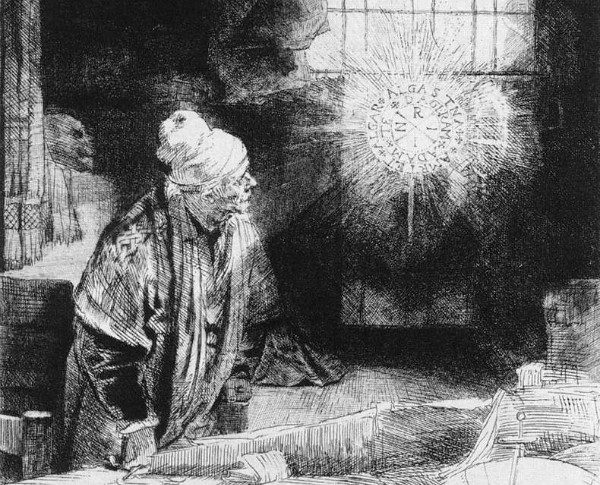
Rembrandt’s “Faust.” It’s a Fausty kind of day.
Once they have appeared bind the sisters by saying:
“O blessed virgins Milia and Achilia I conjure you in the name of the Father, the Son, and the Holy Ghost by their virtues I charge you to depart from me in peace, for a time. And Sibylia, I conjure you by the virtue of our Lord Jesus Christ and by the virtue of his flesh and precious blood that he took of our Lady the Blessed Virgin and by all the holy companies of heaven. I charge thee Sibylia by all the virtues said, that you shall be obedient unto me, in the name of God, and that you shall appear no matter the time or place I call to you. Be ready to come to me at all hours and all minutes and to bring unto me the ring of invisibilitie, whereby I may go invisible at my will and pleasure. Let it be done, Amen.”
If they don’t come the first night repeat the spell until they do come. For doubtless, they will come and lie in your bed. Lay your right hand out of the bed and sleep with a silken kerchief around your hand, and when the fairies appear be not afraid. For the three of them will come to you, fair and pleasant and all in white clothing and one of them will put a ring upon your finger, which will make you invisible. When they appear go with speed and bind them using the bonding spell included above. With the ring upon your finger, look upon a mirror and you will not see yourself. And when you wish to turn invisible slip the ring onto the finger they put it upon, and every new moon renew the ring again. For after the first time you perform this spell you will ever have this ring.
(I don’t ever recommend calling to a spirit, angel, or fairy that one would feel the need to bind. Fairies, like the ones being called to in this ritual, are sentient beings, and just like we don’t like to be commanded to do things, the fey don’t either. With a little bit of adaptation this is a spell that might actually work, though I’d be surprised if they ladies involved brought the conjurer an actual ring.)
1. Owen Davies, Grimoires: A History of Magic Books, Oxford University Press 2010, page 70.
Scot's Discoverie of Witchcraft
Previous Post
January 9, 2017
Show Your Work: Silence & Skepticism in Modern Witchcraft
Next Post

January 20, 2017 Paganism in the Age of Trump
Browse Our Archives
Select a Category Editorializing Gateways to Paganism Guest Posts Holiday Histories Led Zeppelin News and Views Occult Pagan Pagan TV Club Paganism polytheism Ramble On Reviews Ritual Strange Days Uncategorized
Select a Month August 2026 March 2026 February 2026 November 2025 September 2025 August 2025 April 2025 August 2024 April 2024 February 2024 December 2023 October 2023 August 2023 June 2023 May 2023 January 2023 October 2022 August 2022 July 2022 June 2022 May 2022 April 2022 March 2022 February 2022 January 2022 December 2021 November 2021 October 2021 September 2021 August 2021 July 2021 June 2021 April 2021 March 2021 February 2021 January 2021 December 2020 November 2020 October 2020 August 2020 July 2020 June 2020 May 2020 April 2020 March 2020 February 2020 January 2020 December 2019 November 2019 October 2019 September 2019 August 2019 July 2019 June 2019 May 2019 April 2019 March 2019 February 2019 January 2019 December 2018 November 2018 October 2018 September 2018 August 2018 July 2018 June 2018 May 2018 April 2018 March 2018 February 2018 January 2018 December 2017 November 2017 October 2017 September 2017 August 2017 July 2017 June 2017 May 2017 April 2017 March 2017 February 2017 January 2017 December 2016 November 2016 October 2016 September 2016 August 2016 July 2016 June 2016 May 2016 April 2016 March 2016 February 2016 January 2016 December 2015 November 2015 October 2015 September 2015 August 2015 July 2015 June 2015 May 2015 April 2015 March 2015 February 2015 January 2015 December 2014 November 2014 October 2014 September 2014 August 2014 July 2014 June 2014 May 2014 April 2014 March 2014 February 2014 January 2014 December 2013 November 2013 October 2013 September 2013 August 2013 July 2013 June 2013 May 2013 April 2013 March 2013 February 2013 January 2013 December 2012 November 2012 October 2012 September 2012 August 2012 July 2012 June 2012 April 2012 October 2011 September 2011 August 2011
Follow Us!
TAKE THE
Religious Wisdom Quiz
What does the name "Jesus" mean?
Select your answer to see how you score.
Shepherd The Lord saves God is love Prince of peace
Related posts from Raise the Horns

What Makes a Good Ritualist? No Idea

Witchcraft Remembrances & Appreciation at Samhaintide

Raymond Buckland & The Big Blue Book

TRENDING AT PATHEOS Pagan

The Problem with False Prophets
Miller’s Station UMC| 10/18/26| Anchor Verse: Jeremiah 23: 1, 9-23 I...

Emotion in Early Christianity by Andrew Crislip
Andrew Crislip’s Emotion in Early Christianity examines an often overlooked dimension of...

16 Spiritual Touchstones for a More Grounded Life
After decades of spiritual study, here are 16 principles I try...

Catholic Evangelization: Sharing Your Faith Every Day
Welcome back to the Graceful Awakening mini-series called, “From Faith to Mission.” ...

The Pillar of the Boatmen: the Ancient Monument...
The Pillar of the Boatmen is a Romano-Gaulish sculpture that dates from...

In one sense walking into Westminster Abbey is like walking down the...
view all Pagan blogs
Ad-Free & Subscriber Log-In Subscription Support
- About Us
- 2026 Calendar
- Videos
- Podcasts
- Library of World Religions
- Faith In Media Tracker
- Advertise With Us
- Write for Us
- Privacy Policy
- Terms of Service
- Do Not Sell My Data
- Contact Us
- Radiant Digital
- Manage Newsletter Subscriptions
- Unsubscribe From Notifications
- Sitemap
Copyright 2008-2026, Patheos. All rights reserved.
Subscription Support Ad-Free & Subscriber Log-In
Follow Patheos