
BuddhistCatholicContemplativeEvangelicalGeneral ChristianHinduJewishLatter-day SaintMuslimNew VisionsProgressive Christian
Beliefs
- Buddhist
- Catholic
- Contemplative
- Evangelical
- General Christian
- Hindu
- Jewish
- Latter-day Saint
- More Voices
- Muslim
- New Visions
- Pagan
- Progressive Christian
Topics
- Religion News
- Food and Religion
- Sports and Religion
- Religious Art
- Religious Music and Entertainment
- Religious Events
- History and Religion
- Style and Religion
- Politics and Religion
- Women in Religion
- Recreation Outdoors and Religion
- Business Finance and Religion
- Careers Workplace and Religion
- Education and Religion
- Family Parenting and Religion
- Health Fitness and Religion
- Home and Religion
- Relationships and Religion
- Technology and Religion
- Travel and Religion
Columnists
- Buddhist Columnists
- Business Finance and Religion Columnists
- Careers Workplace and Religion Columnists
- Catholic Columnists
- Contemplative Columnists
- Education and Religion Columnists
- Evangelists Columnists
- Family Parenting and Religion Columnists
- General Christian Columnists
- Health Fitness and Religion Columnists
- Hindu Columnists
- History and Religion Columnists
- Home and Religion Columnists
- Jewish Columnists
- More Voices Columnists
- Latter Day Columnists
- Muslim Columnists
- New Visions Columnists
- Nonreligious Columnists
- Pagan Columnists
- Politics and Religion Columnists
- Progressive Columnists
- Recreation Outdoors and Religion Columnists
- Relationships and Religion Columnists
- Religion News Columnists
- Religious Art Columnists
- Religious Events Columnists
- Religious Music and Entertainment Columnists
- Sports and Religion Columnists
- Style and Religion Columnists
- Technology and Religion Columnists
- Travel and Religion Columnists
- Women in Religion Columnists
Resource Library
- 2026 Calendar
- Library of World Religions
- The 100 Most Holy Places on Earth
- Patheos Answers
- Podcasts
- Videos
- Faith Leaders Database
- Anglican Episcopalian
- Bahai
- Baptist
- Buddhism
- Christianity
- Confucianism
- Eastern Orthodoxy
- Hinduism
- Holiness and Pentecostal
- ISKCON
- Islam
- Judaism
- Lutheran
- Methodist
- The Church of Jesus Christ of Latter-day Saints
- New Age
- Paganism
- Presbytarian and Reformed
- Protestantism
- Religion Behind the Scenes
- Roman Catholic
- Scientology
- Shia Islam
- Sikhism
- Sufism
- Sunni Islam
- Taoism
- Zen
- See all religions
Research Tools
 Ad-Free & Subscriber Log-In Subscription Support
Ad-Free & Subscriber Log-In Subscription Support
Follow Patheos 

- Trending:
- Forgiveness
- |
- Marriage
- |
- Consciousness
- |
- Death Penalty
- |
- Election
- |
- Halloween

- HOME
- Me and the Blog
- Defining Pagan
- Rituals & Holidays
- All Posts
- Blogroll
- Publications
- FREE NEWSLETTER
- Home
- Pagan
- Oh Lighten Up Christians, Christmas Is Kinda Sort of Pagan
Oh Lighten Up Christians, Christmas Is Kinda Sort of Pagan
Last updated on: December 13, 2016 at 12:09 pm by Jason Mankey
Oh Lighten Up Christians, Christmas Is Kinda Sort of Pagan 2016-12-13T12:09:08-07:00 Jason Mankey
Patheos Explore the world's faith through different perspectives on religion and spirituality! Patheos has the views of the prevalent religions and spiritualities of the world.
Progressive Christians are our allies. If “Christianity” were out to get all of Modern Paganism we’d be in deep shit. We are completely outnumbered, have no lobbying group in Washington, or even a Senator or Congressperson to call our own. So be glad for Progressive Christians and all of our other friends from the various faith traditions that make up the United States who value our right to worship as we see fit.
But for all the love I have for Progressive Christians, that doesn’t mean they aren’t wrong on occasion, even the best of them. One of the best, Benjamin L. Corey, recently wrote something on Patheos called Oh Lighten Up, Christmas is NOT a Pagan Holiday, but it is, kind of, sort of, mostly, in a whole host of different ways. Christmas is most certainly a Christian holiday when it’s celebrated by Christians who use the day to honor the birth of Jesus. But most Christians don’t really make that the primary focus of their day, and most likely never have.
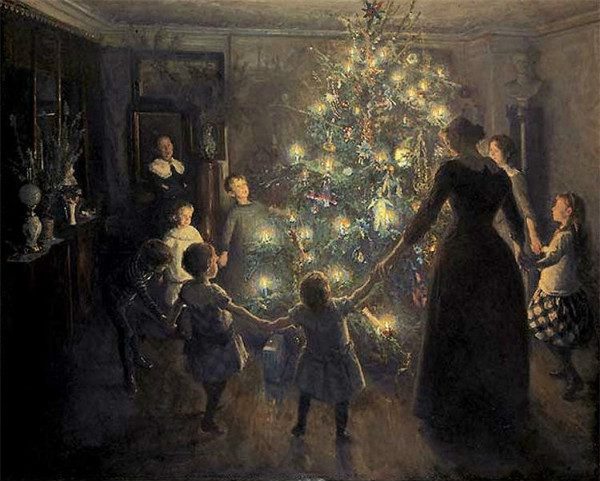
“Happy Christmas” by Viggo Johnson. Notice the lack of Jesus. From WikiMedia.
Does it matter whether or not Christmas is a Pagan or a Christian holiday? Not one bit to be honest, but I like history, and I love that there are some December traditions that are literally over 2000 years old. That some of these things have survived for so bloody long is truly amazing, and it’s worth a shout-out every year. There’s also the fact that I think The Holiday/Christmas Season is the most Pagan time of the year. Oh not every holiday tradition is Pagan, but a whole lot of ’em are, and I write that as someone who is often criticized by other Pagans for giving Christians too much credit.
The central argument in Corey’s Lighten Up piece* is that if Jesus was conceived of a virgin on March 25, he would have been born on December 25. Fair enough, the parallels between Jesus and a whole host of pagan gods has been overstated quite a bit over the last 200 years (something I’ve written about on this blog), and in this instance Corey is probably correct, here’s an abridged version of his thoughts on the matter:
“As early as the 2nd century Christians attempted to pin-point the dates of the birth of Christ and the date of his execution . . . . by the end of the first century/beginning of the second century, it was widely believed/accepted that the crucifixion occurred on the 25th of March, AD 29 . . . . .
There was the common belief in Judaism and early Christianity that saints died on their birthday or the day they were conceived. This means, for these early Christians, that March 25 was not only the date of the crucifixion but was also either Jesus’ birthday, or the day that Mary conceived him. Eventually, viewing March 25th as the day Jesus was conceived became the accepted view– adding 9 months to this would make the date of his birth December 25th.
Thus, the early Christians were not attempting to hijack a Pagan holiday at all– they just had a really weird way of figuring out when your birthday was.
Now, that brings us to the Pagan holiday that did exist on December 25th. This holiday was introduced by Emperor Aurelian in AD 274, after the acceptance of December 25th being the day Christians celebrated the birth of Christ. As Tighe states:
‘The pagan feast which the Emperor Aurelian instituted on that date in the year 274 was not only an effort to use the winter solstice to make a political statement, but also almost certainly an attempt to give a pagan significance to a date already of importance to Roman Christians… Thus the ‘pagan origins of Christmas’ is a myth without historical substance.’”
The problem here is that Christmas is more than just the sum of its parts. Christmas is a great holiday today because it retains bits of ancient paganism and evolved into something more than just a birthday party for Jesus. I’m sure there are some Christians who celebrate Christmas with no presents and no greenery, but I’m guessing that most do. And the problem there is that so many of those traditions are pagan. Not all of them, and I’ll readily admit that the Christmas Tree is probably a more modern invention than some give it credit for, but certainly some of them. If you took out all the pagan present at Christmas you wouldn’t have much left, just a boring Bible story.
Religions (and by extension holidays) don’t exist in a vacuum. They pick up customs and traditions that are probably not what their founders had in mind, and they absorb things from the greater culture they exist in. Christianity has often existed side by side with ancient paganisms, and as a result holidays like Yule, Saturnalia, and the January Kalends have influenced Christmas. None of the trappings we tend to associate with today’s celebration of Christmas are in the Bible. Even the birth narrative of Jesus that many Christians try and recreate every late December isn’t really in the gospels (it’s totally true, the Jesus origin story is mish-mash of Matthew and Luke, with some later tradition thrown in).
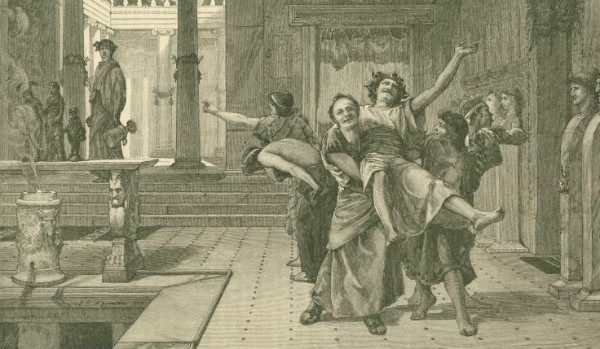
“The Roman Saturnalia” by John Reinhard Weguelin. Like Christmas, but with no Jesus. From WikiMedia.
For most of its history, the major focus of Christmas has always been firmly on the Pagan side of things. Misrule, wassail, mumming, and presents all have likely Pagan origins, and even if they don’t, they certainly aren’t things found in the Bible. Perhaps the argument could be made that Christmas provides an excuse for Christians to do Pagan things? And when traditions like mumming and misrule began to decline in the early 19th Century they weren’t replaced by Christian traditions, they were replaced by more Pagan trappings or new secular traditions.
Santa Claus for all the talk of Saint Nicholas (and we aren’t even sure if Nicholas was an actual historical personage) still has a bit of Pagan in his DNA. But I think that’s what makes him so effective, he’s a combination of everything. Charles Dickens’ A Christmas Carol is one of the most important Christmas stories ever, and one of its central characters (The Spirit of Christmas Present) is more Bacchus than baby in a manger. Even after Paganism’s torch had been effectively extinguished people were still drawing from it for inspiration.
So go ahead Christians, enjoy your date, and continue to enjoy all the stuff you’ve absorbed from Paganisms past and present too. Unless you take all the fun out of Christmas and the Holiday Season your holiday will still kind of sort of be Pagan.
(In fairness to Corey after reading the comments section on his article he does admit that Christmas contains a lot of Pagan elements, it’s a shame he didn’t make that clear in his article.)
*Corey’s article was its self inspired by Calculating Christmas The Story Behind December 25 by William J. Tighe.
Previous Post
December 6, 2016
Alcohol Before and During Ritual
Next Post
December 15, 2016 A Traditional Christmas: Drunken, Subversive, and Pagan
Browse Our Archives
Select a Category Editorializing Gateways to Paganism Guest Posts Holiday Histories Led Zeppelin News and Views Occult Pagan Pagan TV Club Paganism polytheism Ramble On Reviews Ritual Strange Days Uncategorized
Select a Month August 2026 March 2026 February 2026 November 2025 September 2025 August 2025 April 2025 August 2024 April 2024 February 2024 December 2023 October 2023 August 2023 June 2023 May 2023 January 2023 October 2022 August 2022 July 2022 June 2022 May 2022 April 2022 March 2022 February 2022 January 2022 December 2021 November 2021 October 2021 September 2021 August 2021 July 2021 June 2021 April 2021 March 2021 February 2021 January 2021 December 2020 November 2020 October 2020 August 2020 July 2020 June 2020 May 2020 April 2020 March 2020 February 2020 January 2020 December 2019 November 2019 October 2019 September 2019 August 2019 July 2019 June 2019 May 2019 April 2019 March 2019 February 2019 January 2019 December 2018 November 2018 October 2018 September 2018 August 2018 July 2018 June 2018 May 2018 April 2018 March 2018 February 2018 January 2018 December 2017 November 2017 October 2017 September 2017 August 2017 July 2017 June 2017 May 2017 April 2017 March 2017 February 2017 January 2017 December 2016 November 2016 October 2016 September 2016 August 2016 July 2016 June 2016 May 2016 April 2016 March 2016 February 2016 January 2016 December 2015 November 2015 October 2015 September 2015 August 2015 July 2015 June 2015 May 2015 April 2015 March 2015 February 2015 January 2015 December 2014 November 2014 October 2014 September 2014 August 2014 July 2014 June 2014 May 2014 April 2014 March 2014 February 2014 January 2014 December 2013 November 2013 October 2013 September 2013 August 2013 July 2013 June 2013 May 2013 April 2013 March 2013 February 2013 January 2013 December 2012 November 2012 October 2012 September 2012 August 2012 July 2012 June 2012 April 2012 October 2011 September 2011 August 2011
Follow Us!
TAKE THE
Religious Wisdom Quiz
Who said: "Dear friends, do not be surprised at the fiery ordeal that has come on you to test you"?
Select your answer to see how you score.
James John Peter Paul
Related posts from Raise the Horns

Yule is Also a Time for the Dead

The Embers (September-December)


The Return of the Pagan Scapegoats
TRENDING AT PATHEOS Pagan

The Problem with False Prophets
Miller’s Station UMC| 10/18/26| Anchor Verse: Jeremiah 23: 1, 9-23 I...

Emotion in Early Christianity by Andrew Crislip
Andrew Crislip’s Emotion in Early Christianity examines an often overlooked dimension of...

16 Spiritual Touchstones for a More Grounded Life
After decades of spiritual study, here are 16 principles I try...

Catholic Evangelization: Sharing Your Faith Every Day
Welcome back to the Graceful Awakening mini-series called, “From Faith to Mission.” ...

The Pillar of the Boatmen: the Ancient Monument...
The Pillar of the Boatmen is a Romano-Gaulish sculpture that dates from...

In one sense walking into Westminster Abbey is like walking down the...
view all Pagan blogs
Ad-Free & Subscriber Log-In Subscription Support
- About Us
- 2026 Calendar
- Videos
- Podcasts
- Library of World Religions
- Faith In Media Tracker
- Advertise With Us
- Write for Us
- Privacy Policy
- Terms of Service
- Do Not Sell My Data
- Contact Us
- Radiant Digital
- Manage Newsletter Subscriptions
- Unsubscribe From Notifications
- Sitemap
Copyright 2008-2026, Patheos. All rights reserved.
Subscription Support Ad-Free & Subscriber Log-In
Follow Patheos