
BuddhistCatholicContemplativeEvangelicalGeneral ChristianHinduJewishLatter-day SaintMuslimNew VisionsProgressive Christian
Beliefs
- Buddhist
- Catholic
- Contemplative
- Evangelical
- General Christian
- Hindu
- Jewish
- Latter-day Saint
- More Voices
- Muslim
- New Visions
- Pagan
- Progressive Christian
Topics
- Religion News
- Food and Religion
- Sports and Religion
- Religious Art
- Religious Music and Entertainment
- Religious Events
- History and Religion
- Style and Religion
- Politics and Religion
- Women in Religion
- Recreation Outdoors and Religion
- Business Finance and Religion
- Careers Workplace and Religion
- Education and Religion
- Family Parenting and Religion
- Health Fitness and Religion
- Home and Religion
- Relationships and Religion
- Technology and Religion
- Travel and Religion
Columnists
- Buddhist Columnists
- Business Finance and Religion Columnists
- Careers Workplace and Religion Columnists
- Catholic Columnists
- Contemplative Columnists
- Education and Religion Columnists
- Evangelists Columnists
- Family Parenting and Religion Columnists
- General Christian Columnists
- Health Fitness and Religion Columnists
- Hindu Columnists
- History and Religion Columnists
- Home and Religion Columnists
- Jewish Columnists
- More Voices Columnists
- Latter Day Columnists
- Muslim Columnists
- New Visions Columnists
- Nonreligious Columnists
- Pagan Columnists
- Politics and Religion Columnists
- Progressive Columnists
- Recreation Outdoors and Religion Columnists
- Relationships and Religion Columnists
- Religion News Columnists
- Religious Art Columnists
- Religious Events Columnists
- Religious Music and Entertainment Columnists
- Sports and Religion Columnists
- Style and Religion Columnists
- Technology and Religion Columnists
- Travel and Religion Columnists
- Women in Religion Columnists
Resource Library
- 2026 Calendar
- Library of World Religions
- The 100 Most Holy Places on Earth
- Patheos Answers
- Podcasts
- Videos
- Faith Leaders Database
- Anglican Episcopalian
- Bahai
- Baptist
- Buddhism
- Christianity
- Confucianism
- Eastern Orthodoxy
- Hinduism
- Holiness and Pentecostal
- ISKCON
- Islam
- Judaism
- Lutheran
- Methodist
- The Church of Jesus Christ of Latter-day Saints
- New Age
- Paganism
- Presbytarian and Reformed
- Protestantism
- Religion Behind the Scenes
- Roman Catholic
- Scientology
- Shia Islam
- Sikhism
- Sufism
- Sunni Islam
- Taoism
- Zen
- See all religions
Research Tools
 Ad-Free & Subscriber Log-In Subscription Support
Ad-Free & Subscriber Log-In Subscription Support
Follow Patheos 

- Trending:
- Forgiveness
- |
- Marriage
- |
- Consciousness
- |
- Death Penalty
- |
- Election
- |
- Halloween

- HOME
- Me and the Blog
- Defining Pagan
- Rituals & Holidays
- All Posts
- Blogroll
- Publications
- FREE NEWSLETTER
- Home
- Pagan
- How America Helped Invent the Modern Halloween
How America Helped Invent the Modern Halloween
Last updated on: October 20, 2017 at 11:18 am by Jason Mankey
How America Helped Invent the Modern Halloween 2017-10-20T11:18:38-06:00 Jason Mankey
Patheos Explore the world's faith through different perspectives on religion and spirituality! Patheos has the views of the prevalent religions and spiritualities of the world.
We’ve been led to believe over the last 100 years that our holidays are timeless, and that they’ve been celebrated in a similar way for centuries. It’s a beautiful idea, but it’s not true. Christmas, Thanksgiving, and Halloween in the United States have only really emerged over the last two hundred years, and perhaps Halloween even more so than the other two.
It’s true that there was an Irish-Celtic celebration called Samhain that existed in pagan antiquity, but we know almost nothing about it. That celebration had no vampires, no costumes, no pumpkins, not even anything having to do with the dead. People gathered together, they probably ate a lot of food, and most likely they were collectively scared of evil fairies. It was nothing like today’s Samhain or even yesterday’s Halloween.
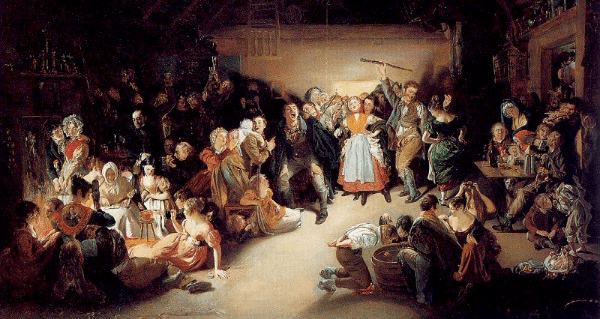
“Snap-Apple Night” by Daniel Maclise. From WikiMedia.
Halloween has existed as a holiday for several hundred years now. There’s not quite a straight line between Samhain and All Saint’s Day, but by the time All Hallow’s Eve became Halloween the two celebrations had become extremely different. By the middle of the Seventeenth Century (about when the term Halloween came into existence) the night of October 31 had evolved into a divination day. Games to get a glimpse of the future were so prevalent that Nutcrack Night was once used an alternative name for the holiday. (People would place whole nuts near their fireplaces to see how they eventually burned, if they “popped” it meant love was fleeting.)
More Samhain/Halloween at Raise the Horns:
A Real History of Samhain
The Origins of Halloween Things (Jack-O-Lanterns, Trick or Treat, Costumes, Bobbing for Apples
Four Halloween & Samhain Myths (Day of the Dead, Black Cats, Poisoned Candy, Halloween as a pagan holiday)
A Halloween History (the Real History of Halloween)
In many parts of England Halloween was almost completely replaced by Guy Fawkes Night (November 5), and Fawkes was also popular in many parts of North America. The two holidays share a lot of similarities beyond their place on the calendar. Both have been an excuse for violence and vandalism (“pranks”) over the centuries, and we tend to associate masks and parties with both as well. It’s not all that difficult to imagine an America with Guy Fawkes emerging supreme over Halloween (especially as anti-Catholic as the United States has been through much of its history), but we were likely spared such a fate due to the sheer number of Catholic immigrants in the late 19th and early 20th Centuries.
The most important groups when it came to establishing Halloween as an American holiday were Irish and Scottish immigrants. In one of its earliest American forms, Halloween served as a day of Scottish (and often Irish) pride. Much like today’s St. Patrick’s celebrations are all about being Irish (and drunk), early Halloween was about being Scottish. Guy Fawkes never succeeded in replacing Halloween as it had nearly done in England, so it served as an important cultural marker between the two nations.
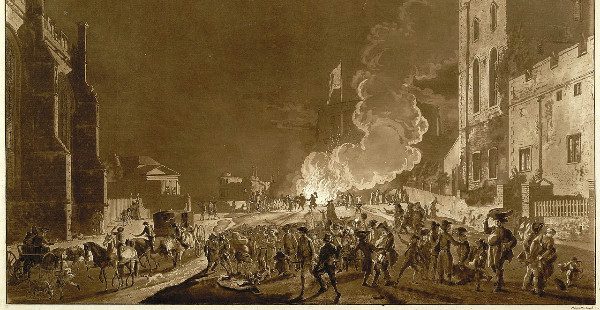
“Festivities in Windsor Castle” by Paul Sandby. From WikiMedia.
While many people used to wish each other a happy “Auld Lang Syne” on Halloween, eventually the more supernatural and fanciful aspects began to reassert themselves. In order to cut down on some of the violence associated with the holiday people began throwing costume parties to celebrate the day. Many of these parties were focused on children, and the day began to become more and more a children’s holiday. Traditional forms of divination (such as bobbing for apples) were turned into parlor games.
The rise of Halloween (and other Autumn holidays) coincided with the growth of the American middle class, and as people had more money, businesses looked for ways to acquire that money. Holidays became a good way of doing so, and those with a real financial interest in growing holidays like Halloween began to promote it. I know a lot of people who complain about Halloween being too commercial, but it likely wouldn’t exist without that promotion.
Did Halloween first emerge in the British Isles? Of course, but many of its most hallowed traditions emerged in North America, and it’s current world-wide popularity can very much be attributed to how popular the holiday has become in the United States. It’s not an American holiday in the traditional sense (we don’t even recognize it as a holiday technically), but it’s one we helped to shape and popularize.
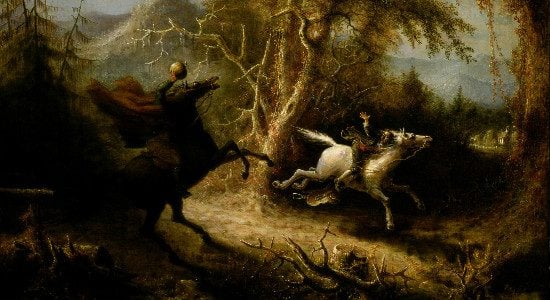
“The Headless Horseman” by John Quidor. From WikiMedia.
Halloween is a mixture of many things-Irish-Celtic Samhain, Walpurgis Night, All Saint’s Day, Guy Fawkes Night-but in its current form it’s a very American holiday, and nearly all the things we associate with Halloween today are generally American ones.
This Halloween night I’ll be lighting the Jack-O-Lantern on my porch, passing out candy, and projecting LED Witches on the front of my house. All of those traditions grew up here in America, making Halloween a holiday that transcends borders.
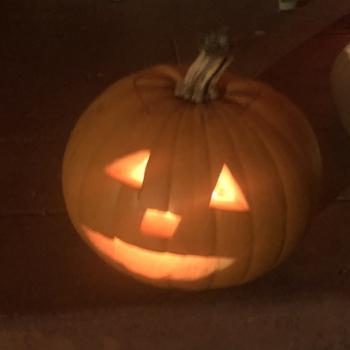
Jack’O’Lantern: Pumpkins are an American vegetable. Native Americans have been cultivating them for at least 8000 years, and they were a staple crop of the first European settlers in North America. But it was Irish-Americans who would turn the pumpkin into the Jack’O’Lantern we all recognize today. There’s a lot of debate over whether or not the Irish carved turnips and other vegetables and turned them into lanterns, but it seems likely. But none of those vegetables were pumpkins, because they didn’t exist in Europe until they were imported later.
Pumpkins are the fall vegetable par excellence, and are the right size for being particularly creepy looking when hollowed out and turned into a face. The Jack-O-Lantern is the most ubiquitous symbol of Halloween in the world today, and it’s origins lie in the Americas (with an assist from Ireland).
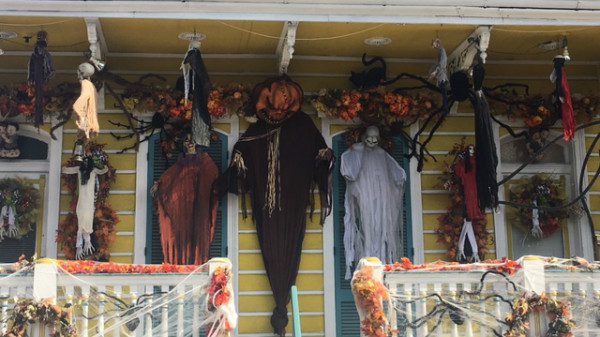
This porch in New Orleans is much better decorated than mine.
Trick or Treating: People have been begging and asking for treats on religious holidays for over a thousand years now, but it’s America that made the tradition a true Halloween staple. Customs similar to trick or treating were once practiced on Christmas, New Year’s, and even Thanksgiving, but beginning in the 1930’s, and escalating quickly after World War II, the custom was increasingly limited to just Halloween.
The term “trick or treat” Is an American one as well. It first shows up in print in 1939, but is likely at least a few years older. There’s no record of any other country using the phrase before it became popular in America.
A Season With the Witch: The Magic & Mayhem of Halloween in Salem Massachusetts by J.W. Ocker (A Mini-Book Review)
America’s biggest Halloween party every year might be the month long celebration that goes on every year in Salem Massachusetts. Over the course of October hundreds of thousands of people descent upon “Witch City USA” to drink, party, and celebrate the season. Salem’s tourism industry is largely built around Witches and Halloween, and A Season With the Witch gets inside what makes that Halloween motor run.
Real Witches, and their shops, play a part in Ocker’s book, but his portrayal of them is largely sympathetic. He’s not a believer, but he’s not looking to ridicule anyone either. They come across as a mostly sympathetic thread in the tapestry of Salem.
The real highlight of Ocker’s book is just how inviting he makes Salem feel. Yeah, some of the tourist traps are showing their age, and might not be worth the prize of admission, but he writes about them as palaces of American kitsch and ingenuity. Ocker’s Salem in the Autumn is like a Disneyland for tourists curious about the word Witch.
It also serves as a short history of how Salem became Witch City USA, and just what the city has to offer beyond the witch-economy. Ocker’s Salem is a city rich in history, and by the time I was done with his book I was ready to visit. He also explores the tensions between those who are embarrassed by Salem’s Halloween extravaganza and those who revel in it, the conflict makes for fascinating reading.
If you’ve ever been curious about Salem, or just delight in Americana this is a book worth picking up.
Monsters & Witches: The rise of Halloween paralleled the heyday of the Universal Studios Movie Monsters. Dracula, Frankenstein, and the Wolf-Man were the superheroes of their day and were perfect for Halloween dress up. Such costumes helped to keep the creepy on October 31 and inspired all of the Teenage Mutant Ninja Turtles that would come later.
After the Jack-O-Lantern the broom riding, black wearing Witch is probably the most well known Halloween icon, but she’s of rather recent vintage. Before the movie The Wizard of Oz (1939), Witches wore all sorts of different colors, rarely had green skin, and sometimes were even portrayed as attractive. (The “Sexy Witch” phenomenon is not necessarily a recent one.) After Dorothy’s trip to Oz most Halloween Witches began to look like the Wicked Witch of the West, a trend that has mostly continued in Halloween iconography.
A lot of our later Halloween icons all have an American origin point too. Jack Skellington (The Nightmare Before Christmas), Michael Myers (Halloween), and Freddy Krueger are all American spectral figures.
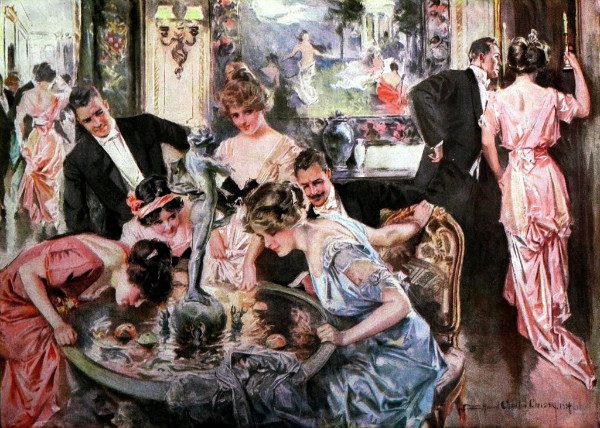
“Halloween” by Howard Chandler Christy. From WikiMedia.
Halloween Parties: October 31 has always been a time for large gatherings. The Irish-Celts used to do it, but as Halloween morphed into a holiday for children in the early 20th Century the party aspect of the day began to fade. But in recent years Halloween has once again become a very adult time of year. Both Generation X’ers and Baby Boomers have proven reluctant to give up many of their childhood traditions, and this has included Halloween.
In addition to Salem Massachusetts, every other city associated with party culture has become a Halloween beacon. Halloween in New Orleans is apparently crazy, and the holiday is a big deal in Las Vegas now too. Sadly the once 250,000 people Halloween celebration in San Francisco’s Castro District is a thing in the past, but just that it existed speaks to the power of Halloween.
Previous Post
October 18, 2016
Adventures in New Orleans: Voodoo & Marie Laveau
Next Post
October 24, 2016 Creating a Tarot Deck: An Interview with Artist Matt Hughes
Browse Our Archives
Select a Category Editorializing Gateways to Paganism Guest Posts Holiday Histories Led Zeppelin News and Views Occult Pagan Pagan TV Club Paganism polytheism Ramble On Reviews Ritual Strange Days Uncategorized
Select a Month August 2026 March 2026 February 2026 November 2025 September 2025 August 2025 April 2025 August 2024 April 2024 February 2024 December 2023 October 2023 August 2023 June 2023 May 2023 January 2023 October 2022 August 2022 July 2022 June 2022 May 2022 April 2022 March 2022 February 2022 January 2022 December 2021 November 2021 October 2021 September 2021 August 2021 July 2021 June 2021 April 2021 March 2021 February 2021 January 2021 December 2020 November 2020 October 2020 August 2020 July 2020 June 2020 May 2020 April 2020 March 2020 February 2020 January 2020 December 2019 November 2019 October 2019 September 2019 August 2019 July 2019 June 2019 May 2019 April 2019 March 2019 February 2019 January 2019 December 2018 November 2018 October 2018 September 2018 August 2018 July 2018 June 2018 May 2018 April 2018 March 2018 February 2018 January 2018 December 2017 November 2017 October 2017 September 2017 August 2017 July 2017 June 2017 May 2017 April 2017 March 2017 February 2017 January 2017 December 2016 November 2016 October 2016 September 2016 August 2016 July 2016 June 2016 May 2016 April 2016 March 2016 February 2016 January 2016 December 2015 November 2015 October 2015 September 2015 August 2015 July 2015 June 2015 May 2015 April 2015 March 2015 February 2015 January 2015 December 2014 November 2014 October 2014 September 2014 August 2014 July 2014 June 2014 May 2014 April 2014 March 2014 February 2014 January 2014 December 2013 November 2013 October 2013 September 2013 August 2013 July 2013 June 2013 May 2013 April 2013 March 2013 February 2013 January 2013 December 2012 November 2012 October 2012 September 2012 August 2012 July 2012 June 2012 April 2012 October 2011 September 2011 August 2011
Follow Us!
TAKE THE
Religious Wisdom Quiz
How long was the wedding celebrations length in Biblical times?
Select your answer to see how you score.
5 days 10 days 3 days 7 days
Related posts from Raise the Horns

Yule is Also a Time for the Dead
The Embers (September-December)
There Are No Absolutes On Samhain
TRENDING AT PATHEOS Pagan

Pope Leo Celebrates Mass for Nurses & Docs...
I don't have any idea how he did it, but Pope Leo...

The Sermon on the Mount, Part I: Matthew...
The Sermon on the Mount, Part I (Matthew 4:12-5:12) St. Matthew moves...

What's up from Crossway: Reviewing some of their latest A few weeks...

Janie Learns the Way of the Cross: A...
Teaching children about Jesus' Passion can be challenging. Many parents and educators...

Looking For Good Catholic Writing - October 2026
He alone extends the heavens, and he walks upon the waves of...

In "Irreplaceable," our book on vocation and technology, Trevor Sutton and I...
view all Pagan blogs
Ad-Free & Subscriber Log-In Subscription Support
- About Us
- 2026 Calendar
- Videos
- Podcasts
- Library of World Religions
- Faith In Media Tracker
- Advertise With Us
- Write for Us
- Privacy Policy
- Terms of Service
- Do Not Sell My Data
- Contact Us
- Radiant Digital
- Manage Newsletter Subscriptions
- Unsubscribe From Notifications
- Sitemap
Copyright 2008-2026, Patheos. All rights reserved.
Subscription Support Ad-Free & Subscriber Log-In
Follow Patheos