
BuddhistCatholicContemplativeEvangelicalGeneral ChristianHinduJewishLatter-day SaintMuslimNew VisionsProgressive Christian
Beliefs
- Buddhist
- Catholic
- Contemplative
- Evangelical
- General Christian
- Hindu
- Jewish
- Latter-day Saint
- More Voices
- Muslim
- New Visions
- Pagan
- Progressive Christian
Topics
- Religion News
- Food and Religion
- Sports and Religion
- Religious Art
- Religious Music and Entertainment
- Religious Events
- History and Religion
- Style and Religion
- Politics and Religion
- Women in Religion
- Recreation Outdoors and Religion
- Business Finance and Religion
- Careers Workplace and Religion
- Education and Religion
- Family Parenting and Religion
- Health Fitness and Religion
- Home and Religion
- Relationships and Religion
- Technology and Religion
- Travel and Religion
Columnists
- Buddhist Columnists
- Business Finance and Religion Columnists
- Careers Workplace and Religion Columnists
- Catholic Columnists
- Contemplative Columnists
- Education and Religion Columnists
- Evangelists Columnists
- Family Parenting and Religion Columnists
- General Christian Columnists
- Health Fitness and Religion Columnists
- Hindu Columnists
- History and Religion Columnists
- Home and Religion Columnists
- Jewish Columnists
- More Voices Columnists
- Latter Day Columnists
- Muslim Columnists
- New Visions Columnists
- Nonreligious Columnists
- Pagan Columnists
- Politics and Religion Columnists
- Progressive Columnists
- Recreation Outdoors and Religion Columnists
- Relationships and Religion Columnists
- Religion News Columnists
- Religious Art Columnists
- Religious Events Columnists
- Religious Music and Entertainment Columnists
- Sports and Religion Columnists
- Style and Religion Columnists
- Technology and Religion Columnists
- Travel and Religion Columnists
- Women in Religion Columnists
Resource Library
- 2026 Calendar
- Library of World Religions
- The 100 Most Holy Places on Earth
- Patheos Answers
- Podcasts
- Videos
- Faith Leaders Database
- Anglican Episcopalian
- Bahai
- Baptist
- Buddhism
- Christianity
- Confucianism
- Eastern Orthodoxy
- Hinduism
- Holiness and Pentecostal
- ISKCON
- Islam
- Judaism
- Lutheran
- Methodist
- The Church of Jesus Christ of Latter-day Saints
- New Age
- Paganism
- Presbytarian and Reformed
- Protestantism
- Religion Behind the Scenes
- Roman Catholic
- Scientology
- Shia Islam
- Sikhism
- Sufism
- Sunni Islam
- Taoism
- Zen
- See all religions
Research Tools
 Ad-Free & Subscriber Log-In Subscription Support
Ad-Free & Subscriber Log-In Subscription Support
Follow Patheos 

- Trending:
- Forgiveness
- |
- Marriage
- |
- Consciousness
- |
- Death Penalty
- |
- Election
- |
- Halloween

- HOME
- Me and the Blog
- Defining Pagan
- Rituals & Holidays
- All Posts
- Blogroll
- Publications
- FREE NEWSLETTER
- Home
- Pagan
- Faith, Intolerance, and Religious Veracity
Faith, Intolerance, and Religious Veracity
Last updated on: October 3, 2016 at 5:14 pm by Jason Mankey
Faith, Intolerance, and Religious Veracity 2016-10-03T17:14:43-06:00 Jason Mankey
Patheos Explore the world's faith through different perspectives on religion and spirituality! Patheos has the views of the prevalent religions and spiritualities of the world.
Does faith prevent or propagate intolerance, and should someone have the right to deny the veracity and historicity of your faith tradition?
The above is a question currently being asked at Patheos, and it’s a tricky one to answer. Faith makes some people better, and it turns others into awful people. The “origin stories” so central to most faiths are also a matter of belief and not history. Denying something that there’s no proof for is not the same as denying an actual, verifiable historical event.

“Venus & Adonis” by Abraham Bloemaert. I’m not perpetually mad at Artemis or his followers for causing Aphrodite pain.
Faith & Intolerance
I don’t think faith necessarily promotes intolerance, but I believe that absolutes do, and some faith traditions do deal in absolutes. I think monotheistic traditions deal with the largest absolutes (“one deity”, “one way”, etc.) which is probably why many monotheistic faiths tend to not play well with others. To some extent I understand it. If someone believes their deity is the only deity, and the only way to worship that deity was revealed X amount of centuries ago, there may not be a lot of wiggle room when it comes to accepting other traditions and ideas.
Not surprisingly, I find the belief in such absolutes limiting and insulting. It limits deity because it makes deity appear weak, ignorant, and without mercy or kindness. It’s weak because it can’t beat back the forces of evil/deception it created. It’s ignorant because it forgot half the world or more when it revealed its absolute, and it’s lacking in mercy because it condemns all sorts of people because its means of communication are so poor.
Let’s say you are a deity trying to spread your absolute message across the world in the year 200 CE, wouldn’t you try and spread it in a couple of places at once? Ever notice how no one in the Americas ever got to hear “the good news” for over a 1000 years?* That seems like quite the oversight for an omnipotent deity. “God so loved the world that he forgot about half of it” just isn’t very inspiring, but it’s a lot closer to the truth.
As a polytheistic Pagan I believe in the reality of my deities, but I don’t think they are completely infallible or all-powerful. In a world with many gods there are many different ways to be, and many people capable of being “right.” I have no idea how many different deities have been worshipped over the course of history, but it’s gotta be at least several thousand. All of those people were wrong? Where are these omnipotent bachelor gods to show us the error of our ways?
My faith tradition doesn’t have a “book” like some do either. Other than not being an asshole to other people there’s not much of an instruction manual. We have certain ways of doing things, but I don’t think those ways are for everyone, just the people who practice in the same tradition I do. How often are the license agreements we get with every app on our phones updated? Every few months? Why isn’t spiritual and moral instruction similar? Why would any deity create a rigid user code 2800 years ago and set it in stone? Nothing else in the world works that way.
When there’s no wiggle room, people will sometimes do stupid things, and I don’t need to give you a history lesson to prove that’s true. On the plus side not every monotheist subscribes to the most rigid and absolute models sometimes found in their traditions. Most monotheistic religions teach people to be nice to one another, and most adherents do so, but as long as there are people preaching in absolutes certain religions will promote intolerance, and that’s a shame. On the plus side there are many more who are now speaking out against such things, so in many ways faith can be an instrument of intolerance and a remedy against it too.
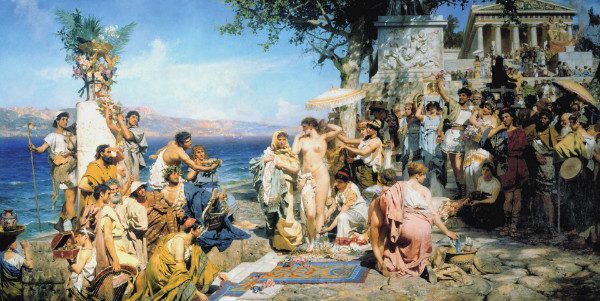
“Phryne in Eleusus” by Henryk Siemiradzki, from WikiMedia.
Veracity & Historicity
Most religions have a certain “starting point” from which everything springs. Generally these starting points are a matter of faith. For instance, Jesus allegedly returning from the dead on Easter Sunday is the moment in Christianity. As a Wiccan-Witch my “starting point” is the alleged initiation of an English civil servant named Gerald Gardner into a Witch coven in 1939.
Neither one of those events stands up very well to scrutiny. In the case of Jesus, people just don’t come back to life after dying. It doesn’t help that he’s mostly missing from the historical record too. I’m not arguing that he wasn’t a real guy (I think he was), but for a “Son of God” he didn’t make much of a mark during his lifetime.
In Gardner’s case we know he was a real person. He wrote some books, we have pictures, and there are people still living who knew him before he did in 1964. However there’s nothing out there that proves he was initiated into a Witch group in 1939. I think there’s a good case that can be made for it, but there’s nothing out there that puts the matter to rest, and may never be.
Unlike a lot of Christians, I don’t really care if my tradition’s origin story is 100% accurate or not. If Gardner made the whole thing up in 1948 that’s fine with me. I just know that it works for me and that’s really good enough. I don’t need anything more than that.
However, because the allegation is out there people are free to try and prove the historicity of it to their heart’s content. There are smart people who say it happened, and smart people who say it didn’t. Both sides make compelling arguments, and I’m fascinated with the discussion either way. But while I might jokingly call Gerald Gardner “Wiccan Jesus,” he was just a dude, that’s really different than Jesus.
For some Christians, Jesus coming back from the dead is everything. The teachings are immaterial, it’s all about the supernatural moment, and that’s fine I guess. But if someone is going to tell me that a guy came back from the dead, they’d better be ready for pushback. It’s just human nature to question the nature of things, and how Jesus the person became Jesus the son of Yahweh who comes back from the dead is a pretty big tale. It’s my right to question it, and if someone is offended by that they are offended by humanity.
I don’t think religious events have to be actual historical happenings to have meaning. Gardner being an initiate into something places his Witchcraft into a bigger space in history, and links it to many organizations and practices I find inspiring. The tale of Jesus’s dying for others shows the value of sacrifice. The power of the story remains, whether or not it literally happened.
What history says about Jesus (or Gerald) ultimately doesn’t matter, it’s all about what the believer thinks. Our faiths are about we believe, they aren’t about how our neighbor interprets what we hold dear. The world would be a in lot better shape today if we stopped caring so much about what everyone else thinks about our religions and instead focused on our own practices.
*The Church of Latter-Day Saints being the exception to this rule, though I don’t think there were Jewish settlements in the “New World.”
Previous Post

September 29, 2016
False Outrage: Witches in Government, Ouija Boards, and Millennials
Next Post

October 4, 2016 Pagan Pilgrimage: San Francisco Bay Area
Browse Our Archives
Select a Category Editorializing Gateways to Paganism Guest Posts Holiday Histories Led Zeppelin News and Views Occult Pagan Pagan TV Club Paganism polytheism Ramble On Reviews Ritual Strange Days Uncategorized
Select a Month August 2026 March 2026 February 2026 November 2025 September 2025 August 2025 April 2025 August 2024 April 2024 February 2024 December 2023 October 2023 August 2023 June 2023 May 2023 January 2023 October 2022 August 2022 July 2022 June 2022 May 2022 April 2022 March 2022 February 2022 January 2022 December 2021 November 2021 October 2021 September 2021 August 2021 July 2021 June 2021 April 2021 March 2021 February 2021 January 2021 December 2020 November 2020 October 2020 August 2020 July 2020 June 2020 May 2020 April 2020 March 2020 February 2020 January 2020 December 2019 November 2019 October 2019 September 2019 August 2019 July 2019 June 2019 May 2019 April 2019 March 2019 February 2019 January 2019 December 2018 November 2018 October 2018 September 2018 August 2018 July 2018 June 2018 May 2018 April 2018 March 2018 February 2018 January 2018 December 2017 November 2017 October 2017 September 2017 August 2017 July 2017 June 2017 May 2017 April 2017 March 2017 February 2017 January 2017 December 2016 November 2016 October 2016 September 2016 August 2016 July 2016 June 2016 May 2016 April 2016 March 2016 February 2016 January 2016 December 2015 November 2015 October 2015 September 2015 August 2015 July 2015 June 2015 May 2015 April 2015 March 2015 February 2015 January 2015 December 2014 November 2014 October 2014 September 2014 August 2014 July 2014 June 2014 May 2014 April 2014 March 2014 February 2014 January 2014 December 2013 November 2013 October 2013 September 2013 August 2013 July 2013 June 2013 May 2013 April 2013 March 2013 February 2013 January 2013 December 2012 November 2012 October 2012 September 2012 August 2012 July 2012 June 2012 April 2012 October 2011 September 2011 August 2011
Follow Us!
TAKE THE
Religious Wisdom Quiz
Who wrote the Book of Acts?
Select your answer to see how you score.
Luke Mark Peter Paul
Related posts from Raise the Horns


The Return of the Pagan Scapegoats


Magickal & Pagan Gathers: Some Thoughts
TRENDING AT PATHEOS Pagan

Janie Learns the Way of the Cross: A...
Teaching children about Jesus' Passion can be challenging. Many parents and educators...

Looking For Good Catholic Writing - October 2026
He alone extends the heavens, and he walks upon the waves of...

In "Irreplaceable," our book on vocation and technology, Trevor Sutton and I...

I was strolling through the top floor of the brand new Parthenon...

What Does Gêvâh Mean For Kimberley Guifoyle &...
This week, a lot of the news is focused on Kimberly Guilfoyle....

INNER CIRCLE: Profound Mystery (Of Christ In All...
Ephesians 5:31-32 “For this reason, a man will leave his father and...
view all Pagan blogs
Ad-Free & Subscriber Log-In Subscription Support
- About Us
- 2026 Calendar
- Videos
- Podcasts
- Library of World Religions
- Faith In Media Tracker
- Advertise With Us
- Write for Us
- Privacy Policy
- Terms of Service
- Do Not Sell My Data
- Contact Us
- Radiant Digital
- Manage Newsletter Subscriptions
- Unsubscribe From Notifications
- Sitemap
Copyright 2008-2026, Patheos. All rights reserved.
Subscription Support Ad-Free & Subscriber Log-In
Follow Patheos