
BuddhistCatholicContemplativeEvangelicalGeneral ChristianHinduJewishLatter-day SaintMuslimNew VisionsProgressive Christian
Beliefs
- Buddhist
- Catholic
- Contemplative
- Evangelical
- General Christian
- Hindu
- Jewish
- Latter-day Saint
- More Voices
- Muslim
- New Visions
- Pagan
- Progressive Christian
Topics
- Religion News
- Food and Religion
- Sports and Religion
- Religious Art
- Religious Music and Entertainment
- Religious Events
- History and Religion
- Style and Religion
- Politics and Religion
- Women in Religion
- Recreation Outdoors and Religion
- Business Finance and Religion
- Careers Workplace and Religion
- Education and Religion
- Family Parenting and Religion
- Health Fitness and Religion
- Home and Religion
- Relationships and Religion
- Technology and Religion
- Travel and Religion
Columnists
- Buddhist Columnists
- Business Finance and Religion Columnists
- Careers Workplace and Religion Columnists
- Catholic Columnists
- Contemplative Columnists
- Education and Religion Columnists
- Evangelists Columnists
- Family Parenting and Religion Columnists
- General Christian Columnists
- Health Fitness and Religion Columnists
- Hindu Columnists
- History and Religion Columnists
- Home and Religion Columnists
- Jewish Columnists
- More Voices Columnists
- Latter Day Columnists
- Muslim Columnists
- New Visions Columnists
- Nonreligious Columnists
- Pagan Columnists
- Politics and Religion Columnists
- Progressive Columnists
- Recreation Outdoors and Religion Columnists
- Relationships and Religion Columnists
- Religion News Columnists
- Religious Art Columnists
- Religious Events Columnists
- Religious Music and Entertainment Columnists
- Sports and Religion Columnists
- Style and Religion Columnists
- Technology and Religion Columnists
- Travel and Religion Columnists
- Women in Religion Columnists
Resource Library
- 2026 Calendar
- Library of World Religions
- The 100 Most Holy Places on Earth
- Patheos Answers
- Podcasts
- Videos
- Faith Leaders Database
- Anglican Episcopalian
- Bahai
- Baptist
- Buddhism
- Christianity
- Confucianism
- Eastern Orthodoxy
- Hinduism
- Holiness and Pentecostal
- ISKCON
- Islam
- Judaism
- Lutheran
- Methodist
- The Church of Jesus Christ of Latter-day Saints
- New Age
- Paganism
- Presbytarian and Reformed
- Protestantism
- Religion Behind the Scenes
- Roman Catholic
- Scientology
- Shia Islam
- Sikhism
- Sufism
- Sunni Islam
- Taoism
- Zen
- See all religions
Research Tools
 Ad-Free & Subscriber Log-In Subscription Support
Ad-Free & Subscriber Log-In Subscription Support
Follow Patheos 

- Trending:
- Forgiveness
- |
- Marriage
- |
- Consciousness
- |
- Death Penalty
- |
- Election
- |
- Halloween

- HOME
- Me and the Blog
- Defining Pagan
- Rituals & Holidays
- All Posts
- Blogroll
- Publications
- FREE NEWSLETTER
- Home
- Pagan
- The Witch’s Toolbox: Altars
The Witch’s Toolbox: Altars
Last updated on: April 4, 2018 at 5:11 pm by Jason Mankey
The Witch’s Toolbox: Altars 2018-04-04T17:11:16-06:00 Jason Mankey
Patheos Explore the world's faith through different perspectives on religion and spirituality! Patheos has the views of the prevalent religions and spiritualities of the world.
As long as people keep using stuff in rituals and ceremonies, there will be altars.
The word altar first shows up in the written record around the year 1200 BCE, but is probably at least 200 years older than that. The Oxford Dictionary links it to the Old English word alter, which it then links to the Latin altus which means “high.” The word altar could also derive from the Latin altare which means to “burn up” or in some translations “to ritually burn.”
Either origin makes a great deal of sense. In both Christian churches and ancient pagan temples altars were always up off the floor, sometimes to a grand degree. Burning materials, generally incense, have been common on altars for centuries too. Whatever the origin of the word, it’s grounded in practicality.
It’s hard to date the first use of an altar, especially since rocks and tree stumps make fine altars, but tables for ritual purposes probably date back at least 30,000 years to ancient cave-painters. (Europe’s painted caves are the most well known, but cave painting took place world-wide. Indonesia’s Pettakere Cave, is as old or even older, than anything discovered so far in Europe.) Chauvet Cave in Southern France has a rock with a bear skull on top of it, and it seems likely it was put there for a ritual purpose (though it can’t be proven absolutely).
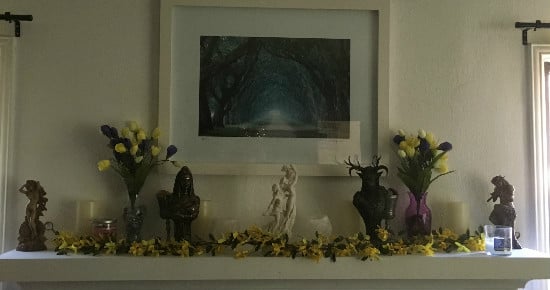
The mantle altar.
MORE WITCH’S TOOLBOX
The Witch’s Toolbox: Book of Shadows
Also be sure to check out my book The Witch’s Athame, and The Witch’s Book of Shadows.
In November of 2018 Laura Tempest Zakroff and I will be releasing a book all about altars!
Though I don’t own any bear skulls, my house does contain several altars. Two of them sit in my living room, one on our fireplace mantle, and a second on top of our oldest (and lowest) communal bookshelf. They aren’t ever really used for Witch-work, but they still hold spiritual significance for my wife and I. The various deities we’ve come to honor over the years are represented on them, as are the ever-changing seasons. (I redecorate them every few months to reflect where are on the wheel of the year.) I like to think that our living room altars are representative of my wife and I’s life together.
On top of yet another bookcase (this time in my office) sits my own personal altar. We use it occasionally during ritual when circumstances dictate the need for a second room, but mostly it’s representative of me. There’s always at least one horned figure on it, along with gifts I’ve received over the years that I feel honor Pan and Dionysus. There’s also a candle holder with figures holding hands dancing in a circle, it’s a reminder of what Paganism can be on its better days.
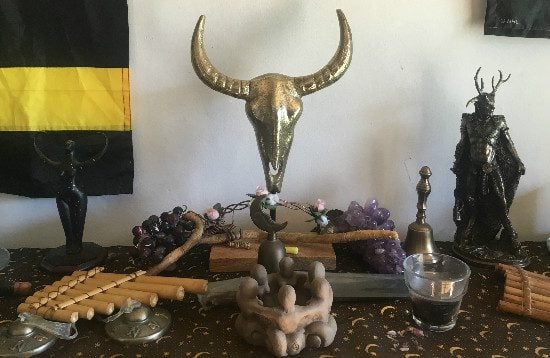
Yup, that’s a Pittsburgh Steelers flag to your left.
The tops of bookshelves have always served me well as altars. As a baby-Pagan I tended to end up living in attics (it was during college), and most of them had sloped walls. That made traditional tall bookshelves out of the question so I littered my space with mini bookcases all with their own altar on top of them. Generally I matched the altar top to whatever books were below it, because I’m like that. Those altars weren’t just ornamental though, they were working spaces too, though rather limited.
The most important altars in our house are, not surprisingly, in our ritual room. I often think of the table that sits in the middle of that room as the altar, but that’s not completely accurate. Our main altar is flanked in the north and south by additional spaces for stuff. One of those is where my wife tends to set up many of our magical workings, and the other often holds our sword, cakes and ale, and the bowl and pitcher we use for ceremonial cleansing. Until I started this article I hesitated to call those spaces altars, but they have defined roles in our work, and are home to specific tools and and other items.
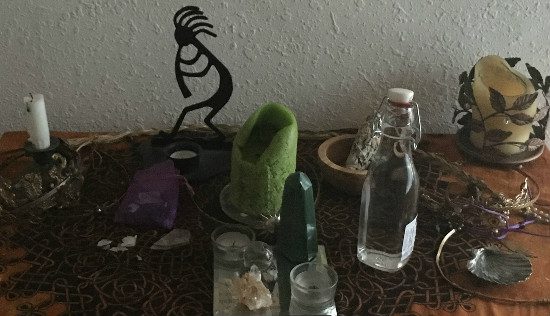
Secondary altar in the ritual room.
For whatever reasons my wife is not a big fan of the altar in the center of our ritual space (“it’s not big enough!” “it’s old and beaten up!”), but we’ve been using it for Witch-purposes for nearly fifteen years now, making it one of our oldest ritual tools. Unlike most of my ritual tools I have no idea where our main altar actually came from. It showed up in our living room one day as a spot for drinks and a lamp, and eventually began to get cleared off periodically when we’d host ritual. When we started our coven out here in California there wasn’t much debate about what we’d be using as an altar.
I’m weirdly attached to our table altar for a number of reasons, even though my wife is right about it being in rough shape (but that’s what altar cloths are for!). I’ve used a lot of altars over the years that are too low to the ground, ours comes up to about my waist meaning I don’t have to lean it over it a whole lot while we are working, or worry about candle-flames lighting my precious locks on fire. (You laugh, but hair on fire is more common in Witch circles than you might think.) Our altar is also strangely solid and doesn’t wobble. This is important when dealing with precious statues that you don’t want breaking, and officiants who might occasionally sit on the altar.
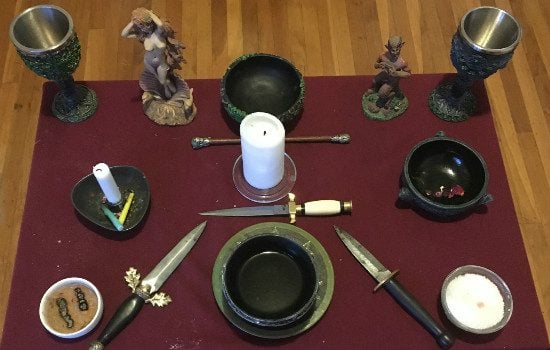
This is our main table altar. I love this thing.
We don’t often give a lot of thought to our altars, we are far more likely to think of the tools we place on them, but a good altar is also a place of power. In my coven the altar is often a focus point for our various spells and energies raisings. When building the cone of power our energy is often directed to a point just above our altar. With so much power being directed at the altar I’m sure that it’s picked up a whole lot of juice over the years. Just setting something on top of it feels like a magical act at this point in our practice.
Traditionally the pentacle is the focal point when it comes to magical work, but if you use the same altar again and again, it will begin to serve a similar function. I often view the pentacle as a gateway to the realm of the gods, but our altar has such presence that I think it has that power all on its own.
Altars are great for places for cleansing items, and not just actively during ritual. When my wife or I purchase a new magical item it generally goes on our altar immediately. There it gets in touch with our energies and those of our coven and deities. If that new item contains any negativity that’s generally all erased by the time we use it in ritual. Even when not in use, our main altar continues to radiate good energy, and it seems wasteful not to put that energy to work.
I don’t think there’s anything necessarily out of bounds when it comes to what goes on an altar. As long as what you are placing there is sacred to you or represents something you find spiritually significant it’s a good fit for the altar. I’m a big fan of the unconventional on the altar, which in my home sometimes means a bottle of good scotch or a birthday card. Creativity is an important Witch-attribute and should be a part of any good altar building.
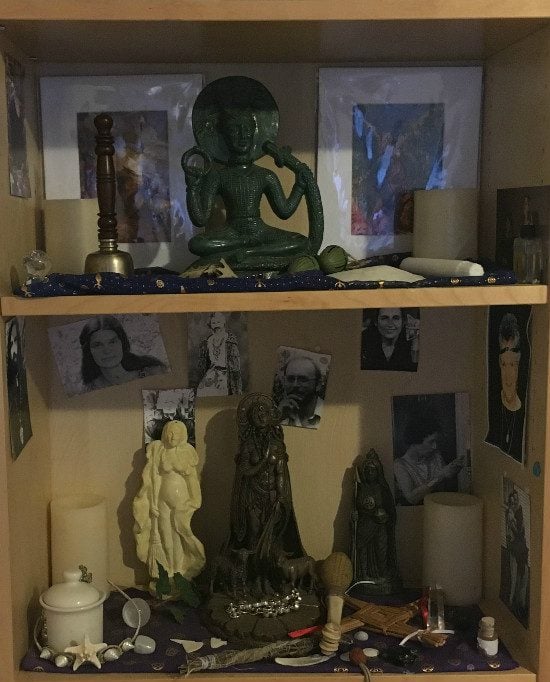
Our shrine space.
In addition to our altars my coven has a “shrine” on a bookshelf in our ritual space. The shrine contains a few non-rotating deities (most notably Cernunnos and Bridget), along with our Mighty Dead of the Craft. It doesn’t make sense to include the pictures of our departed elders on the altar, but the shrine works as a suitable home. Our dead, along with Cernunnos and Bridget, are not actively invoked at every ritual but they know they have a standing offer to join us if they so wish. I think of our shrine space as a less-active altar.
While the best altars probably remain rocks, tree stumps, and other naturally occurring spaces, a dedicated altar in the home has its place too, and it’s more than just a place for stuff.
Previous Post
April 27, 2016
Summer Pagan Festivals 2016: A Guide
Next Post
May 17, 2016 Coven Challenges
Browse Our Archives
Select a Category Editorializing Gateways to Paganism Guest Posts Holiday Histories Led Zeppelin News and Views Occult Pagan Pagan TV Club Paganism polytheism Ramble On Reviews Ritual Strange Days Uncategorized
Select a Month August 2026 March 2026 February 2026 November 2025 September 2025 August 2025 April 2025 August 2024 April 2024 February 2024 December 2023 October 2023 August 2023 June 2023 May 2023 January 2023 October 2022 August 2022 July 2022 June 2022 May 2022 April 2022 March 2022 February 2022 January 2022 December 2021 November 2021 October 2021 September 2021 August 2021 July 2021 June 2021 April 2021 March 2021 February 2021 January 2021 December 2020 November 2020 October 2020 August 2020 July 2020 June 2020 May 2020 April 2020 March 2020 February 2020 January 2020 December 2019 November 2019 October 2019 September 2019 August 2019 July 2019 June 2019 May 2019 April 2019 March 2019 February 2019 January 2019 December 2018 November 2018 October 2018 September 2018 August 2018 July 2018 June 2018 May 2018 April 2018 March 2018 February 2018 January 2018 December 2017 November 2017 October 2017 September 2017 August 2017 July 2017 June 2017 May 2017 April 2017 March 2017 February 2017 January 2017 December 2016 November 2016 October 2016 September 2016 August 2016 July 2016 June 2016 May 2016 April 2016 March 2016 February 2016 January 2016 December 2015 November 2015 October 2015 September 2015 August 2015 July 2015 June 2015 May 2015 April 2015 March 2015 February 2015 January 2015 December 2014 November 2014 October 2014 September 2014 August 2014 July 2014 June 2014 May 2014 April 2014 March 2014 February 2014 January 2014 December 2013 November 2013 October 2013 September 2013 August 2013 July 2013 June 2013 May 2013 April 2013 March 2013 February 2013 January 2013 December 2012 November 2012 October 2012 September 2012 August 2012 July 2012 June 2012 April 2012 October 2011 September 2011 August 2011
Follow Us!
TAKE THE
Religious Wisdom Quiz
True or False: Paul wrote to Titus about overseers needing to be hospitable and able to teach.
Select your answer to see how you score.
FALSE TRUE
Related posts from Raise the Horns

What Makes a Good Ritualist? No Idea

Witchcraft Remembrances & Appreciation at Samhaintide

Raymond Buckland & The Big Blue Book

TRENDING AT PATHEOS Pagan

'Super Scam Me' Exposes AI Jon Bon Jovi...
Leslie Pickett believed she was in a relationship with Jon Bon Jovi....

The Brazilian Remake of Kendricks' 'Flywheel' Opens in...
“Flywheel,” the story that launched the Kendrick Brothers’ filmmaking career is getting...

The Dangers of Gradual Accommodation (Winking at Sin)
Recently, the “law of gradualness” resurfaced during the opening of a weeklong,...

The Iron Gates and the Lion of the...
Yesterday, I didn't finish my report about, well, yesterday. So I'll...

The Image: On the Horror of Capitalism and...
The Image Then went the Pharisees, and took counsel how they might...

We are approaching the date of our new American national holiday: October...
view all Pagan blogs
Ad-Free & Subscriber Log-In Subscription Support
- About Us
- 2026 Calendar
- Videos
- Podcasts
- Library of World Religions
- Faith In Media Tracker
- Advertise With Us
- Write for Us
- Privacy Policy
- Terms of Service
- Do Not Sell My Data
- Contact Us
- Radiant Digital
- Manage Newsletter Subscriptions
- Unsubscribe From Notifications
- Sitemap
Copyright 2008-2026, Patheos. All rights reserved.
Subscription Support Ad-Free & Subscriber Log-In
Follow Patheos