
BuddhistCatholicContemplativeEvangelicalGeneral ChristianHinduJewishLatter-day SaintMuslimNew VisionsProgressive Christian
Beliefs
- Buddhist
- Catholic
- Contemplative
- Evangelical
- General Christian
- Hindu
- Jewish
- Latter-day Saint
- More Voices
- Muslim
- New Visions
- Pagan
- Progressive Christian
Topics
- Religion News
- Food and Religion
- Sports and Religion
- Religious Art
- Religious Music and Entertainment
- Religious Events
- History and Religion
- Style and Religion
- Politics and Religion
- Women in Religion
- Recreation Outdoors and Religion
- Business Finance and Religion
- Careers Workplace and Religion
- Education and Religion
- Family Parenting and Religion
- Health Fitness and Religion
- Home and Religion
- Relationships and Religion
- Technology and Religion
- Travel and Religion
Columnists
- Buddhist Columnists
- Business Finance and Religion Columnists
- Careers Workplace and Religion Columnists
- Catholic Columnists
- Contemplative Columnists
- Education and Religion Columnists
- Evangelists Columnists
- Family Parenting and Religion Columnists
- General Christian Columnists
- Health Fitness and Religion Columnists
- Hindu Columnists
- History and Religion Columnists
- Home and Religion Columnists
- Jewish Columnists
- More Voices Columnists
- Latter Day Columnists
- Muslim Columnists
- New Visions Columnists
- Nonreligious Columnists
- Pagan Columnists
- Politics and Religion Columnists
- Progressive Columnists
- Recreation Outdoors and Religion Columnists
- Relationships and Religion Columnists
- Religion News Columnists
- Religious Art Columnists
- Religious Events Columnists
- Religious Music and Entertainment Columnists
- Sports and Religion Columnists
- Style and Religion Columnists
- Technology and Religion Columnists
- Travel and Religion Columnists
- Women in Religion Columnists
Resource Library
- 2026 Calendar
- Library of World Religions
- The 100 Most Holy Places on Earth
- Patheos Answers
- Podcasts
- Videos
- Faith Leaders Database
- Anglican Episcopalian
- Bahai
- Baptist
- Buddhism
- Christianity
- Confucianism
- Eastern Orthodoxy
- Hinduism
- Holiness and Pentecostal
- ISKCON
- Islam
- Judaism
- Lutheran
- Methodist
- The Church of Jesus Christ of Latter-day Saints
- New Age
- Paganism
- Presbytarian and Reformed
- Protestantism
- Religion Behind the Scenes
- Roman Catholic
- Scientology
- Shia Islam
- Sikhism
- Sufism
- Sunni Islam
- Taoism
- Zen
- See all religions
Research Tools
 Ad-Free & Subscriber Log-In Subscription Support
Ad-Free & Subscriber Log-In Subscription Support
Follow Patheos 

- Trending:
- Forgiveness
- |
- Marriage
- |
- Consciousness
- |
- Death Penalty
- |
- Election
- |
- Halloween

- HOME
- Me and the Blog
- Defining Pagan
- Rituals & Holidays
- All Posts
- Blogroll
- Publications
- FREE NEWSLETTER
- Home
- Pagan
- Armchair Paganism
Armchair Paganism
Last updated on: May 21, 2017 at 12:30 pm by Jason Mankey
Armchair Paganism 2017-05-21T12:30:13-06:00 Jason Mankey
Patheos Explore the world's faith through different perspectives on religion and spirituality! Patheos has the views of the prevalent religions and spiritualities of the world.
I live Paganism in a way that few other people get to. I’m the caretaker of Patheos Pagan, I travel to lots of Pagan events every year, I blog here, and I’ve started to write books. Much of my leisure time is spent reading texts on magickal and occult history for research purposes (and because I just like reading that sort of stuff!). In my spare time I help run a local (open) Pagan group, and currently practice with two covens. I do a lot of Pagan shit in the course of a week, but with the exception of the coven work, a lot of it is Armchair Paganism.
When I was a Witchling I used to read a Pagan and/or Witchcraft book for at least 30 minutes a night before going to sleep. I felt rather smug about this too, because I thought that by doing so I was dedicating at least that amount of time to the Craft on a daily basis. During that period of time I settled down with Scott Cunningham’s Living Wicca (the less well known sequel to Wicca: A Guide For the Solitary Practitioner), and Cunningham’s words in that book served as a wake-up for my own practice. I don’t remember exactly what was written in that book but it was something like “you should practice the Craft everyday (and reading books about the Craft doesn’t count).” It was like a slap in the face, but a welcome one.
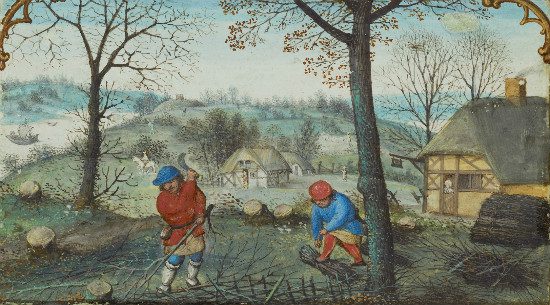
“Gathering Twigs” by Simon Bening. From WikiMedia.
Pagan faiths are generally about what we do, and not what we think. I practice Wiccan-Witchcraft not because I like reading about it, but because it’s what I do. My faith doesn’t live in books, it lives in the magick circle, in the natural world, and truly comes to life when I call to the Watchtowers and invoke deity. Books have helped me get to the point of casting a circle and calling to the Lord and Lady, but they aren’t doing.
Over the years I’ve practiced a lot of Armchair Paganism. There have been times when the only rituals I participated in were at festivals, and away from those festivals I pretty much ignored my deities. There were no covens or even solitary practice during those times, just a few scattered rites that were more about an extended community than growing my practice. I’m not going to beat myself up about it today (what’s done is done) and we all go through dry spells, but looking back on it there was a lot of wasted time in there.
The Blogosphere is Not Paganism
It feels like I’m shooting myself in the foot here, but the Pagan blogosphere is not Paganism. It’s a giant organism about Paganism, and can help facilitate the doing of actual Paganism, but it’s not Paganism. I naturally think blogs have value and contribute to our community, but they also take us away from the natural world and time better spent communing with deity, nature, and the energies that give our lives meaning.
If you find yourself more worried about what’s being said in the blogosphere than your own personal practice you are probably spending too much time engaged in Armchair Paganism. It’s an easy thing to get sucked into, no doubt about that, and it happens to me just as much as it happens to anyone else. Passionately caring about one’s ideas is great, but spending hours a day defending those ideas is not the same as putting them into practice. I get a lot done at this keyboard, but very little actual magick happens here.
When my writing opens up a door that leads to more doing, then I think I’ve accomplished something in this space. I don’t feel that way when a post generates an 80 comment backlash. It might surprise people to know that the most read things on this blog are generally my rituals, holiday histories, and articles on individual deities. I’m proud of that because those are the types of articles that lead to practice.
Writing Rituals is Important, But Not as Important as Doing Them
A couple of weeks ago my coven got together for no particular reason. It wasn’t a sabbat, or a full moon, it was simply a Friday night and we hadn’t had a ritual in awhile. All day I had sort of meant to write a ritual for the evening and never got around to it (hockey playoffs are kind of distracting right now) and once everyone arrived I guiltily admitted that I had chosen to watch tv instead of working on something for the coven.
But there was no reason to feel guilty, because once we got into ritual space everything was great! We generally use the same set-up in ritual every time we meet so a lot of the ritual was done before we even got into the room, but the purpose of Witchcraft is not to simply recite flowery words, it’s about raising energy and directing it towards certain things, and we don’t need a script for that.
Ritual writing is not inconsequential, and certainly public rites are worth a bit of pre-planning, but how much time should we really be spending on these things? The Lord and Lady do not care if my calls to them are perfectly rhymed or not (though I’d argue that they like to be flattered), that’s a personal choice. I don’t need a fully formed ritual to practice Witchcraft, what I need is to get off my butt and into sacred space.
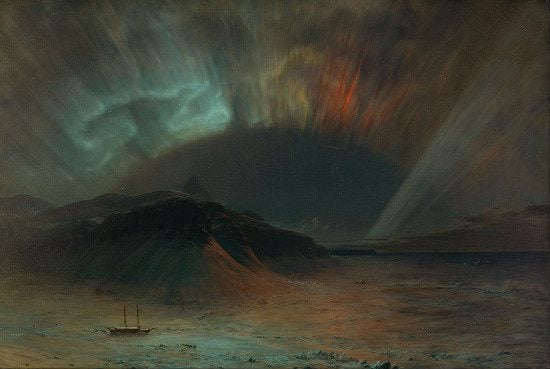
“Aurora Borealis” by Fredric Edwin Church. From WikiMedia.
Sometimes We Worry Too Much About Theology
Don’t get me wrong, I like theology. I think it’s important to have a fairly clear picture of why you believe the way you do, but ultimately that picture is yours and yours alone. I once heard deity called “The Ultimate Mystery” and it’s a turn of phrase I highly value. We might know our own deities, but in the end, we don’t know everything, and probably never will. The nature of goddesses and gods is not something that can be written about in absolutes. Personal understandings on the nature of deity help us make sense of our own reality, but they don’t apply to everyone else.
I’ve read some wonderful articles defending the Neo-Platonist worldview, but I’ve also read some fine articles that make a strong case for polytheism. There are Pagans who argue for a more atheist-viewpoint, and some of their arguments are compelling. I believe what I believe, but I know that I can’t offer absolute proof that my interpretation of things is the proper one.
There’s value in sharing our ideas and experiences about deity, but I’m not sure there’s a whole lot to be gained by the circular “I’m right, you’re wrong” arguments that grow like weeds online. The time spent arguing could be spent much better communing with the deities and ideas we are arguing about! Whether or not Cernunnos is a stand-alone god or part of a greater whole doesn’t really change how I honor him. I find the personal gnosis of other Cernunnos-worshippers beneficial, but what’s beneficial about it are their experiences with Him, not so much the cosmology of it all.
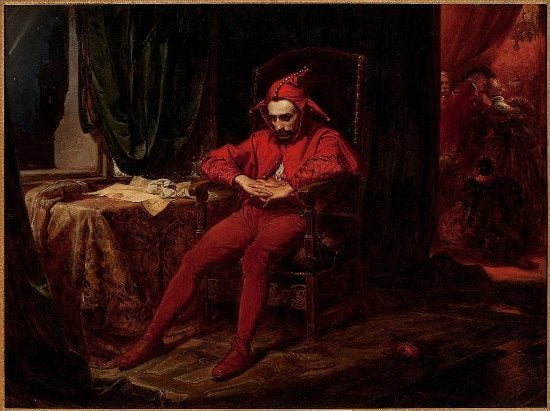
“Stanczyk” by Jan Matejke. From WikiMedia.
And As Cunningham Pointed Out All Those Years Ago, Books Don’t Count
Yes this makes me sad too. I wish that reading about Pagan and magickal things counted as actual practice, but they generally don’t. Sure, sometimes I stop in the middle of a book and take a moment to feel the sacred powers around me, but I’m not reading while I’m doing that. Reading facilitates Paganism, but it’s not the same as practicing Paganism.
More so than any other bad habit associated with my personal practice it’s reading that gets me into trouble. I once thought that simply reading about Witchcraft was the equivalent of practicing Witchcraft and that assumption was completely wrong. I’ve only truly begun to understand my practice and tradition because it’s only been in the last five years that I’ve continually gotten out of the armchair and into the circle. There are no substitutes for daily, solitary, and coven practices, not even reading.
Don’t think for a second that I’m arguing that reading is a waste of time, it’s most certainly not! But it needs to be balanced with putting what we’ve read into practice. Words on a page (or screen) are just that if they aren’t being used in magick, ritual, and practice.
So What’s Next?
The only way to overcome Armchair Paganism is to do what you do. If you find power and majesty in the natural world then get out in the natural world, and that certainly includes short walks around the neighborhood or whatever catches your fantasy. Nature is more than waterfalls and forests, it’s always around us. And I’m of the opinion that our deities are always around us to, and to interact with them we just have to call their names and reach out a little bit. Practice doesn’t have to involve lots of tools or even a circle, all it requires is a little effort!
Previous Post
May 19, 2016
A Witch's Guide to Dion Fortune
Next Post
May 31, 2016 Building an Altar and Finding Ritual Tools
Browse Our Archives
Select a Category Editorializing Gateways to Paganism Guest Posts Holiday Histories Led Zeppelin News and Views Occult Pagan Pagan TV Club Paganism polytheism Ramble On Reviews Ritual Strange Days Uncategorized
Select a Month August 2026 March 2026 February 2026 November 2025 September 2025 August 2025 April 2025 August 2024 April 2024 February 2024 December 2023 October 2023 August 2023 June 2023 May 2023 January 2023 October 2022 August 2022 July 2022 June 2022 May 2022 April 2022 March 2022 February 2022 January 2022 December 2021 November 2021 October 2021 September 2021 August 2021 July 2021 June 2021 April 2021 March 2021 February 2021 January 2021 December 2020 November 2020 October 2020 August 2020 July 2020 June 2020 May 2020 April 2020 March 2020 February 2020 January 2020 December 2019 November 2019 October 2019 September 2019 August 2019 July 2019 June 2019 May 2019 April 2019 March 2019 February 2019 January 2019 December 2018 November 2018 October 2018 September 2018 August 2018 July 2018 June 2018 May 2018 April 2018 March 2018 February 2018 January 2018 December 2017 November 2017 October 2017 September 2017 August 2017 July 2017 June 2017 May 2017 April 2017 March 2017 February 2017 January 2017 December 2016 November 2016 October 2016 September 2016 August 2016 July 2016 June 2016 May 2016 April 2016 March 2016 February 2016 January 2016 December 2015 November 2015 October 2015 September 2015 August 2015 July 2015 June 2015 May 2015 April 2015 March 2015 February 2015 January 2015 December 2014 November 2014 October 2014 September 2014 August 2014 July 2014 June 2014 May 2014 April 2014 March 2014 February 2014 January 2014 December 2013 November 2013 October 2013 September 2013 August 2013 July 2013 June 2013 May 2013 April 2013 March 2013 February 2013 January 2013 December 2012 November 2012 October 2012 September 2012 August 2012 July 2012 June 2012 April 2012 October 2011 September 2011 August 2011
Follow Us!
TAKE THE
Religious Wisdom Quiz
Who led the animals onto the ark?
Select your answer to see how you score.
Jacob Moses Isaac Noah
Related posts from Raise the Horns

What Makes a Good Ritualist? No Idea

Witchcraft Remembrances & Appreciation at Samhaintide

Raymond Buckland & The Big Blue Book

TRENDING AT PATHEOS Pagan

The Problem with False Prophets
Miller’s Station UMC| 10/18/26| Anchor Verse: Jeremiah 23: 1, 9-23 I...

Emotion in Early Christianity by Andrew Crislip
Andrew Crislip’s Emotion in Early Christianity examines an often overlooked dimension of...

16 Spiritual Touchstones for a More Grounded Life
After decades of spiritual study, here are 16 principles I try...

Catholic Evangelization: Sharing Your Faith Every Day
Welcome back to the Graceful Awakening mini-series called, “From Faith to Mission.” ...

The Pillar of the Boatmen: the Ancient Monument...
The Pillar of the Boatmen is a Romano-Gaulish sculpture that dates from...

In one sense walking into Westminster Abbey is like walking down the...
view all Pagan blogs
Ad-Free & Subscriber Log-In Subscription Support
- About Us
- 2026 Calendar
- Videos
- Podcasts
- Library of World Religions
- Faith In Media Tracker
- Advertise With Us
- Write for Us
- Privacy Policy
- Terms of Service
- Do Not Sell My Data
- Contact Us
- Radiant Digital
- Manage Newsletter Subscriptions
- Unsubscribe From Notifications
- Sitemap
Copyright 2008-2026, Patheos. All rights reserved.
Subscription Support Ad-Free & Subscriber Log-In
Follow Patheos