
BuddhistCatholicContemplativeEvangelicalGeneral ChristianHinduJewishLatter-day SaintMuslimNew VisionsProgressive Christian
Beliefs
- Buddhist
- Catholic
- Contemplative
- Evangelical
- General Christian
- Hindu
- Jewish
- Latter-day Saint
- More Voices
- Muslim
- New Visions
- Pagan
- Progressive Christian
Topics
- Religion News
- Food and Religion
- Sports and Religion
- Religious Art
- Religious Music and Entertainment
- Religious Events
- History and Religion
- Style and Religion
- Politics and Religion
- Women in Religion
- Recreation Outdoors and Religion
- Business Finance and Religion
- Careers Workplace and Religion
- Education and Religion
- Family Parenting and Religion
- Health Fitness and Religion
- Home and Religion
- Relationships and Religion
- Technology and Religion
- Travel and Religion
Columnists
- Buddhist Columnists
- Business Finance and Religion Columnists
- Careers Workplace and Religion Columnists
- Catholic Columnists
- Contemplative Columnists
- Education and Religion Columnists
- Evangelists Columnists
- Family Parenting and Religion Columnists
- General Christian Columnists
- Health Fitness and Religion Columnists
- Hindu Columnists
- History and Religion Columnists
- Home and Religion Columnists
- Jewish Columnists
- More Voices Columnists
- Latter Day Columnists
- Muslim Columnists
- New Visions Columnists
- Nonreligious Columnists
- Pagan Columnists
- Politics and Religion Columnists
- Progressive Columnists
- Recreation Outdoors and Religion Columnists
- Relationships and Religion Columnists
- Religion News Columnists
- Religious Art Columnists
- Religious Events Columnists
- Religious Music and Entertainment Columnists
- Sports and Religion Columnists
- Style and Religion Columnists
- Technology and Religion Columnists
- Travel and Religion Columnists
- Women in Religion Columnists
Resource Library
- 2026 Calendar
- Library of World Religions
- The 100 Most Holy Places on Earth
- Patheos Answers
- Podcasts
- Videos
- Faith Leaders Database
- Anglican Episcopalian
- Bahai
- Baptist
- Buddhism
- Christianity
- Confucianism
- Eastern Orthodoxy
- Hinduism
- Holiness and Pentecostal
- ISKCON
- Islam
- Judaism
- Lutheran
- Methodist
- The Church of Jesus Christ of Latter-day Saints
- New Age
- Paganism
- Presbytarian and Reformed
- Protestantism
- Religion Behind the Scenes
- Roman Catholic
- Scientology
- Shia Islam
- Sikhism
- Sufism
- Sunni Islam
- Taoism
- Zen
- See all religions
Research Tools
 Ad-Free & Subscriber Log-In Subscription Support
Ad-Free & Subscriber Log-In Subscription Support
Follow Patheos 

- Trending:
- Forgiveness
- |
- Marriage
- |
- Consciousness
- |
- Death Penalty
- |
- Election
- |
- Halloween

- HOME
- Me and the Blog
- Defining Pagan
- Rituals & Holidays
- All Posts
- Blogroll
- Publications
- FREE NEWSLETTER
- Home
- Pagan
- The First Witch Wars & Why It’s Different Today
The First Witch Wars & Why It’s Different Today
Last updated on: May 4, 2017 at 4:18 pm by Jason Mankey
The First Witch Wars & Why It’s Different Today 2017-05-04T16:18:17-06:00 Jason Mankey
Patheos Explore the world's faith through different perspectives on religion and spirituality! Patheos has the views of the prevalent religions and spiritualities of the world.
I’m under no delusions that everyone who practices Witchcraft today will one day drop their brooms and dance together around the cauldron. There are a whole host of differences among the modern strains of the Craft, and while we share a great deal, we don’t share everything. And while my wife and I don’t quite put up a You Are Not Invited sign when our Gardnerian coven meets, the idea is mostly true. Non-initiates are not welcome, and even certain lines in our tradition don’t have a free pass to join us.
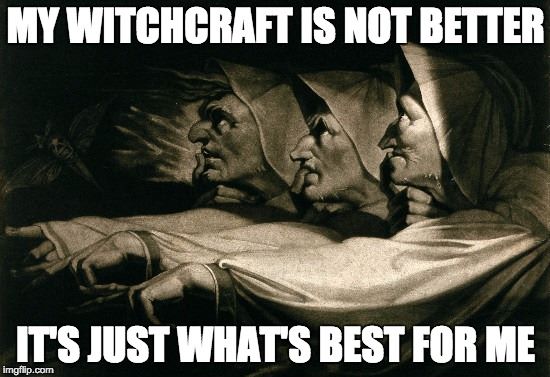
From the start Witchcraft has been rather exclusionary. Much of that is because of how the coven was originally structured. Today the phrase “perfect love and perfect trust” is often used willy-nilly and without a lot of thought, but originally that phrase was one of the core tenants of the Craft. The coven represented chosen family, and the only persons allowed in were those who had earned the love and trust of their fellow Witches.
Particular Witch-traditions are also about particular temperaments. Don’t believe in deity? Perhaps our Goddess-centric group won’t be a good fit. Does archaic (and somewhat sexist) sounding language bother you? Then what we say in our circle probably won’t resonate with you.* I love and trust all sorts of people who just aren’t a good fit with our coven and many of them are cognizant enough to realize that.
What I try not to do is judge the Witchcraft of others. The Feri Path is not for me but I still know that it’s a very real and valid path. My friends who practice it are strong and committed Witches and are doing good work. There is no version of the Craft that is “more authentic,” intense, scary, or real. I’m not threatened or jealous of other Witchcrafts, some are just different, and that’s great. When my wife and I go out for ice cream I go for the cookie dough and she goes for the mint-chocolate-chip, I know that the cookie dough isn’t really better because it’s what I prefer, I just know that it’s better for me.
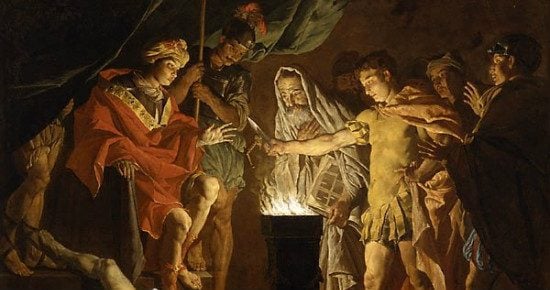
“Mucius Scaevola in the Presence of Lars Porsenna” by Matthias Stom. From WikiMedia.
THE FIRST WITCH WARS
When I complain about the current cosmic pissing contests that seems so prevalent in many Witch circles I’m often reminded by well meaning souls that the “Witch Wars” are nothing new, and that’s completely accurate. The first modern Witch War took probably took place in 1958 when Charles and Mary Cardell showed up in the Spiritualist magazine Light claiming to be Wiccens. After failing to impress Doreen Valiente and other established Witches the Cardells went to “war” on Gardnerian Witchcraft,** which culminated in the book/pamphlet Witch by Charles Cardell released under the pen-name Rex Nemorensis. (1)
Witch was meant to be a “tell all” about Gardner and included (alleged) excerpts of the Gardnerian Book of Shadows. Cardell was too cowardly to release his book while Gardner was still alive and released it in 1964 just a few months after Gardner’s death. I don’t like to speak ill of the dead but the Cardells were quite a strange couple (they liked to pass themself off as brother and sister, which they were not), and they faded from history shortly after the release of Witch. Today they are a curious footnote in Witch history and are probably most famous for being involved in the first public Witch War.
The second major Witch dust-up was instigated by someone who would have a lasting impact on Modern Witchcraft, Robert Cochrane (Roy Bowers). Cochrane was one of the first people to go public with a Witchcraft tradition outside of Gerald Gardner’s, and he wasn’t all that nice about it. (In his defense, I’m sure there were lots of Gardnerians behaving badly here too.) In Doreen Valiente’s memoir The Rebirth of Witchcraft she mentions Cochrane’s desire to have a “Night of the Long Knives” with the people he derisively called Gardnerians. (3) (And since there were not a whole lot of Witches in England at the time, the whole idea is completely absurd.)***
Cochrane had a combative personality and his friend Evan John Jones once remarked that “he seemed to want to be at loggerheads with most other occultists.” (3) By the time Cochrane was calling for his night of the long knives he was most likely dealing with some sort of serious mental duress. He took his own life shortly after Valiente left his Clan of Tubal Cain in 1966.
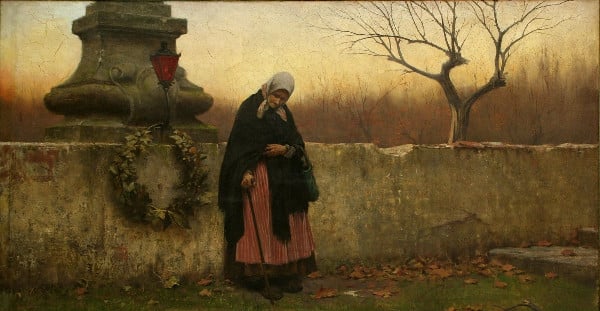
“All Souls’ Day” by Jakub_Schikaneder. From WikiMedia.
WHY IT’S DIFFERENT TODAY
There have always been problems in the world of Witchcraft, but I think it’s a lot different today than it was fifty or even twenty years ago. It shows up in people and groups who define their own Witchcraft not by what they do, but what they stand in opposition to. It’s one thing to say “I don’t practice Witchcraft like she does” and another to say “the Witchcraft they practice is not serious” all while not knowing who they truly are. I understand not liking Gerald in 1960, it’s another when all of his past and present initiates are also dismissed out of hand.
Public arguments amongst Witches were also once considered propositions. If you wanted to argue in a public forum about Witchcraft it required a bit of work. You had to get out the type-writer and put together a letter; there were no outlets for immediate criticisms and condemnations. I remember writing letters to editors, it was a pain in the ass, and by the time you were ready to write your letter the anger had probably already passed anyways. All kinds of arguments were probably avoided due to sheer laziness forty years ago. Even if you got your letter written it often took months for it to appear anywhere, and by that point everyone might have already forgotten about the argument.
Even our most public arguments thirty years ago were still mostly private. They occurred in Pagan magazines, which took a bit of work to track down. In 1993 I didn’t have to worry about my Aunt Donna stumbling across an argument on my Facebook feed about Wiccan privilege. Today our comments are available for just about anyone to see, and even things posted in private groups can be easily copied and shared with thousands. I wasn’t a big fan of Tarostar in the Green Egg Forum circa 1996, but I also didn’t make copies of his letters and pass them around the campfire, but we kind of do that today when we share something on social media.
Social media makes every argument so immediate and personal. Discussions that might have once occurred over the course of a year unfold over an afternoon. Instead of carefully considered opinions responses are written in minutes, without any time to reflect upon them, and issues of great complexity are simplified into yes or no arguments. Today we share memes and quotes without a second thought as to how others might react to or be hurt by such ideas. Yes, there have always been Witch Wars, but they’ve never played out so publicly before.
There have always been spiteful Witches and there have always been Witches intent on telling everyone that their version of the Craft is superior. But because we communicate with one other so quickly and we have so many immediate public forums the arguments and controversies are bigger. Twenty years ago you could hide in your Temple Room and just do your shit, and not worry about Witchcraft outside your own walls. Not as possible in the age of Facebook, Twitter, and blogs. Even if you don’t engage in all the mudslinging you still see and are even possibly affected by it on some internal level.
There is no one Witchcraft that is “better,” there’s only what’s best for each of us. Instead of arguing about what’s “real” let’s share some experiences and create a better Craft. Witchcraft is about what works, and it works much better when we focus on our own Craft instead of everyone else’s.

COMMENTS THAT DIDN”T MAKE THE ARTICLE
*We’ve always recited Doreen’s Valiente Charge of the Goddess with the words “beloved of gods and men” which is how we first heard it. It was later amended to read “gods and mortals,” but we we think the extra syllable throws off the Charge’s cadence.
**Which at the time, was pretty much the only public Witchcraft in the UK. (Note how I wrote “public Witchcraft” and not “only Witchcraft.”)
***I’ve grown quite fond of Cochrane over the last few years and some of his ritual innovations show up in my own rites from time to time. The end of his life is an utter tragedy, and it’s possible that Modern Witchcraft might be very different today had history proceeded a bit differently.
NOTES
1. Taken from Ronald Hutton’s Triumph of the Moon, Oxford University Press, 1999 pages 298-299. I’ve quoted this book so many times in my life that I don’t even have to check the title page for the publisher and year.
2. The quote is from Valiente’s Rebirth of Witchcraft (Phoenix Publishing, 1989), but I looked it up in Philip Heselton’s Doreen Valiente: Witch, published by the Doreen Valiente Foundation in 2016. It actually just came out this past February. Page 135.
3. More Hutton, this time from page 317.
Previous Post

April 7, 2016
When Did Witchcraft Become a Contest?
Next Post
April 20, 2016 10 Pagan Things To Do (Instead of Argue)
Browse Our Archives
Select a Category Editorializing Gateways to Paganism Guest Posts Holiday Histories Led Zeppelin News and Views Occult Pagan Pagan TV Club Paganism polytheism Ramble On Reviews Ritual Strange Days Uncategorized
Select a Month August 2026 March 2026 February 2026 November 2025 September 2025 August 2025 April 2025 August 2024 April 2024 February 2024 December 2023 October 2023 August 2023 June 2023 May 2023 January 2023 October 2022 August 2022 July 2022 June 2022 May 2022 April 2022 March 2022 February 2022 January 2022 December 2021 November 2021 October 2021 September 2021 August 2021 July 2021 June 2021 April 2021 March 2021 February 2021 January 2021 December 2020 November 2020 October 2020 August 2020 July 2020 June 2020 May 2020 April 2020 March 2020 February 2020 January 2020 December 2019 November 2019 October 2019 September 2019 August 2019 July 2019 June 2019 May 2019 April 2019 March 2019 February 2019 January 2019 December 2018 November 2018 October 2018 September 2018 August 2018 July 2018 June 2018 May 2018 April 2018 March 2018 February 2018 January 2018 December 2017 November 2017 October 2017 September 2017 August 2017 July 2017 June 2017 May 2017 April 2017 March 2017 February 2017 January 2017 December 2016 November 2016 October 2016 September 2016 August 2016 July 2016 June 2016 May 2016 April 2016 March 2016 February 2016 January 2016 December 2015 November 2015 October 2015 September 2015 August 2015 July 2015 June 2015 May 2015 April 2015 March 2015 February 2015 January 2015 December 2014 November 2014 October 2014 September 2014 August 2014 July 2014 June 2014 May 2014 April 2014 March 2014 February 2014 January 2014 December 2013 November 2013 October 2013 September 2013 August 2013 July 2013 June 2013 May 2013 April 2013 March 2013 February 2013 January 2013 December 2012 November 2012 October 2012 September 2012 August 2012 July 2012 June 2012 April 2012 October 2011 September 2011 August 2011
Follow Us!
TAKE THE
Religious Wisdom Quiz
What woman became a queen and saved her people?
Select your answer to see how you score.
Hannah Esther Deborah Miriam
Related posts from Raise the Horns

What Makes a Good Ritualist? No Idea

Witchcraft Remembrances & Appreciation at Samhaintide

Raymond Buckland & The Big Blue Book

TRENDING AT PATHEOS Pagan

The Sermon on the Mount, Part I: Matthew...
The Sermon on the Mount, Part I (Matthew 4:12-5:12) St. Matthew moves...

What's up from Crossway: Reviewing some of their latest A few weeks...

Janie Learns the Way of the Cross: A...
Teaching children about Jesus' Passion can be challenging. Many parents and educators...

Looking For Good Catholic Writing - October 2026
He alone extends the heavens, and he walks upon the waves of...

In "Irreplaceable," our book on vocation and technology, Trevor Sutton and I...

I was strolling through the top floor of the brand new Parthenon...
view all Pagan blogs
Ad-Free & Subscriber Log-In Subscription Support
- About Us
- 2026 Calendar
- Videos
- Podcasts
- Library of World Religions
- Faith In Media Tracker
- Advertise With Us
- Write for Us
- Privacy Policy
- Terms of Service
- Do Not Sell My Data
- Contact Us
- Radiant Digital
- Manage Newsletter Subscriptions
- Unsubscribe From Notifications
- Sitemap
Copyright 2008-2026, Patheos. All rights reserved.
Subscription Support Ad-Free & Subscriber Log-In
Follow Patheos