
BuddhistCatholicContemplativeEvangelicalGeneral ChristianHinduJewishLatter-day SaintMuslimNew VisionsProgressive Christian
Beliefs
- Buddhist
- Catholic
- Contemplative
- Evangelical
- General Christian
- Hindu
- Jewish
- Latter-day Saint
- More Voices
- Muslim
- New Visions
- Pagan
- Progressive Christian
Topics
- Religion News
- Food and Religion
- Sports and Religion
- Religious Art
- Religious Music and Entertainment
- Religious Events
- History and Religion
- Style and Religion
- Politics and Religion
- Women in Religion
- Recreation Outdoors and Religion
- Business Finance and Religion
- Careers Workplace and Religion
- Education and Religion
- Family Parenting and Religion
- Health Fitness and Religion
- Home and Religion
- Relationships and Religion
- Technology and Religion
- Travel and Religion
Columnists
- Buddhist Columnists
- Business Finance and Religion Columnists
- Careers Workplace and Religion Columnists
- Catholic Columnists
- Contemplative Columnists
- Education and Religion Columnists
- Evangelists Columnists
- Family Parenting and Religion Columnists
- General Christian Columnists
- Health Fitness and Religion Columnists
- Hindu Columnists
- History and Religion Columnists
- Home and Religion Columnists
- Jewish Columnists
- More Voices Columnists
- Latter Day Columnists
- Muslim Columnists
- New Visions Columnists
- Nonreligious Columnists
- Pagan Columnists
- Politics and Religion Columnists
- Progressive Columnists
- Recreation Outdoors and Religion Columnists
- Relationships and Religion Columnists
- Religion News Columnists
- Religious Art Columnists
- Religious Events Columnists
- Religious Music and Entertainment Columnists
- Sports and Religion Columnists
- Style and Religion Columnists
- Technology and Religion Columnists
- Travel and Religion Columnists
- Women in Religion Columnists
Resource Library
- 2026 Calendar
- Library of World Religions
- The 100 Most Holy Places on Earth
- Patheos Answers
- Podcasts
- Videos
- Faith Leaders Database
- Anglican Episcopalian
- Bahai
- Baptist
- Buddhism
- Christianity
- Confucianism
- Eastern Orthodoxy
- Hinduism
- Holiness and Pentecostal
- ISKCON
- Islam
- Judaism
- Lutheran
- Methodist
- The Church of Jesus Christ of Latter-day Saints
- New Age
- Paganism
- Presbytarian and Reformed
- Protestantism
- Religion Behind the Scenes
- Roman Catholic
- Scientology
- Shia Islam
- Sikhism
- Sufism
- Sunni Islam
- Taoism
- Zen
- See all religions
Research Tools
 Ad-Free & Subscriber Log-In Subscription Support
Ad-Free & Subscriber Log-In Subscription Support
Follow Patheos 

- Trending:
- Forgiveness
- |
- Marriage
- |
- Consciousness
- |
- Death Penalty
- |
- Election
- |
- Halloween

- HOME
- Me and the Blog
- Defining Pagan
- Rituals & Holidays
- All Posts
- Blogroll
- Publications
- FREE NEWSLETTER
- Home
- Pagan
- Valentine’s Day: Pagan or Christian?
Valentine’s Day: Pagan or Christian?
Last updated on: February 11, 2021 at 11:57 am by Jason Mankey
Valentine’s Day: Pagan or Christian? 2021-02-11T11:57:18-07:00 Jason Mankey
Patheos Explore the world's faith through different perspectives on religion and spirituality! Patheos has the views of the prevalent religions and spiritualities of the world.
Valentine’s Day is one of America’s biggest holidays, in fact it’s so big that it only ranks behind Christmas in terms of dollars spent. This year Americans are expected to spend over 17 and a half billion dollars on the holiday. Valentine’s Day is big business and it’s incredibly popular, 62% of us claim to celebrate it each year. These are incredibly surprising numbers, especially since Valentine’s Day is a rather oddball holiday.
Unlike most of the holidays on the American calendar Valentine’s Day is essentially a private holiday generally celebrated two people at a time.* Most of our holidays are designed to be communal affairs and revolve around social and family gatherings. That’s never been the case on February 14. (With the weird exception of Valentine’s Day in our schools. Most of us probably remember handing out tiny little cards with superheroes or whatever else printed on them. That was the only time I’ve ever shared Valentine’s Day with anyone other than a date or my wife.)
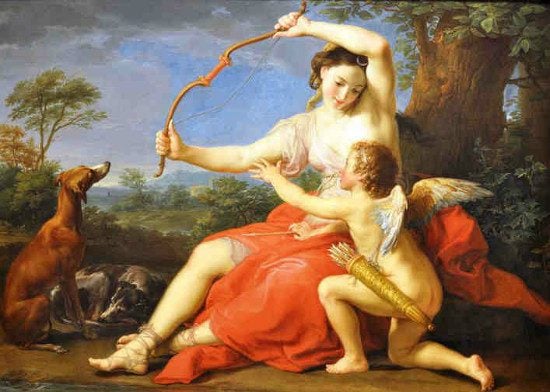
“Diana with Cupid” by Pompeo Batoni, from WikiMedia.
Valentine’s Day also lacks any real religious origin. Christmas, Halloween, and Easter can all be traced back to various ancient pagan and Christian traditions. Valentine’s Day, despite its associations with a rather dubious Catholic saint, lacks significant old pagan and Christian precedent. Valentine’s Day is a quirky little holiday, so quirky that we are probably celebrating it on the wrong day of the year!
Not a pagan holiday in the traditional sense. Over the centuries many historians have attempted to connect Valentine’s Day to the Roman celebration Lupercalia and this connection makes sense if one is only looking at dates. Lupercalia was celebrated February 13-15, but its proximity to our modern Valentine’s Day is the only thing the two holidays share.
The Roman historian Plutarch described the holiday in his work Morals:
Why do the Luperci sacrifice a dog? The Luperci are they that run up and down naked (saving only their girdles) in the Lupercal plays, and slash all that they meet with a whip.
Solution. Is it not because these feats are done for the purification of the city? For they call the month February, and indeed the very day Februatus, and the habit of whip ping with thongs they call februare, the word signifying to cleanse. And to speak the truth, all the Grecians have used, and some do use to this very day, a slain dog for an expiatory sacrifice; and among other sacrifices of purification, they offer whelps to Hecate, and sprinkle those that need cleansing with the puppy’s blood, calling this kind of purifying puppification. Or is it that lupus is λύϰος, a wolf, and Lupercalia are Lycaea; but a dog is at enmity with a wolf, therefore is sacrificed on the Lycaean festivals? Or is it because the dogs do bark at and perplex the Luperci as they scout about the city? Or is it that this sacrifice is offered to Pan, and Pan loves dogs because of his herds of goats.
While I love the connection to the great god Pan, there’s nothing connecting the celebration described here to heart shaped chocolates. Lupercalia was associated with cleansing, and the tradition may have influenced the Christian celebration of Candlemas, but that’s not Valentine’s Day. Later on the holiday of Lupercalia would be romanticized a bit with tales of young lovers coming together during the celebration, but those stories arose after Valentine’s Day become a popular holiday.
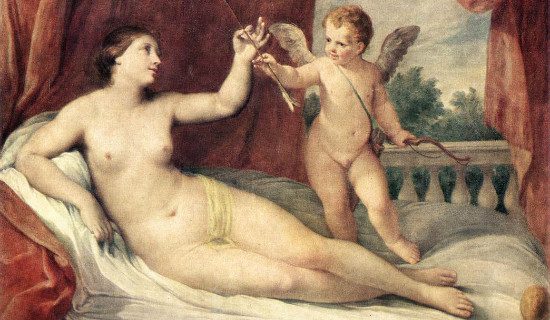
“Reclining Venus with Cupid” by Guido Reni. From WikiMedia.
Saint Valentine probably wasn’t a real guy, or guys. There might have been an actual (Saint) Valentine, or even Valentines, but we don’t know very much about him if he was real, and he certainly had nothing to do with love and romance. Tales of Valentine as a crusader for marriage are abundant this time of year, they are also all malarkey.
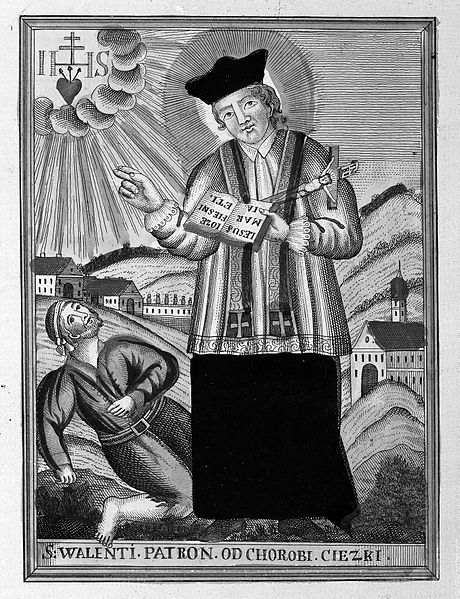
The Saint in an old etching, from WikiMedia.
There were two Valentines allegedly martyred on February 14, but none of their stories originally included any tales of love, and they also weren’t written down for centuries. Like many “saints” of that era they could be entirely fictitious or perhaps simply martyrs who were turned into legend. We have no way of knowing for sure. There were also several other Valentines (perhaps as many as 30!) not related to the person (or persons) whose feast day was celebrated on February 14. Don’t take my word for it here either, we know so little about Saint Valentine that the Catholic Church “discontinued liturgical veneration of him in 1969.”
The first reference to Valentine’s Day comes from Geoffrey Chaucer (and yes, that Chaucer). When we think of Chaucer today we generally think of his Canterbury Tales but during his lifetime he was widely known as a love poet, with one of those odes to love being especially important in the development of Valentine’s Day. Written sometime between 1370-1380 Geoffrey Chaucer’s The Parliament of Fowls is a poem dedicated to courtly love in the fullness of Spring. It also has the first mention of Valentine’s Day:
And in a clearing on a hill of flowers
Was set this noble goddess, Nature;
Of branches were her halls and her bowers
Wrought according to her art and measure;
Nor was there any fowl she does engender
That was not seen there in her presence,
To hear her judgement, and give audience.For this was on Saint Valentine’s day,
When every fowl comes there his mate to take,
Of every species that men know, I say,
And then so huge a crowd did they make,
That earth and sea, and tree, and every lake
Was so full, that there was scarcely space
For me to stand, so full was all the place.
Chaucer’s creation of Valentine’s Day was also linked to the beauty of the Earth in early Spring, here personified as a goddess. So while the actual holiday probably can’t be linked with any ancient pagan custom, certainly the imagery invoked here by Chaucer is rather “pagan.” Chaucer’s use of “Valentine’s Day” occurs two more times in the poem, with another reference to the saint of the same name.

William Blake’s Geoffrey Chaucer
Curiously, Chaucer’s poem might have been an attempt to romanticize a different time of year, one more likely to be associated with Spring and courtship than mid-February. One of the myriad Valentines mentioned earlier had a feast day on May 3 (1), and a love holiday celebrated around the maypole feels really appropriate to me, more so than February that’s for sure. Many of the Valentine’s Day tropes we expect today would be far more appropriate near the first of May.
What Chaucer was trying to accomplish with his references to a Valentine’s Day is a bit of a mystery. He was obviously trying to link his poem to a particular time of year, but he chose a rather laborious way to go about it. Whatever the reasoning, Chaucer continued referencing the day in other poems and the idea was quickly picked up by his peers. Within fifty years the term “valentine” was being used as a way to describe a lover, with Valentine’s Day settling into its now traditional date of February 14.
If Valentine’s Day is not an ancient pagan tradition, why does so much of it’s iconography look pagan? This is a question that has never really been tackled by historians, but is worth speculating on. “Love” is often a difficult idea to express, especially in a reserved manner. One of the advantages of the Greek and Roman gods is that they often “personify” certain things. A painting of Aphrodite immediately brings to mind beauty, and pictures of Cupid make us think of getting shot with his arrows.
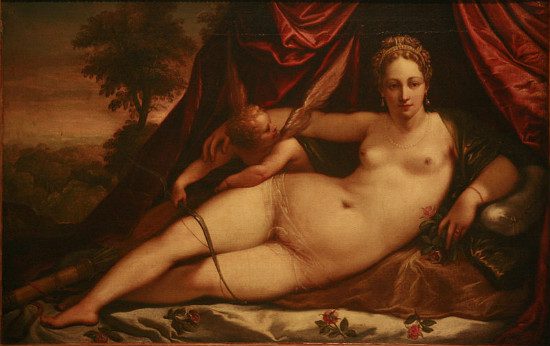
“Venus and Cupid,” artist unknown. From WikiMedia.
Besides, how romantic would Valentine’s Day be today if someone had decided that pictures of a decapitated St. Valentine were romantic? Old guys without heads attached to their bodies do very little for passion, add that to the sexually neutered Jesus and it’s easy to see why Cupid caught on so quickly (and absolutely, it’s as much his holiday today as it is any saint’s).
However you celebrate (or don’t) I wish you and your beloveds a most happy Valentine’s Day.
*Though if you have several Valentines, good for you!
1. Bruce David Forbers, America’s Favorite Holidays: Candid Histories, pages 60-61, University of California Press, 2015. This is a most excellent book and is required reading for holiday history nerds such as myself.
Stay in touch! Like Raise the Horns on Facebook:
Previous Post

February 1, 2016
Winter/Early Spring Pagan Festivals: A Guide
Next Post

February 23, 2016 The Horned God: Not As Old As You Think
Browse Our Archives
Select a Category Editorializing Gateways to Paganism Guest Posts Holiday Histories Led Zeppelin News and Views Occult Pagan Pagan TV Club Paganism polytheism Ramble On Reviews Ritual Strange Days Uncategorized
Select a Month August 2026 March 2026 February 2026 November 2025 September 2025 August 2025 April 2025 August 2024 April 2024 February 2024 December 2023 October 2023 August 2023 June 2023 May 2023 January 2023 October 2022 August 2022 July 2022 June 2022 May 2022 April 2022 March 2022 February 2022 January 2022 December 2021 November 2021 October 2021 September 2021 August 2021 July 2021 June 2021 April 2021 March 2021 February 2021 January 2021 December 2020 November 2020 October 2020 August 2020 July 2020 June 2020 May 2020 April 2020 March 2020 February 2020 January 2020 December 2019 November 2019 October 2019 September 2019 August 2019 July 2019 June 2019 May 2019 April 2019 March 2019 February 2019 January 2019 December 2018 November 2018 October 2018 September 2018 August 2018 July 2018 June 2018 May 2018 April 2018 March 2018 February 2018 January 2018 December 2017 November 2017 October 2017 September 2017 August 2017 July 2017 June 2017 May 2017 April 2017 March 2017 February 2017 January 2017 December 2016 November 2016 October 2016 September 2016 August 2016 July 2016 June 2016 May 2016 April 2016 March 2016 February 2016 January 2016 December 2015 November 2015 October 2015 September 2015 August 2015 July 2015 June 2015 May 2015 April 2015 March 2015 February 2015 January 2015 December 2014 November 2014 October 2014 September 2014 August 2014 July 2014 June 2014 May 2014 April 2014 March 2014 February 2014 January 2014 December 2013 November 2013 October 2013 September 2013 August 2013 July 2013 June 2013 May 2013 April 2013 March 2013 February 2013 January 2013 December 2012 November 2012 October 2012 September 2012 August 2012 July 2012 June 2012 April 2012 October 2011 September 2011 August 2011
Follow Us!
TAKE THE
Religious Wisdom Quiz
What material was used to make Moses' basket waterproof?
Select your answer to see how you score.
Tar and pitch Camel hide Linen and clay Palm leaves
Related posts from Raise the Horns


The Return of the Pagan Scapegoats


Magickal & Pagan Gathers: Some Thoughts
TRENDING AT PATHEOS Pagan

Janie Learns the Way of the Cross: A...
Teaching children about Jesus' Passion can be challenging. Many parents and educators...

Looking For Good Catholic Writing - October 2026
He alone extends the heavens, and he walks upon the waves of...

In "Irreplaceable," our book on vocation and technology, Trevor Sutton and I...

I was strolling through the top floor of the brand new Parthenon...

What Does Gêvâh Mean For Kimberley Guifoyle &...
This week, a lot of the news is focused on Kimberly Guilfoyle....

INNER CIRCLE: Profound Mystery (Of Christ In All...
Ephesians 5:31-32 “For this reason, a man will leave his father and...
view all Pagan blogs
Ad-Free & Subscriber Log-In Subscription Support
- About Us
- 2026 Calendar
- Videos
- Podcasts
- Library of World Religions
- Faith In Media Tracker
- Advertise With Us
- Write for Us
- Privacy Policy
- Terms of Service
- Do Not Sell My Data
- Contact Us
- Radiant Digital
- Manage Newsletter Subscriptions
- Unsubscribe From Notifications
- Sitemap
Copyright 2008-2026, Patheos. All rights reserved.
Subscription Support Ad-Free & Subscriber Log-In
Follow Patheos