
BuddhistCatholicContemplativeEvangelicalGeneral ChristianHinduJewishLatter-day SaintMuslimNew VisionsProgressive Christian
Beliefs
- Buddhist
- Catholic
- Contemplative
- Evangelical
- General Christian
- Hindu
- Jewish
- Latter-day Saint
- More Voices
- Muslim
- New Visions
- Pagan
- Progressive Christian
Topics
- Religion News
- Food and Religion
- Sports and Religion
- Religious Art
- Religious Music and Entertainment
- Religious Events
- History and Religion
- Style and Religion
- Politics and Religion
- Women in Religion
- Recreation Outdoors and Religion
- Business Finance and Religion
- Careers Workplace and Religion
- Education and Religion
- Family Parenting and Religion
- Health Fitness and Religion
- Home and Religion
- Relationships and Religion
- Technology and Religion
- Travel and Religion
Columnists
- Buddhist Columnists
- Business Finance and Religion Columnists
- Careers Workplace and Religion Columnists
- Catholic Columnists
- Contemplative Columnists
- Education and Religion Columnists
- Evangelists Columnists
- Family Parenting and Religion Columnists
- General Christian Columnists
- Health Fitness and Religion Columnists
- Hindu Columnists
- History and Religion Columnists
- Home and Religion Columnists
- Jewish Columnists
- More Voices Columnists
- Latter Day Columnists
- Muslim Columnists
- New Visions Columnists
- Nonreligious Columnists
- Pagan Columnists
- Politics and Religion Columnists
- Progressive Columnists
- Recreation Outdoors and Religion Columnists
- Relationships and Religion Columnists
- Religion News Columnists
- Religious Art Columnists
- Religious Events Columnists
- Religious Music and Entertainment Columnists
- Sports and Religion Columnists
- Style and Religion Columnists
- Technology and Religion Columnists
- Travel and Religion Columnists
- Women in Religion Columnists
Resource Library
- 2026 Calendar
- Library of World Religions
- The 100 Most Holy Places on Earth
- Patheos Answers
- Podcasts
- Videos
- Faith Leaders Database
- Anglican Episcopalian
- Bahai
- Baptist
- Buddhism
- Christianity
- Confucianism
- Eastern Orthodoxy
- Hinduism
- Holiness and Pentecostal
- ISKCON
- Islam
- Judaism
- Lutheran
- Methodist
- The Church of Jesus Christ of Latter-day Saints
- New Age
- Paganism
- Presbytarian and Reformed
- Protestantism
- Religion Behind the Scenes
- Roman Catholic
- Scientology
- Shia Islam
- Sikhism
- Sufism
- Sunni Islam
- Taoism
- Zen
- See all religions
Research Tools
 Ad-Free & Subscriber Log-In Subscription Support
Follow Patheos 

- Trending:
- Advent
- |
- Forgiveness
- |
- Thanksgiving
- |
- Election
- |
- Seasonal Holidays
- |
- Marriage

- HOME
- Me and the Blog
- Defining Pagan
- Rituals & Holidays
- All Posts
- Blogroll
- Publications
- FREE NEWSLETTER
- Home
- Pagan
- Santa Muerte: Holy Death
Santa Muerte: Holy Death
Last updated on: October 14, 2015 at 9:22 am by Jason Mankey
Santa Muerte: Holy Death 2015-10-14T09:22:59-06:00 Jason Mankey
Patheos Explore the world's faith through different perspectives on religion and spirituality! Patheos has the views of the prevalent religions and spiritualities of the world.
The goddess and folk-saint Santa Muerte is quickly becoming one of the most beloved, and feared, deities in all of North America. Her rise to prominence has been incredibly fast, and yet she’s been around in various forms for perhaps thousands of years. Today her worship spans several religious traditions. She can be found in Catholic households, Santerian rites, and even the occasional Wiccan ritual.
My interest in Santa Muerte is tied directly to the land I currently call home. California was once a part of Mexico, and Mexican-culture is very much a part of California-culture. Candles depicting the Skeleton Saint are available at my local grocery store. To ignore her is to ignore the California I’ve come to love so much. I hesitate to call myself a devotee, but I can certainly feel her presence. As a goddess of death, everyone will eventually feel her presence, and she does not discriminate.
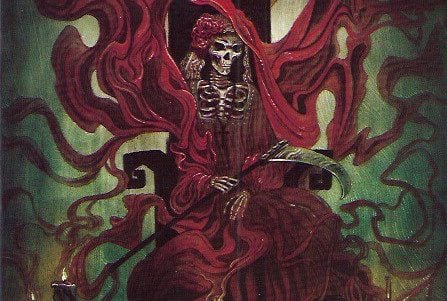
Cover close up, Image by Sam Guay.
To many people Santa Muerte translates as “Saint Death,” with Santa being the feminine form of the word saint, and Muerte translating as death. But a more accurate translations is Holy Death, as santa also means holy. There’s also the pesky little fact that La Santa Muerte was never mortal like actual Catholic Saints (in most versions of her origin at least*). For those reasons Holy Death makes a lot more sense than Saint Death. (1)

Mictlantecuhtli, photo by Phil Konstantin. F rom WikiMedia.
There’s a lot of debate over the origins of Santa Muerte. There are many who believe her origins lie with the Aztec Mictecacihuatl, a death goddess who ruled over the otherworld with her husband Mictlantecuhtli. Both deities were often depicted as skeletons, and were often called upon to deal with earthly issues. (2) For many devotees this is the most likely origin story for Holy Death, and a quick Google search for Mictecacihuatl will turn up many images of Santa Muerte.
I’m a firm believer that La Santa Muerte is somehow tied to Mictecacihuatl, but many scholars believe her most likely origin point is Western Europe and not Mexico. Images of the Grim Reaper were commonplace in Spain during the 16th and 17th Centuries and when the Spanish arrived in the Americas they brought the image with them. While we tend to think of the Grim Reaper as masculine, he was often depicted with a female assistant, La Parca. Eventually, so the theory goes, images of La Parca were misinterpreted and she ended up being mistaken for a saint. (3)

Do her origins lie with the Grim Reaper or with Mictecacihuatl? I think it’s possible that both a played a role in the development of Santa Muerte. It’s always much easier to hide an old faith in the clothes of the new. Perhaps Mictecacihuatl chose to stay with her children by adopting the iconography of La Parca? It’s all very difficult to determine because there’s a gap of several hundred years between the fall of the Aztec Empire in 1521 and the first recorded reference to Santa Muerte in the 1790’s.
READING ABOUT SANTA MUERTE
There are not a whole lot of books in English about Holy Death, which is why the footnotes below only contain two names. On the plus side the two most readily available books on La Santa Muerte are worth picking up and might even already be at your favorite bookstore.
The best place to start is with R. Andrew Chesnut’s Devoted to Death: Santa Muerte The Skeleton Saint (published in 2012 by Oxford University Press). Don’t let the “Oxford Press” stuff fool you, this is not an academic book. Sure, Chesnut is a college professor, but this is a popular history documenting the origins of Santa Muerte while going through the various roles she plays in folk-Catholicism. It’s also full of personal stories and some interviews with the people most prominent in Holy Death’s resurgence. If there’s a downside to this book it’s that it’s not long enough. It’s barely 200 pages, and a lot of the material is repeated throughout the book. I think I read a review once that said Devoted to Death reads more like a magazine article than a book, which is probably true. Reading Devoted to Death won’t help much when it comes to honoring the Boney Lady, but it does provide a detailed look at her followers.
For those looking to begin devotions to The Lady of the Shadows you probably want La Santa Muerte: Unearthing the Magic and Mysticism of Death by Tomaås Prower (Llewellyn Publications, 2015). This book isn’t so much about the history of our Lady, but about honoring and working with her. There are times when Unearthing the Magic tries a bit too hard to be all things (I didn’t really need an overview of death deities from various other pantheons) but the magic is solid and it’s obvious in his prose just how much Prower loves La Santa Muerte. One thing Prower does exceptionally well is open up the worship of Santa Muerte to anyone who hears her call. In his interpretation her worship is open to anyone and everyone. As a Wiccan I felt right at home in Prower’s world.
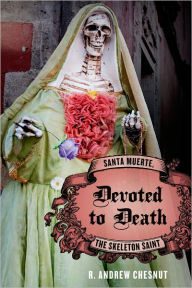 It’s probable that people were honoring Holy Death for hundreds of years before she was first written about, but that worship was most likely underground. The Catholic Church did not look favorably on Skeleton Saints (and Santa Muerte is not the only one) then or now, and her worship sites have been destroyed by church and government authorities many times over the centuries. In fact that destruction is a part of the first documented instance featuring Santa Muerte.
In 1779 30 members of the Chichimec people in present day Guanajuato were “caught” honoring Santa Muerte by local authorities. According to the official report the Chichimec would “at night gather in their chapel to drink peyote until they lose their minds; they light upside down candles, some of which are black; they dance with paper dolls; they whip Holy Crosses and also a figure of death that they call Santa Muerte, and they bind it with a wet rope and burn it if it does not perform a miracle.” (4) Holy Death’s shrine was demolished as punishment for such “idolatry.”
NICKNAMES OF HOLY DEATH
La Santa Muerte has many nicknames amongst her followers, some of the more popular include:
The Skinny Lady The White Girl The Boney Lady The Girl The Lady of the Shadows The Holy Girl
Prower lists several more names in his book, and gives a detailed explanation as to each nickname. Word of warning, many of these titles are meant to be terms of endearment and are usually only used by La Santa Muerte’s most devoted followers. In other words, don’t petition her as “The Girl” on your first go-around.
 Santa Muerte then disappears from the historical record for over 150 years, next appearing in the late 1940’s. For many Santa Muerte is a Goddess of Death, but until fairly recently she was most likely to be invoked for matters of the heart. The Boney Lady is an expert on love, and is often asked to return a straying lover to their significant other. In the 1970’s one group of devotees is said to have chanted “Most Holy Death, torture him, mortify him” as they asked for the great Lady’s help with their significant others. (5)
Worship of La Santa Muerte remained mostly underground until 2002 when an oversized statue of the folk-saint (a gift from her son) forced Enriqueta Romero to leave the front door of her house open so she’d have more room to work. As soon as people noticed the Bony Lady in Romoero’s home they asked if they could venerate her there. Very quickly her kitchen turned into a devotional space, along with Romero becoming one of the pivotal figures in the public acceptance of La Santa Muerte.
Today Santa Muerte is more likely to be associated with criminals than affairs of the heart, but much of that is due to our sensationalist media. Because Holy Death is an equal opportunity deity, she appeals to many on the margins of society, including drug traffickers and smugglers. As a result she’s often listed as a “Narco Saint” instead of as the universal figure she most definitely is. Unlike some saints (and even deities) La Santa Muerte is generally more interested in helping her followers than judging them, which explains why she’s so popular among the “Narcos.”
(One exception to the La Santa Muerte’s generally bad press was in the 2014 movie The Book of Life. No one ever comes right out and says that the female death goddess in the film is La Santa Muerte but I think it’s heavily implied. If you have yet to see The Book of Life you should attempt to remedy that situation.)

“The Book of Life” released by 20th Century Fox in 2014.
As her popularity has grown so to have her spheres of influence. In addition to love and death, La Santa Muerte is also a goddess of prosperity, justice, protection, and healing, and the list continues to grow, as does her cult. Worship of Holy Death is now widespread throughout the Americas, and is quickly becoming a world wide phenomenon.
Most of the Western World has a bad relationship with death. We often hide from it and try to ignore it. One of the many great things about Mexican culture is how open and honest it is about the other side of the veil. The idea of a skeleton saint is frightening to many in the United States and Europe, but the imagery and practices of Dia de los Muertos (The Day of the Dead) makes death, and by extension its matriarch, less frightening. I’m of the opinion that we could all use a little more Holy Death in our day to day lives.
*There is an interesting legend that claims Santa Muerte was born as a fully grown woman to a couple from the Purépecha tribe. In this story the girl who became Santa Muerte was extremely pale and beautiful and often wore white and black robes while wandering the countryside. Because of her beauty and wandering she was eventually tried for Witchcraft, and was sentenced to be burned to death. The flames took her life, but her skeleton emerged from the flames unharmed. (6)
ENDNOTES
1. Tomås Powers, La Santa Muerte: Unearthing the Magic & Mysticism of Death, Llewellyn Publications, page 36.
2. R. Andrew Chesnut, Devoted to Death: Santa Muerte the Skeleton Saint, Oxford University Press, page 28.
3. Chesnut page 30
4. Chesnut page 31
5. Chesnut page 34
6. Chesnut pages 29-30
Previous Post

October 9, 2015
Samhain Ritual For the Mighty Dead
Next Post

October 22, 2015 4 Halloween & Samhain Myths
Browse Our Archives
Select a Category Editorializing Gateways to Paganism Guest Posts Holiday Histories Led Zeppelin News and Views Occult Pagan Pagan TV Club Paganism polytheism Ramble On Reviews Ritual Strange Days Uncategorized
Select a Month August 2026 March 2026 February 2026 November 2025 September 2025 August 2025 April 2025 August 2024 April 2024 February 2024 December 2023 October 2023 August 2023 June 2023 May 2023 January 2023 October 2022 August 2022 July 2022 June 2022 May 2022 April 2022 March 2022 February 2022 January 2022 December 2021 November 2021 October 2021 September 2021 August 2021 July 2021 June 2021 April 2021 March 2021 February 2021 January 2021 December 2020 November 2020 October 2020 August 2020 July 2020 June 2020 May 2020 April 2020 March 2020 February 2020 January 2020 December 2019 November 2019 October 2019 September 2019 August 2019 July 2019 June 2019 May 2019 April 2019 March 2019 February 2019 January 2019 December 2018 November 2018 October 2018 September 2018 August 2018 July 2018 June 2018 May 2018 April 2018 March 2018 February 2018 January 2018 December 2017 November 2017 October 2017 September 2017 August 2017 July 2017 June 2017 May 2017 April 2017 March 2017 February 2017 January 2017 December 2016 November 2016 October 2016 September 2016 August 2016 July 2016 June 2016 May 2016 April 2016 March 2016 February 2016 January 2016 December 2015 November 2015 October 2015 September 2015 August 2015 July 2015 June 2015 May 2015 April 2015 March 2015 February 2015 January 2015 December 2014 November 2014 October 2014 September 2014 August 2014 July 2014 June 2014 May 2014 April 2014 March 2014 February 2014 January 2014 December 2013 November 2013 October 2013 September 2013 August 2013 July 2013 June 2013 May 2013 April 2013 March 2013 February 2013 January 2013 December 2012 November 2012 October 2012 September 2012 August 2012 July 2012 June 2012 April 2012 October 2011 September 2011 August 2011
Follow Us!
TAKE THE
Religious Wisdom Quiz
True or False: Jacob deceived his father Isaac by pretending to be Esau to receive the blessing.
Select your answer to see how you score.
FALSE TRUE
Related posts from Raise the Horns
The Great God Pan Among the Stars
What Makes a Good Ritualist? No Idea

Yule is Also a Time for the Dead
TRENDING AT PATHEOS Pagan

As was predicted many years ago, the Interpreter Foundation's website is...

"Why Do Churches Talk So Much About Money?"
If you were inclined to do so, you could probably find any...

Watch and Pray: On Mark 13:33-37
Jesus said to his disciples: “Be watchful! Be alert! You do not...

Debate on Purgatory & Biblical Evidences for It
This is from a combox on my video channel, Catholic Bible Highlights....

Set the table for the coming King
On Thursday we visited my sister-in-law for Thanksgiving, and throughout the entire...

If I Stop Becoming, Will I Disappear?
(At our most recent half day Zen retreat, Dr Chris Hoff, a...
view all Pagan blogs
Ad-Free & Subscriber Log-In Subscription Support
- About Us
- 2026 Calendar
- Videos
- Podcasts
- Library of World Religions
- Faith In Media Tracker
- Advertise With Us
- Write for Us
- Privacy Policy
- Terms of Service
- Do Not Sell My Data
- Contact Us
- Radiant Digital
- Manage Newsletter Subscriptions
- Unsubscribe From Notifications
- Sitemap
Copyright 2008-2026, Patheos, part of the Radiant Digital network of media brands. All rights reserved.
Subscription Support Ad-Free & Subscriber Log-In
Follow Patheos