
BuddhistCatholicContemplativeEvangelicalGeneral ChristianHinduJewishLatter-day SaintMuslimNew VisionsProgressive Christian
Beliefs
- Buddhist
- Catholic
- Contemplative
- Evangelical
- General Christian
- Hindu
- Jewish
- Latter-day Saint
- More Voices
- Muslim
- New Visions
- Pagan
- Progressive Christian
Topics
- Religion News
- Food and Religion
- Sports and Religion
- Religious Art
- Religious Music and Entertainment
- Religious Events
- History and Religion
- Style and Religion
- Politics and Religion
- Women in Religion
- Recreation Outdoors and Religion
- Business Finance and Religion
- Careers Workplace and Religion
- Education and Religion
- Family Parenting and Religion
- Health Fitness and Religion
- Home and Religion
- Relationships and Religion
- Technology and Religion
- Travel and Religion
Columnists
- Buddhist Columnists
- Business Finance and Religion Columnists
- Careers Workplace and Religion Columnists
- Catholic Columnists
- Contemplative Columnists
- Education and Religion Columnists
- Evangelists Columnists
- Family Parenting and Religion Columnists
- General Christian Columnists
- Health Fitness and Religion Columnists
- Hindu Columnists
- History and Religion Columnists
- Home and Religion Columnists
- Jewish Columnists
- More Voices Columnists
- Latter Day Columnists
- Muslim Columnists
- New Visions Columnists
- Nonreligious Columnists
- Pagan Columnists
- Politics and Religion Columnists
- Progressive Columnists
- Recreation Outdoors and Religion Columnists
- Relationships and Religion Columnists
- Religion News Columnists
- Religious Art Columnists
- Religious Events Columnists
- Religious Music and Entertainment Columnists
- Sports and Religion Columnists
- Style and Religion Columnists
- Technology and Religion Columnists
- Travel and Religion Columnists
- Women in Religion Columnists
Resource Library
- 2026 Calendar
- Library of World Religions
- The 100 Most Holy Places on Earth
- Patheos Answers
- Podcasts
- Videos
- Faith Leaders Database
- Anglican Episcopalian
- Bahai
- Baptist
- Buddhism
- Christianity
- Confucianism
- Eastern Orthodoxy
- Hinduism
- Holiness and Pentecostal
- ISKCON
- Islam
- Judaism
- Lutheran
- Methodist
- The Church of Jesus Christ of Latter-day Saints
- New Age
- Paganism
- Presbytarian and Reformed
- Protestantism
- Religion Behind the Scenes
- Roman Catholic
- Scientology
- Shia Islam
- Sikhism
- Sufism
- Sunni Islam
- Taoism
- Zen
- See all religions
Research Tools
 Ad-Free & Subscriber Log-In Subscription Support
Ad-Free & Subscriber Log-In Subscription Support
Follow Patheos 

- Trending:
- Forgiveness
- |
- Marriage
- |
- Consciousness
- |
- Death Penalty
- |
- Election
- |
- Halloween

- HOME
- Me and the Blog
- Defining Pagan
- Rituals & Holidays
- All Posts
- Blogroll
- Publications
- FREE NEWSLETTER
- Home
- Pagan
- You Don’t Have to Be Initiated To Be a Wiccan
You Don’t Have to Be Initiated To Be a Wiccan
Last updated on: January 28, 2017 at 5:23 pm by Jason Mankey
You Don’t Have to Be Initiated To Be a Wiccan 2017-01-28T17:23:16-07:00 Jason Mankey
Patheos Explore the world's faith through different perspectives on religion and spirituality! Patheos has the views of the prevalent religions and spiritualities of the world.
One Sunday morning a friend sent me a message saying: “the idea that you have to be initiated to be Wiccan is going around again.” Much of that debate was inspired by this article on the website Gardnerians. Let me start by saying I’m a huge fan of Gardnerians, it’s snarky and informative, but when it comes to the idea that one must be an initiate to be a Wiccan I’m in complete disagreement. Here’s a little bit of the post that upset my friend so much:
“Just as you cannot ordain yourself a Catholic priest, you similarly cannot initiate yourself as a priestess of Wicca. That is something that is done for us, by others of us . . . . Many pagans who lean toward Wicca but are uninitiated are under the false perception that they can initiate themselves into Wicca and become a priest or priestess by reading books and deciding that yes, they are feeling priestly. The sad thing is that these are usually the same people that don’t know that there is one Book of Shadows that is used in Wicca (in forms that vary slightly from coven to coven) . . . . .
To be initiated, you must be put through the Wiccan initiation rite present in the Book of Shadows. Hell, even if you want to go an eclectic route that doesn’t even use the Wiccan rites, have at it: but initiation will still be required for membership into pretty much any form of Wicca even if they do silly, un-Wiccan things like keep their clothes on.”
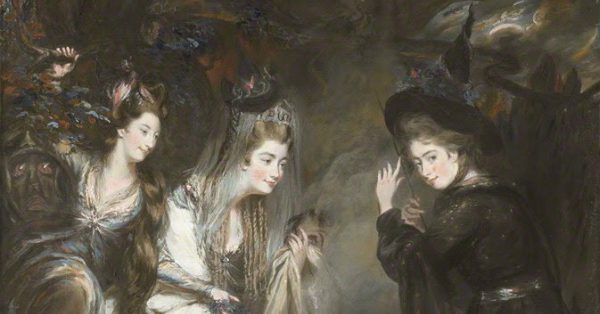
“Witches Round the Cauldron” by Daniel Gardner. From WikiMedia
The moment we begin a relationship with deity and magic inside a ritual circle we are acting as Priestesses and Priests. There is no barrier between a Witch and the powers they serve (and that serve them). Just because one is a Priest or a Priestess though does not mean that they are a “High Priestess” or anything or that their authority extends anywhere beyond the circle they’ve cast. But I have to believe that what we do is about breaking down barriers between mortals and the divine. (This doesn’t of course mean every Priest or Priestess is doing things in a way to achieve maximum efficiency.)
I sympathize with other Wiccans who believe that initiation is a prerequisite to calling ones self Wiccan because that was the way of things for several decades. Wicca was originally an initiation only tradition. If you wanted the rituals and wanted to practice you had to be an initiate. That was the way of things until the 1970’s when the first “101” books complete with rituals began to show up on the shelves.
It should be pointed out that most of those books used the word Witchcraft to define the (Wicca-like) systems they described, most but not all. Raymond Buckland’s The Tree: The Complete Book of Saxon Witchcraft (1974) has the word Wicca literally right on page one, though it’s Wicca with one “c” (something we will get to a bit later). It’s important to remember that the entire point of The Tree was to provide a non-initiatory form of the Craft to interested persons.
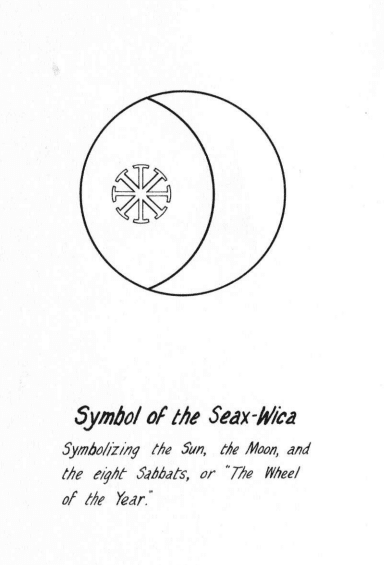 Certainly to be a Gardnerian Witch (or a Witch of any tradition) one must have a valid initiation. No one has ever argued against that position. Even if someone were to have a complete copy of a Gard Book of Shadows (BoS) they still wouldn’t be a Gardnerian because much of the point is lineage. Having a book doesn’t connect you to a family tree, nor does it reveal the oral tradition associated with the tradition.
One of the problems with words is that they evolve over time and their meanings often change. At some point it’s no longer “you are using the word wrong” and it becomes “this is the new definition of the word.” As far as “word evolvement” goes one needs look no further than the word Wicca its self. In Triumph of the Moon Professor Ronald Hutton shares a bit of history surrounding the word Wicca:
“The 1950s were the decade in which Gerald Gardner announced the existence of of his with religion to the world . . . . .In 1954 his book Witchcraft Today gave that religion a generic name of ‘Wica,’ adapted by the 1960s to its enduring form of ‘Wicca,’ . . . The word in in Gardner’s spelling occurs only in Chamber’s Dictionary of of Scots-English, where it means ‘wise’ and this volume may have well been the source for it. The later adaptation resulted from the older and more precise connotation of the Saxon wicca, signifying a male witch (female version wicce).”
In his published works Gardner consistently uses the word Wica and he uses it in a way that’s equivalent to how we use the words “The Wiccans” or “The Witches” today. It’s not the name of a religion, it’s the name of a practitioner. Here’s Gardner’s one use of the word in Wica in Witchcraft Today (1954):
“These Wica generally work for good purposes and help those in trouble to the best of their ability. Of course whatever you do in this world you tread on someone’s toes; if a witch raised a good crop of corn in the old days, people complained she was deflating the prices. I think it unwise to lay down the law without knowing the subject.”
Gardner doubles down on Wica in The Meaning of Witchcraft (1959). In that book he uses the word seventeen times, this is the most famous instance:
“I realised that I had stumbled on something interesting; but I was half-initiated before the word ‘Wica’ which they used hit me like a thunderbolt, and I knew where I was, and that the Old Religion still existed. And so I found myself in the Circle, and there took the usual oath of secrecy, which bound me not to reveal certain things. In this way I made the discovery that the witch cult, that people thought to have been persecuted out of existence, still lived.”
Gardner’s use of Wica in Meaning matches his use of it in Witchcraft Today, it’s not the name of a religion but the name of a religion’s adherents. “Is there a future for the Craft of the Wica?” he writes on page 257 of the version I’m looking at. I’m quoting this because it’s a crystal-clear example of how he uses the word.
Curiously Gardner actually uses the word wicca six times in The Meaning of Witchcraft but it’s all limited to a discussion on word history. Here’s the first instance:
“By this time the Celts in their out-of-the-way dwellings were regaining their prosperity, and the Danish-Saxon lawgivers began making laws against the aboriginal magic they feared. As they had no witches of their own they had no special name for them; however, they made one up from wig, an idol, and laer, learning, wiglaer, which they shortened into wicca.”
So Gardner was clearly aware of a spelling with two c’s, he just chose not to use it.
In the tradition of Gardner I count myself very much among “the Wica” and the only way to be “of the Wica” is to be an initiate. I sometimes feel like I’m taking the easy way out by writing such things, but I also believe it to be true. Also no one’s ever been offended when I’ve said the only way to be of the Wica is to be an initiate of the Wica. It certainly cuts down on hurt feelings and it also retains Gardner’s original use of the term.
The words Wicca and Wiccan became popular during the 1960’s, but probably owe their popularity to one of Gardner’s earliest critics. In 1958 a witch going by the name of Charles Cardell claimed to be Wiccen in an English occult magazine, and soon thereafter declared “war” on Gardner and his initiates. (1) There’s some disagreement over whether or not Cardell’s wiccen was what lead to the word Wicca becoming commonplace. In 1960 a satirical poem by a friend of Gardner’s used the word Wicca in reference to Cardell and his sister Mary:*
‘We feel it is tragick
That those who lack Magick.
Should start a vendetta
With those who know betta
We who practice the Art
Have no wish to take part
Seems a pity the ‘Wicca’
Don’t realise this Quicca.’ (2)
By the early 1960’s the words Wica and Wicca began showing up in increasing frequency in British occult magazines. Melissa Seims sums up that history in her article Wica or Wicca:
Another example of the word ‘Wica’ being used in a defining way can be seen in a 1963 letter sent from Arnold Crowther to Gardner.[9] The letter has the phrase ‘The Wica detective agency’ at the top and is about Crowther’s investigations into a new Witch that had appeared on the publicity scene – Alex Sanders. Such ‘detective’ work was probably partially inspired by the fact that Alex, who started to appear in the media in 1962, initially showed a clear preference for the one ‘c’ spelling. Arnold’s reference to himself as ‘The Wica Detective Agency’ reveals a sense of ownership of the word ‘Wica’.
This same year also sees the following advertisements appearing in Fate Magazine. One was for a ‘Wica Perthshire Circle’. This is almost certainly Monique and Scotty Wilson. Another advert is for ‘Wicca – Dianic and Aradian’ based in Cardiff Wales. Mary Cardell was originally from Wales and Diana is the main Goddess mentioned in the Atho material which appears to have originated with Cardell, so it seems likely that this advertisement is something to do with them.
By the late 1960s a glance through newspaper archives will readily show that the word ‘Wicca’ is increasing in frequency. This isn’t to suggest that Cardell’s Witchcraft was gaining strength but rather that people were becoming more aware of the etymology of the word and had started to assume that Gardner had mis-spelt it in the first instance. Additionally the writings of Doreen Valiente (whose more perspicacious personality generally chose correct etymology over Gardner’s spelling), were also increasing in frequency and I suspect that her use of Wicca served a double purpose. For not only was it etymologically correct, but it also meant that she could aid in reclaiming a word that she considered Cardell as unworthy of using. Other 1960s writings by Justine Glass and June John’s book, King of the Witches, also used ‘Wicca’, with Glass stating that ‘Wiccan’ was the correct plural form of ‘Wicce’. By the end of the 1960s its reclamation was just about complete.
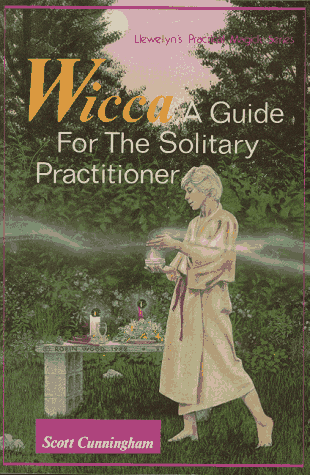 In fifteen years the Wica became Wicca with traditions outside direct linkage to Gardner also using the term. By the middle of the 1970’s people even further removed from Gardner (and even Alex Sanders) began using the term to describe themselves. By the early 1980’s the name was being used in titles of books and in 1989 Llewellyn published Scott Cunningham’s Wicca: A Guide For the Solitary Practitioner forever putting the words Wicca and Wiccan in the hands of anyone who wished to claim them.
Has this all been good for Wicca? That’s up for every individual Witch to decide, but I probably wouldn’t be here without an eclectic path to first wander down. At this point in my life I’m comfortable calling anyone who casts a circle, calls quarters, invokes deity, and celebrates cakes and ale a Wiccan. I know that position is not popular in every circle, but I just don’t feel as if I have the authority to say who is what and who is not what. If someone has eighteen books on their shelf with the word “Wicca” on them and they self-identify that way who am I to stop them? What purpose does that serve? Words get away from us and it’s hard to police their meanings after they do so. Besides no one who self-identifies as a Wiccan and hears “you’re not a Wiccan” from an initiate is likely to change how they view themselves.
*Mary Cardell was not really Charles’s sister but that’s how they introduced themselves to others. The Cardells were odd ducks.
NOTES
1. From The Triumph of the Moon by Ronald Hutton, Oxford University Press, 1999. This is from page 298, but Hutton writes about Cardell for about three pages.
2. Taken from this awesome article (Wica or Wicca) from The Cauldron issue 129 by Melissa Seims.
Previous Post

September 6, 2015
The Blessings of Autumn
Next Post
September 11, 2015 Does Authenticity Matter? (The Necronomicon and Other Magical Books)
Browse Our Archives
Select a Category Editorializing Gateways to Paganism Guest Posts Holiday Histories Led Zeppelin News and Views Occult Pagan Pagan TV Club Paganism polytheism Ramble On Reviews Ritual Strange Days Uncategorized
Select a Month August 2026 March 2026 February 2026 November 2025 September 2025 August 2025 April 2025 August 2024 April 2024 February 2024 December 2023 October 2023 August 2023 June 2023 May 2023 January 2023 October 2022 August 2022 July 2022 June 2022 May 2022 April 2022 March 2022 February 2022 January 2022 December 2021 November 2021 October 2021 September 2021 August 2021 July 2021 June 2021 April 2021 March 2021 February 2021 January 2021 December 2020 November 2020 October 2020 August 2020 July 2020 June 2020 May 2020 April 2020 March 2020 February 2020 January 2020 December 2019 November 2019 October 2019 September 2019 August 2019 July 2019 June 2019 May 2019 April 2019 March 2019 February 2019 January 2019 December 2018 November 2018 October 2018 September 2018 August 2018 July 2018 June 2018 May 2018 April 2018 March 2018 February 2018 January 2018 December 2017 November 2017 October 2017 September 2017 August 2017 July 2017 June 2017 May 2017 April 2017 March 2017 February 2017 January 2017 December 2016 November 2016 October 2016 September 2016 August 2016 July 2016 June 2016 May 2016 April 2016 March 2016 February 2016 January 2016 December 2015 November 2015 October 2015 September 2015 August 2015 July 2015 June 2015 May 2015 April 2015 March 2015 February 2015 January 2015 December 2014 November 2014 October 2014 September 2014 August 2014 July 2014 June 2014 May 2014 April 2014 March 2014 February 2014 January 2014 December 2013 November 2013 October 2013 September 2013 August 2013 July 2013 June 2013 May 2013 April 2013 March 2013 February 2013 January 2013 December 2012 November 2012 October 2012 September 2012 August 2012 July 2012 June 2012 April 2012 October 2011 September 2011 August 2011
Follow Us!
TAKE THE
Religious Wisdom Quiz
What Persian king chose Esther as queen?
Select your answer to see how you score.
Artaxerxes Xerxes (Ahasuerus) Darius Cyrus
Related posts from Raise the Horns

What Makes a Good Ritualist? No Idea

Witchcraft Remembrances & Appreciation at Samhaintide

Raymond Buckland & The Big Blue Book

TRENDING AT PATHEOS Pagan

In "Irreplaceable," our book on vocation and technology, Trevor Sutton and I...

I was strolling through the top floor of the brand new Parthenon...

What Does Gêvâh Mean For Kimberley Guifoyle &...
This week, a lot of the news is focused on Kimberly Guilfoyle....

INNER CIRCLE: Profound Mystery (Of Christ In All...
Ephesians 5:31-32 “For this reason, a man will leave his father and...

Do Not Rejoice When Your Enemy Falls: The...
Turning an execution into a public spectacle is a disturbing expression of...

'The Chosen' S6 Trailer: The Passion Gets Very...
Not many watching 'The Chosen' worry about spoilers, but just because they...
view all Pagan blogs
Ad-Free & Subscriber Log-In Subscription Support
- About Us
- 2026 Calendar
- Videos
- Podcasts
- Library of World Religions
- Faith In Media Tracker
- Advertise With Us
- Write for Us
- Privacy Policy
- Terms of Service
- Do Not Sell My Data
- Contact Us
- Radiant Digital
- Manage Newsletter Subscriptions
- Unsubscribe From Notifications
- Sitemap
Copyright 2008-2026, Patheos. All rights reserved.
Subscription Support Ad-Free & Subscriber Log-In
Follow Patheos