
BuddhistCatholicContemplativeEvangelicalGeneral ChristianHinduJewishLatter-day SaintMuslimNew VisionsProgressive Christian
Beliefs
- Buddhist
- Catholic
- Contemplative
- Evangelical
- General Christian
- Hindu
- Jewish
- Latter-day Saint
- More Voices
- Muslim
- New Visions
- Pagan
- Progressive Christian
Topics
- Religion News
- Food and Religion
- Sports and Religion
- Religious Art
- Religious Music and Entertainment
- Religious Events
- History and Religion
- Style and Religion
- Politics and Religion
- Women in Religion
- Recreation Outdoors and Religion
- Business Finance and Religion
- Careers Workplace and Religion
- Education and Religion
- Family Parenting and Religion
- Health Fitness and Religion
- Home and Religion
- Relationships and Religion
- Technology and Religion
- Travel and Religion
Columnists
- Buddhist Columnists
- Business Finance and Religion Columnists
- Careers Workplace and Religion Columnists
- Catholic Columnists
- Contemplative Columnists
- Education and Religion Columnists
- Evangelists Columnists
- Family Parenting and Religion Columnists
- General Christian Columnists
- Health Fitness and Religion Columnists
- Hindu Columnists
- History and Religion Columnists
- Home and Religion Columnists
- Jewish Columnists
- More Voices Columnists
- Latter Day Columnists
- Muslim Columnists
- New Visions Columnists
- Nonreligious Columnists
- Pagan Columnists
- Politics and Religion Columnists
- Progressive Columnists
- Recreation Outdoors and Religion Columnists
- Relationships and Religion Columnists
- Religion News Columnists
- Religious Art Columnists
- Religious Events Columnists
- Religious Music and Entertainment Columnists
- Sports and Religion Columnists
- Style and Religion Columnists
- Technology and Religion Columnists
- Travel and Religion Columnists
- Women in Religion Columnists
Resource Library
- 2026 Calendar
- Library of World Religions
- The 100 Most Holy Places on Earth
- Patheos Answers
- Podcasts
- Videos
- Faith Leaders Database
- Anglican Episcopalian
- Bahai
- Baptist
- Buddhism
- Christianity
- Confucianism
- Eastern Orthodoxy
- Hinduism
- Holiness and Pentecostal
- ISKCON
- Islam
- Judaism
- Lutheran
- Methodist
- The Church of Jesus Christ of Latter-day Saints
- New Age
- Paganism
- Presbytarian and Reformed
- Protestantism
- Religion Behind the Scenes
- Roman Catholic
- Scientology
- Shia Islam
- Sikhism
- Sufism
- Sunni Islam
- Taoism
- Zen
- See all religions
Research Tools
 Ad-Free & Subscriber Log-In Subscription Support
Ad-Free & Subscriber Log-In Subscription Support
Follow Patheos 

- Trending:
- Forgiveness
- |
- Marriage
- |
- Consciousness
- |
- Death Penalty
- |
- Election
- |
- Halloween

- HOME
- Me and the Blog
- Defining Pagan
- Rituals & Holidays
- All Posts
- Blogroll
- Publications
- FREE NEWSLETTER
- Home
- Pagan
- Uppercase Paganism
Uppercase Paganism
Last updated on: July 1, 2015 at 5:36 pm by Jason Mankey
Uppercase Paganism 2015-07-01T17:36:21-06:00 Jason Mankey
Patheos Explore the world's faith through different perspectives on religion and spirituality! Patheos has the views of the prevalent religions and spiritualities of the world.
My days generally begin with a cup of coffee and a trip to Patheos Pagan. One of my jobs as “channel manager” is scheduling posts for our Facebook feed. If this sounds unglamorous, well it is. The only real upside to it is that I get to read a lot of great stuff while my head gently defogs.
This morning I find myself (very) slightly perplexed by two of my favorite writers here. The first is John Beckett at Under the Ancient Oaks who writes: “Must we always obey the Gods or suffer great calamities?” The second is Molly Khan from Heathen at Heart: “Altars are usually simple, but there is an emphasis on quality, with less-expensive representations of the Gods seen as undesirable.” Can you spot what’s similar about these sentences?
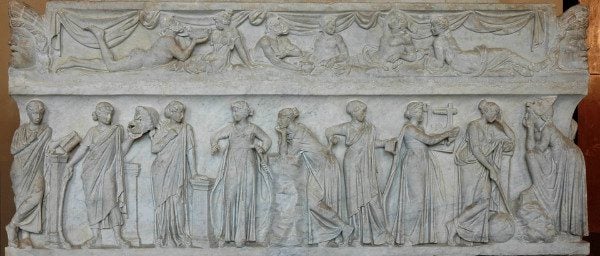
Muses on a Roman sarcophagus, photo by Jastrow, from WikiMedia.
Until this morning I had no idea that it was becoming commonplace in Modern Paganism to capitalize “Gods” when speaking of deities. I guess it looks polite, and I’m certain that it’s meant to honor those gods, but it’s something that just strikes me as a little odd. For me, capitalizing gods would be like capitalizing the word dudes, and I don’t think that’s anywhere we want to go. “Pay your devotions to the Dudes.” Doesn’t that just look wrong?
I realize that not everyone has such a casual relationship with their gods, but for me they can certainly be “the dudes.” I don’t have conversations with them as if they are hipsters at my local watering hole, but we communicate, and it’s generally a very positive and often informal thing. What strikes me as odd about Molly and John’s sentences are that they aren’t even referring to their personal deities, but gods in general.
What to capitalize in Paganism has long been a tricky and confusing subject. I always tend to capitalize the word Pagan when referring to someone who self-identifies that way. Peg Aloi who is an academic and writes here at The Witching Hour does not. Is Witchcraft a religion or a practice? Depends on who you ask, and the definition one chooses has a lot to do with how the word is subsequently written.
What follows are some of the more troublesome words in Modern Paganism and how I approach them. This is not a style guide, and how people approach capitalizing words within Paganism is often a very personal thing. This is just how I do it, and I’m sharing it with all of you simply because it’s on my mind.
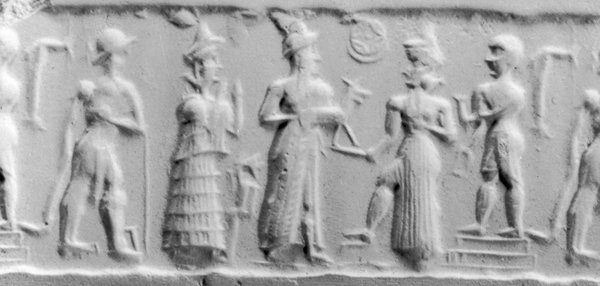
Cylinder Seal with a Deity Accepting an Offering, Mesopotamian. From the Walters Art Museum and WikiMedia.
Pagan and Paganism: These are words I capitalize when they are used as self-identifiers. “My name is Jason and I’m a Pagan and I practice Paganism,” is an example of that. There’s a lot of disagreement on what the word “Pagan” means in 2015 but as long as it’s being used to identify our large and eclectic community it should probably be in uppercase.
When using the word to describe ancient beliefs and practices I use the lowercase p. “The Ancient Greeks practiced paganism,” is an example of this. Since the Greeks would not have referred to their religion as “paganism” I keep it in lowercase. Ancient Europe wasn’t full of paganism back in the day it was full of paganisms, lots of different religions which today are grouped under the word pagan. Nobody would have self-identified that way.
Today though, it’s possible to be a follower of the Greek Gods and identify in a way that calls for the uppercase “p.” If someone describes themselves as a Hellenic Pagan uppercase is the way to go.
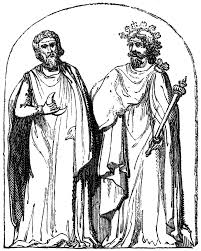 Druid and Druidry: We don’t know a whole lot about the ancient druids, but the word is kind of like a job title. “What do you do for the community?” “Well, I’m a druid.” It’s probably the equivalent of a judge or minister today. As a result of this I don’t capitalize the word when writing about the druids of antiquity. They practiced a Celtic Religion, not a religion called druidry.
Modern Druids are an all together different fish. Because they self-identify as Druids and that identity forms their spiritual selves I capitalize the word. If they describe their faith as Druidry, that also goes in caps. There are also Druid social orders, and since I capitalize Freemason and Masonic I extend that courtesy to the word Druid too.
Witchcraft, Witches, and Wicca: Wicca refers to a religious path and should always be capitalized. The words Wicca and Wiccan have no other context in 2015. Sadly, the easy stops there, and the other two words included in this section are far more problematic.
For many of us the words Wicca and Witchcraft behave like synonyms. The title of Gerald Gardner’s books on Witchcraft were called Witchcraft Today and The Meaning of Witchcraft. He was referring to a religious practice in those titles; in addition, he didn’t even use the word Wicca as we use it today.
This is a big issue to some people because the word witchcraft is also used to signify a practice instead of a spirituality, and there are many out there who see this is as the true meaning of the word. In such a context witchcraft is simply a way to approach magic, and one can be both a religious something and practice witchcraft separately from that. “I’m a Christian who practices witchcraft” is an example.
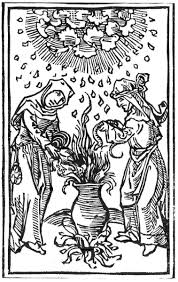
From WikiMedia
Many people who use the identifier Traditional Witchcraft see witchcraft as more of a practice than a religion. However they identify so strongly with the term Traditional Witchcraft that I always capitalize it. In addition many branches of Traditional Witchcraft have strong spiritual components. Robert Cochrane’s Trad Craft contains long odes to deity and is much more a spiritual system than a magical one.
The words witch and witchcraft are often used in a very broad sense as well. Often anyone who practices an indigenous form of folk-magic is labeled a witch. Since witch is an English word and the practitioners themselves wouldn’t identify themselves that way I keep the w lower-case. For me the self-identity thing is always the most important, if one thinks of themself as a Witch then I capitalize the word. If I’m hoisting an identity onto someone else (like a cunning-person who would have identified as, well, a cunning-woman or cunning-man) then I use witch with the lower-case spelling.
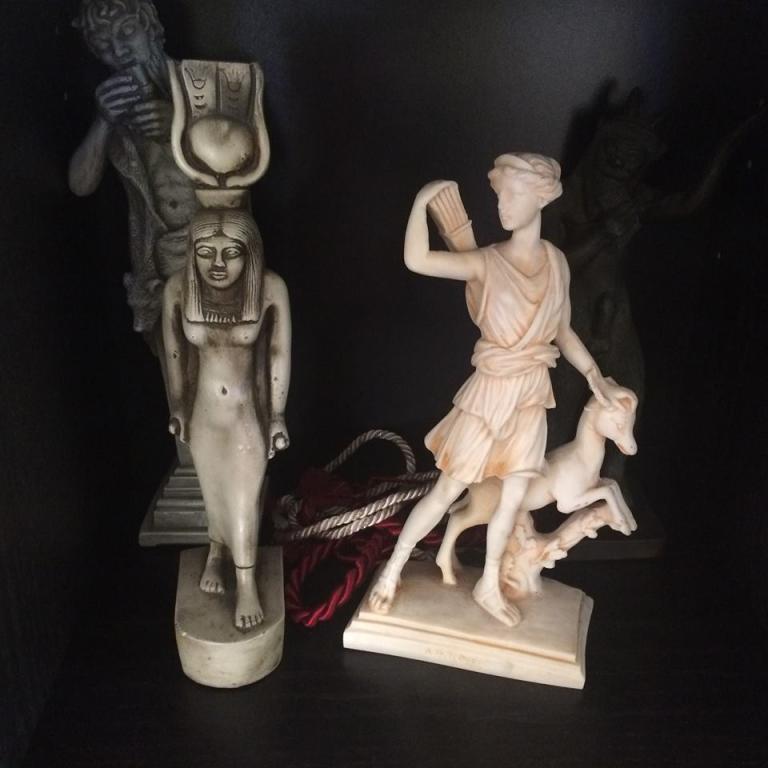 Polytheism and Polytheist: Two years ago this wouldn’t have been an issue but with the rise of the term polytheism as a descriptor for a religious movement it now has to be addressed. If someone’s primary means of self-identification is polytheism, then I will call them a Polytheist with a capital p. But I don’t think most people do that, at least not yet. I think of myself as a polytheist, but my primary means of self-identification is British Traditional Witch. In my case it’s an adjective to describe how I view (my) Wicca, it’s not a general term of self-identification. Many polytheists identify with particular traditions, and in those case I capitalize the tradition and not the descriptor.
Polytheism is quickly becoming an umbrella term for many people who practice polytheism and feel left out of the broader Pagan Community. When Polytheism and Polytheist are being used to identify someone in this community they get the big P. This will probably require more nuance in the future as our community fractures and more people gravitate towards Polytheism as a movement.
Gods, gods, and God: We’ve now come full circle and have returned to the word that started this article. Generally when I’m writing about various deities and using the word gods it remains lowercase. It’s possible that I might choose to capitalize the word gods if I were referring specifically to my gods, something like “these are the Gods of my household,” but even then I think that looks a little funny. To me the word god signifies a “particular type of being,” it’s not an honorific, so it doesn’t get capitalized.
 Lately I’ve tried to avoid the word “gods” while writing because it infers maleness, all while being used to reference dozens of deities representing every aspect of human sexuality. Because of this I’ve gotten into the habit of mostly using deity and/or deities to make sure my meaning is clear. Also using a capital g in gods might infer to the casual reader that one is writing about Yahweh. I don’t want lazy readers to think I’m writing about Yahweh unless I’m specifically writing about Yahweh.
Monotheists often use the word god to signify their one deity. When writing about their god I’ll capitalize the word. For example: “Suzy told me that she worships God.” In such a context it’s rather likely that she’s referring to Jesus’s alleged father. “God” isn’t so much a descriptor as to what their god is as it is a name.
The terms The Goddess and The God are similar. Originally the terms “Goddess and God” were used as placeholder titles for specific deities in oathbound traditions. Eventually they became associated with specific deities in their own right. When The Goddess or The God are being used as the name of a higher power they get capitalized. When I’m referring to goddesses or gods they go back to lowercase, but that’s just me.
I try hard to be consistent with my capitalization because I think the use of lower and uppercase letters signifies specific ideas. Of course, what is here is just how I use them. Your interpretation (or Molly’s or John’s) may be completely different, and that’s just fine.
Previous Post

June 30, 2015
ISIL Executes For "Witchcraft and Sorcery"
Next Post
July 2, 2015 Paganism, the 60's, and the Grateful Dead
Browse Our Archives
Select a Category Editorializing Gateways to Paganism Guest Posts Holiday Histories Led Zeppelin News and Views Occult Pagan Pagan TV Club Paganism polytheism Ramble On Reviews Ritual Strange Days Uncategorized
Select a Month August 2026 March 2026 February 2026 November 2025 September 2025 August 2025 April 2025 August 2024 April 2024 February 2024 December 2023 October 2023 August 2023 June 2023 May 2023 January 2023 October 2022 August 2022 July 2022 June 2022 May 2022 April 2022 March 2022 February 2022 January 2022 December 2021 November 2021 October 2021 September 2021 August 2021 July 2021 June 2021 April 2021 March 2021 February 2021 January 2021 December 2020 November 2020 October 2020 August 2020 July 2020 June 2020 May 2020 April 2020 March 2020 February 2020 January 2020 December 2019 November 2019 October 2019 September 2019 August 2019 July 2019 June 2019 May 2019 April 2019 March 2019 February 2019 January 2019 December 2018 November 2018 October 2018 September 2018 August 2018 July 2018 June 2018 May 2018 April 2018 March 2018 February 2018 January 2018 December 2017 November 2017 October 2017 September 2017 August 2017 July 2017 June 2017 May 2017 April 2017 March 2017 February 2017 January 2017 December 2016 November 2016 October 2016 September 2016 August 2016 July 2016 June 2016 May 2016 April 2016 March 2016 February 2016 January 2016 December 2015 November 2015 October 2015 September 2015 August 2015 July 2015 June 2015 May 2015 April 2015 March 2015 February 2015 January 2015 December 2014 November 2014 October 2014 September 2014 August 2014 July 2014 June 2014 May 2014 April 2014 March 2014 February 2014 January 2014 December 2013 November 2013 October 2013 September 2013 August 2013 July 2013 June 2013 May 2013 April 2013 March 2013 February 2013 January 2013 December 2012 November 2012 October 2012 September 2012 August 2012 July 2012 June 2012 April 2012 October 2011 September 2011 August 2011
Follow Us!
TAKE THE
Religious Wisdom Quiz
What is the correct sequence of the fruit of the Spirit as listed in Galatians?
Select your answer to see how you score.
Love, peace, joy, kindness, forbearance, faithfulness, goodness, self-control, gentleness Love, joy, peace, forbearance, kindness, goodness, faithfulness, gentleness, self-control Love, joy, peace, kindness, goodness, forbearance, faithfulness, self-control, gentleness Joy, love, peace, goodness, kindness, faithfulness, forbearance, gentleness, self-control
Related posts from Raise the Horns

What Makes a Good Ritualist? No Idea

Witchcraft Remembrances & Appreciation at Samhaintide

Raymond Buckland & The Big Blue Book

TRENDING AT PATHEOS Pagan

I was strolling through the top floor of the brand new Parthenon...

What Does Gêvâh Mean For Kimberley Guifoyle &...
This week, a lot of the news is focused on Kimberly Guilfoyle....

INNER CIRCLE: Profound Mystery (Of Christ In All...
Ephesians 5:31-32 “For this reason, a man will leave his father and...

Do Not Rejoice When Your Enemy Falls: The...
Turning an execution into a public spectacle is a disturbing expression of...

'The Chosen' S6 Trailer: The Passion Gets Very...
Not many watching 'The Chosen' worry about spoilers, but just because they...

The purpose-driven labor priest
A labor activist reads Rick Warren and it gets me wondering about...
view all Pagan blogs
Ad-Free & Subscriber Log-In Subscription Support
- About Us
- 2026 Calendar
- Videos
- Podcasts
- Library of World Religions
- Faith In Media Tracker
- Advertise With Us
- Write for Us
- Privacy Policy
- Terms of Service
- Do Not Sell My Data
- Contact Us
- Radiant Digital
- Manage Newsletter Subscriptions
- Unsubscribe From Notifications
- Sitemap
Copyright 2008-2026, Patheos. All rights reserved.
Subscription Support Ad-Free & Subscriber Log-In
Follow Patheos