
BuddhistCatholicContemplativeEvangelicalGeneral ChristianHinduJewishLatter-day SaintMuslimNew VisionsProgressive Christian
Beliefs
- Buddhist
- Catholic
- Contemplative
- Evangelical
- General Christian
- Hindu
- Jewish
- Latter-day Saint
- More Voices
- Muslim
- New Visions
- Pagan
- Progressive Christian
Topics
- Religion News
- Food and Religion
- Sports and Religion
- Religious Art
- Religious Music and Entertainment
- Religious Events
- History and Religion
- Style and Religion
- Politics and Religion
- Women in Religion
- Recreation Outdoors and Religion
- Business Finance and Religion
- Careers Workplace and Religion
- Education and Religion
- Family Parenting and Religion
- Health Fitness and Religion
- Home and Religion
- Relationships and Religion
- Technology and Religion
- Travel and Religion
Columnists
- Buddhist Columnists
- Business Finance and Religion Columnists
- Careers Workplace and Religion Columnists
- Catholic Columnists
- Contemplative Columnists
- Education and Religion Columnists
- Evangelists Columnists
- Family Parenting and Religion Columnists
- General Christian Columnists
- Health Fitness and Religion Columnists
- Hindu Columnists
- History and Religion Columnists
- Home and Religion Columnists
- Jewish Columnists
- More Voices Columnists
- Latter Day Columnists
- Muslim Columnists
- New Visions Columnists
- Nonreligious Columnists
- Pagan Columnists
- Politics and Religion Columnists
- Progressive Columnists
- Recreation Outdoors and Religion Columnists
- Relationships and Religion Columnists
- Religion News Columnists
- Religious Art Columnists
- Religious Events Columnists
- Religious Music and Entertainment Columnists
- Sports and Religion Columnists
- Style and Religion Columnists
- Technology and Religion Columnists
- Travel and Religion Columnists
- Women in Religion Columnists
Resource Library
- 2026 Calendar
- Library of World Religions
- The 100 Most Holy Places on Earth
- Patheos Answers
- Podcasts
- Videos
- Faith Leaders Database
- Anglican Episcopalian
- Bahai
- Baptist
- Buddhism
- Christianity
- Confucianism
- Eastern Orthodoxy
- Hinduism
- Holiness and Pentecostal
- ISKCON
- Islam
- Judaism
- Lutheran
- Methodist
- The Church of Jesus Christ of Latter-day Saints
- New Age
- Paganism
- Presbytarian and Reformed
- Protestantism
- Religion Behind the Scenes
- Roman Catholic
- Scientology
- Shia Islam
- Sikhism
- Sufism
- Sunni Islam
- Taoism
- Zen
- See all religions
Research Tools
 Ad-Free & Subscriber Log-In Subscription Support
Ad-Free & Subscriber Log-In Subscription Support
Follow Patheos 

- Trending:
- Forgiveness
- |
- Marriage
- |
- Consciousness
- |
- Death Penalty
- |
- Election
- |
- Halloween

- HOME
- Me and the Blog
- Defining Pagan
- Rituals & Holidays
- All Posts
- Blogroll
- Publications
- FREE NEWSLETTER
- Home
- Pagan
- Lughnassa/Lammas: What’s In a Name (or Date)?
Lughnassa/Lammas: What’s In a Name (or Date)?
Last updated on: July 25, 2017 at 9:54 am by Jason Mankey
Lughnassa/Lammas: What’s In a Name (or Date)? 2017-07-25T09:54:32-06:00 Jason Mankey
Patheos Explore the world's faith through different perspectives on religion and spirituality! Patheos has the views of the prevalent religions and spiritualities of the world.
One of these sabbats is not like the other ones, one of these sabbats just isn’t the same-Traditional Children’s Folk Song
Oh great, it’s Lughnassa this weekend! Did I fake enough enthusiasm there? I try so hard every year to get excited about early August/late July and I tend to fail. It’s cool to see pumpkins growing in my backyard and tonight I’m going to go harvest some corn, but I have trouble getting excited about it all. Usually I just want August to be over with so I can get to fall and football and sabbats I actually love like Samhain, Yule, and even Mabon Halig (I’m trying to make that a thing).
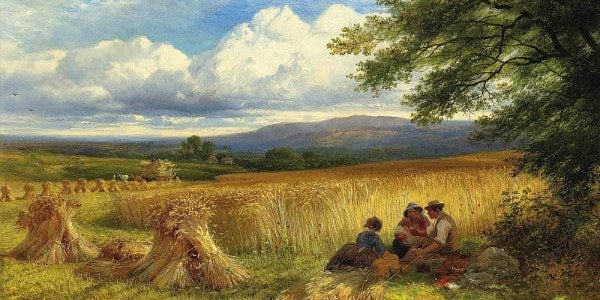
“Harvest Rest” by George Cole, from WikiMedia Commons.
Lammas is sort of the ugly-duckling of sabbats. Out of the Big Four (Samhain, Imbolc, and Beltane being the other three) it sits alone without a major Christian or cultural holiday beside it. For some that’s a reason to rejoice, but in some ways it makes the holiday seem a bit smaller. It’s easy to get revved up for something when everyone else around you (often regardless of religious tradition) is doing the same. It’s certainly possible to link county fairs with the original purpose of Lammas, but those can occur nearly anytime in late Summer/early Fall. They also just don’t feel like a holiday in the way that Christmas or Halloween do.
It’s also the only cross-quarter sabbat regularly called by two different names and spelled about eight different ways. Maybe that’s a small thing to some, but it’s a big thing to me. (Will people be offended if I use Lammas in this ritual invitation?) There’s even some disagreement on the holiday’s date, making it all the more different.
I know for some of you that it’s your absolute favorite sabbat, and I think that’s grand. But every year when I survey the Pagan landscape it tends to be Lughnasadh that falls through the cracks.
What’s In a Name?
Lammas? Lughnassa? Lughnasadh? First Fruits? What do you call this time of year? The four greater sabbats all have rather agreed upon names with this one exception. It’s true that many early Witches preferred the Christian names for some of those holidays, but that seems to be rare these days. Samhain is Samhain not All Hallow’s and while some people might spell Imbolc with a “g” (Imbolg) or Beltane as Bealtaine it’s pretty obvious that we are all talking about the same holiday. Lammas is strange because it has two very different sounding names, and a third one that just never quite caught on.*
Lughnassa and its variants (Lugnasa, Lughnasa, and Lughnasadh, with the latter often pronounced differently too) is obviously connected to the god Lugh, but may also be connected to a word. Over the last 100 years various words have been proposed as being connected to Lugh, the problem being that many of them have differing definitions. In the 19th Century it was common to link Lugh with the word luk which means “bright” or “shining,” a linkage that often resulted in Lugh being worshipped as a sun god. Lugh has also been connected to the words lug (raven), leu (dark place), and lou (an oath or vow), notice how those are all very different things. (1) If Lughnassa is named after Lugh it’s the only sabbat with a specific deity in its name (there is a god named Bel, but that’s most likely not related to Beltane). Lughnassa was a real enough holiday in Celtic-Ireland and most likely related to the harvest, but it’s hard to say with any absolute certainty.
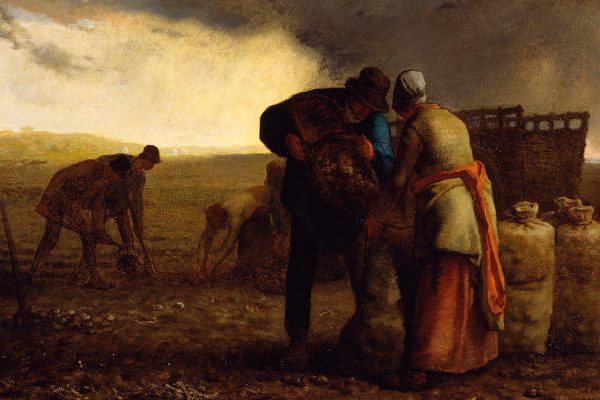
“The Potato Harvest” by Jean Francois Millet. From WikiMedia.
For years I’ve always assumed that Lammas (“loaf mass”) was a Christianized version of Lughnassa, today I’m not so sure. Lammas might be Anglo-Saxon in origin, or perhaps it’s an Anglo-Saxon appropriation of Lughnassa. In medieval times Lammas was sometimes called the Gule of August, which might mean the “Yule of August.” A more logical explanation is that gule is an Anglicized version of the Welsh word gwyl, which translates as feast. (2) The Welsh did celebrate their own Gwyl Aust at the start of August, so that would make sense. I think it’s probable that all three holidays are in some way related. If your neighbors were all having a big party wouldn’t you want to play along?
So which one’s right? Probably depends on how close you feel to the Celts of Ireland. I’ve always been a fan of Lammas, but that might be just because it’s easier to spell. Either one seems better to me than Bron Trogain which is yet another name for the holiday (appearing in the Tochmarc Emire or “The Wooing of Emer”). Bron translates as wrath, I don’t know what Trogain means, and I’m not sure I want to. I prefer to leave wrath out of my sabbats.
What’s In a Date?
I’ve always celebrated Lammas on August 2, but I’ve seen other dates for the sabbat over the years. In Janet and Stewart Farrar’s A Witches’ Bible Lughnasadh is celebrated on July 31. In the book Essential Wicca August 1 is given as the date, and that’s the same as in Scott Cunningham’s Wicca: A Guide For the Solitary Practitioner. Both of my Witch calendars (The GBG Year & A Day and Llewellyn’s Witches’ Calendar) list August 1 too. The strangest date I’ve found yet is in Silver Ravenwolf’s To Ride a Silver Broomstick:
“Lammas is celebrated on August 2nd, where Lughnassadh, a Celtic festival in honor of the Sun God, is held on the 7th.” –Broomstick page 36.
Does it matter what day one celebrates a sabbat? Not in the slightest. One days is as good as any other as long as it means something to those doing the celebrating. But why so many different dates?
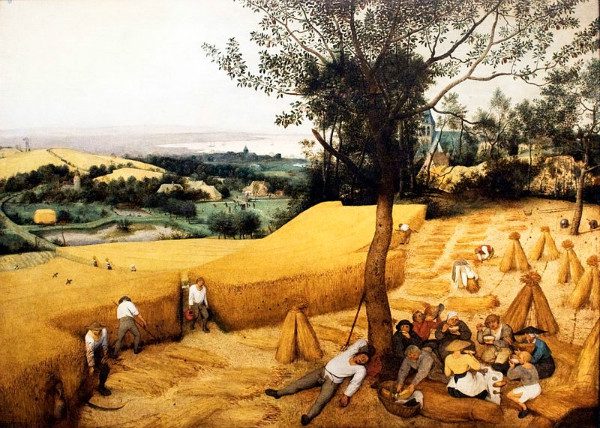
“The Corn Harvest” by Pieter Bruegel the Elder, from WikiMedia.
A lot of it has to do with the confusion that occurs when a culture begins their new day at sunset. That becomes near impossible to translate correctly when your own day begins at midnight. So the Lughnassa of old began on the evening of July 31 and then ended at sunset on August 1.
The popularity of the August 2 in some Pagan circles is probably due to the influence of Robert Graves and his book The White Goddess. Graves gives Lammas an August 2 date, and while many Pagans have not read The White Goddess, it’s influence on Pagandom as a whole has been ongoing for over almost 70 years now. (I was pretty sure it wasn’t all because of Silver Ravenwolf.)
So Lammas/Lughnassa is kind of different, but when you stop to think about it, all the sabbats are different in their own way. And that’s what makes them such important markers on the Wheel of the Year. Have a blessed sabbat, no matter what you call it or what day you celebrate.
1. Pagan Britain by Ronald Hutton Yale University Press, page 365.
2. See Ronald Hutton’s Stations of the Sun, Oxford University Press, 1996. page 330. What he has to say about Lammas/Lughnassa only takes up about four pages because there’s just not very much there.
*An earlier version of this article translated Lugh as “bright or shining,” adjustments have been made.
Previous Post
July 26, 2015
American Paganisms: Feraferia
Next Post
August 3, 2015 One Does Not Simply Boycott a Sabbat
Browse Our Archives
Select a Category Editorializing Gateways to Paganism Guest Posts Holiday Histories Led Zeppelin News and Views Occult Pagan Pagan TV Club Paganism polytheism Ramble On Reviews Ritual Strange Days Uncategorized
Select a Month August 2026 March 2026 February 2026 November 2025 September 2025 August 2025 April 2025 August 2024 April 2024 February 2024 December 2023 October 2023 August 2023 June 2023 May 2023 January 2023 October 2022 August 2022 July 2022 June 2022 May 2022 April 2022 March 2022 February 2022 January 2022 December 2021 November 2021 October 2021 September 2021 August 2021 July 2021 June 2021 April 2021 March 2021 February 2021 January 2021 December 2020 November 2020 October 2020 August 2020 July 2020 June 2020 May 2020 April 2020 March 2020 February 2020 January 2020 December 2019 November 2019 October 2019 September 2019 August 2019 July 2019 June 2019 May 2019 April 2019 March 2019 February 2019 January 2019 December 2018 November 2018 October 2018 September 2018 August 2018 July 2018 June 2018 May 2018 April 2018 March 2018 February 2018 January 2018 December 2017 November 2017 October 2017 September 2017 August 2017 July 2017 June 2017 May 2017 April 2017 March 2017 February 2017 January 2017 December 2016 November 2016 October 2016 September 2016 August 2016 July 2016 June 2016 May 2016 April 2016 March 2016 February 2016 January 2016 December 2015 November 2015 October 2015 September 2015 August 2015 July 2015 June 2015 May 2015 April 2015 March 2015 February 2015 January 2015 December 2014 November 2014 October 2014 September 2014 August 2014 July 2014 June 2014 May 2014 April 2014 March 2014 February 2014 January 2014 December 2013 November 2013 October 2013 September 2013 August 2013 July 2013 June 2013 May 2013 April 2013 March 2013 February 2013 January 2013 December 2012 November 2012 October 2012 September 2012 August 2012 July 2012 June 2012 April 2012 October 2011 September 2011 August 2011
Follow Us!
TAKE THE
Religious Wisdom Quiz
What did Job’s wife tell him to do after his suffering began?
Select your answer to see how you score.
Curse God and die Offer a sacrifice for healing Go to the priests for help Leave the city and start over
Related posts from Raise the Horns

Mabon: The Most Pressing Issue of Our Time
Why No One Loves Lammas (& Lughnasadh)
Your Favorite Sabbats (Or Sabbats By the Numbers)
TRENDING AT PATHEOS Pagan

In one sense walking into Westminster Abbey is like walking down the...

'Super Scam Me' Exposes AI Jon Bon Jovi...
Leslie Pickett believed she was in a relationship with Jon Bon Jovi....

The Brazilian Remake of Kendricks' 'Flywheel' Opens in...
“Flywheel,” the story that launched the Kendrick Brothers’ filmmaking career is getting...

The Dangers of Gradual Accommodation (Winking at Sin)
Recently, the “law of gradualness” resurfaced during the opening of a weeklong,...

The Iron Gates and the Lion of the...
Yesterday, I didn't finish my report about, well, yesterday. So I'll...

The Image: On the Horror of Capitalism and...
The Image Then went the Pharisees, and took counsel how they might...
view all Pagan blogs
Ad-Free & Subscriber Log-In Subscription Support
- About Us
- 2026 Calendar
- Videos
- Podcasts
- Library of World Religions
- Faith In Media Tracker
- Advertise With Us
- Write for Us
- Privacy Policy
- Terms of Service
- Do Not Sell My Data
- Contact Us
- Radiant Digital
- Manage Newsletter Subscriptions
- Unsubscribe From Notifications
- Sitemap
Copyright 2008-2026, Patheos. All rights reserved.
Subscription Support Ad-Free & Subscriber Log-In
Follow Patheos