
BuddhistCatholicContemplativeEvangelicalGeneral ChristianHinduJewishLatter-day SaintMuslimNew VisionsProgressive Christian
Beliefs
- Buddhist
- Catholic
- Contemplative
- Evangelical
- General Christian
- Hindu
- Jewish
- Latter-day Saint
- More Voices
- Muslim
- New Visions
- Pagan
- Progressive Christian
Topics
- Religion News
- Food and Religion
- Sports and Religion
- Religious Art
- Religious Music and Entertainment
- Religious Events
- History and Religion
- Style and Religion
- Politics and Religion
- Women in Religion
- Recreation Outdoors and Religion
- Business Finance and Religion
- Careers Workplace and Religion
- Education and Religion
- Family Parenting and Religion
- Health Fitness and Religion
- Home and Religion
- Relationships and Religion
- Technology and Religion
- Travel and Religion
Columnists
- Buddhist Columnists
- Business Finance and Religion Columnists
- Careers Workplace and Religion Columnists
- Catholic Columnists
- Contemplative Columnists
- Education and Religion Columnists
- Evangelists Columnists
- Family Parenting and Religion Columnists
- General Christian Columnists
- Health Fitness and Religion Columnists
- Hindu Columnists
- History and Religion Columnists
- Home and Religion Columnists
- Jewish Columnists
- More Voices Columnists
- Latter Day Columnists
- Muslim Columnists
- New Visions Columnists
- Nonreligious Columnists
- Pagan Columnists
- Politics and Religion Columnists
- Progressive Columnists
- Recreation Outdoors and Religion Columnists
- Relationships and Religion Columnists
- Religion News Columnists
- Religious Art Columnists
- Religious Events Columnists
- Religious Music and Entertainment Columnists
- Sports and Religion Columnists
- Style and Religion Columnists
- Technology and Religion Columnists
- Travel and Religion Columnists
- Women in Religion Columnists
Resource Library
- 2026 Calendar
- Library of World Religions
- The 100 Most Holy Places on Earth
- Patheos Answers
- Podcasts
- Videos
- Faith Leaders Database
- Anglican Episcopalian
- Bahai
- Baptist
- Buddhism
- Christianity
- Confucianism
- Eastern Orthodoxy
- Hinduism
- Holiness and Pentecostal
- ISKCON
- Islam
- Judaism
- Lutheran
- Methodist
- The Church of Jesus Christ of Latter-day Saints
- New Age
- Paganism
- Presbytarian and Reformed
- Protestantism
- Religion Behind the Scenes
- Roman Catholic
- Scientology
- Shia Islam
- Sikhism
- Sufism
- Sunni Islam
- Taoism
- Zen
- See all religions
Research Tools
 Ad-Free & Subscriber Log-In Subscription Support
Ad-Free & Subscriber Log-In Subscription Support
Follow Patheos 

- Trending:
- Forgiveness
- |
- Marriage
- |
- Consciousness
- |
- Death Penalty
- |
- Election
- |
- Halloween

- HOME
- Me and the Blog
- Defining Pagan
- Rituals & Holidays
- All Posts
- Blogroll
- Publications
- FREE NEWSLETTER
- Home
- Pagan
- 7 Ways to Celebrate the Summer Solstice
7 Ways to Celebrate the Summer Solstice
Last updated on: June 15, 2020 at 2:36 pm by Jason Mankey
7 Ways to Celebrate the Summer Solstice 2020-06-15T14:36:48-06:00 Jason Mankey
Patheos Explore the world's faith through different perspectives on religion and spirituality! Patheos has the views of the prevalent religions and spiritualities of the world.
I’ve never been particularly good at celebrating the Summer Solstice. Some of that is related to travel and festivals and sometimes practical considerations get in the way. Ritual space in Northern California is hard to come by, especially private outdoor ritual space. My coven generally meets indoors, which is great at Samhain, not so great at Midsummer.
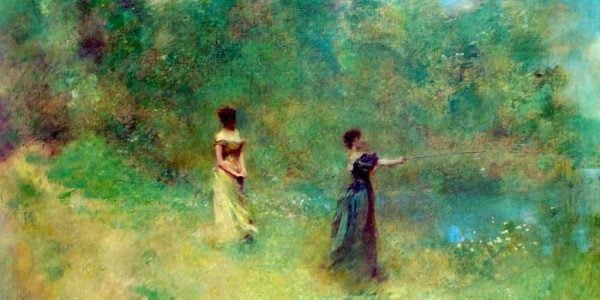
Thomas Wiler Dewing-“Summer” (1890). From WikiMedia Commons.
While I tend to have difficulty finding a two hour block of time (or the motivation) to really celebrate the sabbat, Midsummer its self is full of lore and ritual ideas. Some of these are rather new, some old, and some in the middle, but they all work towards the end of June. There’s lots of stuff associated with all eight sabbats, but Midsummer is a treasure trove of riches. Here are a few of my favorite ritual ideas this time of year.
More Midsummer at Raise the Horns:
Midsummer Ritual 2014
Names of the Summer Solstice (And Why I Don’t Call it Litha)
The Ancient Nature of Midsummer
Solar Wheel
It’s not surprising that our ancestors venerated the sun in a variety of forms what’s often surprising is how they did so and how widespread it was. The solar wheel is an extremely ancient representation of the sun and one that was honored on the Summer Solstice right up through the Nineteenth Century.
In many parts of Europe large wheels were stuffed full of hay, set on fire, and rolled down hills to celebrate the solstice. If you’ve got a lot of space for ritual, a powerful hose (just in case), and a hill I’m going to envy your Midsummer ritual. We used solar wheels for our Midsummer rite last year but in a much different way:
“Wheels were made and then lit on fire and hurled down mountains and hills. If the wheel made it to the end of its journey without falling down the harvest was guaranteed to be a good and strong one. The wheel falling was a bad omen, but as luck would have it, that happened only rarely. Tonight we won’t release a wheel down a hill, but we will make our own Sun Wheels and then light them on fire. We will put all that’s negative and destructive in our lives into our wheels and then light them on fire, releasing that negativity from our lives. Nothing positive and bright can live in the cleansing fires of Midsummer!”
We made our wheels out of grapevine and then threw them in the fire-pit in our backyard. You can also make a simple representation of a solar wheel by cutting a circle out of paper or cardboard and then sitting four candles on it arranged like the direction markers on a compass. Even if this is your only solar wheel it’s still a great way to link your Midsummer to those of our ancestors.
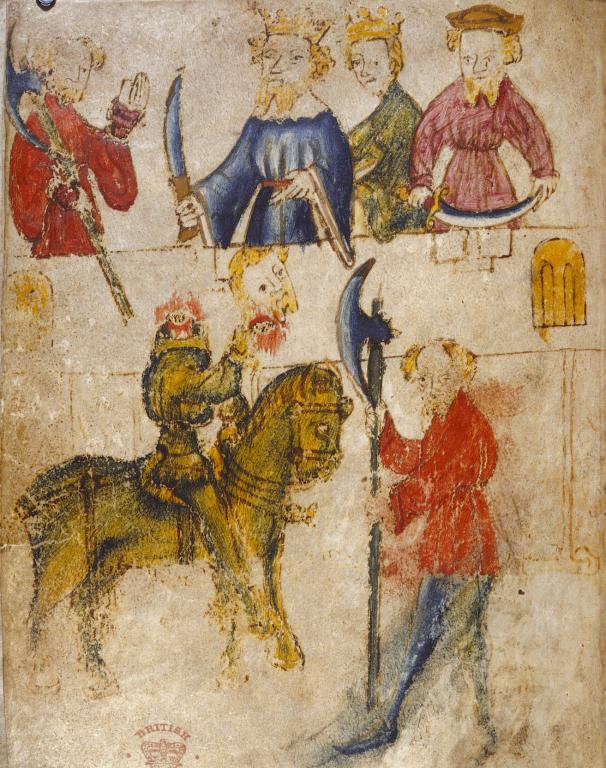
Gawain & The Green Knight, From WikiMedia Commons.
Oak King/Holly King
The Oak King/Holly King myth in its current form is a rather recent construct (dating back to Robert Graves’ The White Goddess in 1948) but it’s powerful, and beloved by many Pagans. One of my all time favorite Midsummer rituals featured two of my friends battling as the Kings of Waxing and Waning. In our tale the Oak King mortally wounds the Holly King but does not kill him, instead that task falls to the Goddess who knows that for the Wheel to turn the Holly King must die. This was all quite dramatic and it still resonates with me today. Word of warning though, an epic sword fight takes some practice; dramatic confrontations involving steel should not be entered into lightly.
The only real downside to an Oak King/Holly King Midsummer is that it can be kind of a downer. It’s not always the most uplifting story. I did have a friend enact a version of this timeless tale with wands (a la Harry Potter) and invisible, mystical energies. That made it more fun, and it required less practice.
Fairy Folk
From my earliest days as a Pagan I’ve associated Midsummer with the Fey (or Fairy Folk), and this is keeping with the holiday’s ancient origins. Of course two thousand years ago when people celebrated Midsummer and mentioned the Fey they usually did so with fear in their voices. Giant bonfires were lit to keep the bad spirits away. Today we tend to view our interactions with the Fey a little more positively, but a little caution is always advisable.
One of my favorite pieces of Fairy lore is specifically related to the summer solstice. It’s said that if one walks around a fairy mound three times on the night of Midsummer and then stops to knock there they will be whisked away to the world of the Fey. Instead of attempting to travel to the world of Fairy I use Midsummer to honor them. We leave them gifts at the Fairy Tree in our backyard and have even dared to ask them to bless some ritual items for us (all while leaving other things in exchange). We also keep looking for just the right Fairy House to put back there, maybe one of these Midsummers.
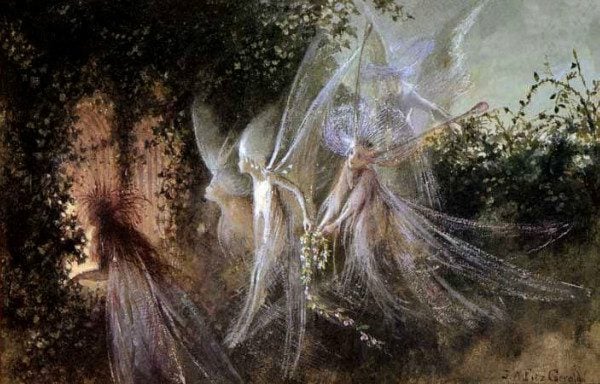
“Fairy Passage” by John Anster Fitzgerald from WikiMedia Commons.
Shakespeare and Puck
One of the first big Midsummer rituals I was ever a part of revolved around Shakespeare’s* A Midsummer Night’s Dream. I have very fond memories of playing Puck during this ritual, with poetry from the play weaving in and out of our regularly scheduled Wiccan ritual. Looking back on my notes from that night I don’t think our ritual was nearly as good as I remember it being but the adventures of Puck, Titania, and Oberon are still worth ritualing around.
Thou speak’st aright;
I am that merry wanderer of the night.
I jest to Oberon and make him smile
When I a fat and bean-fed horse beguile,
Neighing in likeness of a filly foal:
And sometime lurk I in a gossip’s bowl,
In very likeness of a roasted crab,
And when she drinks, against her lips I bob
And on her wither’d dewlap pour the ale.
The wisest aunt, telling the saddest tale,
Sometime for three-foot stool mistaketh me;
Then slip I from her bum, down topples she,
And “tailor” cries, and falls into a cough;
And then the whole quire hold their hips and laugh,
And waxen in their mirth and neeze and swear
A merrier hour was never wasted there.
But, room, fairy! here comes Oberon.
How could you NOT want to find a place for that at Midsummer? Even better are Puck’s closing remarks:
If we shadows have offended,
Think but this, and all is mended,
That you have but slumber’d here
While these visions did appear.
And this weak and idle theme,
No more yielding but a dream,
Gentles, do not reprehend:
if you pardon, we will mend:
And, as I am an honest Puck,
If we have unearned luck
Now to ‘scape the serpent’s tongue,
We will make amends ere long;
Else the Puck a liar call;
So, good night unto you all.
Give me your hands, if we be friends,
And Robin shall restore amends.
Building a ritual around all of this isn’t easy, but totally worth it!
King Arthur and Other “Sun Gods”
I don’t really think King Arthur began his mythological career as a sun deity, but I remember stumbling across that idea in Dan and Pauline Campanelli’s** Wheel of the Year book. I ended up building a ritual around the story of Arthur, connecting the major events of his life to certain times of the day (per Pauline’s suggestion I believe). It wasn’t the best ritual I’ve ever written, but it was interesting and different.
If the multiplex is any indication, Summer is a time for blockbusters and what could be more of a blockbuster than the life of a figure like Arthur or perhaps Robin Hood? I’m not always a huge fan of sacred drama during ritual but it seems appropriate at Midsummer. There’s a leisurely vibe to the day that sort of lends its self to sitting and watching, or even storytelling. Perhaps the place for some of these yarns is at the campfire post-ritual?
“The Judgement of Paris” by Enrique Simonet, from WikiMedia Commons.
Crops in the Field=fun
I’m guessing that the ancients who followed a Spring-Fall agricultural calendar (like the Celtic-Irish) looked upon Midsummer as a period of a little less work. The crops were in the field, but not yet ready to be gathered, providing some welcome down time. Sure there would have still been work, but conceivably people could have at least taken a day or two off.
So instead of worrying about what to do at Midsummer, it might be best just to celebrate what’s already been done. Things have been planted and now we just watch them grow. The seeds we put into the ground at Beltane are now alive and stirring in the wind, instead of asking for anything else, why not honor that? Take stock and look at what’s good in your life right now and put off worrying about tomorrow for at least a few hours.
Bonfires and Smoke
Ancient holidays were often celebrated as fire festivals and Midsummer was no exception. Instead of working on a ritual I’m sure a lot of people just sat around large bonfires, content to keep malevolent spirits at bay and to celebrate what they had. There’s no shame in just dancing around a fire to celebrate Midsummer, especially if you are stuck with relatives. (I can’t think of anything more Pagan really than dancing around a fire.)
In addition to fire the ancients often used smoke to purify and bless things. We made this a part of our Midsummer Ritual last year:
“For centuries people have blessed their crops and livestock with smoke. Lit torches were run through the fields, the purifying heat and smoke ensuring the crops against blight, and the people against hunger. Tonight we cleanse ourselves with the sacred smoke, blessed by the Fey, to keep us safe from harm this Summer and Autumn. As the sage-smoke surrounds you feel it cleansing you, but also protecting you, forming a shield around you. As you breathe the smoke inside your lungs let its scent fill you up inside. Feel the magic of the others, feel the protective power of the smoke, and in your mind’s eye use this opportunity to connect with those Pagans and Witches who came before us.”
However you choose to celebrate Midsummer I hope your rites are filled with sunshine and wonder!
*Or if you prefer, Edward de Vere. I’m a pretty ardent Oxforidan.
**Much of the history in Wheel of the Year is pretty bad today, but I still treasure this book. The art, the ideas, the closeness to the Earth I felt while reading it . . . . find a place for this in your library.
Previous Post
June 12, 2015
Not Fakelore: The Burning Times
Next Post

June 18, 2015 Etsy Bans Spellwork?
Browse Our Archives
Select a Category Editorializing Gateways to Paganism Guest Posts Holiday Histories Led Zeppelin News and Views Occult Pagan Pagan TV Club Paganism polytheism Ramble On Reviews Ritual Strange Days Uncategorized
Select a Month August 2026 March 2026 February 2026 November 2025 September 2025 August 2025 April 2025 August 2024 April 2024 February 2024 December 2023 October 2023 August 2023 June 2023 May 2023 January 2023 October 2022 August 2022 July 2022 June 2022 May 2022 April 2022 March 2022 February 2022 January 2022 December 2021 November 2021 October 2021 September 2021 August 2021 July 2021 June 2021 April 2021 March 2021 February 2021 January 2021 December 2020 November 2020 October 2020 August 2020 July 2020 June 2020 May 2020 April 2020 March 2020 February 2020 January 2020 December 2019 November 2019 October 2019 September 2019 August 2019 July 2019 June 2019 May 2019 April 2019 March 2019 February 2019 January 2019 December 2018 November 2018 October 2018 September 2018 August 2018 July 2018 June 2018 May 2018 April 2018 March 2018 February 2018 January 2018 December 2017 November 2017 October 2017 September 2017 August 2017 July 2017 June 2017 May 2017 April 2017 March 2017 February 2017 January 2017 December 2016 November 2016 October 2016 September 2016 August 2016 July 2016 June 2016 May 2016 April 2016 March 2016 February 2016 January 2016 December 2015 November 2015 October 2015 September 2015 August 2015 July 2015 June 2015 May 2015 April 2015 March 2015 February 2015 January 2015 December 2014 November 2014 October 2014 September 2014 August 2014 July 2014 June 2014 May 2014 April 2014 March 2014 February 2014 January 2014 December 2013 November 2013 October 2013 September 2013 August 2013 July 2013 June 2013 May 2013 April 2013 March 2013 February 2013 January 2013 December 2012 November 2012 October 2012 September 2012 August 2012 July 2012 June 2012 April 2012 October 2011 September 2011 August 2011
Follow Us!
TAKE THE
Religious Wisdom Quiz
Who cried out, "My God, my God, why have you forsaken me?" while dying?
Select your answer to see how you score.
Stephen Paul David Jesus
Related posts from Raise the Horns

What Makes a Good Ritualist? No Idea

Witchcraft Remembrances & Appreciation at Samhaintide

Raymond Buckland & The Big Blue Book

TRENDING AT PATHEOS Pagan

Swimfan: Forgotten Aughts Pleasures
This is a recovery effort. In 2002, My Big Fat Greek Wedding...

Top Three Anti-Catholic Lies About Catholicism
This is my initial transcript for the video, "THE 3 WORST...

Pope Leo Celebrates Mass for Nurses & Docs...
I don't have any idea how he did it, but Pope Leo...

The Sermon on the Mount, Part I: Matthew...
The Sermon on the Mount, Part I (Matthew 4:12-5:12) St. Matthew moves...

What's up from Crossway: Reviewing some of their latest A few weeks...

Janie Learns the Way of the Cross: A...
Teaching children about Jesus' Passion can be challenging. Many parents and educators...
view all Pagan blogs
Ad-Free & Subscriber Log-In Subscription Support
- About Us
- 2026 Calendar
- Videos
- Podcasts
- Library of World Religions
- Faith In Media Tracker
- Advertise With Us
- Write for Us
- Privacy Policy
- Terms of Service
- Do Not Sell My Data
- Contact Us
- Radiant Digital
- Manage Newsletter Subscriptions
- Unsubscribe From Notifications
- Sitemap
Copyright 2008-2026, Patheos. All rights reserved.
Subscription Support Ad-Free & Subscriber Log-In
Follow Patheos