
BuddhistCatholicContemplativeEvangelicalGeneral ChristianHinduJewishLatter-day SaintMuslimNew VisionsProgressive Christian
Beliefs
- Buddhist
- Catholic
- Contemplative
- Evangelical
- General Christian
- Hindu
- Jewish
- Latter-day Saint
- More Voices
- Muslim
- New Visions
- Pagan
- Progressive Christian
Topics
- Religion News
- Food and Religion
- Sports and Religion
- Religious Art
- Religious Music and Entertainment
- Religious Events
- History and Religion
- Style and Religion
- Politics and Religion
- Women in Religion
- Recreation Outdoors and Religion
- Business Finance and Religion
- Careers Workplace and Religion
- Education and Religion
- Family Parenting and Religion
- Health Fitness and Religion
- Home and Religion
- Relationships and Religion
- Technology and Religion
- Travel and Religion
Columnists
- Buddhist Columnists
- Business Finance and Religion Columnists
- Careers Workplace and Religion Columnists
- Catholic Columnists
- Contemplative Columnists
- Education and Religion Columnists
- Evangelists Columnists
- Family Parenting and Religion Columnists
- General Christian Columnists
- Health Fitness and Religion Columnists
- Hindu Columnists
- History and Religion Columnists
- Home and Religion Columnists
- Jewish Columnists
- More Voices Columnists
- Latter Day Columnists
- Muslim Columnists
- New Visions Columnists
- Nonreligious Columnists
- Pagan Columnists
- Politics and Religion Columnists
- Progressive Columnists
- Recreation Outdoors and Religion Columnists
- Relationships and Religion Columnists
- Religion News Columnists
- Religious Art Columnists
- Religious Events Columnists
- Religious Music and Entertainment Columnists
- Sports and Religion Columnists
- Style and Religion Columnists
- Technology and Religion Columnists
- Travel and Religion Columnists
- Women in Religion Columnists
Resource Library
- 2026 Calendar
- Library of World Religions
- The 100 Most Holy Places on Earth
- Patheos Answers
- Podcasts
- Videos
- Faith Leaders Database
- Anglican Episcopalian
- Bahai
- Baptist
- Buddhism
- Christianity
- Confucianism
- Eastern Orthodoxy
- Hinduism
- Holiness and Pentecostal
- ISKCON
- Islam
- Judaism
- Lutheran
- Methodist
- The Church of Jesus Christ of Latter-day Saints
- New Age
- Paganism
- Presbytarian and Reformed
- Protestantism
- Religion Behind the Scenes
- Roman Catholic
- Scientology
- Shia Islam
- Sikhism
- Sufism
- Sunni Islam
- Taoism
- Zen
- See all religions
Research Tools
 Ad-Free & Subscriber Log-In Subscription Support
Ad-Free & Subscriber Log-In Subscription Support
Follow Patheos 

- Trending:
- Forgiveness
- |
- Marriage
- |
- Consciousness
- |
- Death Penalty
- |
- Election
- |
- Halloween

- HOME
- Me and the Blog
- Defining Pagan
- Rituals & Holidays
- All Posts
- Blogroll
- Publications
- FREE NEWSLETTER
- Home
- Pagan
- Handfastings & Weddings: A Guide
Handfastings & Weddings: A Guide
Last updated on: May 20, 2015 at 8:42 am by Jason Mankey
Handfastings & Weddings: A Guide 2015-05-20T08:42:44-06:00 Jason Mankey
Patheos Explore the world's faith through different perspectives on religion and spirituality! Patheos has the views of the prevalent religions and spiritualities of the world.
I’ve presided over a lot of marriage ceremonies the last fifteen yeas. When I first started marrying folks there were very few resources out there for the aspiring Pagan clergy-person. Information tended to be either 100% Pagan or generic-Christian. That was a problem because in my experience most want something resembling a traditional ceremony, but with a small handfasting rite in the middle.
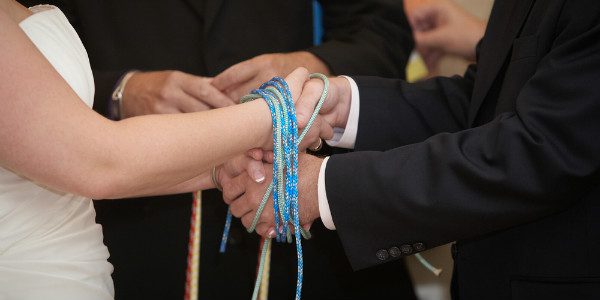
Photo courtesy of Shutterstock.
Since wedding ceremonies often involve all sorts of different people from various walks of life, many of the rituals involved in a wedding have very little explicit connection to a particular religious tradition. Most of the Pagan weddings I’ve been a part of have been more like “stealth Pagan weddings” than extensive affairs things resembling traditional Pagan/Wiccan ritual. (Sometimes you just don’t want to bother Grandma with something she might not understand.) There are often “Pagan parts” identifiable to those who know how to find such things, but generally invisible to everyone else.
Wedding ceremonies aren’t one seamless ritual, they are a combination of several smaller rites that create a greater whole. Society at large tends to fixate on the exchange of rings as the primary rite, but for many Pagans it’s the actual handfasting/tying the wrists together that’s most central. Candle lightings and chalice sharing rites also occur with some frequency, and can be great ways to make a wedding ceremony last a little bit longer.
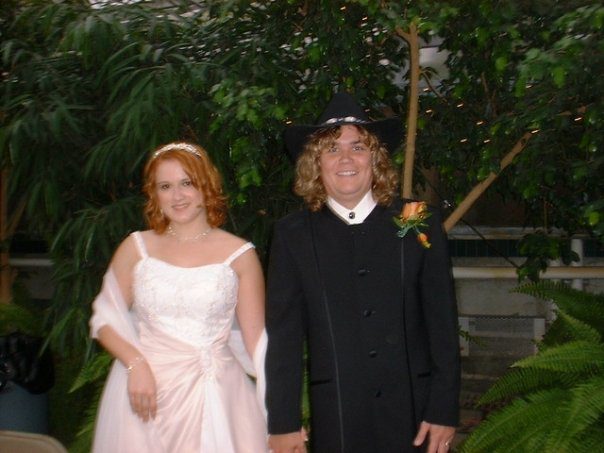 Weddings ceremonies can be exceedingly brief. I officiated my sister-in-law’s wedding a few weeks ago and after sending her my initial “standard wedding ceremony” script she replied with “that’s awfully short.” She was right, it was short, but since she didn’t want to talk there wasn’t a whole lot I could do to make it longer. I did eventually add some “Jesus stuff” that ended with me quoting Paul McCartney and John Lennon in addition to the Apostle Paul, but it was her wedding, no one was there to listen to me.* And weddings are always a little bit longer than most people anticipate because the simple act of a bride or groom walking down the aisle is a rite unto its self.
Instead of a putting a full ritual in this post, I’m going to share my ritual outline and then some of the “individual rites” that make up a wedding.
Procession(s) Family/Wedding Attendants/Couple
At my sister-in-laws wedding the highlight of the procession was her walking down the aisle arm in arm with her father. As they approached me, Dad gave his blessing to the groom by leaving his daughter when they reached her fiancee.
Officiant Greets those Gathered
Officiant welcomes everyone to the ceremony, if the officiant knows the couple this is sometimes a good opportunity for a joke. Breaking the tension can be really beneficial to the nervous couple.
God Stuff
I’ve done a lot of weddings with a Christian-slant. If I have to put some Bible stuff I usually do it here while ruminating on the meaning of love. It’s rather cliche but the best Christian-leaning love stuff comes from Paul (“love is patient, love is king”) and can be found in 1st Corinthians Chapter 13.
(Song?)
Sometimes people will put a song into the middle of their ceremony (that helps with length!). I tend to put it here because it’s a good transition spot.
Handfasting
Even when marrying Pagans the exchange of rings tends to take precedence over the handfasting rite. As a result I tend to it do before the Ring Exchange.
(Reading?)
Want a friend to read some poetry during the ceremony? Put it here. Can also be swapped with the song. Generally, most weddings I’ve done have been short on songs and poetry, but I’ve seen both in various weddings.
(Additional Activity)
If someone wants a chalice or candle rite it usually goes here, this can also be swapped with the handfasting rite above.
Exchange of Rings/Vows
“The exchange” (and it doesn’t necessarily have to be rings) remains the “big thing” in most weddings and is generally accompanied by vows. I have had some couples exchange vows during a chalice ceremony.
(Jumping the Broom)
Nothing feels more Witchy to me than jumping a broom, but this is not an ancient Pagan tradition. Slave couples in the American-South used to “jump the broom” to publicly proclaim their love and devotion to one another since they were not allowed to legally marry. The tradition persisted in African-American communities after the Civil War and is a part of many modern marriage celebrations. Since a lot Modern Witches today cherish their brooms this rite has become common-place in more witchy wedding ceremonies. I’ve never really “read” anything for a broom jumping, it’s just something jumped over as the couple walks back down the aisle at the end of the wedding. In such instance two of the attendants place the broom on the ground to be jumped or stepped over. The broom can be left on an altar or carried down the aisle by an attendant.
 Handfasting Rite
Officiant: “Today we will be performing a handfasting. For those of you who don’t know, a handfasting is a marriage rite that began in the Middle Ages. At that time when peasants got married they usually were unable to afford a clergyman to hear their vows or diamond rings to signify their love, so they began the ritual of handfasting.”
“In a handfasting a cord is wrapped around the wrists of the two people exchanging vows. Long ago this was tangible, physical proof that two people were married. They didn’t have licenses, pictures, or cellphone vidoes, but they could keep a cord as reminder of their love and commitment. Back in those days the cord was left wrapped around the happy couple’s wrists until the union was . . .uhmm . . consummated. I think the reception might end up being a little tricky if we follow that custom, so we will untie our couple at the end of this rite.”
Attendant presents the chord. At my sister-in-laws wedding one of her bridesmaids-and my wife-carried the chord down the aisle. She and the Best Man later tied the couple together.
“The cord we will use to bind our Bride and Groom is a symbol of their love for one another. It is love that binds them together, and love which has brought them here together today. This cord will always be seen by them as a symbol of that love.”
Attendants tie the wrists of the couple together very loosely. Instead of knots, simply wrap the chord loosely around the couple’s wrists. Some couples also use this as a time for song while they stare lovingly in each others eyes.
“This cord is a reminder of today, and a promise of the days to come which will be shared in your love for one another.”
The cord is untied by the officiant and placed on the altar. If there is no altar the officiant can hold onto for the duration of the ceremony, or hand it back to one of the attendants.
 Chalice Sharing
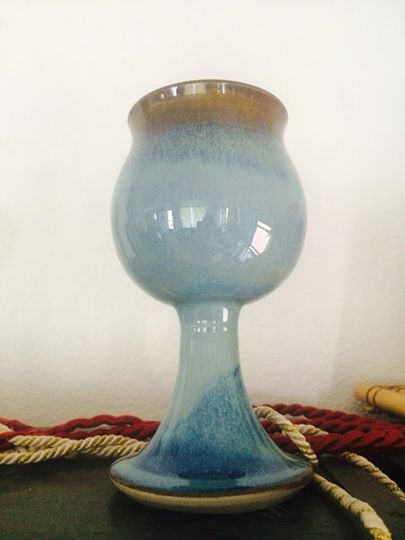
Officiant: “A marriage is a commitment, a promise between two people to love, cherish, and honor one another. No one can better articulate that promise than the two here who are sharing their day with us. These cups are symbols of the promise that the two of you share, by sharing your words and the contents of these chalices, you are physically and verbally sharing your vows and love for one another.”
Officiant picks up chalice from the altar or is handed a chalice carried by one of the attendants. The cup is then handed to whoever in the couple wants to speak first. I’ve had some couples read their own vows here, but more commonly people have “repeated after me” and then offered the chalice to their partner. After the chalice is handed off the other half of the couple reads their vows/repeats after the officiant. Someone repeats after the officiant, the person doing the repeating raises the cup up and then it hands it to their love. Love drinks from cup and then everything is repeated. The chalice can then be given back to the person who carried it down the aisle, or placed on an altar/table.
Officiant: “Repeat after me: This chalice represents (this chalice represents) my love for you (my love for you) and my desire to give (and my desire to give) all of myself to you (all of myself to you). I share the contents of this cup (I share the contents of this cup) and my life with you (and my life with you).”
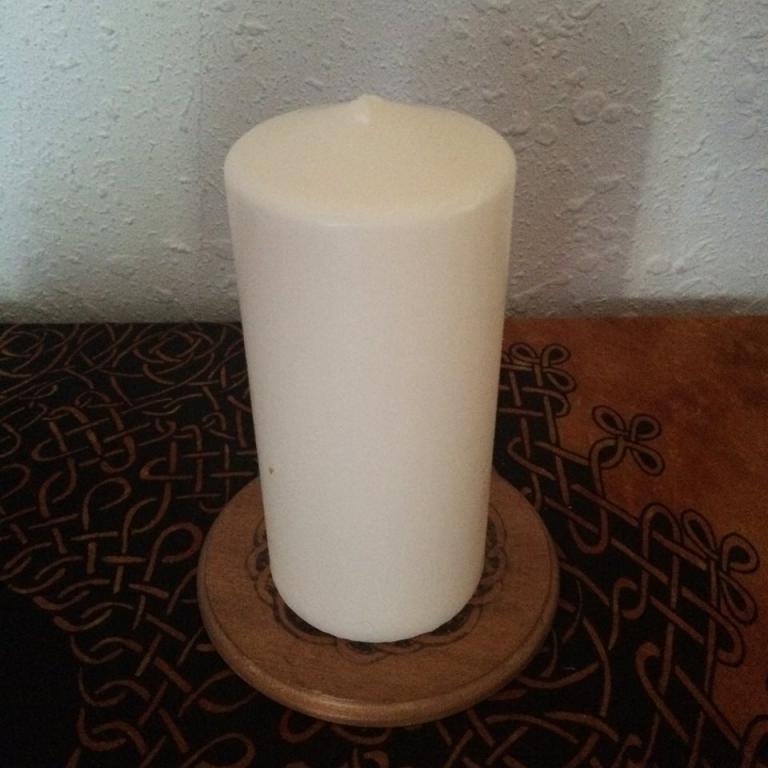 Candle Lighting
I am not a huge fan of candle lighting ceremonies because fire is dangerous. Getting a little water on a wedding gown is one thing, setting one on fire is something else entirely. I’ve also done a lot of outdoor weddings over the years and keeping candles lit in such situations can be tricky (I know hurricane lamps, or candles in a jar, but it still never works out as neatly as people would like). Candle lighting ceremonies also require an altar or table, adding another thing for the couple being wed to worry about.
For this rite you’ll need three candles, I generally use two pillar candles and one big fat candle. My preference here is to have the taper candles so firmly in their holders that the holder will stay attached to the candle if the candle is picked directly up. You’ll also want a lighter, I prefer the big lighters, it looks a little classier than a Bic.
Officiant: “The world surrounds us with reminders of nature’s duality. There is night and day, moon and sun, sadness and joy, youth and old age, life and death. These candles here before us represent nature’s balance and the energies which surround us on a day to day basis.”
Each half of the couple should pick up a taper candle and light it while saying: “I light this candle to represent me and all that I bring to this marriage.” The officiant can hold out a lighter to help light each candle. After both sweethearts have lit their respective candle they should light the big candle in the middle together, either reciting after the officiant prompts them or they can simply light the big candle while the officiant speaks.
Officiant: “This candle signifies that you are stronger when united, in balance with nature, and giving of yourselves.”
Or they can repeat after the officiant or memorize the line: “We light this candle (we light this candle) to signify that we are stronger when united (to signify that we are stronger when united) in balance with nature (in balance with nature) and giving of our ourselves (and giving of ourselves).”
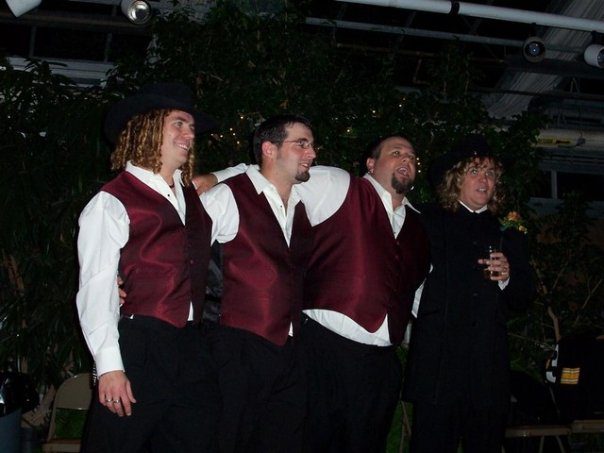
Me & My Groomsmen
Ring Exchange
This particular version of the ring exchange is really heteronormative, but was what I used in my sister-in-law’s ceremony. If you are officiating a wedding you should address each member of the couple in whatever manner they prefer. There are also some couples who like to be presented after a wedding ceremony “Mr. and Mrs. Doug Hopkins” (or whatever). I don’t like doing that because I despise the idea that a woman should be known by her husband’s name. (If anything at my house we are Mrs. and Mr. Ari Mankey.)
Officiant: “There is no greater symbol of the love shared between two people than the ring. Circular, it has no beginning and no end, much like the love between two people being wed. (Groom’s name) do you take this woman to be your wife, to love her in sickness and in health, for richer or for poorer, for as long as your love shall last (or for as long as you both shall live)?”
Groom: “I do.”
(Groom places ring on the bride’s finger.)
Officiant: “(Bride’s Name) do you take this man to be your husband, to love him in sickness and in health, for richer or for poorer, for as long as your love shall last (or for as long as you both shall live)?”
Bride: “I do.”
(Bride places ring on groom’s finger.)
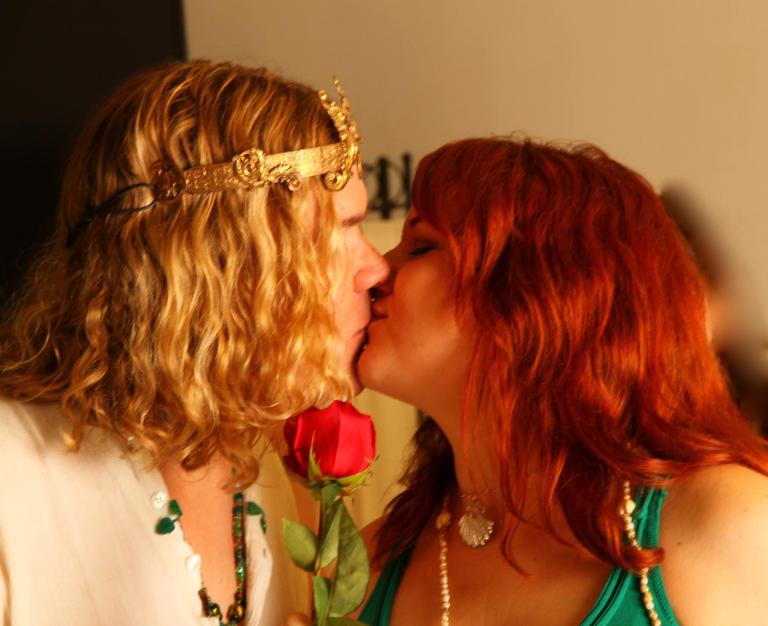
Officiant: “I now pronounce you husband and wife, you may kiss the bride!”
Before getting to the kissing part I’ll often give the happy couple a blessing. One of my favorites is often called the Navajo or Apache Blessing, but actually only dates from 1950 where it shows up in the book Blood Brother by Elliot Arnold.
Officiant: “Now you will feel no rain, for each of you will be the shelter for each other.
Now you will feel no cold, for each of you will be the warmth for the other.
Now you are two persons, but there is only one life before.
Go now to your dwelling place to enter into the days of your life together.
And may your days be good and long upon the earth.”
May your handfasting/wedding ceremony go off without a hitch, and may it be as special and as meaningful as my own was.
*I have run into a lot of officiants over the years who have forgotten this part. If you are presiding over a wedding your job is to be loud, not screw up any names, and communicate clearly. That doesn’t mean the ceremony is about you, because it’s not. Attention should always be focused on the happy couple.
Help me out! Like Patheos Pagan on Facebook!
 CLICK HERE TO “LIKE” PATHEOS PAGAN ON FACEBOOK
It’s easy to do, like Patheos Pagan and Raise the Horns on Facebook!
Previous Post
May 15, 2015
Summer Pagan Festivals 2015: A Guide
Next Post

May 21, 2015 A Pagan Memorial Day
Browse Our Archives
Select a Category Editorializing Gateways to Paganism Guest Posts Holiday Histories Led Zeppelin News and Views Occult Pagan Pagan TV Club Paganism polytheism Ramble On Reviews Ritual Strange Days Uncategorized
Select a Month August 2026 March 2026 February 2026 November 2025 September 2025 August 2025 April 2025 August 2024 April 2024 February 2024 December 2023 October 2023 August 2023 June 2023 May 2023 January 2023 October 2022 August 2022 July 2022 June 2022 May 2022 April 2022 March 2022 February 2022 January 2022 December 2021 November 2021 October 2021 September 2021 August 2021 July 2021 June 2021 April 2021 March 2021 February 2021 January 2021 December 2020 November 2020 October 2020 August 2020 July 2020 June 2020 May 2020 April 2020 March 2020 February 2020 January 2020 December 2019 November 2019 October 2019 September 2019 August 2019 July 2019 June 2019 May 2019 April 2019 March 2019 February 2019 January 2019 December 2018 November 2018 October 2018 September 2018 August 2018 July 2018 June 2018 May 2018 April 2018 March 2018 February 2018 January 2018 December 2017 November 2017 October 2017 September 2017 August 2017 July 2017 June 2017 May 2017 April 2017 March 2017 February 2017 January 2017 December 2016 November 2016 October 2016 September 2016 August 2016 July 2016 June 2016 May 2016 April 2016 March 2016 February 2016 January 2016 December 2015 November 2015 October 2015 September 2015 August 2015 July 2015 June 2015 May 2015 April 2015 March 2015 February 2015 January 2015 December 2014 November 2014 October 2014 September 2014 August 2014 July 2014 June 2014 May 2014 April 2014 March 2014 February 2014 January 2014 December 2013 November 2013 October 2013 September 2013 August 2013 July 2013 June 2013 May 2013 April 2013 March 2013 February 2013 January 2013 December 2012 November 2012 October 2012 September 2012 August 2012 July 2012 June 2012 April 2012 October 2011 September 2011 August 2011
Follow Us!
TAKE THE
Religious Wisdom Quiz
What woman became a queen and saved her people?
Select your answer to see how you score.
Hannah Esther Deborah Miriam
Related posts from Raise the Horns

What Makes a Good Ritualist? No Idea

Witchcraft Remembrances & Appreciation at Samhaintide

Raymond Buckland & The Big Blue Book

TRENDING AT PATHEOS Pagan

The Sermon on the Mount, Part I: Matthew...
The Sermon on the Mount, Part I (Matthew 4:12-5:12) St. Matthew moves...

What's up from Crossway: Reviewing some of their latest A few weeks...

Janie Learns the Way of the Cross: A...
Teaching children about Jesus' Passion can be challenging. Many parents and educators...

Looking For Good Catholic Writing - October 2026
He alone extends the heavens, and he walks upon the waves of...

In "Irreplaceable," our book on vocation and technology, Trevor Sutton and I...

I was strolling through the top floor of the brand new Parthenon...
view all Pagan blogs
Ad-Free & Subscriber Log-In Subscription Support
- About Us
- 2026 Calendar
- Videos
- Podcasts
- Library of World Religions
- Faith In Media Tracker
- Advertise With Us
- Write for Us
- Privacy Policy
- Terms of Service
- Do Not Sell My Data
- Contact Us
- Radiant Digital
- Manage Newsletter Subscriptions
- Unsubscribe From Notifications
- Sitemap
Copyright 2008-2026, Patheos. All rights reserved.
Subscription Support Ad-Free & Subscriber Log-In
Follow Patheos