
BuddhistCatholicContemplativeEvangelicalGeneral ChristianHinduJewishLatter-day SaintMuslimNew VisionsProgressive Christian
Beliefs
- Buddhist
- Catholic
- Contemplative
- Evangelical
- General Christian
- Hindu
- Jewish
- Latter-day Saint
- More Voices
- Muslim
- New Visions
- Pagan
- Progressive Christian
Topics
- Religion News
- Food and Religion
- Sports and Religion
- Religious Art
- Religious Music and Entertainment
- Religious Events
- History and Religion
- Style and Religion
- Politics and Religion
- Women in Religion
- Recreation Outdoors and Religion
- Business Finance and Religion
- Careers Workplace and Religion
- Education and Religion
- Family Parenting and Religion
- Health Fitness and Religion
- Home and Religion
- Relationships and Religion
- Technology and Religion
- Travel and Religion
Columnists
- Buddhist Columnists
- Business Finance and Religion Columnists
- Careers Workplace and Religion Columnists
- Catholic Columnists
- Contemplative Columnists
- Education and Religion Columnists
- Evangelists Columnists
- Family Parenting and Religion Columnists
- General Christian Columnists
- Health Fitness and Religion Columnists
- Hindu Columnists
- History and Religion Columnists
- Home and Religion Columnists
- Jewish Columnists
- More Voices Columnists
- Latter Day Columnists
- Muslim Columnists
- New Visions Columnists
- Nonreligious Columnists
- Pagan Columnists
- Politics and Religion Columnists
- Progressive Columnists
- Recreation Outdoors and Religion Columnists
- Relationships and Religion Columnists
- Religion News Columnists
- Religious Art Columnists
- Religious Events Columnists
- Religious Music and Entertainment Columnists
- Sports and Religion Columnists
- Style and Religion Columnists
- Technology and Religion Columnists
- Travel and Religion Columnists
- Women in Religion Columnists
Resource Library
- 2026 Calendar
- Library of World Religions
- The 100 Most Holy Places on Earth
- Patheos Answers
- Podcasts
- Videos
- Faith Leaders Database
- Anglican Episcopalian
- Bahai
- Baptist
- Buddhism
- Christianity
- Confucianism
- Eastern Orthodoxy
- Hinduism
- Holiness and Pentecostal
- ISKCON
- Islam
- Judaism
- Lutheran
- Methodist
- The Church of Jesus Christ of Latter-day Saints
- New Age
- Paganism
- Presbytarian and Reformed
- Protestantism
- Religion Behind the Scenes
- Roman Catholic
- Scientology
- Shia Islam
- Sikhism
- Sufism
- Sunni Islam
- Taoism
- Zen
- See all religions
Research Tools
 Ad-Free & Subscriber Log-In Subscription Support
Ad-Free & Subscriber Log-In Subscription Support
Follow Patheos 

- Trending:
- Forgiveness
- |
- Marriage
- |
- Consciousness
- |
- Death Penalty
- |
- Election
- |
- Halloween

- HOME
- Me and the Blog
- Defining Pagan
- Rituals & Holidays
- All Posts
- Blogroll
- Publications
- FREE NEWSLETTER
- Home
- Pagan
- The Roebuck in the Ritual (A Cochrane Inspired Rite)
The Roebuck in the Ritual (A Cochrane Inspired Rite)
Last updated on: March 4, 2015 at 3:03 pm by Jason Mankey
The Roebuck in the Ritual (A Cochrane Inspired Rite) 2015-03-04T15:03:21-07:00 Jason Mankey
Patheos Explore the world's faith through different perspectives on religion and spirituality! Patheos has the views of the prevalent religions and spiritualities of the world.
 It’s no secret that I have a keen interest in the histories of Modern Paganism and Witchcraft. One of the most fascinating Witches to emerge in the 1960’s was Roy Bowers, who went by the pen-name of Robert Cochrane. Cochrane’s letters (he didn’t write any books) have served as a source of inspiration to many Witches over the last forty years, and judging by recent blogs and books, his influence is stronger now than ever.
This ritual was written for the ConVocation festival held annually just outside of Detroit Michigan. Me leading a Saturday night ritual there is a tradition at this point, and I hate to mess with tradition. This ritual was assembled from a variety of sources, most notably Cochrane’s letters, but I used more than that to flesh out some things. The writings of Evan John Jones (Cochrane’s heir in many ways) were a tremendous help. I recommend his book Witchcraft: A Tradition Renewed not just for people interested in Cochrane, but for anyone interested in Witchcraft, it’s superb. The Forge of Tubal Cain by Ann Finnin was also invaluable and helped with the crafting of my quarter calls. Two books edited by Michael Howard and featuring the writing the writings of Jones and Cochrane (The Roebuck in the Thicket and The Robert Cochrane Letters) provided much of the backbone to this ritual. In addition John of Monmouth’s recent Genuine Witchcraft is Explained was a true gift from the gods.
To truly do justice to Cochrane style ritual it should be enacted outdoors. However since this was written for a festival in Michigan in late February that was not really an option. Because its an indoor rite it’s only partially representative of what a Cochrane style rite might have been like. Sprinkled throughout this ritual are notes on where the words being used came from along with some commentary.
Happy Witching!
Materials Needed
Broom
Sword
Cauldron
Stang (a pitchfork will do, and is probably preferred)
Ritual knife (athame)
Pitcher of water
Bowl for water
Bowl of Salt
Bowl of Ash/Cinders
Oil
Small pocket mirror
Lantern or candle
Twig Brush
The Roebuck in the Ritual
Fashioning the Bridge
(Magister and Maid start the ritual at the altar while the rest of the coven waits outside of the ritual space. Maid and Magister start the ritual by laying down a sword and broom at the entryway’s threshold, signifying entry into sacred space.)
Magister: “I lay down this sword.”
Maid: “And I this broom. Conjoined and bound together they represent the most ancient of magics.”
Magister: “Step across this gate and come into the Otherworld the Spiral Castle where all true Witches tread.”
(Sword and broom are laid upon each other at the entryway’s threshold. All must walk over the broom and sword in order to be a part of the ritual. Once everyone has entered the ritual area proceed with the welcome.)
(This was adapted from Jones’s “Witchcraft a Tradition Renewed”, page 124)
Welcome
Magister: “I welcome you People of Goda; those who would be a part of the Clan of Tubal Cain!”
Sangreal Prayer
Maid: “Beloved Bloodmother of my especial breed,
Welcome to me at this moment your willing womb.
Let me learn to live in love with all you are,
So my seeking spirit serves the Sangreal.
(Again borrowed from Jones appearing in “A Tradition Renewed.” This was originally written by William “Bill” Gray.)
Thanks/Dedication/Guidance
Maid: “We give thanks to the Goddess and God for allowing us to meet in this magical place. Through their power we tread the path of the Witch. So be it done.”
Magister: “We dedicate ourselves to their service this night and into the future. We hail the Horned One . . Hail the Horned One! We hail the Great Mother . . . Hail the Great Mother! So be it done.”
Maid: “Lord and Lady we ask for your guidance as we begin these rites. Guide our steps, our mouths, and our actions. So be it done.”
(Inspired by a letter from Joan Bowers in which she stated: “I think that he should be inside for the opening prayer. One that should give thanks and express our dedication, and then a plea for guidance, etc. See “Genuine Witchcraft” page 423.)

Opening Prayer/Statement of Witchery:
(Maid and Magister alternate line readings with Maid reading first)
“This is the taper that lights the way
This is the cloak that covers the stone
That sharpens the knife
That cuts the cord
That binds the staff
That’s owned by the maid
Who tends the fire
That boils the pot
That scalds the sword
That fashions the bridge
That crosses the ditch
That compasses the hand
That knocks the door
That fetches the watch
That releases the man
That turns the mill
That grinds the corn
That makes the cake
That feeds the hound
That guards the gate
That hides the maze
That’s worth a light
And into the castle that Jack built.”
(In a letter to William Grey written by Cochrane.)
The Mask of God
Magister: Before we begin we must consider our own bodies and our own faces as the Mask of God and bless ourselves accordingly. Repeat my words and my gestures as we don the mask.
(Touch center top of forehead) “Divine Goddess! Fount of all Life, bearing ever anew, bringing forth fro the unknown Life, Love, and Beauty. Thou Who art first born we pray to thee!”
(Touch right side of forehead) “Transformed Being, Sun of Suns bringer of glad daylight, of Dawn and the vanquisher of Evil, I salute thee!”
(Touch left side of forehead) “Master of Death, Lord who Judges, Redeemer of the Soul. I salute thee.”
(Touch left ear) “Thou bringer of news, Messenger of the Gods inspirer of the spirits I salute Thee.”
(Touch right eye) “Splendour, though growing behind, inhabitant of the Knife. I salute Thee.”
(Touch lips) “Thou who are One in Two, Love I salute Thee.”
(Touch right side of chin) “Father, Old Pan, Earth God who has shepherded life from its beginning I pray unto Thee. Hail.”
(Touch center of beard/chin) “Root of all life that stretches from heaven to earth I greet Thee. Vouchsafe us deliverance this day. Amen.”
(This was taken from one of Cochrane’s letters detailing a Midsummer Ritual. It’s rather odd, which is why I included it. See page 428 of “Genuine Witchcraft.”)
Fains/Atonement/Blessing
(The “Fains” is about admitting pass misdeeds or mistakes made in the Craft. After we admit our faults we atone for them, and then are blessed so we might proceed with the ritual.)
Magister: “Fains I have neglected my duties as your Magister.”
Maid: “Fains I have _________” (I know you aren’t perfect, you’ll think of something here.)
Magister: For our transgressions there must be penance before setting up the altar. I give this offering so I might atone for my mistakes.”
Maid: “I give this offering so I too might atone for my mistakes. Gods forgive me . . . . (pause) . . . . And the gods do forgive. My Magister I offer you this blessing so that you might serve the gods.”
(Blesses forehead with sign of the cross.)
Magister: “My Maid, I also offer you this blessing so that you might serve the gods.”
Both: “Amen.”
(Anointing is done with oil. In a small ritual everyone would do this in the ritual. At a large one, not so much.)
(This is adapted from a document known as “Basic Ritual” by Cochrane. It’s in “Genuine Witchcraft” page 421. The original suggests three cuts with a willow wand for expiation/amends. I have no way of knowing but this seems like a substitute for the scourge found in other Witchcraft traditions.)
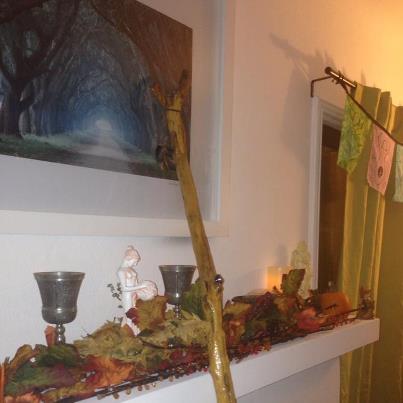 Placement of the Stang and Cauldron/Call to Goddess and God
(The stang is picked up and placed in center-north near the table altar, standing upright.)
Magister: “I place this stang here so that we might call upon the Divine-God-King of the woodland glade, the god of hunting and fertility. This stang is the symbol of the god Herne lord of forest and glen and the staff of Tubal Cain the great smith of legend.”
“The stang is where great powers come together, where the child of promise is reborn to the world after his father’s sacrifice. Be welcome at our rite.”
(Water is poured into a cauldron on the altar.)
Maid: “I fill this cauldron so we might glimpse the cauldron of Cerridwen that is the cup of life and immortality. Within her waters we begin our journey to the Otherworld where true witchery dwells. We are the children of Goda and this cauldron is her symbol.”
Magister: “She comes to us neither clothed or unclothed, neither on foot nor on horseback, nor on water nor on dry lady and neither with nor without gift. She is the water of the world and the Goddess of the earth.”
Maid: “I am what they think me to be
I am what ye consider of thyself
I am myself. And thou as thou art
Who will be time come.
I am that without form
I am that without force
Yet form and force I be
I am the lover and the beloved
I am the whole and the part
I am compassion healing rift
I am diamond cutting stone hearts
I am the mirror without reflection
All eight of those I be.
I am the well without water
From which all must drink and die
I am words, letters if ye understand me
I am words without sound, listen to the wind
I am pain, grief, sorrow, and tears
The rack, the noose, and the stake
The flayer and the flayed
The hunted and the hunter
The head without a body
Hung upon a tree
Yea! All this but still I am whole
I am Night and sleepless Fear, I am Fear!
Thou must overthrow me to release thy soul.
I am the Watcher Upon the Hill,
The Keeper of the Gate, all keys I own.
I am peace now, understand thou things of clay.
I am turned about and turned again
A rose amongst the living dead.
I am a root, a tree
My tap draws strength from eternity
All things be mould for me.
Few know me at all, and that be secret.
Yet Woman is my name.
A plated host marcheth at my skirts
For I am might as the Dark One knows me
My nostrils smell the blood of the slain
I am weak as woman knows me . . . .
Yea! Be that my truest strength.
I am desire, the First Created, the first Sin.
Behold! For I am she!”
(Letter to Norman Gills written by Cochrane. I think this is Cochrane’s stab at something like “The Charge of the Goddess” for his tradition. It’s interesting, but lacks the punch of Valiente’s piece.)
Calling the Quarters
Magister: “In the beginning there was only Night, and She was alone. Being was absolute, movement was there none. Being force without form, and since She desired, that form was created . . .Woman. Being Woman, she desired union, and created Man from her North side. Having created Man, She discovered love, and so on all things began. Here was the first of all sins, Desire. From desire sprang all movement, all Life, all Time, all Death, joy and sorrow alike.”
Maid: “From the Gods came seven children, who created seven worlds to rule over, and they formed a halo about about the Great gods as seven stars. They also created Earth, Air, Fire, and Water, and gave these lands to four of the seven Gods. These Gods each live in a seperate land bounded by the great gulf of Annwn, which is the land of chaos and unredeemed souls.”
Magister: “We journey first to a castle in the East surrounded by fire ruled by Lacet.”
Maid: “We next journey to to a castle in the South surrounded by trees, ruled by Carenos.”
Maid: “On to the west and a castle beneath the depths of the sea ruled by Nodens.”
Maid: “And finally to the north and a castle built in the clouds ruled by Tettans.”
(Magister should dip his knife into the cauldron and splash water at each of the four points after the gods have been invoked.)
(Much of this comes directly from one of Cochrane’s letters to Norman Giles, with some additional material from Finnin’s “The Forge of Tubal Cain.”)
Maid: “Now begins our true journey to the Spiral Castle the place of magic just beyond. First, a layer of salt to represent life and agitate the dead. Second, a layer of soot and ash to represent death, the principle of universal decay. Thirdly, the waters of Lethe that separate the living from the dead.”
(Magister sprinkles salt around the circle, then ash, and finally water. The Maid begins each new line after the Magister has sprinkled the salt and ash.)
The Blessing
Maid: “I call upon the Old Gods and guardians of this gathering to see and understand the burdens that are upon us. Once realized, take from us the cause of our disharmony. Where once a blood price would be paid for absolving, water, without which none can live, is offered in its place. Water, the symbol of the forgetfulness and oblivion of the timeless river; to wash way the discord from our souls and bring harmony in its place.”
(The Magister joins the Maid in the circle carrying a bowl and a pitcher of water. He hands the water to her and she pours it into the bowl saying: )
Maid: “By the powers granted to me as a Maid of the Goddess I charge this water with the sacred powers invoked for the washing clean of the soul.”
(The Maid then picks up the bowl and holds it up near her shoulders. The Priest takes his knife and sticks it into the bowl and says: )
Magister: “Thus with the act of joining knife to water, symbolizing the joining of the Goddess as the Young Maid with the Young Horned King. So the water in this vessel shall be charged with the powers of the sacred blood of sacrifice to pay the price for the removal of the burdens upon us.”
(Maid and Magister kiss, he sheaths his knife and takes the bowl in his hands. She picks up a the twig brush and dips it into the water. She sprinkles a few drops on herself and the Priest with the brush. She then proceeds to sprinkle water around the entire circle saying: )
Maid: “Thus with this lustration, given in the knowledge of the rightness of our call I wash away from us that which has brought disharmony. In this token rite of washing, shall be the knowledge that all that has gone before is now taken from us leaving us as the newly washed babe cleansed in body and soul and once again ready to work the mysteries of our faith.”
(In Jones’s ritual the Maid says the above line, however in my version I ended up saying it so my Maid could concentrate on sprinkling people.)
After this opening bit if there’s more time to kill various phrases can be inserted, “I cleanse you removing all disharmony.” “All has been washed away.” “You are now ready to face the Mysteries.” Etc etc.
When the Maid has gone around the entire circle she sets the bowl down upon the altar and says:
Maid: “As for the charged water that is left . . . From the earth it came and from the earth it will return when we depart this place. In the name of the Goddess, so be it done.”
(This all came from Jones, and is a part of his Imbolc rite in “A Tradition Renewed.”)
The Witches Mill
Magister: “Now blessed and ready we will walk the tread the Witches Mill. We do this to change our consciousness to truly leave the mundane behind, perhaps to see Herne waiting her for us near the stang. Deosil we go upwards to the realm of the gods, widdershins we proceed downward to the land of the dead. This night we tread deosil.”
“I need all of you to place your left hand upon the shoulder of the person in front of you. With your right hand point outwards toward the stang. Now, finally, stare with all of your might into the stang. Let it be all that you see and may it guide you to the Witch God.”
“While we tread the mill we will chant Io Io Evohe (Yo You Evo Hey) quietly in honor of Goda with the hope that one day all Witches will be free to tread the mill around the stang.”
(Maid stands in the middle of the circle directing the tempo and will signal when to stop with the working.)
(The Mill Dance was the central rite in Cochrane’s ritual and was used not just to raise energy but to induce a trance like state. In my ritual I was going for the trace like state more than anything else. Upon initially trying it out with ten people in a small space it didn’t work all that well. Doing it with sixty people was something else entirely! I found it works best with large groups of people.)
Cakes and Ale
The Maid steps forward and picks up the cup along with a small mirror. The Magister comes up behind her with a lantern, or candle, whose light is then reflected from the mirror into the chalice.
Magister: “I bring you the light of the moon.”
Maid: “For it brings us the light of the Lady.”
(Light is reflected into the cup while the Maid begins the blessing: )
 Maid: “I call upon the Goddess to see this our ritual-to lift the veil between us. For by joining the cup and knife, we symbolize the joining of the two elements for the continuation of life. For this cup shall be the symbol of the Mother, and the knife shall be the symbol of the Horned God, her lover.”
(The Magister sets down the lantern and picks up a sharpening stone. He then ritually sharpens his knife upon the stone while saying: )
Magister: “By the symbol of the knife, I call upon the Horned God to join the Mother in the charging of this cup, so that the wisdom of the ages may mingle with the wine for the benefit of us all.”
Knife is plunged into the chalice and stirred around within it three times. Then he takes his knife out and splashes a drop from it at each of the cardinal points of the circle. Returning to the Maid he kisses her on the mouth and they both drink from the cup. The cup is set down and the Priestess picks up the plate of cakes.
“I call upon the Old Gods to look upon this our sacrfice with pleasure and understanding. For we do this in memory of the past. By the eating of this bread, we take within ourselvesthe ancient wisdom of the high and lonely places. By the call of blood to blood, we claim the rights of our heritage.”
He then touches each cake with the knife while saying:
“By the virtue of this knife,
Be fillwed with wisdom and with life!
Grain that the Mother doth give,
Sown and reaped that we may live.
So we too in time return
To earth that claimeth all in turn,
Yet as the seed lies hid in earth,
In death is promise of rebirth.
By earth and water, wind and flame,
Be blessed in the Old Ones name!”
Maid and Magister each take a piece of bread and eat it. Cakes are handed back to the Priest and the Priestess takes the cup. Before leaving to distribute the wine and bread to the rest of the circle they stare into each other’s eyes and say:
“In the Old One’s name we eat this bread,
With great terror and fearful dread.
We drink this in our Lady’s name,
And She’ll gather us home again.”
(Most of this is from Jones, however the opening part with the mirror and the light is adapted from Valiente’s account of Cochrane’s ritual in “The Rebirth Witchcraft.” Instead of reflecting candle light the mirror is meant to reflect moonlight, but we were inside so that wouldn’t work.)
Closing the Circle
Maid walks up to the cauldron and pours the water within it back into a bowl or pitcher.
Maid: “From the earth it came and from the earth it will return when we depart this place. In the name of the Goddess, so be it done.”
Magister walks up to the stang and pulls it out of the ground.
Magister: “From work you came and now our work is done. Soon all will be as it once was. In the name of the God so be it done.”
Magister and Maid walk forward to the sword and broom, the Magister picking up the sword and broom.
Magister: “That which was joined in now asunder.”
Maid: “The gate is now open, let all who have journeyed into the mysteries be free to depart this place.”
Magister: So be it done.”
(Adapted from Jones.)
FINS
Previous Post
February 26, 2015
How the Claim of Being Old Saved Modern Paganism
Next Post

March 6, 2015 Not My Council
Browse Our Archives
Select a Category Editorializing Gateways to Paganism Guest Posts Holiday Histories Led Zeppelin News and Views Occult Pagan Pagan TV Club Paganism polytheism Ramble On Reviews Ritual Strange Days Uncategorized
Select a Month August 2026 March 2026 February 2026 November 2025 September 2025 August 2025 April 2025 August 2024 April 2024 February 2024 December 2023 October 2023 August 2023 June 2023 May 2023 January 2023 October 2022 August 2022 July 2022 June 2022 May 2022 April 2022 March 2022 February 2022 January 2022 December 2021 November 2021 October 2021 September 2021 August 2021 July 2021 June 2021 April 2021 March 2021 February 2021 January 2021 December 2020 November 2020 October 2020 August 2020 July 2020 June 2020 May 2020 April 2020 March 2020 February 2020 January 2020 December 2019 November 2019 October 2019 September 2019 August 2019 July 2019 June 2019 May 2019 April 2019 March 2019 February 2019 January 2019 December 2018 November 2018 October 2018 September 2018 August 2018 July 2018 June 2018 May 2018 April 2018 March 2018 February 2018 January 2018 December 2017 November 2017 October 2017 September 2017 August 2017 July 2017 June 2017 May 2017 April 2017 March 2017 February 2017 January 2017 December 2016 November 2016 October 2016 September 2016 August 2016 July 2016 June 2016 May 2016 April 2016 March 2016 February 2016 January 2016 December 2015 November 2015 October 2015 September 2015 August 2015 July 2015 June 2015 May 2015 April 2015 March 2015 February 2015 January 2015 December 2014 November 2014 October 2014 September 2014 August 2014 July 2014 June 2014 May 2014 April 2014 March 2014 February 2014 January 2014 December 2013 November 2013 October 2013 September 2013 August 2013 July 2013 June 2013 May 2013 April 2013 March 2013 February 2013 January 2013 December 2012 November 2012 October 2012 September 2012 August 2012 July 2012 June 2012 April 2012 October 2011 September 2011 August 2011
Follow Us!
TAKE THE
Religious Wisdom Quiz
Who is credited with predicting Cyrus by name, who would rebuild Jerusalem?
Select your answer to see how you score.
Isaiah Ezekiel Jeremiah Zechariah
Related posts from Raise the Horns

What Makes a Good Ritualist? No Idea

Witchcraft Remembrances & Appreciation at Samhaintide

Raymond Buckland & The Big Blue Book

TRENDING AT PATHEOS Pagan

The Sermon on the Mount, Part I: Matthew...
The Sermon on the Mount, Part I (Matthew 4:12-5:12) St. Matthew moves...

What's up from Crossway: Reviewing some of their latest A few weeks...

Janie Learns the Way of the Cross: A...
Teaching children about Jesus' Passion can be challenging. Many parents and educators...

Looking For Good Catholic Writing - October 2026
He alone extends the heavens, and he walks upon the waves of...

In "Irreplaceable," our book on vocation and technology, Trevor Sutton and I...

I was strolling through the top floor of the brand new Parthenon...
view all Pagan blogs
Ad-Free & Subscriber Log-In Subscription Support
- About Us
- 2026 Calendar
- Videos
- Podcasts
- Library of World Religions
- Faith In Media Tracker
- Advertise With Us
- Write for Us
- Privacy Policy
- Terms of Service
- Do Not Sell My Data
- Contact Us
- Radiant Digital
- Manage Newsletter Subscriptions
- Unsubscribe From Notifications
- Sitemap
Copyright 2008-2026, Patheos. All rights reserved.
Subscription Support Ad-Free & Subscriber Log-In
Follow Patheos