
BuddhistCatholicContemplativeEvangelicalGeneral ChristianHinduJewishLatter-day SaintMuslimNew VisionsProgressive Christian
Beliefs
- Buddhist
- Catholic
- Contemplative
- Evangelical
- General Christian
- Hindu
- Jewish
- Latter-day Saint
- More Voices
- Muslim
- New Visions
- Pagan
- Progressive Christian
Topics
- Religion News
- Food and Religion
- Sports and Religion
- Religious Art
- Religious Music and Entertainment
- Religious Events
- History and Religion
- Style and Religion
- Politics and Religion
- Women in Religion
- Recreation Outdoors and Religion
- Business Finance and Religion
- Careers Workplace and Religion
- Education and Religion
- Family Parenting and Religion
- Health Fitness and Religion
- Home and Religion
- Relationships and Religion
- Technology and Religion
- Travel and Religion
Columnists
- Buddhist Columnists
- Business Finance and Religion Columnists
- Careers Workplace and Religion Columnists
- Catholic Columnists
- Contemplative Columnists
- Education and Religion Columnists
- Evangelists Columnists
- Family Parenting and Religion Columnists
- General Christian Columnists
- Health Fitness and Religion Columnists
- Hindu Columnists
- History and Religion Columnists
- Home and Religion Columnists
- Jewish Columnists
- More Voices Columnists
- Latter Day Columnists
- Muslim Columnists
- New Visions Columnists
- Nonreligious Columnists
- Pagan Columnists
- Politics and Religion Columnists
- Progressive Columnists
- Recreation Outdoors and Religion Columnists
- Relationships and Religion Columnists
- Religion News Columnists
- Religious Art Columnists
- Religious Events Columnists
- Religious Music and Entertainment Columnists
- Sports and Religion Columnists
- Style and Religion Columnists
- Technology and Religion Columnists
- Travel and Religion Columnists
- Women in Religion Columnists
Resource Library
- 2026 Calendar
- Library of World Religions
- The 100 Most Holy Places on Earth
- Patheos Answers
- Podcasts
- Videos
- Faith Leaders Database
- Anglican Episcopalian
- Bahai
- Baptist
- Buddhism
- Christianity
- Confucianism
- Eastern Orthodoxy
- Hinduism
- Holiness and Pentecostal
- ISKCON
- Islam
- Judaism
- Lutheran
- Methodist
- The Church of Jesus Christ of Latter-day Saints
- New Age
- Paganism
- Presbytarian and Reformed
- Protestantism
- Religion Behind the Scenes
- Roman Catholic
- Scientology
- Shia Islam
- Sikhism
- Sufism
- Sunni Islam
- Taoism
- Zen
- See all religions
Research Tools
 Ad-Free & Subscriber Log-In Subscription Support
Ad-Free & Subscriber Log-In Subscription Support
Follow Patheos 

- Trending:
- Forgiveness
- |
- Marriage
- |
- Consciousness
- |
- Death Penalty
- |
- Election
- |
- Halloween

- HOME
- Me and the Blog
- Defining Pagan
- Rituals & Holidays
- All Posts
- Blogroll
- Publications
- FREE NEWSLETTER
- Home
- Pagan
- 4 Things People Say At Christmas (That Are Most Likely Wrong)
4 Things People Say At Christmas (That Are Most Likely Wrong)
Last updated on: November 28, 2018 at 1:40 pm by Jason Mankey
4 Things People Say At Christmas (That Are Most Likely Wrong) 2018-11-28T13:40:14-07:00 Jason Mankey
Patheos Explore the world's faith through different perspectives on religion and spirituality! Patheos has the views of the prevalent religions and spiritualities of the world.
Every time a major holiday rolls around, misinformation comes around with it. I don’t think most people share bad information with the intention of misleading anyone, it just happens. The history of our holidays and the traditions that come with them are often among the most poorly researched corners of our collective past. Much of that is due to religion.
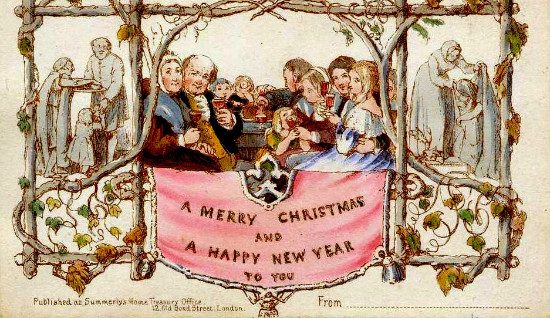
The world’s first commercially produced Christmas card, designed by John Callcott Horsley for Henry Cole in 1843. From WikiMedia.
Christians battle with the pagan past, and modern day Pagans and Atheists have their battle lines drawn too. Instead of enjoying the richness of our shared traditions people on both sides enjoy tearing one another down. Ideas from pagan antiquity are Christianized and anything that can be done to marginalize little baby Jesus is thrown into his manger. I’m not a big fan of Christianity either but I’m not going to make stuff up about its founder to make myself feel better about it.
Super Holiday content at Raise the Horns:
The History and Origins of Santa Claus
The Other Gift Givers: Beyond Santa Claus
Christmas Traditions: Christian or Pagan?
Christmas Is Not Yours or Mine (On the True Origins of the Holiday)
Best Yuletide Cartoons
The New Testament and the Nativity
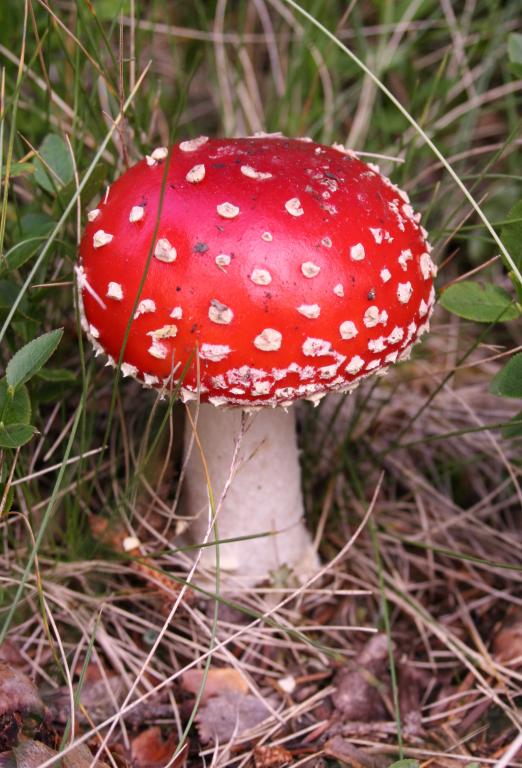
Photo by MichaelMaggs , from WikiMedia.
SANTA EVOLVED FROM SHAMANISM & MAGIC MUSHROOMS
I see this every year, and yeah, on the surface, it seems pretty cool and all, but it just doesn’t hold up. To begin with Santa is a complex piece of mythology and has several origin points. Legends of Saint Nicholas are a very real part of his legend and they should not be ignored (Santa is not just Odin or Saint Nicholas).
Most “Santa was a shaman” stories start in Siberia and claim that Santa’s famous red and white suit comes from agaric mushrooms which are also red and white. This idea is problematic for several reasons. The first is that Santa has not always worn red and white, and while it’s not true that Coca-Cola invented that particular outfit, it is of fairly recent vintage. In addition Siberian Shamans rarely use mushrooms.
 Since reindeer exist in Siberia, shamans of that area are also credited with introducing reindeer to Santa’s sleigh. This argument is even more nonsensical because reindeer weren’t introduced into the Santa mythos until the Nineteenth Century. Before that Santa/St. Nick rode a horse (most likely borrowed from the Norse god Odin!).
It is possible that the Sami people of Northern Europe contributed in some way to the Santa Claus myth (and they do have shamans), but they didn’t invent Santa.
JESUS IS JUST AN APPROPRIATED PAGAN GOD
No religion exists in a vacuum and Christianity is no exception to that. I think there are several pagan elements in the birth stories of Jesus: the star over Bethlehem, the virgin birth, the angels talking to the shepherds . . . In the marketplace of religions Jesus had to compete with pagan gods who did miraculous stuff but that doesn’t mean Jesus was a carbon-copy of Horus, Osiris, Dionysus, Tammuz, or any other god. To start with, none of those other gods were Jewish.
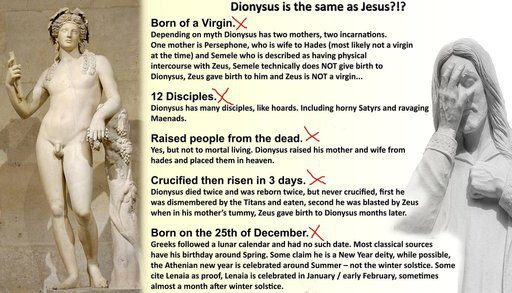
People have been equating Jesus to various Pagan gods for 150 years now, and I understand the confusion, it’s just that none of it’s really true. The idea has gained new currency because of the movie Zeitgeist which was released back in 2007. It’s a cool story, and a fun idea, but just because it’s in a movie doesn’t make it true.
I’ll start with Dionysus because I saw that meme earlier today. Dionysus wasn’t born of a virgin because his Dad Zeus actually liked having sex with people (and other deities). No one has ever claimed that Semele (mother of Dionysus) was a virgin. Dionysus wasn’t crucified either, I know books like The Jesus Mysteries make such claims, but it’s just not in the myth.
Horus is another god often compared to Jesus, but again the story isn’t quite the same. Horus is the result of the union between Osiris and Isis, as in coupling, having sex, Isis was no virgin. Osiris might have been wearing a golden phallus during coitus but there was most certainly sex going on. Horus wasn’t crucified either. There are several depictions of Horus in antiquity with his arms spread in a crucifixion-like pose, but there’s no cross, and no evidence anyone was every trying to depict a crucifixion.
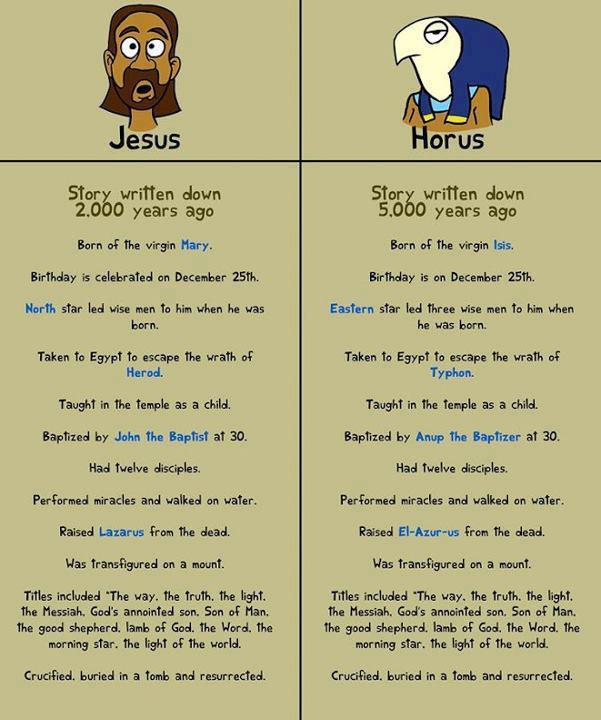 A lot of the supposed parallels between Jesus and Horus come from the pen of amateur Egyptologist Gerald Massey (1828-1907). I’m sure Massey did the very best he could do back in the Nineteenth Century but his work is not held in very high regard by scholars now or even during his own era. There’s no conspiracy here either, Massey’s work just simply doesn’t hold water. Massey claims that Horus raised an individual named Asar from the dead and that Asar translates as Lazarus. Asar is actually another name for Horus’s dad Osiris, who was brought back to life by Horus’s mom Isis. Modern writers who link Horus to Jesus still use Massey’s discredited work to do so, because that’s pretty much all there is linking the two.
The case between Jesus and Mithra is a little trickier but again there are differences. Mithra wasn’t born of a virgin, he came into this world as an adult bursting through solid rock. Mithra wasn’t crucified either, but he did kill a bull. I guess both involve death but they aren’t the same thing. Mithra’s birthday was celebrated on Dec. 25 though, and the date was most likely associated with him before it was with Jesus. Mithra ended up with the birthday for precisely the same reason Jesus did, they were both trying to get in on the birthday of Sol Invictus, the Unconquerable Sun.
One other thing that’s important to remember about all of these comparisons between Jesus and various pagan gods . . . . they’re being done to discredit both Jesus and those gods. The idea is that it’s ridiculous in the modern era to worship Dionysus, Mithra, or Horus and that if Jesus is basically those gods with a fresh coat of paint then it’s ridiculous to worship him too.
JESUS WAS BORN IN THE SPRING
The idea that Jesus was born in the Spring comes from the Gospel of Luke:
“And there were shepherds living out in the fields nearby, keeping watch over their flocks at night. An angel of the Lord appeared to them, and the glory of the Lord shone around them, and they were terrified . . . ” Luke 2:8-9
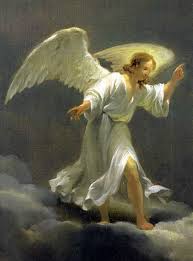 It’s true that shepherds in the Middle East are more likely to be “watching their flocks by night” in the Spring than the Winter, but just because Luke makes mentions of shepherds and angels doesn’t mean it’s true. If you think the writer of Luke got this part right, did he get the angels talking to those shepherds right too? You can’t have it both ways.
The gospels were not written as biographies, they were written to illustrate certain theological points. Shepherds hang out with the little baby Jesus because they were commoners, a theme found throughout the book of Luke. The Three Wise Men show up in The Gospel of Matthew because the writer of Matthew saw Jesus as the King of Israel, and less a man of the people.
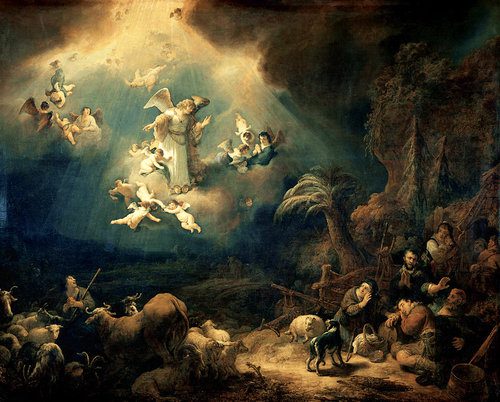
Most scholars think the birth narratives arrived to the Jesus mythology rather late too. The earliest New Testament writings, the seven authentic letters from the Apostle Paul, make no mention of Jesus’s birth; nor does the earliest gospel, Mark. The simple truth is that no one knows when Jesus was born. So he could have been born in the Spring, and he could have been born in the Winter. Luke doesn’t prove anything because the author of Luke didn’t know. He was just writing a story.

DRUIDS INVENTED TODAY’S CHRISTMAS TREE
We know very little about the ancient Druids, but it seems unlikely that they invented the Christmas Tree. There were other pagan faiths that existed during their era that did use evergreens near the Winter Solstice but that doesn’t mean that the Druids did. The Romans for instance decorated with evergreen branches during the January Kalends, a holiday that would look familiar to many of us today. (Kalend is the first day of the month, the January Kalend was celebrated as the start of the New Year.)
The idea that the Christmas Tree is somehow associated with Druids comes from a Christian source. This excerpt from Christmas in America by Penne L. Restad explains the origins of the tale:
“One legend credited St. Winfred, reputed to have felled a giant oak that had been used for Druidic worship, with dedicating the evergreen tree to Christmas. ‘This little tree,’ he is said to have told a crowd of converts who looked on, ‘shall be your holy tree to-night…Let this be called the tree of the Christ-child; gather about it…in your own homes; there is will shelter no deeds of blood, but loving gifts and rites of kindness.'”
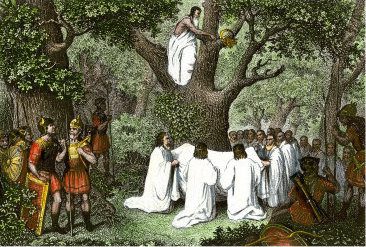 For a lot of medieval Christians the word “druid” was about the equivalent of the word “witch” meaning that people applied the term to negative magic users and other undesirables. Christians loved to tell miraculous conversion stories and this is just another in a line of tall tales. The Ancient Celts would have actually had to celebrate the Winter Solstice or some other winter holiday in ancient times to have invented the Christmas Tree, but alas, they did not. Though that doesn’t mean that the use of such trees is a completely Christian tradition.
Druids are often mis-associated with the Winter Solstice because that has sometimes been seen as the day they gathered their sacred mistletoe. In the original account of how Druids gathered the plant the author (Pliny the Elder 23-79) claimed that they performed the rite on the “sixth day after a new moon.” Only later was this somehow changed to March 1 and then to the Winter Solstice. The change is likely due to the popularity of mistletoe during the Holiday Season, a tradition that’s been in place since the days of the Roman Empire.
Christmas is a holiday rich with tradition, and that tradition comes from a multitude of sources, both pagan and Christian. No one group “owns” Christmas, and besides, it’s all what we make of it anyways! Happy Holidays and Merry Christmas!
Previous Post

December 6, 2014
No Man Is an Island
Next Post

December 10, 2014 A Pagan Celebrating Christmas
Browse Our Archives
Select a Category Editorializing Gateways to Paganism Guest Posts Holiday Histories Led Zeppelin News and Views Occult Pagan Pagan TV Club Paganism polytheism Ramble On Reviews Ritual Strange Days Uncategorized
Select a Month August 2026 March 2026 February 2026 November 2025 September 2025 August 2025 April 2025 August 2024 April 2024 February 2024 December 2023 October 2023 August 2023 June 2023 May 2023 January 2023 October 2022 August 2022 July 2022 June 2022 May 2022 April 2022 March 2022 February 2022 January 2022 December 2021 November 2021 October 2021 September 2021 August 2021 July 2021 June 2021 April 2021 March 2021 February 2021 January 2021 December 2020 November 2020 October 2020 August 2020 July 2020 June 2020 May 2020 April 2020 March 2020 February 2020 January 2020 December 2019 November 2019 October 2019 September 2019 August 2019 July 2019 June 2019 May 2019 April 2019 March 2019 February 2019 January 2019 December 2018 November 2018 October 2018 September 2018 August 2018 July 2018 June 2018 May 2018 April 2018 March 2018 February 2018 January 2018 December 2017 November 2017 October 2017 September 2017 August 2017 July 2017 June 2017 May 2017 April 2017 March 2017 February 2017 January 2017 December 2016 November 2016 October 2016 September 2016 August 2016 July 2016 June 2016 May 2016 April 2016 March 2016 February 2016 January 2016 December 2015 November 2015 October 2015 September 2015 August 2015 July 2015 June 2015 May 2015 April 2015 March 2015 February 2015 January 2015 December 2014 November 2014 October 2014 September 2014 August 2014 July 2014 June 2014 May 2014 April 2014 March 2014 February 2014 January 2014 December 2013 November 2013 October 2013 September 2013 August 2013 July 2013 June 2013 May 2013 April 2013 March 2013 February 2013 January 2013 December 2012 November 2012 October 2012 September 2012 August 2012 July 2012 June 2012 April 2012 October 2011 September 2011 August 2011
Follow Us!
TAKE THE
Religious Wisdom Quiz
Who lived in Ur of the Chaldeans before God called him?
Select your answer to see how you score.
Isaac Jacob Lot Abram
Related posts from Raise the Horns

Yule is Also a Time for the Dead
The Embers (September-December)


The Return of the Pagan Scapegoats
TRENDING AT PATHEOS Pagan

'Super Scam Me' Exposes AI Jon Bon Jovi...
Leslie Pickett believed she was in a relationship with Jon Bon Jovi....

The Brazilian Remake of Kendricks' 'Flywheel' Opens in...
“Flywheel,” the story that launched the Kendrick Brothers’ filmmaking career is getting...

The Dangers of Gradual Accommodation (Winking at Sin)
Recently, the “law of gradualness” resurfaced during the opening of a weeklong,...

The Iron Gates and the Lion of the...
Yesterday, I didn't finish my report about, well, yesterday. So I'll...

The Image: On the Horror of Capitalism and...
The Image Then went the Pharisees, and took counsel how they might...

We are approaching the date of our new American national holiday: October...
view all Pagan blogs
Ad-Free & Subscriber Log-In Subscription Support
- About Us
- 2026 Calendar
- Videos
- Podcasts
- Library of World Religions
- Faith In Media Tracker
- Advertise With Us
- Write for Us
- Privacy Policy
- Terms of Service
- Do Not Sell My Data
- Contact Us
- Radiant Digital
- Manage Newsletter Subscriptions
- Unsubscribe From Notifications
- Sitemap
Copyright 2008-2026, Patheos. All rights reserved.
Subscription Support Ad-Free & Subscriber Log-In
Follow Patheos