
BuddhistCatholicContemplativeEvangelicalGeneral ChristianHinduJewishLatter-day SaintMuslimNew VisionsProgressive Christian
Beliefs
- Buddhist
- Catholic
- Contemplative
- Evangelical
- General Christian
- Hindu
- Jewish
- Latter-day Saint
- More Voices
- Muslim
- New Visions
- Pagan
- Progressive Christian
Topics
- Religion News
- Food and Religion
- Sports and Religion
- Religious Art
- Religious Music and Entertainment
- Religious Events
- History and Religion
- Style and Religion
- Politics and Religion
- Women in Religion
- Recreation Outdoors and Religion
- Business Finance and Religion
- Careers Workplace and Religion
- Education and Religion
- Family Parenting and Religion
- Health Fitness and Religion
- Home and Religion
- Relationships and Religion
- Technology and Religion
- Travel and Religion
Columnists
- Buddhist Columnists
- Business Finance and Religion Columnists
- Careers Workplace and Religion Columnists
- Catholic Columnists
- Contemplative Columnists
- Education and Religion Columnists
- Evangelists Columnists
- Family Parenting and Religion Columnists
- General Christian Columnists
- Health Fitness and Religion Columnists
- Hindu Columnists
- History and Religion Columnists
- Home and Religion Columnists
- Jewish Columnists
- More Voices Columnists
- Latter Day Columnists
- Muslim Columnists
- New Visions Columnists
- Nonreligious Columnists
- Pagan Columnists
- Politics and Religion Columnists
- Progressive Columnists
- Recreation Outdoors and Religion Columnists
- Relationships and Religion Columnists
- Religion News Columnists
- Religious Art Columnists
- Religious Events Columnists
- Religious Music and Entertainment Columnists
- Sports and Religion Columnists
- Style and Religion Columnists
- Technology and Religion Columnists
- Travel and Religion Columnists
- Women in Religion Columnists
Resource Library
- 2026 Calendar
- Library of World Religions
- The 100 Most Holy Places on Earth
- Patheos Answers
- Podcasts
- Videos
- Faith Leaders Database
- Anglican Episcopalian
- Bahai
- Baptist
- Buddhism
- Christianity
- Confucianism
- Eastern Orthodoxy
- Hinduism
- Holiness and Pentecostal
- ISKCON
- Islam
- Judaism
- Lutheran
- Methodist
- The Church of Jesus Christ of Latter-day Saints
- New Age
- Paganism
- Presbytarian and Reformed
- Protestantism
- Religion Behind the Scenes
- Roman Catholic
- Scientology
- Shia Islam
- Sikhism
- Sufism
- Sunni Islam
- Taoism
- Zen
- See all religions
Research Tools
 Ad-Free & Subscriber Log-In Subscription Support
Ad-Free & Subscriber Log-In Subscription Support
Follow Patheos 

- Trending:
- Forgiveness
- |
- Marriage
- |
- Consciousness
- |
- Death Penalty
- |
- Election
- |
- Halloween

- HOME
- Me and the Blog
- Defining Pagan
- Rituals & Holidays
- All Posts
- Blogroll
- Publications
- FREE NEWSLETTER
- Home
- Pagan
- Degrees, Guilds, and Initiation: Second Degree
Degrees, Guilds, and Initiation: Second Degree
Last updated on: November 28, 2018 at 1:11 pm by Guest Contributor
Degrees, Guilds, and Initiation: Second Degree 2018-11-28T13:11:13-07:00 Guest Contributor
Patheos Explore the world's faith through different perspectives on religion and spirituality! Patheos has the views of the prevalent religions and spiritualities of the world.
 Introduction
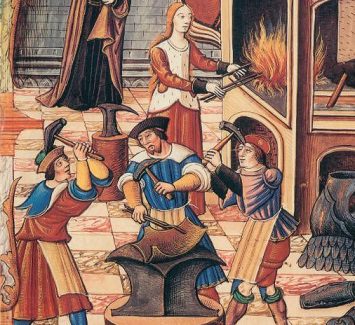
Within British Traditional Wicca (called in Britain simply “Initiatory Wicca”), there exists a structure known as the degree system. One’s first degree is initiation, or becoming one of the Wicca. Second and third degree initiates are acknowledged to be more experienced initiates of progressively greater skill, talent, or “power.” But what does it all mean in practice? In order to answer this question, let’s discuss the parallels that the medieval guild structure has with the Wiccan degree system . . . .
This series of posts is designed to be read in order if you haven’t seen the first installment click here for part one.
Journeyman
Journeymen artisans were expected to do just that, journey. Travel from town to town, work with others of the same guild in which they had apprenticed, learn and share styles, materials, tools, and techniques. Like apprenticeship, a journeyman’s study could take years. Journeymen were paid a wage, might live apart from the master’s residence, often married and started a family.
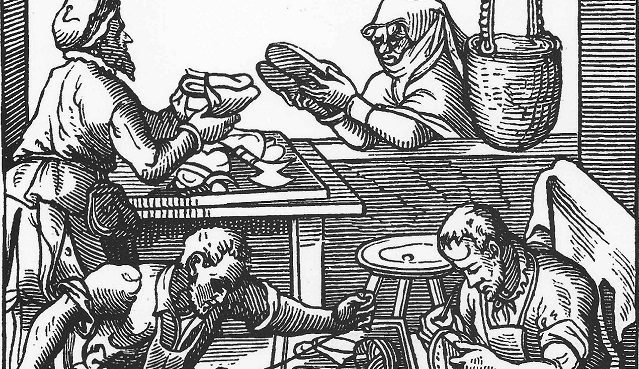
To transition to mastery, journeymen undertook to create a master-piece, a piece of work by their hands that was adjudged to be work worthy of a guild master. And not every journeyman, sometimes called a “jack,” succeeded in becoming a master in his guild. “Jack of all trades and master of none” refers to a person unsuccessful in achieving master status. A competent journeyman often remained in his master’s business as a valued assistant and still might rise to mastery in time. In larger craft workshops, a number of masters might work in a common facility. (1)
The Second Degree
Whether an initiate has been once or thrice round the Wheel of the Year and its sabbat cycle, elevation to the second degree brings many responsibilities and connections. First and foremost, second-degree elevation connects an initiate to the current of energy specific to initiatory Wicca. Such connection causes inevitable changes in an initiate—ones that need to be absorbed throughout her ensuing year and a day. The second degree carries a responsibility to the Craft as a whole.
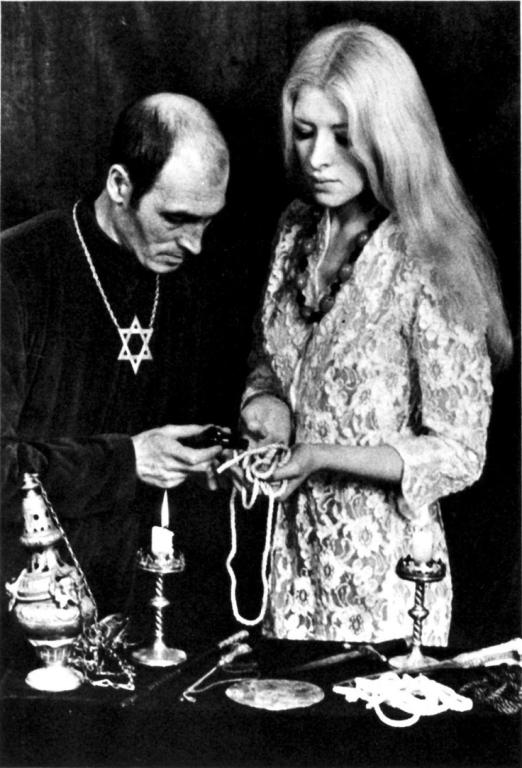 The expectations for a newly elevated second-degree witch begin with getting to know the God, a task which often involves path-workings and underworld trance journeys. Once the degree has settled, the second may guest with other covens, or attend multi-tradition open sabbats or classes of other traditions of witchcraft. During second degree work, initiates explore within themselves as well as without. Often second-degree initiates find challenges in dealing with their shadow selves, those parts which they’d rather not acknowledge, confront, resolve, nor have others know.
The duties of a second-degree witch include learning to teach magical skills, assisting the leaders of the coven, and learning the process of initiation to first or second degree. (2) The teaching requirement of second degree does not send our initiates out in search of converts; the Wicca do not proselytize. A second-degree initiate may have personal or family knowledge that interests the coven. For example, a student of eastern European ancestry might give the coven a class on traditional techniques and designs for dying pysanky, Slavic Easter eggs. Another may pursue research into home-brewing methods for making ritual ales or wines or meads, and share successful recipes in ritual. A working geologist may introduce the group to practical uses of natural minerals, including how to find the crystal that works—in contrast to the one that just looks pretty.
My Journey: Second Degree
As has been told elsewhere, teaching—that is, sharing the understanding I have of the basics of Craft study and magical techniques with other seekers—is something both that I felt “called” to do, and that is an expectation of initiates seeking to become a second-degree Wiccan. I had done so before I was “called,” and continued to do so, with restraint that respected my oaths as well as my students, for several years. A specific instance occurred during that teaching which affirmed my “calling” . . . . . .
I and my working partner taught a several-week series of the sort often known as “Wicca 101”—we titled it Introduction to Wicca. He and I both felt strongly that even at that level some very rudimentary energetic exercises must be a part of what we taught. Grounding, centering, the very first steps towards spiritual journeys or “astral travel” that provide basic safety protocols—those were among the energetic instruction that we included. Also an introduction to sensing auras—something that was part of our last session in the series.
A lovely middle-aged couple, a woman whose connection to Goddess fairly shone out of her, and her husband, an innately grounded man with a wide-open mind and pragmatic nature, were two of our students—I’ll call them Rose and Charlie. When it came to that last session of the course with our students in Rose & Charlie’s class, we partnered everyone up with someone else, someone not closer than just a fellow student, and asked them to ground, center, close their eyes, and try to perceive/sense/determine, by reaching out gently with both palms at chest height, to where their partner stood facing them—as they each stood matched up about four feet apart.
As was typical of our experience, everyone in the group found themselves sensing something of her or his partner at a distance of as little as 15 inches and as much as three feet. Except Charlie. I had partnered with Charlie, as it happens, and I found myself struggling to stand still as I watched him move his hands so close to me I thought he’d make contact. And then he stopped, at a distance of about ¾ of an inch. He pulled his hands back, and tried again, with the same result, and a look on his face of profound interest.
My memory will not retain the more routine details of the remainder of class, because once we wrapped up, Charlie told us that he had taken the course both to accompany his wife and learn about her spirituality…and as an exercise in spiritual philosophy. He had not expected to encounter anything that altered his perception of what was reality…but he had, not 20 minutes past. So not only did Rose take our second course offering, the forthcoming Wicca for Practitioners series or “Wicca 201”, but Charlie did, too.
The poem presented here is my understanding of the oath that I swore both at my initiation and on a later occasion.
To Swear an Oath
Upon my self I take the charge
To know and will and dare,
And to keep silent lest my kin
Be taken unaware.
Unto the Ancient Ones I heed
That, teaching me, hath wrought
The growth within me, and the pain
Of lessons dearly bought.
The Mystery I can never show,
Nor share, nor tell untime;
Yet ever share with kinfolk so:
In prose, and deed, and rhyme.
—2000 CE
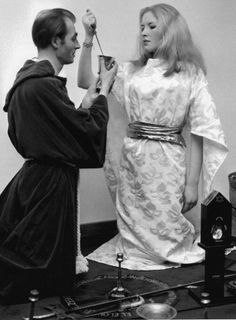 A second-degree practitioner may be given responsibilities beyond that of every coven member. A woman might be named “maiden” of the coven, often considered a deputy high priestess. Similarly, a man might be appointed “guardian” or “summoner” or asked to understudy the role of the high priest. Such understudy roles match the custom of the “maiden coven,” where its coven leaders are second-degree initiates growing into fully-fledged coven leaders under the guidance of their parent coven.
Underworld journeying, shamanic studies, divinatory methods beyond any yet used, Craft history, the second degree calls the witch to live the Wiccan path as much as study it. Inevitably, bumps and bruises, missteps and mistakes occur along the way. Often, coven leaders are called upon to assist with mistakes, correct missteps, cluck over the bumps, and salve the bruises… or not, as seems good to them. Sometimes a coven leader’s hardest task is to allow the error to occur, and wait until asked for assistance before deciding whether to act or to let be, to speak or to keep silent.
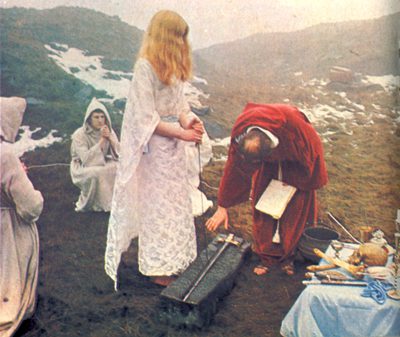 During second-degree studies, practitioners determine or discover any Craft specialties. They may have healing talent, and learn ways to use it within Craft as well as without. They may find they develop undiscovered psychic skills, or even the ability to teach them. A second-degree witch may choose a wider audience, presenting open rituals for the local pagan community, offering classes in herbs, stones, divination, or dance. Nothing in the tradition forbids such public teaching, and nothing in the tradition demands it.
Second degree also requires practitioners to step out of their comfort zone, another form of journeying. They may be adept at tarot but ignorant of astrology, talented at rhymed spells but unable to keep a steady beat on drum or rattle. Learning unfamiliar skills, stretching into tasks and techniques that are unfamiliar or outright alien, these challenges broaden practitioners while adding more tools to their witchy toolbox.
Unlike the first degree, once one has progressed to the second degree, one is expected to work to achieve the third degree. First degrees are practitioners, plain and simple, with but responsibility to their gods, their coven, and themselves. Second degree engenders a deeper change, imbuing a sense of having begun something which is less than complete… and an awareness of challenges to come.
Click here for part three!
 About Our Guest
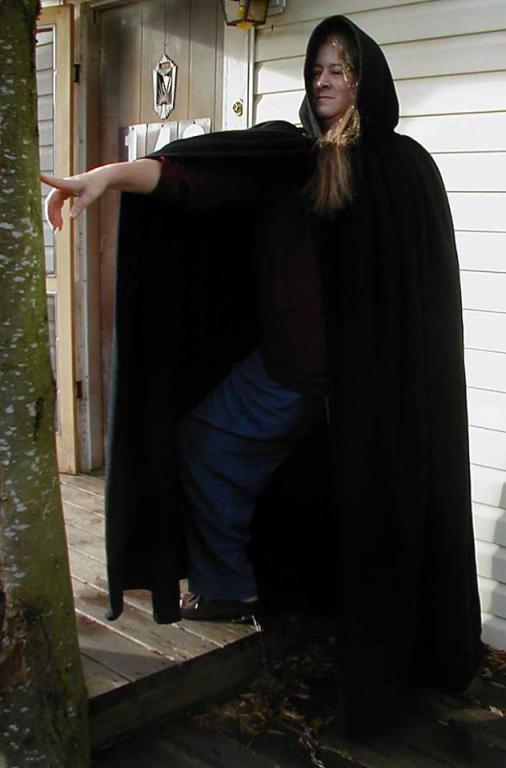
Deborah Snavely has been a Gardnerian initiate since 1995, and became an elder in the Craft in 2001. The following year she founded her first coven, a second followed in 2010. During the 1990’s she was editor of Pagan Muse & World Report, which won a Reader’s Choice Bronze Award from the Wiccan/Pagan Press Alliance in 1996. Deborah was an early online presence and hosted a weekly Pagan/Wiccan Discussion Group at AOL’s Religion and Ethics Forum. That forum was named “One of the 50 Best Places to Be Online”by PC Week Magazine in 1995.
Deborah has been studying divination since 1975, and has worked as a professional reader. Her favorite deck is the Robin Wood Tarot.
NOTES
1. http://en.wikipedia.org/wiki/Journeyman
2. At second degree, most North American initiates have the ability—but not the authority—to initiate another person into the Wicca; that authority remains with the third-degree coven leaders, who may appoint a working pair of second degrees to lead what is sometimes called a maiden coven. Initiations into such a maiden coven are performed by the second-degree leaders…whose authority to perform the initiations are granted by their elder third degrees. In contrast, some European BTW covens are led by second-degree initiates; the third degree being viewed as almost a spiritual retirement, or one undertaken by a working partnership together to complete the hieros gamos.
Previous Post

November 4, 2014
Degrees, Guilds, and Initiation Into the Wicca
Next Post

November 5, 2014 Degrees, Guilds, and Initiations: Third Degree
Browse Our Archives
Select a Category Editorializing Gateways to Paganism Guest Posts Holiday Histories Led Zeppelin News and Views Occult Pagan Pagan TV Club Paganism polytheism Ramble On Reviews Ritual Strange Days Uncategorized
Select a Month August 2026 March 2026 February 2026 November 2025 September 2025 August 2025 April 2025 August 2024 April 2024 February 2024 December 2023 October 2023 August 2023 June 2023 May 2023 January 2023 October 2022 August 2022 July 2022 June 2022 May 2022 April 2022 March 2022 February 2022 January 2022 December 2021 November 2021 October 2021 September 2021 August 2021 July 2021 June 2021 April 2021 March 2021 February 2021 January 2021 December 2020 November 2020 October 2020 August 2020 July 2020 June 2020 May 2020 April 2020 March 2020 February 2020 January 2020 December 2019 November 2019 October 2019 September 2019 August 2019 July 2019 June 2019 May 2019 April 2019 March 2019 February 2019 January 2019 December 2018 November 2018 October 2018 September 2018 August 2018 July 2018 June 2018 May 2018 April 2018 March 2018 February 2018 January 2018 December 2017 November 2017 October 2017 September 2017 August 2017 July 2017 June 2017 May 2017 April 2017 March 2017 February 2017 January 2017 December 2016 November 2016 October 2016 September 2016 August 2016 July 2016 June 2016 May 2016 April 2016 March 2016 February 2016 January 2016 December 2015 November 2015 October 2015 September 2015 August 2015 July 2015 June 2015 May 2015 April 2015 March 2015 February 2015 January 2015 December 2014 November 2014 October 2014 September 2014 August 2014 July 2014 June 2014 May 2014 April 2014 March 2014 February 2014 January 2014 December 2013 November 2013 October 2013 September 2013 August 2013 July 2013 June 2013 May 2013 April 2013 March 2013 February 2013 January 2013 December 2012 November 2012 October 2012 September 2012 August 2012 July 2012 June 2012 April 2012 October 2011 September 2011 August 2011
Follow Us!
TAKE THE
Religious Wisdom Quiz
In 1 Thessalonians, what does Paul say about the dead in Christ when the Lord returns?
Select your answer to see how you score.
They will rise last They will rise first They will be caught up in glory They will be judged
Related posts from Raise the Horns

What Makes a Good Ritualist? No Idea

Witchcraft Remembrances & Appreciation at Samhaintide

Raymond Buckland & The Big Blue Book

TRENDING AT PATHEOS Pagan

The Sermon on the Mount, Part I: Matthew...
The Sermon on the Mount, Part I (Matthew 4:12-5:12) St. Matthew moves...

What's up from Crossway: Reviewing some of their latest A few weeks...

Janie Learns the Way of the Cross: A...
Teaching children about Jesus' Passion can be challenging. Many parents and educators...

Looking For Good Catholic Writing - October 2026
He alone extends the heavens, and he walks upon the waves of...

In "Irreplaceable," our book on vocation and technology, Trevor Sutton and I...

I was strolling through the top floor of the brand new Parthenon...
view all Pagan blogs
Ad-Free & Subscriber Log-In Subscription Support
- About Us
- 2026 Calendar
- Videos
- Podcasts
- Library of World Religions
- Faith In Media Tracker
- Advertise With Us
- Write for Us
- Privacy Policy
- Terms of Service
- Do Not Sell My Data
- Contact Us
- Radiant Digital
- Manage Newsletter Subscriptions
- Unsubscribe From Notifications
- Sitemap
Copyright 2008-2026, Patheos. All rights reserved.
Subscription Support Ad-Free & Subscriber Log-In
Follow Patheos