
BuddhistCatholicContemplativeEvangelicalGeneral ChristianHinduJewishLatter-day SaintMuslimNew VisionsProgressive Christian
Beliefs
- Buddhist
- Catholic
- Contemplative
- Evangelical
- General Christian
- Hindu
- Jewish
- Latter-day Saint
- More Voices
- Muslim
- New Visions
- Pagan
- Progressive Christian
Topics
- Religion News
- Food and Religion
- Sports and Religion
- Religious Art
- Religious Music and Entertainment
- Religious Events
- History and Religion
- Style and Religion
- Politics and Religion
- Women in Religion
- Recreation Outdoors and Religion
- Business Finance and Religion
- Careers Workplace and Religion
- Education and Religion
- Family Parenting and Religion
- Health Fitness and Religion
- Home and Religion
- Relationships and Religion
- Technology and Religion
- Travel and Religion
Columnists
- Buddhist Columnists
- Business Finance and Religion Columnists
- Careers Workplace and Religion Columnists
- Catholic Columnists
- Contemplative Columnists
- Education and Religion Columnists
- Evangelists Columnists
- Family Parenting and Religion Columnists
- General Christian Columnists
- Health Fitness and Religion Columnists
- Hindu Columnists
- History and Religion Columnists
- Home and Religion Columnists
- Jewish Columnists
- More Voices Columnists
- Latter Day Columnists
- Muslim Columnists
- New Visions Columnists
- Nonreligious Columnists
- Pagan Columnists
- Politics and Religion Columnists
- Progressive Columnists
- Recreation Outdoors and Religion Columnists
- Relationships and Religion Columnists
- Religion News Columnists
- Religious Art Columnists
- Religious Events Columnists
- Religious Music and Entertainment Columnists
- Sports and Religion Columnists
- Style and Religion Columnists
- Technology and Religion Columnists
- Travel and Religion Columnists
- Women in Religion Columnists
Resource Library
- 2026 Calendar
- Library of World Religions
- The 100 Most Holy Places on Earth
- Patheos Answers
- Podcasts
- Videos
- Faith Leaders Database
- Anglican Episcopalian
- Bahai
- Baptist
- Buddhism
- Christianity
- Confucianism
- Eastern Orthodoxy
- Hinduism
- Holiness and Pentecostal
- ISKCON
- Islam
- Judaism
- Lutheran
- Methodist
- The Church of Jesus Christ of Latter-day Saints
- New Age
- Paganism
- Presbytarian and Reformed
- Protestantism
- Religion Behind the Scenes
- Roman Catholic
- Scientology
- Shia Islam
- Sikhism
- Sufism
- Sunni Islam
- Taoism
- Zen
- See all religions
Research Tools
 Ad-Free & Subscriber Log-In Subscription Support
Ad-Free & Subscriber Log-In Subscription Support
Follow Patheos 

- Trending:
- Forgiveness
- |
- Marriage
- |
- Consciousness
- |
- Death Penalty
- |
- Election
- |
- Halloween

- HOME
- Me and the Blog
- Defining Pagan
- Rituals & Holidays
- All Posts
- Blogroll
- Publications
- FREE NEWSLETTER
- Home
- Pagan
- Pagan Time Capsule: 1990’s
Pagan Time Capsule: 1990’s
Last updated on: August 23, 2014 at 9:23 am by Jason Mankey
Pagan Time Capsule: 1990’s 2014-08-23T09:23:07-06:00 Jason Mankey
Patheos Explore the world's faith through different perspectives on religion and spirituality! Patheos has the views of the prevalent religions and spiritualities of the world.
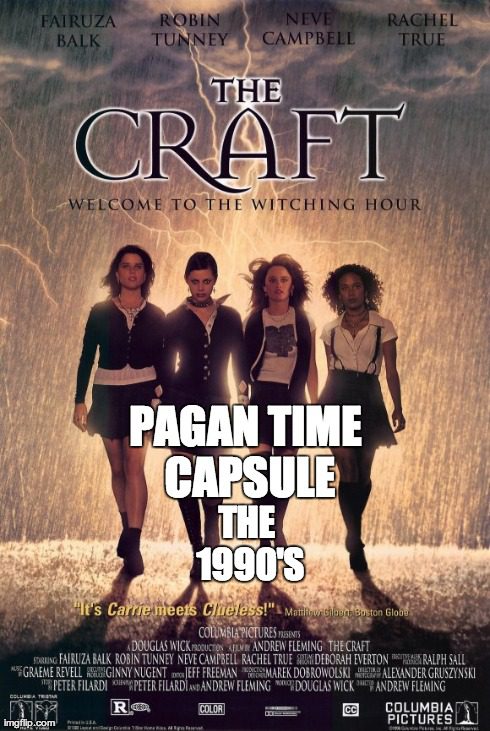 This year marks the 60th Anniversary of Public Paganism. Back in 1954 Gerald Gardner released the first book documenting a living, breathing, and long-lasting Witch tradition and kicked off the Pagan revival. Gifted with an introduction by Dr. Margaret Murray Witchcraft Today launched a now world-wide religious movement. I’m sure that Witches and other Pagans existed and practiced before Gardner, but Gardner made his (and by extension our) presence known in a big way. Modern Paganism would most likely have existed without Gardner but perhaps in a very different and/or diminished form.
In celebration of sixty years and seven decades of Public Paganism I’ll be breaking down the essentials of Paganism decade by decade. I’ll take a look a the books, the music, and movies that have driven (and continue to drive) Modern Paganism. The items contained in many of our early Pagan Time Capsules will be a bit Witchcraft-Centric, but that will change as the decades move along. In each time capsule I’ll be placing five to six books, one or two movies, a few albums/songs, and one bonus item.
Once the 1990’s get rolling things get pretty personal for me, that was the decade I became a Pagan, and I’m way too close to the books and music of the era to write about it all objectively. I tried to write as a historian over the first four installments of this series, but I’m just too close to the 90’s to be able to do that here. So while you are reading all of this remember that a lot of it is directly filtered through my own experiences. All that being said I think the 1990’s were a huge decade in the development of Modern Paganism. We sort of went mainstream in the 90’s and we’ve never looked back . . . . .
Other editions of Pagan Time Capsule: The Fabulous Fifties, the Swinging Sixties, Shagging Seventies, Ecstatic Eighties, and The Nifty Nineties. The entire series is also summed up here in Pagan History on the Margins.
BOOKS
 Much of Modern Paganism’s early history focuses almost exclusively on Modern Witchcraft. I know how aggravating that is for some and as a history buff myself I realize that the heavy focus on Witchcraft is rather dishonest. There have always been lots of Pagans outside of the sphere of Witchcraft and Wicca, but until the 1990’s there were few books available on those “other” traditions. As a young Pagan in the 90’s I was immediately attracted to Witchcraft (and that attraction has continued unabated since) but I also felt as if reading about traditions outside of Witchcraft was imperative. How could I possible be a good Pagan without knowing something about Druidry and the Norse traditions?
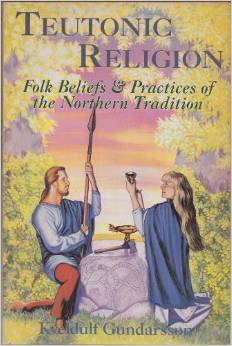
Speaking of Norse traditions, one of the earliest Teutonic “101” books was Kveldulf Gundarsson’s Teutonic Religion: Folk Beliefs & Practices of the Northern Tradition (1991). I have no idea if Gundarsson’s book is considered a classic in the genre, what’s important to me is simply its existence. Until the early 90’s everything seemed to only be about Witchcraft, even some of the books claiming to be “Norse” were simply re-worked versions of Wicca with a few “Hail Odins” tossed in for shits and giggles. Gundarsson’s book was of real interest to me not because I thought it was where I was headed, but because I wanted to learn more about the broad expanse of Paganism.
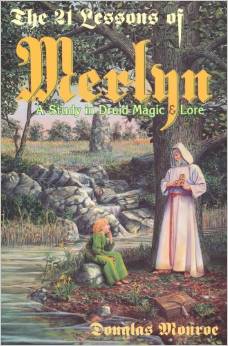 On the opposite spectrum but fascinating as a curio is Douglas Monroe’s The 21 Lessons of Merlyn: A Study in Druid and Magic Lore (1992). As a young Pagan I thought this was the book to read in order to understand Celtic Paganism, oh how wrong I was! I’m not sure “con job” is how I should describe this book, but the lessons shared by Merlyn are all from the mind of Monroe (with a nod to the movie Excalibur). As a work of very speculative spiritual fiction it’s fine for what it is, but Monroe tried so hard to pass it off as historical . . . . a few knowing winks would have been welcome. I’m adding Merlyn to my time capsule though because it’s rather representative of the 90’s. There was a lot of good and a lot of bad. Merlyn was the volume available at Barnes and Noble (it was the 90’s, the heyday of the book superstore) when maybe it should have been something from Phillip Carr-Gomm.
You know your religious movement is growing up when it has a book available for families raising “the next generation.” Such was Circle Round: Raising Children in Goddess Traditions by Starhawk, Anne Hill, and Diane Baker (1998). Circle Round is such a good book that even as a person without kids I still sometimes flip through it looking for inspiration and ritual ideas. I’ve always enjoyed Paganism’s little victories, I’ve always felt that this book was one of them.
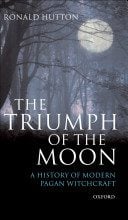 Speaking of triumphs, my favorite book of the 90’s remains Triumph of the Moon by Ronald Hutton (1999). Triumph changed the way we look at our history and helped establish “Pagan Studies” as a viable academic discipline. I know that there are some folks out there who don’t care for this book (and some, though not all, of their criticisms are valid) but this is one I still re-read all these years later. I literally skipped through my local B&N the first day I held this book in my hands (I worked there so I had it even before its official release date) and when I re-read it I sometimes do the same. To some extent Hutton helped us grow up. A mythological past is not a bad thing, but a past grounded in history is sometimes even more satisfying.
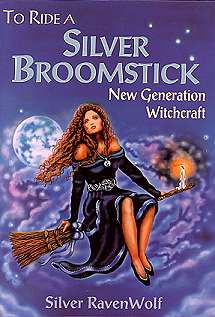 If I were to sum up the 1990’s in one book it would be To Ride a Silver Broomstick by Silver RavenWolf (1994). For a certain generation Broomstick is the book we grew up with and while some of us loathe it twenty years later the fact that so many of us Gen X folks have an opinion about it tells you all you need to know. I think a lot of the criticisms of Broomstick are overblown, and no matter what one thinks of RavenWolf her skills as a writer shouldn’t be called into question. For a generation of Witches (especially those who came to the Craft as young women) Broomstick pushed all the right buttons. Silver wrote about magic in a way that felt magical and not clinical and she made being a Witch look like the coolest, most interesting thing in the world. (I posted a very long look at Broomstick and Silver in May of last year, in many ways it’s a great companion piece to this article.)
MOVIES
https://www.youtube.com/watch?v=oRxTe9APAJ0
One of the things that made RavenWolf so popular in the 90’s was that her books seemed perfectly suited to pick up where the 1996 movie The Craft left off. It’s easy to simply dismiss The Craft as The Crap but it had its moments. The scene at the beach (located right above you on this page) with the calls to the Watchtowers was pretty spiffy and sounds like an actual Witch ritual. Sure it all goes downhill shortly thereafter but aren’t those few fleeting moments gorgeous? In 1996 I was mostly a solitary and while I had met some other Pagans I never really got to do ritual with them. The Craft was kind of a show and tell for how ritual might actually look if it was being done on a beach with four super-hot girls. (I’m sorry for the objectification, but I think that’s exactly how the producers of the movie wanted me to feel.) There was even a representative from Covenant of the Goddess consulting on The Craft (for all the good it did), but come on, it’s Hollywood! They weren’t making a documentary.
I remember getting a phone call in 1998 from a girlfriend imploring me to turn my TV over to PBS. Since it wasn’t during football season I complied and got swept up in Lord of the Dance at least until the show was interrupted by several twenty minute interludes asking me for money. Premiering in 1996 Lord of the Dance was a bigger louder version of 1994’s Riverdance (but with moving arms) and I though it was one of the coolest things I’d ever seen at the time. During the 1990’s “Celtic” was all the rage and if it was Irish or Welsh or Scottish it was Celtic right? And if it was Celtic it was probably linked to ancient paganisms? Again am I right? I’m not of course, but stuff like Lord of the Dance was how a lot of us imagined paganism might have looked one thousand years ago. The whole “things labeled Celtic=Paganism” equation is still here in 2014 too!
MUSIC
Picking out just a few albums from the 90’s is near impossible. There was a lot of mainstream music during the decade with Pagan overtones (Tori Amos, 311, Godsmack, and Julian Cope) and narrowing everything down to only a couple of selections presents a real challenge. I don’t think any artist has “scored” more of my rituals than Loreena McKennitt so she has to be my first choice here. Sure her first few records came out in the late 80’s, but she really found her musical footing (and a larger audience) on 1991’s The Visit. All of her 90’s era albums “feel Pagan” but it’s The Visit that was almost most explicitly so. All Soul’s Night, The Old Ways, Between the Shadows . . . . . those song-titles sound ready made to insert into your nearest Samhain Ritual. Lyrically and musically McKennitt has always drawn from a wide variety of sources (culturally and religiously) but most of her best music has always had a distinctly Pagan-Witch-lost-in-the-moonlight sort of vibe.
I was late to the Inkubus Sukkubus (and before 1995 spelled Incubus Succubus) party partly because the songs that everyone played for me were always the overly “gothy” ones. What makes Inkubus Sukkubus great are how they mix those goth influences with heavy metal, folk music, orchestrations, and overtly Pagan themes and lyrics. It’s probably easier to hear and find IS today than it was fifteen years ago, though that didn’t stop a whole lot of Pagans I know from listening to the band back in the 90’s. Wytches (1994) is an easy choice for the time capsule because of the title and because there’s a song to Pan on there (I’m a sucker for Pan songs). Until writing this article I had always believed that IS were signed to a major label, it’s rare for a mostly independent band to have the kind of following IS does.
I’ll always love me some Dar Williams and every Yuletide her song The Christians and the Pagans (from the album The Mortal City, 1996) finds itself on every Holiday Playlist I put together. As a song tCatP is cute, as a theological statement it’s pretty close to what I believe. Dar was also the most “mainstream” artist on the 2004 Serpentine release The Best of Pagan Song, which features The Christians and the Pagans of course.
BONUS
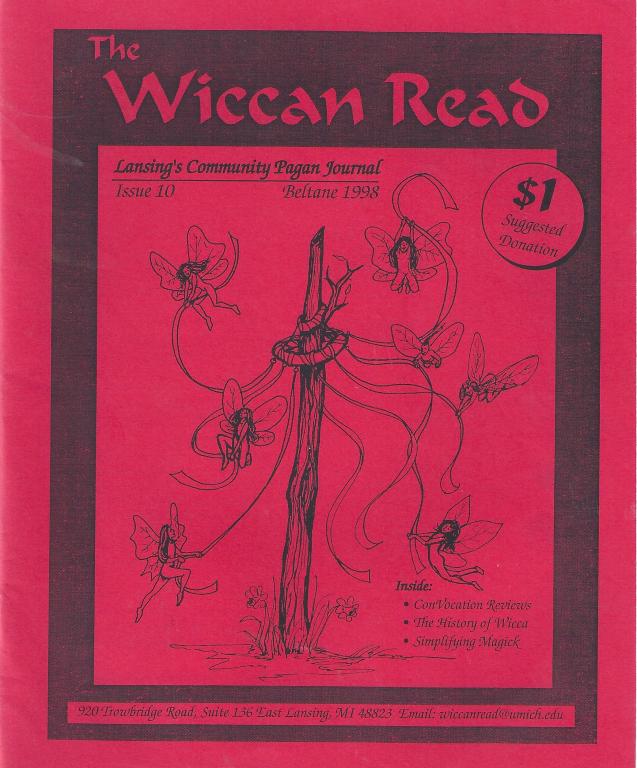 The 90’s were a pretty heady and pretty transitional time. Pagan magazines and Pagan ‘zines were at their height, and the very thing that made them so easy to put together eventually killed them too! Lansing Michigan’s The Wiccan Read (featuring 1998’s tenth issue) wasn’t the best Pagan ‘zine in the world but it was the best ‘zine in the Lansing Michigan area and featured my earliest forays into Pagan writing. Our Beltane issue had articles on Pagan history, The Necronomicon, a Horned God meditation, music reviews . . . . . maybe it’s not as bad as I remember (hats off to us Dwayne and Maggi!).
I ended up online because of Paganism. The first big group of Pagans I ran around with were all a part of Green Spiral at Michigan State University and staying in contact with them meant using Netscape and signing up for something called “email”. Back in those days (1995) checking that email meant visiting a university computer lab or a “cyber cafe” and nearly anything new on “the net” was “like totally the most awesome thing in the world.” One of those most awesome things in the world was The Witches Voice website circa February/March of 1997. I remember thinking “how Pagan can we make Michigan look!?!?” Witchvox made our little calendar in The Wiccan Read almost instantly obsolete. The internet changed everything. All of a sudden Pagans and Pagandom became a lot easier to find. It was the end of an era and the beginning of one too.

Do you like Raise the Horns? Even if you don’t how about humoring a harmless blond-haired guy? Like RtH on Facebook, and also like Patheos Pagan for more great articles most of them far better than this one. Are you a Pagan living in the UK? Jason will be in London and Edinburgh this September and October, send him a message if you’d like to get a cup of tea or a pint of cider.
Previous Post

August 10, 2014
Pagan Time Capsule: 1980's
Next Post

August 19, 2014 The Grass is Always Greener . . . . . Pagan Community
Browse Our Archives
Select a Category Editorializing Gateways to Paganism Guest Posts Holiday Histories Led Zeppelin News and Views Occult Pagan Pagan TV Club Paganism polytheism Ramble On Reviews Ritual Strange Days Uncategorized
Select a Month August 2026 March 2026 February 2026 November 2025 September 2025 August 2025 April 2025 August 2024 April 2024 February 2024 December 2023 October 2023 August 2023 June 2023 May 2023 January 2023 October 2022 August 2022 July 2022 June 2022 May 2022 April 2022 March 2022 February 2022 January 2022 December 2021 November 2021 October 2021 September 2021 August 2021 July 2021 June 2021 April 2021 March 2021 February 2021 January 2021 December 2020 November 2020 October 2020 August 2020 July 2020 June 2020 May 2020 April 2020 March 2020 February 2020 January 2020 December 2019 November 2019 October 2019 September 2019 August 2019 July 2019 June 2019 May 2019 April 2019 March 2019 February 2019 January 2019 December 2018 November 2018 October 2018 September 2018 August 2018 July 2018 June 2018 May 2018 April 2018 March 2018 February 2018 January 2018 December 2017 November 2017 October 2017 September 2017 August 2017 July 2017 June 2017 May 2017 April 2017 March 2017 February 2017 January 2017 December 2016 November 2016 October 2016 September 2016 August 2016 July 2016 June 2016 May 2016 April 2016 March 2016 February 2016 January 2016 December 2015 November 2015 October 2015 September 2015 August 2015 July 2015 June 2015 May 2015 April 2015 March 2015 February 2015 January 2015 December 2014 November 2014 October 2014 September 2014 August 2014 July 2014 June 2014 May 2014 April 2014 March 2014 February 2014 January 2014 December 2013 November 2013 October 2013 September 2013 August 2013 July 2013 June 2013 May 2013 April 2013 March 2013 February 2013 January 2013 December 2012 November 2012 October 2012 September 2012 August 2012 July 2012 June 2012 April 2012 October 2011 September 2011 August 2011
Follow Us!
TAKE THE
Religious Wisdom Quiz
Whom did Paul leave sick at Miletus, showing that early Christians sometimes suffered illness?
Select your answer to see how you score.
Barnabas Trophimus Silas Timothy
Related posts from Raise the Horns

What Makes a Good Ritualist? No Idea

Witchcraft Remembrances & Appreciation at Samhaintide

Raymond Buckland & The Big Blue Book

TRENDING AT PATHEOS Pagan

The Sermon on the Mount, Part I: Matthew...
The Sermon on the Mount, Part I (Matthew 4:12-5:12) St. Matthew moves...

What's up from Crossway: Reviewing some of their latest A few weeks...

Janie Learns the Way of the Cross: A...
Teaching children about Jesus' Passion can be challenging. Many parents and educators...

Looking For Good Catholic Writing - October 2026
He alone extends the heavens, and he walks upon the waves of...

In "Irreplaceable," our book on vocation and technology, Trevor Sutton and I...

I was strolling through the top floor of the brand new Parthenon...
view all Pagan blogs
Ad-Free & Subscriber Log-In Subscription Support
- About Us
- 2026 Calendar
- Videos
- Podcasts
- Library of World Religions
- Faith In Media Tracker
- Advertise With Us
- Write for Us
- Privacy Policy
- Terms of Service
- Do Not Sell My Data
- Contact Us
- Radiant Digital
- Manage Newsletter Subscriptions
- Unsubscribe From Notifications
- Sitemap
Copyright 2008-2026, Patheos. All rights reserved.
Subscription Support Ad-Free & Subscriber Log-In
Follow Patheos