
BuddhistCatholicContemplativeEvangelicalGeneral ChristianHinduJewishLatter-day SaintMuslimNew VisionsProgressive Christian
Beliefs
- Buddhist
- Catholic
- Contemplative
- Evangelical
- General Christian
- Hindu
- Jewish
- Latter-day Saint
- More Voices
- Muslim
- New Visions
- Pagan
- Progressive Christian
Topics
- Religion News
- Food and Religion
- Sports and Religion
- Religious Art
- Religious Music and Entertainment
- Religious Events
- History and Religion
- Style and Religion
- Politics and Religion
- Women in Religion
- Recreation Outdoors and Religion
- Business Finance and Religion
- Careers Workplace and Religion
- Education and Religion
- Family Parenting and Religion
- Health Fitness and Religion
- Home and Religion
- Relationships and Religion
- Technology and Religion
- Travel and Religion
Columnists
- Buddhist Columnists
- Business Finance and Religion Columnists
- Careers Workplace and Religion Columnists
- Catholic Columnists
- Contemplative Columnists
- Education and Religion Columnists
- Evangelists Columnists
- Family Parenting and Religion Columnists
- General Christian Columnists
- Health Fitness and Religion Columnists
- Hindu Columnists
- History and Religion Columnists
- Home and Religion Columnists
- Jewish Columnists
- More Voices Columnists
- Latter Day Columnists
- Muslim Columnists
- New Visions Columnists
- Nonreligious Columnists
- Pagan Columnists
- Politics and Religion Columnists
- Progressive Columnists
- Recreation Outdoors and Religion Columnists
- Relationships and Religion Columnists
- Religion News Columnists
- Religious Art Columnists
- Religious Events Columnists
- Religious Music and Entertainment Columnists
- Sports and Religion Columnists
- Style and Religion Columnists
- Technology and Religion Columnists
- Travel and Religion Columnists
- Women in Religion Columnists
Resource Library
- 2026 Calendar
- Library of World Religions
- The 100 Most Holy Places on Earth
- Patheos Answers
- Podcasts
- Videos
- Faith Leaders Database
- Anglican Episcopalian
- Bahai
- Baptist
- Buddhism
- Christianity
- Confucianism
- Eastern Orthodoxy
- Hinduism
- Holiness and Pentecostal
- ISKCON
- Islam
- Judaism
- Lutheran
- Methodist
- The Church of Jesus Christ of Latter-day Saints
- New Age
- Paganism
- Presbytarian and Reformed
- Protestantism
- Religion Behind the Scenes
- Roman Catholic
- Scientology
- Shia Islam
- Sikhism
- Sufism
- Sunni Islam
- Taoism
- Zen
- See all religions
Research Tools
 Ad-Free & Subscriber Log-In Subscription Support
Ad-Free & Subscriber Log-In Subscription Support
Follow Patheos 

- Trending:
- Forgiveness
- |
- Marriage
- |
- Consciousness
- |
- Death Penalty
- |
- Election
- |
- Halloween

- HOME
- Me and the Blog
- Defining Pagan
- Rituals & Holidays
- All Posts
- Blogroll
- Publications
- FREE NEWSLETTER
- Home
- Pagan
- A (Pagan) Wind in the Willows
A (Pagan) Wind in the Willows
Last updated on: June 29, 2017 at 7:04 pm by Jason Mankey
A (Pagan) Wind in the Willows 2017-06-29T19:04:11-06:00 Jason Mankey
Patheos Explore the world's faith through different perspectives on religion and spirituality! Patheos has the views of the prevalent religions and spiritualities of the world.
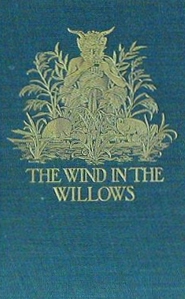 In many ways there are two different versions of the Greek God Pan. There’s the classic understanding of Pan: Arcadian, son of Hermes, and god of shepherds, panic, lust, and masturbation. I’ve never been a shepherd but I understand those three other impulses reasonably well. This is also the “darker” Pan, the one who rapes nymphs and causes armies to fall on their own swords just for entering his domain. Pan is often portrayed as sweetness and light today, but that’s not how he was understood in Ancient Greece.
The kinder, gentler version of Pan many of us know today comes courtesy of early Nineteenth Century England and can be directly traced to the Romantic Poetry of the period. In the writings of Keats, Shelley, Hunt, and Wordsworth Pan was transformed from a more minor untamed god into the protector of the eternal English Countryside. Certainly the Ancient Greeks liked Pan, but they never quite saw him as the embodiment of all nature. In the Nineteenth Century Pan went from god of the shepherds (the Indo-European root word “pa” means shepherd) to god of all (which is how the word pan translates in Modern Greek). The change in Pan’s disposition can be looked at in a number of ways. The easiest one might be that of “artistic license,” with Pan becoming the English god of nature through a misunderstanding of his name. That’s certainly possibly, but I’ve always believed that it most likely came about due to a change in the god himself.
 The “literary cult of Pan” lasted for about one hundred and twenty years, from the start of the Nineteenth Century up until the end of World War One. I wouldn’t say that “Pan left the building” after the first world war, but he did recede a bit from popular literature. One of my favorite Pan appearances post-1920 is in Dion Fortune’s The Goat Foot God, and my second favorite treatment of Pan in all of literature takes place in Jitterbug Perfume by Tom Robbins, first published in 1986. (Jitterbug Perfume contains perhaps my favorite line in all of English literature: “In losing you they were losing their body wisdom, their moon mystery, their mountain wisdom, they were trading the live wood of the maypole for the dead carpentry of the cross.”) Even more recently Rick Riordan, the author of the Percy Jackson series of books, has written some rather flattering things about my favorite hoofed deity. Pan has appeared in literally hundreds of poems, plays, and stories, but to me the greatest flowering of Pan in literature will always be found in Kenneth Grahame’s The Wind in the Willows from 1908.
Pan was never the star of Willows, but the chapter in which he appears (Chapter Seven, The Piper at the Gates of Dawn) ended up as the inspiration for the book’s initial cover art. It’s also been the part of the book that has most resonated with me over the years (for perhaps obvious reasons), but when I talk to people about the book or share a little bit of it with the unfamiliar, I find them just as hooked. I’ve read Piper at the Gates of Dawn probably a hundred times or so in my life and nearly every time I do so I find myself nearly reduced to tears. Pan isn’t just a “nature god” in Grahame’s book; he’s an “august Presence” and “the Friend and Helper.” He’s knowable and awesome, beautiful and terrifying, and completely worthy of worship. How a book that contains this passage:
“Rat!” he found breath to whisper, shaking. “Are you afraid?”
“Afraid?” murmured the Rat, his eyes shining with unutterable love. “Afraid! Of Him? O, never, never! And yet—and yet—O, Mole, I am afraid!”
Then the two animals, crouching to the earth, bowed their heads and did worship.
How The Wind in the Willows has managed to stay in public school libraries over the years with very little controversy is a testament to just how great the god Pan truly is. (Or perhaps blessed ignorance . . . it’s a book with talking toads, moles, and otters, how theological could it ever be?)
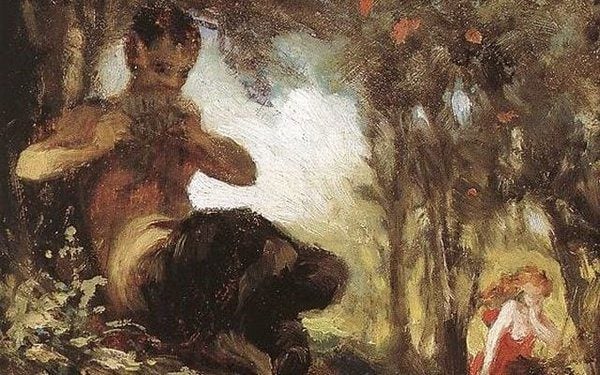
A Faun, by Pál Szinyei Merse, from WikiMedia.
While Pan only shows up once in Willows he (along with some of his Olympian brethren) was a frequent guest in the writings of Kenneth Grahame. I think it’s safe to write that Grahame saw Pan as his link to the British Countryside. Reading about the life of Grahame it’s clear that all he really wanted to do was fish, boat, travel, and hunt. He was also a bit of a curmudgeon who enjoyed his privacy. He liked being away from civilization and his version of Pan is a clear expression of that. One of Grahame’s first (anonymously) published pieces was specifically about the god Pan in nature. The Rural Pan, An April Essay was originally published in 1891 and in 1893 made its way into Grahame’s first book, The Pagan Papers (mostly a collection of previously published essays). The Pan in April Essay has a lot in common with the Piper who would turn up in The Wind in the Willows:
“But remote in other haunts than these the rural Pan is hiding, and piping the low, sweet strain that reaches only the ears of a chosen few. And now that the year wearily turns and stretches herself before the perfect waking, the god emboldened begins to blow a clearer note.”
“Yes: to-day the iron horse has searched the country through . . . . Bringing, too, into every nook and corner fashion and chatter, the tailor-made gown and the eyeglass. Happily a great part is still spared . . . . in which the rural Pan and his following may hide their heads for yet a little longer, until the growing tyranny has invaded the last common, spinney, and sheep-down, and driven the kindly god, the well-wisher to man — whither?”
I would never go so far as to say that Grahame worshipped the god Pan, but clearly Grahame felt something for the goat footed one.
To me Grahame’s version of Pan is exceedingly clear: he’s the personification of benign nature, “the god” of the wild places, but some scholars have come up with different interpretations over the years. Writing in the periodical Victorian Studies Michael Steig envisions Pan as both a Father and Mother figure: ” . . the animals’ response combines a worship of the nurturing mother . . . with a submission to the all-powerful but benign father,” interesting, but the literary cult of Pan was not a new thing in 1908. If anything it was a 100 year old literary tradition, a tradition that had never before seen Pan as both a mother and father.
Stein also describes Mole and Rat’s encounter with Pan as: “intensely erotic, from the initial intoxication of melody, to the violent trembling at the sight of ‘things rightly kept hidden.'” Other commenters over the years have described Grahame’s Pan as having “a touch of the homoerotic.” Certainly Pan can be a sexual (and sensual) god, but there’s enough of the chaste and reserved in Grahame to make such assumptions unlikely. In other words, I just don’t see it, but that doesn’t necessarily mean it’s not there.
For the last nine years I’ve been facilitating workshops on the worship of Pan in Ancient Greece and his re-emergence in the Modern World. I’ve typically finished my lectures on Pan with an excerpt from Piper, and to this day it still gets to me. I know that the Pan of Arcadian Greece still plays his pan-pipes, but Grahame’s modern understanding of Pan most directly illustrates the god who stole my heart. It’s Pan at his very best. He’s powerful, vulnerable, and his tune is the very song of Nature. There are things like it in English literature, but nothing as beautiful, and it can all be found in a beloved “children’s book.”
Io Pan!
Below is an audio clip of me reading my favorite passage from Willows. The relevant text is below that.
Jason’s Favorite Bit in all of Literature:
“This is the place of my song-dream, the place the music played to me,” whispered the Rat, as if in a trance. “Here, in this holy place, here if anywhere, surely we shall find Him!”
Then suddenly the Mole felt a great Awe fall upon him, an awe that turned his muscles to water, bowed his head, and rooted his feet to the ground. It was no panic terror—indeed he felt wonderfully at peace and happy—but it was an awe that smote and held him and, without seeing, he knew it could only mean that some august Presence was very, very near. With difficulty he turned to look for his friend, and saw him at his side, cowed, stricken, and trembling violently. And still there was utter silence in the populous bird-haunted branches around them; and still the light grew and grew.
Perhaps he would never have dared to raise his eyes, but that, though the piping was now hushed, the call and the summons seemed still dominant and imperious. He might not refuse, were Death himself waiting to strike him instantly, once he had looked with mortal eye on things rightly kept hidden. Trembling he obeyed, and raised his humble head; and then, in that utter clearness of the imminent dawn, while Nature, flushed with fulness of incredible colour, seemed to hold her breath for the event, he looked in the very eyes of the Friend and Helper; saw the backward sweep of the curved horns, gleaming in the growing daylight; saw the stern, hooked nose between the kindly eyes that were looking down on them humorously, while the bearded mouth broke into a half-smile at the corners; saw the rippling muscles on the arm that lay across the broad chest, the long supple hand still holding the pan-pipes only just fallen away from the parted lips; saw the splendid curves of the shaggy limbs disposed in majestic ease on the sward; saw, last of all, nestling between his very hooves, sleeping soundly in entire peace and contentment, the little, round, podgy, childish form of the baby otter. All this he saw, for one moment breathless and intense, vivid on the morning sky; and still, as he looked, he lived; and still, as he lived, he wondered.
“Rat!” he found breath to whisper, shaking. “Are you afraid?”
“Afraid?” murmured the Rat, his eyes shining with unutterable love. “Afraid! Of Him? O, never, never! And yet—and yet—O, Mole, I am afraid!”
Then the two animals, crouching to the earth, bowed their heads and did worship.
Quotes taken from: The Annotated Wind in the Willows by Kenneth Grahame, Edited with a Preface by Annie Gauger. It’s Gauger who writes that Grahame’s Pan had a “touch of the homoerotic.”
Do you like Raise the Horns? Even if you don’t would you be interested in humoring me? Like us on Facebook, and also like Patheos Pagan for more great articles just like this one. All you gotta do is click on those links.
Previous Post

July 10, 2014
Ignorance is Afoot
Next Post
July 17, 2014 Oh No I'm Naked!
Browse Our Archives
Select a Category Editorializing Gateways to Paganism Guest Posts Holiday Histories Led Zeppelin News and Views Occult Pagan Pagan TV Club Paganism polytheism Ramble On Reviews Ritual Strange Days Uncategorized
Select a Month August 2026 March 2026 February 2026 November 2025 September 2025 August 2025 April 2025 August 2024 April 2024 February 2024 December 2023 October 2023 August 2023 June 2023 May 2023 January 2023 October 2022 August 2022 July 2022 June 2022 May 2022 April 2022 March 2022 February 2022 January 2022 December 2021 November 2021 October 2021 September 2021 August 2021 July 2021 June 2021 April 2021 March 2021 February 2021 January 2021 December 2020 November 2020 October 2020 August 2020 July 2020 June 2020 May 2020 April 2020 March 2020 February 2020 January 2020 December 2019 November 2019 October 2019 September 2019 August 2019 July 2019 June 2019 May 2019 April 2019 March 2019 February 2019 January 2019 December 2018 November 2018 October 2018 September 2018 August 2018 July 2018 June 2018 May 2018 April 2018 March 2018 February 2018 January 2018 December 2017 November 2017 October 2017 September 2017 August 2017 July 2017 June 2017 May 2017 April 2017 March 2017 February 2017 January 2017 December 2016 November 2016 October 2016 September 2016 August 2016 July 2016 June 2016 May 2016 April 2016 March 2016 February 2016 January 2016 December 2015 November 2015 October 2015 September 2015 August 2015 July 2015 June 2015 May 2015 April 2015 March 2015 February 2015 January 2015 December 2014 November 2014 October 2014 September 2014 August 2014 July 2014 June 2014 May 2014 April 2014 March 2014 February 2014 January 2014 December 2013 November 2013 October 2013 September 2013 August 2013 July 2013 June 2013 May 2013 April 2013 March 2013 February 2013 January 2013 December 2012 November 2012 October 2012 September 2012 August 2012 July 2012 June 2012 April 2012 October 2011 September 2011 August 2011
Follow Us!
TAKE THE
Religious Wisdom Quiz
What structure did humans try to build to reach the heavens, leading God to scatter them?
Select your answer to see how you score.
Temple of Solomon Golden Calf Tower of Babel Great Pyramid
Related posts from Raise the Horns
The Great God Pan Among the Stars

What Makes a Good Ritualist? No Idea


The Return of the Pagan Scapegoats
TRENDING AT PATHEOS Pagan

When Halloween Unmasks Married Hearts
Written by Dr. David K. Ewen from Eternal Truth Bible College Behind...

Aristotle. He’s been called the father of logic, the father of the...

Methodist Central Hall and Westminster Abbey
Situated on the same square is Methodist Central Hall and Westminster Abbey. ...

57th Dove Awards Honor Dolly Parton, Crown New...
On gospel music’s biggest night, the 57th annual GMA Dove Awards honored...

The First Eucharistic Controversy: Christ’s Real Presence
For Catholics, the Eucharist is the source and summit of the Christian...

What a Stop Sign Can Teach Us About...
How to Make a Decision When You Can't Hear God Main point:...
view all Pagan blogs
Ad-Free & Subscriber Log-In Subscription Support
- About Us
- 2026 Calendar
- Videos
- Podcasts
- Library of World Religions
- Faith In Media Tracker
- Advertise With Us
- Write for Us
- Privacy Policy
- Terms of Service
- Do Not Sell My Data
- Contact Us
- Radiant Digital
- Manage Newsletter Subscriptions
- Unsubscribe From Notifications
- Sitemap
Copyright 2008-2026, Patheos. All rights reserved.
Subscription Support Ad-Free & Subscriber Log-In
Follow Patheos