
BuddhistCatholicContemplativeEvangelicalGeneral ChristianHinduJewishLatter-day SaintMuslimNew VisionsProgressive Christian
Beliefs
- Buddhist
- Catholic
- Contemplative
- Evangelical
- General Christian
- Hindu
- Jewish
- Latter-day Saint
- More Voices
- Muslim
- New Visions
- Pagan
- Progressive Christian
Topics
- Religion News
- Food and Religion
- Sports and Religion
- Religious Art
- Religious Music and Entertainment
- Religious Events
- History and Religion
- Style and Religion
- Politics and Religion
- Women in Religion
- Recreation Outdoors and Religion
- Business Finance and Religion
- Careers Workplace and Religion
- Education and Religion
- Family Parenting and Religion
- Health Fitness and Religion
- Home and Religion
- Relationships and Religion
- Technology and Religion
- Travel and Religion
Columnists
- Buddhist Columnists
- Business Finance and Religion Columnists
- Careers Workplace and Religion Columnists
- Catholic Columnists
- Contemplative Columnists
- Education and Religion Columnists
- Evangelists Columnists
- Family Parenting and Religion Columnists
- General Christian Columnists
- Health Fitness and Religion Columnists
- Hindu Columnists
- History and Religion Columnists
- Home and Religion Columnists
- Jewish Columnists
- More Voices Columnists
- Latter Day Columnists
- Muslim Columnists
- New Visions Columnists
- Nonreligious Columnists
- Pagan Columnists
- Politics and Religion Columnists
- Progressive Columnists
- Recreation Outdoors and Religion Columnists
- Relationships and Religion Columnists
- Religion News Columnists
- Religious Art Columnists
- Religious Events Columnists
- Religious Music and Entertainment Columnists
- Sports and Religion Columnists
- Style and Religion Columnists
- Technology and Religion Columnists
- Travel and Religion Columnists
- Women in Religion Columnists
Resource Library
- 2026 Calendar
- Library of World Religions
- The 100 Most Holy Places on Earth
- Patheos Answers
- Podcasts
- Videos
- Faith Leaders Database
- Anglican Episcopalian
- Bahai
- Baptist
- Buddhism
- Christianity
- Confucianism
- Eastern Orthodoxy
- Hinduism
- Holiness and Pentecostal
- ISKCON
- Islam
- Judaism
- Lutheran
- Methodist
- The Church of Jesus Christ of Latter-day Saints
- New Age
- Paganism
- Presbytarian and Reformed
- Protestantism
- Religion Behind the Scenes
- Roman Catholic
- Scientology
- Shia Islam
- Sikhism
- Sufism
- Sunni Islam
- Taoism
- Zen
- See all religions
Research Tools
 Ad-Free & Subscriber Log-In Subscription Support
Ad-Free & Subscriber Log-In Subscription Support
Follow Patheos 

- Trending:
- Forgiveness
- |
- Marriage
- |
- Consciousness
- |
- Death Penalty
- |
- Election
- |
- Halloween

- HOME
- Me and the Blog
- Defining Pagan
- Rituals & Holidays
- All Posts
- Blogroll
- Publications
- FREE NEWSLETTER
- Home
- Pagan
- Brigid: Myth & Magick
Brigid: Myth & Magick
Last updated on: January 30, 2020 at 2:21 pm by Jason Mankey
Brigid: Myth & Magick 2020-01-30T14:21:19-07:00 Jason Mankey
Patheos Explore the world's faith through different perspectives on religion and spirituality! Patheos has the views of the prevalent religions and spiritualities of the world.
The first named goddess I ever developed a relationship with was Brigid (also known as Bríg, Bríd, Brigid, Brighid, and by many other spellings). Until Brigid (often pronounced “bride” or Bridge-ett) my devotions were reserved to archetypal Mother Goddess figures; powerful but nameless beyond the epithet. Brigid changed all of that and opened up a world to me full of Pans, Shivas, and Aphrodites.

Not surprisingly I encountered Brigid fairly early on my Pagan journey. Pagan books from popular presses in the 1990’s were full of Celtic imagery, gods, goddesses, mythology, and lore. Not finding Brigid in that milieu would have been damn near impossible. She was written about as a Celtic-Isis, a near universal deity who was the goddess of just about everything. According to those books she was a goddess of fire, the forge, fertility, healing, the arts, poetry, divination, animals, inspiration, agriculture, witchcraft (!), love, learning, sacred prostitutes, and martial arts. (1) About the only thing missing or not inferred on that list is death.
Beyond the universal lists of things associated with Brigid was the fact that she was later transformed into a Christian Saint. When first encountering Paganism those types of revelations were absolutely stunning. Since I wasn’t a neophyte-Pagan recovering from a bad experience with Christianity I gravitated towards those moments when the Pagan and Christian inter-mingled. I loved the idea of someone praying to Saint Brigid not realizing it was secretly one of our goddesses! Such is Her power that the usurpers were unable to take Brigid from the folk!
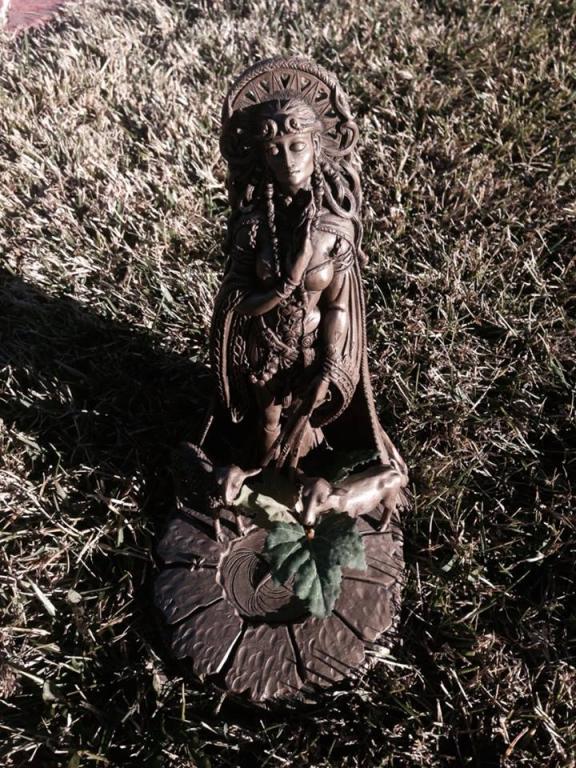 While that idea has most certainly been overly romanticized, it’s still essentially true. The origins of Saint Brigid the Irish Saint most certainly mingle with that of the Celtic Goddess Brihid. (2) There are no contemporary or near contemporary surviving records of the Irish Saint, and the legends surrounding her range from her being a contemporary of Jesus, to a nun in dying in the year 524 CE. A medieval list of Irish Saints actually lists 25 different Brigits/Bríds, all or none of whom may have been historical personages (though it’s more likely the latter). (3) It’s certainly possible that a real Brigid existed and was a Catholic nun in Ireland, but the myth and cult that grew up around the name has at least some of its origins in Celtic paganism.
While it’s easy to link the deity with saint, we know very little about the goddess herself. Though she’s generally written about as a near universal-Celtic deity, there’s a great deal of debate over whether or not that was actually the case. Some scholars argue that she was a local, tutelary deity generally limited to Kildare Ireland, whose reach grew when the goddess was transformed into a Saint. There could have also been several different goddesses named Brigid (and its variations) who were mistaken for the same deity by later chroniclers. (This would be like all the different Michelles in my county being mistaken for one Michelle.) The most well known goddess of Ireland has also been linked to the Romano-British Brigantia. (4) All of these different theories may be correct, it’s also possible that none of them are. Personally I think there were many different Brigids who most likely arose from a common ancestor, but that’s just a personal theory.
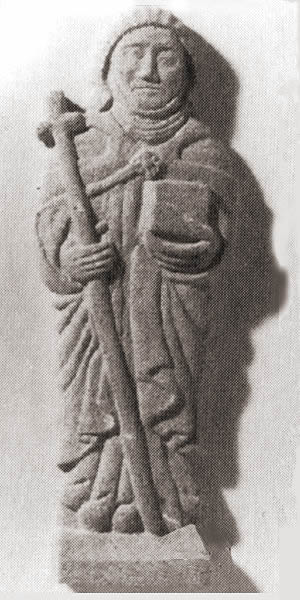 Even if her origins are lost, and her reach perhaps over-stated, there are still some things that can be said with certainty about the goddess. She was a goddess of prophesy, learning, metal working, and healing. Ronald Hutton calls her “the most pleasant Irish deity.” (5) Once one gets beyond those attributes the picture becomes a bit more fuzzy; Goddess and Saint often blend together in ways that make separating them impossible.
The goddess Brigid is often characterized as a fire deity, which her association with metal-working certainly implies. The word Brigid even translates as “fiery arrow” lending more credence to the argument. The most celebrated relationship Brigid had with fire was at her shrine in Kildare, which according to legend was kept first for the goddess Brigid and then later for the Saint. The first written record of the shrine its self dates back to the Seventh Century, but makes no mention of a flame being kept for the Saint. (6) That’s not to say it didn’t exist in the Seventh Century (and before!) but there’s no way of knowing for sure. The first recorded instance of Brigid’s fire at Kildare only dates to the 12th Century, though even the most conservative of scholars believe that the flame there most likely transferred form goddess to saint.
Brigid is often labeled a Triple Goddess, a term popularized by the English writer Robert Graves in his seminal work The White Goddess and used by him to describe Ireland’s most pleasant deity. When Modern Pagans use the term “Triple Goddess” it generally refers to a goddess who is (and can be worshipped as) Maiden, Mother, and Crone. This doesn’t really work for Brigid, as her myth is not one of being a Spring Maiden and a Winter Crone. Brigid was sometimes revered in triplicate, but as three sisters all bearing the same name. There was Brigid patroness of prophecy and learning, along with two sisters who shared her name, one a goddess of healing and the other a goddess of metal-work. (7) It’s possible that she was worshipped as a trio of sisters, it’s also possible that depicting her in three parts served as a way to illustrate the three talents over which she claimed dominion.
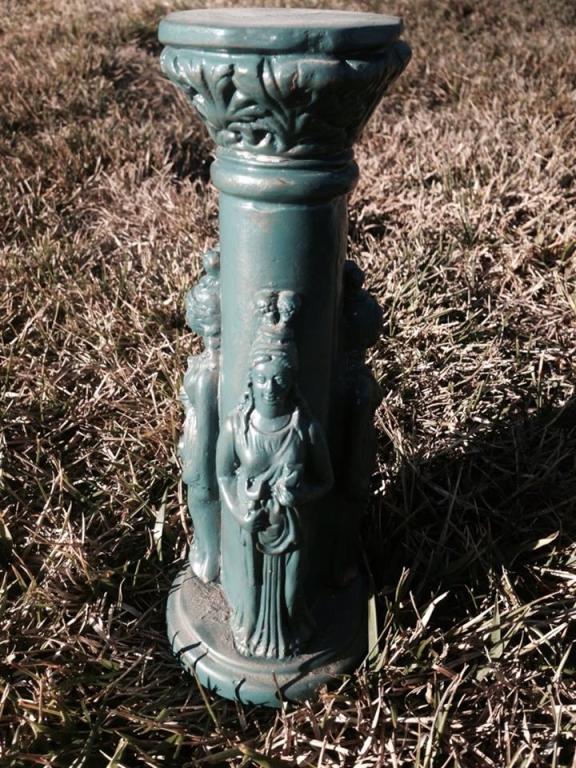 In Modern Paganism the goddess Brigid is often associated with Imbolc, but there’s no way of knowing how ancient that pairing truly is. Certainly Saint Brigid has long been associated with the date, making it likely that the goddess was as well, but the historical record is sadly silent on the issue. In the case of Saint Brigid her association with the holiday arose due to a number of factors. Unlike her goddess predecessor, Saint Brigid was generally seen as a friend to animals and a giver of grain. Add this to the legend of her role as Jesus’s wet-nurse and it’s no surprise that she was honored in early February. The latter half of the word Imbolc has something to do with milk, and by the year 900 it was being erroneously translated as “sheep’s milk.” (8) If your Saint is a wet-nurse and a friend of domesticated animals where better to place her feast day on the Wheel of the year?
Some of Imbolc’s most revered customs associated with Brigid are impossible to date back to ancient paganism. For years I took for granted that the Brigid’s Cross was a pagan survival, but the first recorded instance of one appearing over a door only dates back to the late Seventeenth Century CE. That doesn’t necessarily disqualify it as a pagan survival, it only makes the possibility less likely. I’d argue that it doesn’t matter, and that if you place one above your door, whether Pagan or Christian, someone with the name of Brigid is going to be looking out for you. (For more on the history of Imbolc, click here.)
Writing these pieces that seem to diminish a particular goddess or god often make me feel like a bearer of bad news. Personally I would much prefer Brigid to have been an unquestionable pan-Celtic European goddess of the highest order, but history paints a picture with more questions than answers. One thing I do know for certain is that as a goddess Brigid is a survivor, and one of the most continually worshipped and celebrated deities in all of ancient European paganism(s). When the conquerors and convertors came to her lands she didn’t give up the fight or go underground, she simply changed her clothing and reappeared ready to serve those who needed her. Hail Brigid (and her sisters too) unconquerable goddess!
Photos
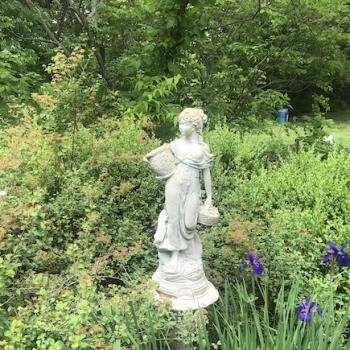
1. Brigit by Mythic Images. Photo taken by me in my front yard.
2. Brigid statue by Maxine Miller. If you want to find it online, use the googles.
3. A depiction of Saint Brigit.
4. A Brigit column piece from JBL Statues which you can buy at Sacred Source. Yes I own a lot of statues.
References
1. At least according to D.J. Conway in Celtic Magic, the first Pagan book I ever owned. This list fascinated me in 1994, I find it a little bit dubious in 2014, though it does paint a mental image of Brigid in a mixed martial arts competition.
2. I perhaps rely on Ronald Hutton a bit too much, but Stations of the Sun (Oxford University Press 1996) is just packed with so much information that I have trouble putting it down. Most of the things written about Brihid in this piece that go back to Sun came be found on page 135.
3. Not nearly as celebrated as Sun, but one of my favorite reference works is The Pagan Religions of the British Isles Their Nature and Legacy (Blackwell Publishers 1991) also by Ronald Hutton. Yes I have kind of a fan-boy thing going on with Hutton, I won’t deny it. This citation is from page 153.
4. Stations of the Sun page 135
5. Stations of the Sun again on page 135
6. Guess what? Stations of the Sun page 135
7. Not Sun, this time Pagan Religions page 153
8. Stations of the Sun page 134
Though I didn’t reference it, my early Pagan days were influenced by the book Celtic Gods, Celtic Goddesses by R.J. Stewart (Blandford 1990).
For more on Brigid vist:
Brigit’s Forge, a most excellent resource on all things Brigit.
Previous Post
January 12, 2014
10 Responsibilities of a Host
Next Post

January 16, 2014 Imbolc: Growth of the Light & Candle Blessing Ritual
Browse Our Archives
Select a Category Editorializing Gateways to Paganism Guest Posts Holiday Histories Led Zeppelin News and Views Occult Pagan Pagan TV Club Paganism polytheism Ramble On Reviews Ritual Strange Days Uncategorized
Select a Month August 2026 March 2026 February 2026 November 2025 September 2025 August 2025 April 2025 August 2024 April 2024 February 2024 December 2023 October 2023 August 2023 June 2023 May 2023 January 2023 October 2022 August 2022 July 2022 June 2022 May 2022 April 2022 March 2022 February 2022 January 2022 December 2021 November 2021 October 2021 September 2021 August 2021 July 2021 June 2021 April 2021 March 2021 February 2021 January 2021 December 2020 November 2020 October 2020 August 2020 July 2020 June 2020 May 2020 April 2020 March 2020 February 2020 January 2020 December 2019 November 2019 October 2019 September 2019 August 2019 July 2019 June 2019 May 2019 April 2019 March 2019 February 2019 January 2019 December 2018 November 2018 October 2018 September 2018 August 2018 July 2018 June 2018 May 2018 April 2018 March 2018 February 2018 January 2018 December 2017 November 2017 October 2017 September 2017 August 2017 July 2017 June 2017 May 2017 April 2017 March 2017 February 2017 January 2017 December 2016 November 2016 October 2016 September 2016 August 2016 July 2016 June 2016 May 2016 April 2016 March 2016 February 2016 January 2016 December 2015 November 2015 October 2015 September 2015 August 2015 July 2015 June 2015 May 2015 April 2015 March 2015 February 2015 January 2015 December 2014 November 2014 October 2014 September 2014 August 2014 July 2014 June 2014 May 2014 April 2014 March 2014 February 2014 January 2014 December 2013 November 2013 October 2013 September 2013 August 2013 July 2013 June 2013 May 2013 April 2013 March 2013 February 2013 January 2013 December 2012 November 2012 October 2012 September 2012 August 2012 July 2012 June 2012 April 2012 October 2011 September 2011 August 2011
Follow Us!
TAKE THE
Religious Wisdom Quiz
What acrostic device is used in many Psalms and Proverbs?
Select your answer to see how you score.
Reversed order Chronological order Alphabetic order Numerical sequence
Related posts from Raise the Horns


The Return of the Pagan Scapegoats

Magickal & Pagan Gathers: Some Thoughts
TRENDING AT PATHEOS Pagan

The Sermon on the Mount, Part I: Matthew...
The Sermon on the Mount, Part I (Matthew 4:12-5:12) St. Matthew moves...

What's up from Crossway: Reviewing some of their latest A few weeks...

Janie Learns the Way of the Cross: A...
Teaching children about Jesus' Passion can be challenging. Many parents and educators...

Looking For Good Catholic Writing - October 2026
He alone extends the heavens, and he walks upon the waves of...

In "Irreplaceable," our book on vocation and technology, Trevor Sutton and I...

I was strolling through the top floor of the brand new Parthenon...
view all Pagan blogs
Ad-Free & Subscriber Log-In Subscription Support
- About Us
- 2026 Calendar
- Videos
- Podcasts
- Library of World Religions
- Faith In Media Tracker
- Advertise With Us
- Write for Us
- Privacy Policy
- Terms of Service
- Do Not Sell My Data
- Contact Us
- Radiant Digital
- Manage Newsletter Subscriptions
- Unsubscribe From Notifications
- Sitemap
Copyright 2008-2026, Patheos. All rights reserved.
Subscription Support Ad-Free & Subscriber Log-In
Follow Patheos