
BuddhistCatholicContemplativeEvangelicalGeneral ChristianHinduJewishLatter-day SaintMuslimNew VisionsProgressive Christian
Beliefs
- Buddhist
- Catholic
- Contemplative
- Evangelical
- General Christian
- Hindu
- Jewish
- Latter-day Saint
- More Voices
- Muslim
- New Visions
- Pagan
- Progressive Christian
Topics
- Religion News
- Food and Religion
- Sports and Religion
- Religious Art
- Religious Music and Entertainment
- Religious Events
- History and Religion
- Style and Religion
- Politics and Religion
- Women in Religion
- Recreation Outdoors and Religion
- Business Finance and Religion
- Careers Workplace and Religion
- Education and Religion
- Family Parenting and Religion
- Health Fitness and Religion
- Home and Religion
- Relationships and Religion
- Technology and Religion
- Travel and Religion
Columnists
- Buddhist Columnists
- Business Finance and Religion Columnists
- Careers Workplace and Religion Columnists
- Catholic Columnists
- Contemplative Columnists
- Education and Religion Columnists
- Evangelists Columnists
- Family Parenting and Religion Columnists
- General Christian Columnists
- Health Fitness and Religion Columnists
- Hindu Columnists
- History and Religion Columnists
- Home and Religion Columnists
- Jewish Columnists
- More Voices Columnists
- Latter Day Columnists
- Muslim Columnists
- New Visions Columnists
- Nonreligious Columnists
- Pagan Columnists
- Politics and Religion Columnists
- Progressive Columnists
- Recreation Outdoors and Religion Columnists
- Relationships and Religion Columnists
- Religion News Columnists
- Religious Art Columnists
- Religious Events Columnists
- Religious Music and Entertainment Columnists
- Sports and Religion Columnists
- Style and Religion Columnists
- Technology and Religion Columnists
- Travel and Religion Columnists
- Women in Religion Columnists
Resource Library
- 2026 Calendar
- Library of World Religions
- The 100 Most Holy Places on Earth
- Patheos Answers
- Podcasts
- Videos
- Faith Leaders Database
- Anglican Episcopalian
- Bahai
- Baptist
- Buddhism
- Christianity
- Confucianism
- Eastern Orthodoxy
- Hinduism
- Holiness and Pentecostal
- ISKCON
- Islam
- Judaism
- Lutheran
- Methodist
- The Church of Jesus Christ of Latter-day Saints
- New Age
- Paganism
- Presbytarian and Reformed
- Protestantism
- Religion Behind the Scenes
- Roman Catholic
- Scientology
- Shia Islam
- Sikhism
- Sufism
- Sunni Islam
- Taoism
- Zen
- See all religions
Research Tools
 Ad-Free & Subscriber Log-In Subscription Support
Follow Patheos 

- Trending:
- Advent
- |
- Forgiveness
- |
- Thanksgiving
- |
- Election
- |
- Seasonal Holidays
- |
- Marriage

- HOME
- Me and the Blog
- Defining Pagan
- Rituals & Holidays
- All Posts
- Blogroll
- Publications
- FREE NEWSLETTER
- Home
- Pagan
- The History and Origins of Santa Claus
The History and Origins of Santa Claus
Last updated on: December 9, 2015 at 10:04 am by Jason Mankey
The History and Origins of Santa Claus 2015-12-09T10:04:37-07:00 Jason Mankey
Patheos Explore the world's faith through different perspectives on religion and spirituality! Patheos has the views of the prevalent religions and spiritualities of the world.
 I was nine years old and in fourth grade the Christmas Eve Santa Claus visited my brothers and I in the flesh. Nine is the age when most kids have stopped believing in Santa Claus but haven’t necessarily admitted it to their parents yet, so when Santa made his visit I was pretty dubious. He came in through the front door with a bag slung over his shoulder and he gave all four of us boys the toy type present we were interested in at the time. My brothers were into match-box cars and they each got a set that suited them perfectly. I liked those little green army men back then, but Santa did one better, he got me a set of army men with Japanese soldiers, the holy grail of hard to find two inch plastic toys. Completely mind blowing.
I spent the rest of the night trying to figure which adult in my family had dressed up as Santa Claus, but they were all in the back-room when he made his entrance. It had to be someone who was familiar with us because he knew all of our names, but I couldn’t come up with any probable candidates. We were also a hundred miles away from home at my Grandparents’ house, so it wasn’t a neighbor. It was a Christmas Eve mystery, and one I’ve never solved. The next year I asked my Dad about the Santa incident who replied that he had no idea who our visitor was, and that his parents didn’t know either. Over the succeeding years I continued to ask the question, and always got the same reply.
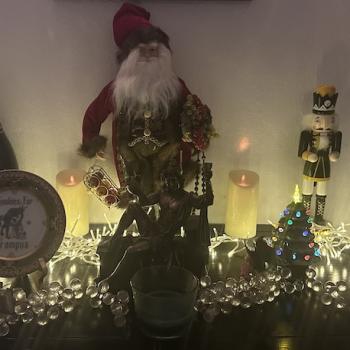
Deep down I know that we weren’t visited by a citizen of the North Pole that evening, but the mystery of it all makes it special. It’s a magical memory, the exact type of thing that the image and myth of Santa Claus should conjure up. Santa Claus has power and an energy all his own. To say that Santa “isn’t real” completely misses the point. Few myths are as universal in the Western World as that of Midwinter gift-bringer, and it’s a myth that speaks to the best of who we can be as people. Santa is the spirit of giving and child-like wonder, two impulses that are often in short supply.
 Any serious discussion on the origins of Santa Claus has to begin with Saint Nicholas, even though it’s difficult to know exactly just where to begin. Just like Santa Claus the story of Nicholas is myth; there’s just not enough evidence to say with any certainty whether or not Nicholas actually existed. According to legend Nicholas was the Bishop of Myra (a coastal town in present day Turkey) and was active in the early Fourth Century. He allegedly died on December 6, in the year 343 CE, which later became his feast day.
Over the ensuing centuries all sorts of miraculous stories began to circulate involving Nicholas. He fed the hungry, calmed oceans, and gave generously to those in need. Many of the Nicholas stories are so ridiculously over the top that they read more like comic-books than events with any basis in reality. Nicholas was apparently capable of flight and was able to teleport; appearing suddenly out of thin air to confront individuals about their misdeeds.
The most famous of the Nicholas stories involves a poor old widower unable to provide a dowry for his daughters, condemning them to a probable life of spinsterhood. Upon hearing of the old man’s plight Nicholas anonymously tossed bags of gold into stockings hanging in the man’s house over three consecutive nights. Nicholas’s act allowed the widower to provide a dowry and the girls were subsequently wed and lived happily ever after. In early versions of this tale Nicholas provides dowries, but the socks are absent, most definitely a later addition to line up more favorably with the later myths of Nicholas as gift giver.
 Nicholas also had the ability to overcome death. One of the most famous of his myths involves a murderous inn-keeper and the murders of three university students. Upon entering the establishment of the evil inn-keeper Nicholas immediately sensed that something horrible had happened. He strode into the inn’s cellar and found the corpses of the murdered boys in a pickling barrel, and then promptly resurrected them from the dead. Instead of condemning the inn-keeper Nicholas forgave the man and even blessed his barren wife with the ability to produce offspring. Stories of Nicholas’s miraculous powers, love of children, and ability to forgive made him the favored Saint in much of Europe, and by the year 1100 he had become the most revered Saint in the Catholic Church. (It didn’t hurt that by 1100 Nicholas was the patron Saint of almost everything.)
Nicholas was also renowned as the patron Saint of sailors. Stories tell of Nicholas saving the lives of sailors “perishing at sea” while also being involved in the deliberations happening at the First Council of Nicaea in 325 CE. The stories of Nicholas at sea are interesting because it’s been speculated that at least some of his myth was borrowed from pagan sea-gods, most specifically the Greek Poseidon. In fact, one of Nicholas’s earliest cathedrals was built on the site of a temple dedicated to Poseidon and several other places dedicated to Nicholas are near those once reserved for the Greek god of the sea.
One of the most interesting things about the Nicholas myth is that the Saint simply died of old age. He did not die a martyr, nor are any stories of martyrdom associated with the old Bishop. How much this factored in the popularity of his cult is an open question. Instead of a grisly end, it’s the stories of Nicholas’s generosity and good-nature that are remembered.
 Whatever the origins of Nicholas’s myths his popularity in Medieval Europe was indisputable. He was even said to assist Muslims and Jews in their times of need (along with any other “unbelievers”). By the year 1100 French nuns were leaving gifts at the homes of poor children on the night of December 5 in the name of Saint Nicholas. Soon St. Nicholas would be doing the same thing in other places, but only after going through yet another re-imagining of his mythos.
The legend of Nicholas is an important piece of the puzzle that eventually became Santa Claus, but it’s not the only one. The Santa Claus myth was affected to a large degree by a whole host of Norse myths and gods. The most influential of these are the Norse Odin and Germanic Woden (two similar deities that share a great deal of mythology). One of the most important holidays in Norse and Germanic paganisms was the celebration of Yule, the Winter Solstice. On that day Odin would lead the Wild Hunt, descending from the skies upon the back of a magical horse to punish the wicked. It’s from these myths that St. Nicholas would derive the white horse (Schimmel) he now rides in the Netherlands in order to give gifts. Odin’s horse was also capable of landing on rooftops, an important development. Odin was also a gift-giver like Nicholas, sharing his wisdom with mortals via the runes.
In 1980 a theory began to circulate that Santa Claus was a direct descendant of Siberian shamanism. According to this theory everything related to Santa can be found in Siberian shamanic tradition. In this hypothesis Santa flies like a shaman in a sleigh, reindeer are representative of Siberian reindeer spirits, and his red and white robes derive from the agaric mushrooms used to facilitate shamanic trance. In reality shamans never rode in sleighs, rarely contacted reindeer spirits, and only used mushrooms on very rare occasions. In addition, reindeer were a Nineteenth Century addition to the Santa-mythos and Siberians didn’t wear red and white clothes. In other words, if Santa is related to shamanism, it’s very indirectly. (See Ronald Hutton, Stations of the Sun, pages 117-119.)
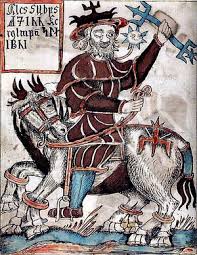 In some parts of Scandinavia it’s possible that Thor was the more influential of the Norse gods. In those areas Nicholas would end up with a goat pulling his cart, or in the case of the Yule Goat, the goat would become the gift-giver. Like Odin, Thor was also capable of great generosity and was honored near the Winter Solstice.
Several other holiday gift givers would later influence the Santa Claus myth, with many of those “others” also coming from Scandinavian paganism and folklore. Until relatively recently no one ever characterized Saint Nicholas as “elvish” or small, but before Santa Claus there were several elvish and gnomish gift givers. Many of them bare far more similarities to early versions of Santa Claus than to the St. Nicholas myth. It’s possible that remembrances of gift-givers like the Tomte led to not only Saint Nicholas/Santa being an elf but to the big-man having an elven workforce.
During the Reformation, Protestants tried in vain to cease the veneration of Saints, especially Saint Nicholas. Reformers suggested switching Saint Nicholas with the Christ Child (Baby Jesus) and leaving gifts on Christmas instead of the Feast Day of Nicholas. Their efforts had some success in Eastern Europe and Germany, less so in the Netherlands where children led protests demanding the reinstatement of Nicholas as gift-giver. Nicholas won. (Eventually the Christ Child became the Christkindl and evolved from baby Jesus into an angelic figure, generally portrayed by a young woman. In English Christkindl was often pronounced Kris Kringle and led to another name for Santa Claus.)
It’s logical to assume that the Dutch colonists who settled in North America brought their tradition of Sinterklaas with them (a Dutch term for Saint Nicholas, who is also sometimes known as Sint Nicolaas in the Netherlands) but remarkably, there’s little to evidence to back up that claim. The first mention of Saint Nicholas as magical gift giver in what would become the United States dates back to 1773 when the New York newspaper Rivingston’s Gazatteer makes mention of Saint Nicholas “otherwise called St. a Claus.” It’s likely that several Dutch families maintained the cult of Nicholas, but it’s impossible to say with absolute certainty.
What is known is how interest in Sinterklaas reawakened in the Nineteenth Century, and how it quickly spread everywhere in just a few decades. In 1809 Washington Irving released A History of New-York from the Beginning of the World to the End of the Dutch Dynasty, by Diedrich Knickerbocker with references to Saint Nicholas as New York’s patron Saint and guardian along with stories of him delivering presents and sliding down chimneys. Irving was a New Yorker, but he wasn’t Dutch, and his history was meant as satire, but people responded to his imagined reminisces and interest in Nicholas was revived. In 1810 a poem about the gift-giver appeared in the New York Spectator, complete with the line “Oh good holy man! whom we Sancte Claus name.” Santa Claus was in business.
In 1821 an uncredited poem appeared in a small book entitled The Children’s Friend: A New Year’s Present, to Little Ones From Five to Twelve. It’s one of the most important poems in all of Santa history, though mostly forgotten today. Not only does it establish “Santeclaus” as a magical Christmas gift-giver, but it also marks the first recorded instance of Santa having reindeer. (Until 1821 Santa still generally travelled by horse.) The picture of Santa painted in The Children’s Friend is far more stern than our modern Santa, but it’s recognizable. The pictures that accompany the poem show a very Saintly looking Santa, though he is wearing red. (You could buy a hand-colored edition of the The Children’s Friend at extra cost.)
Old Santeclaus with much delight
His reindeer drives this frosty night,
O’er chimney-tops, and tracks of snow,
To bring his yearly gifts to you.The steady friend of virtuous youth,
The friend of duty, and of truth,
Each Christmas eve he joys to come
Where love and peace have made their home.Through many houses he has been,
And various beds and stockings seen;
Some, white as snow, and neatly mended,
Others, that seemed for pigs intended.Where e’er I found good girls or boys,
That hated quarrels, strife and noise,
I left an apple, or a tart,
Or wooden gun, or painted cart.To some I gave a pretty doll,
To some a peg-top, or a ball;
No crackers, cannons, squibs, or rockets,
To blow their eyes up, or their pockets.No drums to stun their Mother’s ear,
Nor swords to make their sisters fear;
But pretty books to store their mind
With knowledge of each various kind.But where I found the children naughty,
In manners rude, in temper haughty,
Thankless to parents, liars, swearers,
Boxers, or cheats, or base tale-bearers,I left a long, black, birchen rod,
Such as the dread command of God
Directs a Parent’s hand to use
When virtue’s path his sons refuse.
 The most important poem ever written about Santa Claus was first published in 1823. Though there is some dispute over the authorship, most people attribute An Account of a Visit From St. Nicholas (The Night Before Christmas) to Clement C. Moore who originally wrote the poem for his children. The following year it was reprinted without his permission and in 1844 Moore made his first public claims of authorship. Once his claim to authorship became public knowledge he tweaked the poem in several places, most notably changing the names of the reindeer formally known as Dunder and Blixem.
Santa is instantly recognizable in The Night Before Christmas, yet a closer reading of the poem indicates that the stately figures of Odin and Saint Nicholas have been completely revised. Santa is now a “right jolly old elf” and with a belly like “a bowlful of jelly.” His clothing had changed too. No longer was in he robes, now he was “dressed all in fur, from his head to his foot, And his clothes were all tarnished with ashes and soot.” Santa’s reindeer have also multiplied since 1821, and due to the influence of Moore’s poem “eight” (nine with Rudolph) has become the agreed upon number of sleigh pullers. Even if Santa doesn’t look quite right in Christmas it contains all the other essential Santa elements.
While Moore’s Santa became the accepted version after the publication of his poem, several alternate versions of the character persisted over the next few decades. Some writers took the “elf” idea a little too far and made Santa the size of a mouse. Other variants on the character had him riding a broomstick instead of driving a sleigh, there was even a clean-shaven Santa with a turban on top of his head. An African-American representation of Santa also existed, forever putting to bed the stupid theory that “Santa is just white.” Santa was all kinds of things, but the image that resonated most involved a little driver, lively and quick.
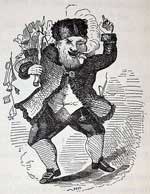
 For most Americans it would be the Bavarian-born Thomas Nast who would forever define Santa Claus. Nast’s Santa was much like Moore’s, but a short man instead of a jolly elf, and most likely influenced by the customs of his homeland. Nast didn’t look for his Santa in the images of Saint Nicholas, he found them in the European folk traditions of characters like the Belsnickel (German for Nicholas in Furs). His Santa looked similar to the Wild Men of legend in Europe (essentially boogie-men living outside of society), but less scary. His Santa Claus wasn’t a bishop but a man of the people.
 Nast built upon the Santa Claus being established by other writers and illustrator. In Nast’s illustrations Santa was seen living at the North Pole (one cartoon even lists it as his proper address). He also established the tradition that Santa knows “when you’ve been bad or good.” Nast also showed Santa getting mail from children listing their yearly wants.
When Nast’s Santa Claus drawings were reprinted in magazines the furs he drew in black and white were often colored red. By the 1850’s the red and white suit was already Santa’s most popular outfit, and when Nast’s drawings appeared in color the same way it cemented the deal. It’s cute to think that Coca-Cola had some sort of input on the design of Santa’s suit, but they were simply going along with what was already popular.
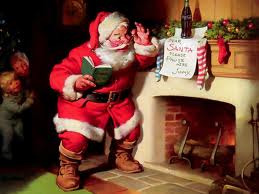 The famous Coke adds depicting Santa that began in the 1930’s were the work of Haddon Sundblom, and they did help contribute to the Santa Claus mythos. Sundblom made his Santa taller than Nast’s, and that increased height for Santa increasingly became the standard. Sundblom’s Santa also lacks the ocassional rough edges Nast gave to his versions of the character. When you look at Sundblom’s illustrations it’s clear that Santa belongs in every house on Christmas Eve, it would be hard to mistake this Santa for a burglar or vagrant. Sundblom’s vision of Santa became the standard image of the gift-bringer, and remains so nearly eighty years later.
Santa’s had a long and bumpy road on his way to becoming a modern icon, but now that he’s here he doesn’t look likely to leave anytime soon. In a world that so often lacks any magic, Santa provides a doorway into a realm of imagination and wonderment. A world without Santa is a world I don’t want to live in. We share so little myth these days, and what myth we do share rarely transcends religious boundaries, but Santa is different. With his origins in Greek myth, Catholic tradition, Norse paganism, and the wilds of the human imagination, he’s capable of not just magically jumping down chimneys, but of jumping into the hearts of whoever will have him.
A Santa Bibliography
Santa Claus: A Biography by Gerry Bowler. McClelland & Stewart, 1997. There’s a lot to like here. His history of Saint Nicholas is thorough and the look at Santa’s first 100 years is pretty thorough. Sadly, Bowler dismisses any pagan connections to Santa Claus with a footnote directing interested readers to other sources.
Stations of the Sun by Ronald Hutton. Oxford University Press, 1996. Hutton’s book is dedicated to the history of the ritual year in Great Britain, as a result his treatment of Santa Claus only gets a few pages, but they are insightful few pages.
Santa Claus, Last of the Wild Men: The Origins and Evolution of Saint Nicholas, Spanning 50,000 Years by Phyllis Siefker. McFarland and Company, 2006. I don’t buy into any origin story of Santa dating back to pre-history, the gaps in the historical record are just too large. That being said, this is still an interesting take on the Santa mythos and I believe it has some merit.
When Santa Was a Shaman by Tony van Renterghem. Llewellyn Publications, 1995. I just got through re-reading this book, it’s an experience I don’t ever want to repeat. There’s some information here, but mostly bad history. Any book that attempts to equate the gods Herne and Pan is not going to sit well with me. There are some nice pictures.
Previous Post

December 14, 2013
Everything Yule & Christmas (Rituals, History, and More!)
Next Post

December 19, 2013 Midwinter: Light in the Darkness
Browse Our Archives
Select a Category Editorializing Gateways to Paganism Guest Posts Holiday Histories Led Zeppelin News and Views Occult Pagan Pagan TV Club Paganism polytheism Ramble On Reviews Ritual Strange Days Uncategorized
Select a Month August 2026 March 2026 February 2026 November 2025 September 2025 August 2025 April 2025 August 2024 April 2024 February 2024 December 2023 October 2023 August 2023 June 2023 May 2023 January 2023 October 2022 August 2022 July 2022 June 2022 May 2022 April 2022 March 2022 February 2022 January 2022 December 2021 November 2021 October 2021 September 2021 August 2021 July 2021 June 2021 April 2021 March 2021 February 2021 January 2021 December 2020 November 2020 October 2020 August 2020 July 2020 June 2020 May 2020 April 2020 March 2020 February 2020 January 2020 December 2019 November 2019 October 2019 September 2019 August 2019 July 2019 June 2019 May 2019 April 2019 March 2019 February 2019 January 2019 December 2018 November 2018 October 2018 September 2018 August 2018 July 2018 June 2018 May 2018 April 2018 March 2018 February 2018 January 2018 December 2017 November 2017 October 2017 September 2017 August 2017 July 2017 June 2017 May 2017 April 2017 March 2017 February 2017 January 2017 December 2016 November 2016 October 2016 September 2016 August 2016 July 2016 June 2016 May 2016 April 2016 March 2016 February 2016 January 2016 December 2015 November 2015 October 2015 September 2015 August 2015 July 2015 June 2015 May 2015 April 2015 March 2015 February 2015 January 2015 December 2014 November 2014 October 2014 September 2014 August 2014 July 2014 June 2014 May 2014 April 2014 March 2014 February 2014 January 2014 December 2013 November 2013 October 2013 September 2013 August 2013 July 2013 June 2013 May 2013 April 2013 March 2013 February 2013 January 2013 December 2012 November 2012 October 2012 September 2012 August 2012 July 2012 June 2012 April 2012 October 2011 September 2011 August 2011
Follow Us!
TAKE THE
Religious Wisdom Quiz
What structure did people build to try to reach heaven?
Select your answer to see how you score.
Temple of Solomon Tower of Babel Ark Altar of Baal
Related posts from Raise the Horns

Yule is Also a Time for the Dead
The Embers (September-December)
TRENDING AT PATHEOS Pagan

Thomas Paine, the Smiths, the apostles in England,...
I'm pleased to announce that the Becoming Brigham Black Friday Sale,...

CatholicTV Series: Six Black Catholics on Path to...
WATERTOWN, Mass., November 9, 2026 – In recognition of Black Catholic History...

New Advent Journal Invites Catholics to Be Pilgrims
Florissant, MO, November 16, 2026— What if Advent were more than a...

INNER CIRCLE: John's Quantum Gospel
INTRODUCTION In this next Inner Circle series, which I anticipate will...

"Three B's" of My Apologetics Ministry (+ VIDEO)
In early December 2026 (less than a week from the time...

James Ishmael Ford's books on Zen
James Ishmael Ford's Official Website provides the most complete annotated list of...
view all Pagan blogs
Ad-Free & Subscriber Log-In Subscription Support
- About Us
- 2026 Calendar
- Videos
- Podcasts
- Library of World Religions
- Faith In Media Tracker
- Advertise With Us
- Write for Us
- Privacy Policy
- Terms of Service
- Do Not Sell My Data
- Contact Us
- Radiant Digital
- Manage Newsletter Subscriptions
- Unsubscribe From Notifications
- Sitemap
Copyright 2008-2026, Patheos, part of the Radiant Digital network of media brands. All rights reserved.
Subscription Support Ad-Free & Subscriber Log-In
Follow Patheos