
BuddhistCatholicContemplativeEvangelicalGeneral ChristianHinduJewishLatter-day SaintMuslimNew VisionsProgressive Christian
Beliefs
- Buddhist
- Catholic
- Contemplative
- Evangelical
- General Christian
- Hindu
- Jewish
- Latter-day Saint
- More Voices
- Muslim
- New Visions
- Pagan
- Progressive Christian
Topics
- Religion News
- Food and Religion
- Sports and Religion
- Religious Art
- Religious Music and Entertainment
- Religious Events
- History and Religion
- Style and Religion
- Politics and Religion
- Women in Religion
- Recreation Outdoors and Religion
- Business Finance and Religion
- Careers Workplace and Religion
- Education and Religion
- Family Parenting and Religion
- Health Fitness and Religion
- Home and Religion
- Relationships and Religion
- Technology and Religion
- Travel and Religion
Columnists
- Buddhist Columnists
- Business Finance and Religion Columnists
- Careers Workplace and Religion Columnists
- Catholic Columnists
- Contemplative Columnists
- Education and Religion Columnists
- Evangelists Columnists
- Family Parenting and Religion Columnists
- General Christian Columnists
- Health Fitness and Religion Columnists
- Hindu Columnists
- History and Religion Columnists
- Home and Religion Columnists
- Jewish Columnists
- More Voices Columnists
- Latter Day Columnists
- Muslim Columnists
- New Visions Columnists
- Nonreligious Columnists
- Pagan Columnists
- Politics and Religion Columnists
- Progressive Columnists
- Recreation Outdoors and Religion Columnists
- Relationships and Religion Columnists
- Religion News Columnists
- Religious Art Columnists
- Religious Events Columnists
- Religious Music and Entertainment Columnists
- Sports and Religion Columnists
- Style and Religion Columnists
- Technology and Religion Columnists
- Travel and Religion Columnists
- Women in Religion Columnists
Resource Library
- 2026 Calendar
- Library of World Religions
- The 100 Most Holy Places on Earth
- Patheos Answers
- Podcasts
- Videos
- Faith Leaders Database
- Anglican Episcopalian
- Bahai
- Baptist
- Buddhism
- Christianity
- Confucianism
- Eastern Orthodoxy
- Hinduism
- Holiness and Pentecostal
- ISKCON
- Islam
- Judaism
- Lutheran
- Methodist
- The Church of Jesus Christ of Latter-day Saints
- New Age
- Paganism
- Presbytarian and Reformed
- Protestantism
- Religion Behind the Scenes
- Roman Catholic
- Scientology
- Shia Islam
- Sikhism
- Sufism
- Sunni Islam
- Taoism
- Zen
- See all religions
Research Tools
 Ad-Free & Subscriber Log-In Subscription Support
Follow Patheos 

- Trending:
- Advent
- |
- Forgiveness
- |
- Thanksgiving
- |
- Election
- |
- Seasonal Holidays
- |
- Marriage

- HOME
- Me and the Blog
- Defining Pagan
- Rituals & Holidays
- All Posts
- Blogroll
- Publications
- FREE NEWSLETTER
- Home
- Pagan
- Happy Pagan New Year?
Happy Pagan New Year?
Last updated on: October 31, 2020 at 5:35 pm by Jason Mankey
Happy Pagan New Year? 2020-10-31T17:35:39-06:00 Jason Mankey
Patheos Explore the world's faith through different perspectives on religion and spirituality! Patheos has the views of the prevalent religions and spiritualities of the world.
For many Pagans Samhain is the Pagan New Year. That feeling isn’t universal by any means, there are some Pagan groups that celebrate the “New Year” at Beltane, and I’d be willing to guess that there have to be at least a few groups who celebrate it at Yule. World wide there are dozens of “New Years” ranging from the well known Chinese New Year to the Buddhist Songkran April 13-15. Rosh Hashanah is the Jewish New Year (always 163 days after Passover) and the Russian Orthodox Church holds to the Julian Calendar and celebrates the new year on January 14. The astrological New Year occurs on the Spring Equinox, and in Iran the New Year is still celebrated on that day.
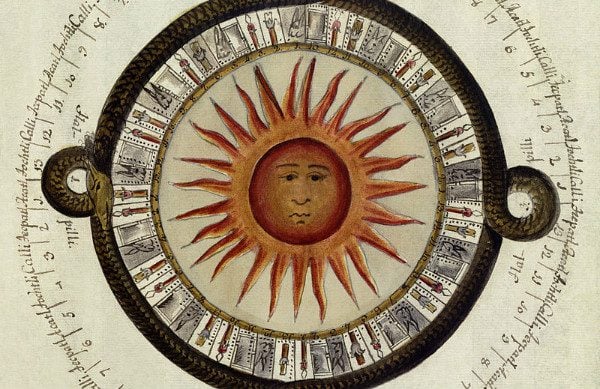
Mexican Calendar from 1791. From WikiMedia.
For most Americans and Europeans the new year is celebrated on January 1, and despite being a Pagan, that’s generally when I celebrate it too. I like the party, and there’s a distinctive cultural shift at the time of year as well. The Christmas stuff finally comes down and most of society takes a figurative deep breath as it recovers from the bustling holiday season. Celestially, January first makes little sense as the start of a new year, but it’s where we’ve ended up in the Western World, and I’m not one for big battles.
In ritual, I play lip-service to the idea that Samhain marks the beginning of a new year, and I probably do it because it’s generally expected in Pagan circles. My Samhain rituals this year and last opened up with the line: “We gather here tonight to celebrate the passing of the Old Year and to welcome in the new.” The Celts who celebrated Samhain allegedly used that night to mark the new year, so putting those echoes into my own rituals is a bit of an homage, but I’ve never made a New Year’s Resolution on Samhain.
Perhaps that’s because Samhain has never felt like the start of a new year to me, instead it’s always felt like the beginning of the end. There are many sabbat celebrations during the “dark” part of the year that feel more like a new start. Yule is an obvious answer here; it’s the darkest night of the year, but it’s also the start of the sun’s waxing phase. From winter solstice to summer solstice the days will continually get longer. In ritual I’ve often acknowledged that return of the light, but it’s not something I really feel in December. If anything I just feel the darkness and the stillness of early winter; with work often starting before the sun fully rises and not ending until it goes down.
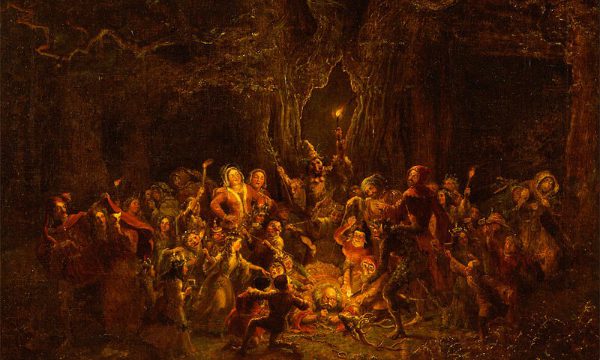
George Cruikshank – Herne’s Oak from ‘The Merry Wives of Windsor. From WikiMedia.
Imbolc has always felt like the true “return of the light” sabbat. By early February the days are finally noticeably longer, and in some parts of the country there are even signs of Spring. Even when I lived in Michigan there were always stirrings of the Spring yet to come in early February. Sometimes you’d find a bud on a tree, hear a bird chirp, or see a little creature stirring. (In Northern California lots of things bloom in early February, February showers bring March flowers.) Yule and Imbolc for very different reasons feel more like a “Pagan New Year” to me than Samhain does.
There are groups that celebrate Beltane as a Pagan New Year, something which has never quite worked for me. By Beltane everything has been reborn. The grass is green, flowers are blooming, and formerly empty branches are now full of leaves. The Maiden is now a young woman, to me, celebrating a new year here would be like celebrating someone’s “first birthday” on the day they turn seventeen. No problem here with those that celebrate a new turn of the wheel in early May, but my brain doesn’t quite grasp it.
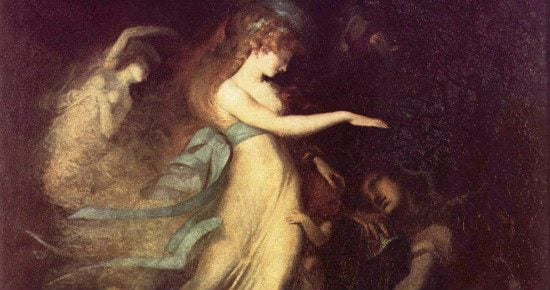
“Prince Arthur and the Faerie Queen” by Henry Fuseli. From WikiMedia
Midsummer makes celestial sense as the start of a new turn, but the time I feel the most transition and change on a year to year basis is in September. Part of that is most certainly conditioning. Late August/early September has traditionally been the start of the new school year (I say traditionally because that’s starting to change) for my entire lifetime. Even with or without kids (or school) we are all used to the “back to school sales” and dial into the feeling of new beginnings. Top that off with the beginning of new television and football seasons and you’ve got a lot of new starts all near the first week of September. The transition from Summer to Fall has always been the most dramatic seasonal shift for me as well. Samhain occurs either in the middle or at the end of that shift (depending on where one lives), and as a result doesn’t feel like a logical start to the new year.
When I became a Wiccan I adopted all the traditions that go along with that religious choice. One of those adoptions were the seasonal rituals first celebrated by the Celts along with the cross-quarter celebrations of equinoxes and solstices. While Wicca utilizes old Celtic holidays, it’s not a Celtic tradition, and I have never felt any real personal connection to the Ancient Celts (all while having some Welsh heritage). I’ve always been most connected to Greek deities, but since I’m most comfortable with Wiccan ritual I’ve never felt the need to adopt a Hellenic Re-constructionist holiday cycle. If I ever did, maybe I’d celebrate the Ancient Greek New Year (the first new moon after the summer solstice) or maybe March 1, the Roman New Year.
Instead of one “New Year” perhaps we all celebrate multiple New Year’s throughout the course of twelve months? There’s the acknowledgement of the year’s turn at Samhain, and the welcoming of the light at Imbolc or Yule. The secular New Year is always good for a party, and legally at least marks society’s change from one year to another. There are the early autumn re-starts as well, giving me at least four “New Year Celebrations” each Turn of the Wheel. I love holidays, so the more the merrier, but don’t look at me funny if I don’t wish you a “Happy New Year” next Samhain.
Previous Post

October 30, 2013
American Horror Story: Fearful Pranks Ensue
Next Post

November 5, 2013 When Someone Leaves Paganism
Browse Our Archives
Select a Category Editorializing Gateways to Paganism Guest Posts Holiday Histories Led Zeppelin News and Views Occult Pagan Pagan TV Club Paganism polytheism Ramble On Reviews Ritual Strange Days Uncategorized
Select a Month August 2026 March 2026 February 2026 November 2025 September 2025 August 2025 April 2025 August 2024 April 2024 February 2024 December 2023 October 2023 August 2023 June 2023 May 2023 January 2023 October 2022 August 2022 July 2022 June 2022 May 2022 April 2022 March 2022 February 2022 January 2022 December 2021 November 2021 October 2021 September 2021 August 2021 July 2021 June 2021 April 2021 March 2021 February 2021 January 2021 December 2020 November 2020 October 2020 August 2020 July 2020 June 2020 May 2020 April 2020 March 2020 February 2020 January 2020 December 2019 November 2019 October 2019 September 2019 August 2019 July 2019 June 2019 May 2019 April 2019 March 2019 February 2019 January 2019 December 2018 November 2018 October 2018 September 2018 August 2018 July 2018 June 2018 May 2018 April 2018 March 2018 February 2018 January 2018 December 2017 November 2017 October 2017 September 2017 August 2017 July 2017 June 2017 May 2017 April 2017 March 2017 February 2017 January 2017 December 2016 November 2016 October 2016 September 2016 August 2016 July 2016 June 2016 May 2016 April 2016 March 2016 February 2016 January 2016 December 2015 November 2015 October 2015 September 2015 August 2015 July 2015 June 2015 May 2015 April 2015 March 2015 February 2015 January 2015 December 2014 November 2014 October 2014 September 2014 August 2014 July 2014 June 2014 May 2014 April 2014 March 2014 February 2014 January 2014 December 2013 November 2013 October 2013 September 2013 August 2013 July 2013 June 2013 May 2013 April 2013 March 2013 February 2013 January 2013 December 2012 November 2012 October 2012 September 2012 August 2012 July 2012 June 2012 April 2012 October 2011 September 2011 August 2011
Follow Us!
TAKE THE
Religious Wisdom Quiz
What ailment did Jesus heal with mud made from saliva?
Select your answer to see how you score.
Deafness Blindness Leprosy Paralysis
Related posts from Raise the Horns
What Makes a Good Ritualist? No Idea

Yule is Also a Time for the Dead
Raymond Buckland & The Big Blue Book
The Embers (September-December)
TRENDING AT PATHEOS Pagan

For many years, Catholicism has been caught up in division over the...

'Statements of Faith' never get shorter
Nothing demonstrates a conservative commitment to faith and faithfulness like a "statement...

Michele's Reviews - Future Grace by John Piper
In God's Place, at God's Pace, by Future Grace Impatience is...

Bama Gramma's Blackout Christmas: the Power of Light...
Another Christmas Skit: I have an alter ego: Bama Gramma. She shows...

Thanksgiving as a Way of Life: A Christian...
Each year, Thanksgiving brings families and friends together to share meals, stories,...

Two Women Doctors Who Went Against the Current
Women physicians who transformed healthcare for "Indians" “I shall have an advantage...
view all Pagan blogs
Ad-Free & Subscriber Log-In Subscription Support
- About Us
- 2026 Calendar
- Videos
- Podcasts
- Library of World Religions
- Faith In Media Tracker
- Advertise With Us
- Write for Us
- Privacy Policy
- Terms of Service
- Do Not Sell My Data
- Contact Us
- Radiant Digital
- Manage Newsletter Subscriptions
- Unsubscribe From Notifications
- Sitemap
Copyright 2008-2026, Patheos, part of the Radiant Digital network of media brands. All rights reserved.
Subscription Support Ad-Free & Subscriber Log-In
Follow Patheos