
BuddhistCatholicContemplativeEvangelicalGeneral ChristianHinduJewishLatter-day SaintMuslimNew VisionsProgressive Christian
Beliefs
- Buddhist
- Catholic
- Contemplative
- Evangelical
- General Christian
- Hindu
- Jewish
- Latter-day Saint
- More Voices
- Muslim
- New Visions
- Pagan
- Progressive Christian
Topics
- Religion News
- Food and Religion
- Sports and Religion
- Religious Art
- Religious Music and Entertainment
- Religious Events
- History and Religion
- Style and Religion
- Politics and Religion
- Women in Religion
- Recreation Outdoors and Religion
- Business Finance and Religion
- Careers Workplace and Religion
- Education and Religion
- Family Parenting and Religion
- Health Fitness and Religion
- Home and Religion
- Relationships and Religion
- Technology and Religion
- Travel and Religion
Columnists
- Buddhist Columnists
- Business Finance and Religion Columnists
- Careers Workplace and Religion Columnists
- Catholic Columnists
- Contemplative Columnists
- Education and Religion Columnists
- Evangelists Columnists
- Family Parenting and Religion Columnists
- General Christian Columnists
- Health Fitness and Religion Columnists
- Hindu Columnists
- History and Religion Columnists
- Home and Religion Columnists
- Jewish Columnists
- More Voices Columnists
- Latter Day Columnists
- Muslim Columnists
- New Visions Columnists
- Nonreligious Columnists
- Pagan Columnists
- Politics and Religion Columnists
- Progressive Columnists
- Recreation Outdoors and Religion Columnists
- Relationships and Religion Columnists
- Religion News Columnists
- Religious Art Columnists
- Religious Events Columnists
- Religious Music and Entertainment Columnists
- Sports and Religion Columnists
- Style and Religion Columnists
- Technology and Religion Columnists
- Travel and Religion Columnists
- Women in Religion Columnists
Resource Library
- 2026 Calendar
- Library of World Religions
- The 100 Most Holy Places on Earth
- Patheos Answers
- Podcasts
- Videos
- Faith Leaders Database
- Anglican Episcopalian
- Bahai
- Baptist
- Buddhism
- Christianity
- Confucianism
- Eastern Orthodoxy
- Hinduism
- Holiness and Pentecostal
- ISKCON
- Islam
- Judaism
- Lutheran
- Methodist
- The Church of Jesus Christ of Latter-day Saints
- New Age
- Paganism
- Presbytarian and Reformed
- Protestantism
- Religion Behind the Scenes
- Roman Catholic
- Scientology
- Shia Islam
- Sikhism
- Sufism
- Sunni Islam
- Taoism
- Zen
- See all religions
Research Tools
 Ad-Free & Subscriber Log-In Subscription Support
Ad-Free & Subscriber Log-In Subscription Support
Follow Patheos 

- Trending:
- Forgiveness
- |
- Marriage
- |
- Consciousness
- |
- Death Penalty
- |
- Election
- |
- Halloween

- HOME
- Me and the Blog
- Defining Pagan
- Rituals & Holidays
- All Posts
- Blogroll
- Publications
- FREE NEWSLETTER
- Home
- Pagan
- Occult in America: Albert Pike & Freemasonry
Occult in America: Albert Pike & Freemasonry
Last updated on: July 26, 2013 at 8:45 am by Jason Mankey
Occult in America: Albert Pike & Freemasonry 2013-07-26T08:45:23-06:00 Jason Mankey
Patheos Explore the world's faith through different perspectives on religion and spirituality! Patheos has the views of the prevalent religions and spiritualities of the world.
 (This post is the third in a series based upon a lecture I began presenting this past Spring. That talk, “Magick and The Occult in America 1820-1952″ surveys a large swath of American History and the occult and magickal practices contained within it. None of this is meant to be the last or only word on the subject, it’s just a look into corners of history I find particularly interesting. The actual lecture has more information than the written versions (and usually more jokes!) but I wanted to present at least some of that talk here on Raise the Horns. -jason)
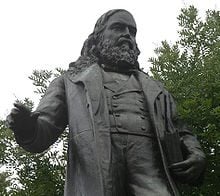
There are no statues of any Confederate leaders in Washington DC, with one exception. That one exception is a statue of Albert Pike one of the most influential American Freemasons in history and a onetime Confederate general. No less of an authority than Arthur Edward Waite once wrote that Pike “had a mind to transform the ancient accepted Scottish right into a seminary of occult study.” (1) Pike was not only one of the most transformative Masons in the history of the United States, he was also one of the most influential American occultists of the 19th century.
 When I talk to my friends about Freemasonry the question of whether or not the Freemasons are an occult organization often comes up. I am of the opinion that the amount of occult material in modern Masonry depends on the perspective of the practitioner. If you are looking for an occult experience, you can find it in Freemasonry. If you are simply looking for a fraternal order you can also find that within Freemasonry, and there are many devout Christians who are Freemasons who are not actively looking for any sort of occult meaning in “The Craft.” To put it simply, it’s there if you want it, and if you don’t want it, that’s fine too.
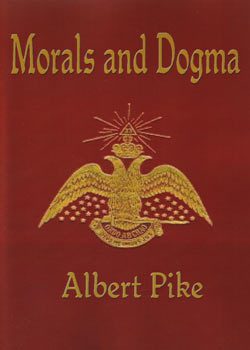
For most of its public history occult images have been associated with Freemasonry. Over the centuries various “rites” and degrees have been built around occult and (ancient) pagan ideas. Even during the relatively quiet 18th Century (well, quiet by occult standards) several esoteric Christian rites competed amongst each other in various Masonic Halls. (2) Pike’s rituals amplified the occult imagery in his Reformed Scottish Rite and he provided the keys to understanding it. Up until the early 1970’s his book Morals and Dogma of The Ancient and Accepted Scottish Rite of Freemasonry was given to anyone who obtained the 14th Degree within that system.
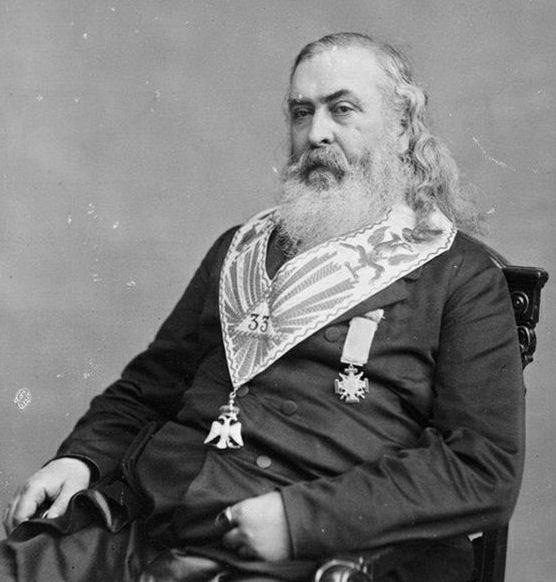
While his ideas are widely known amongst occult and Masonic historians there are many conflicting stories about his life. Some have claimed that he attended Harvard while many modern scholars dismiss the idea. In addition to fighting for the Confederacy in the Civil War he was said to have had many manly adventures in Missouri and Arkansas and some claim that he helped to establish the Ku Klux Klan. What is known is that in 1859 he was elected Sovereign Grand Commander of the Southern Jurisdiction of the Scottish Rite. It was a post that he would hold until his death in 1891. It was upon his election as Sovereign Grand Commander that he began rewriting the rituals of the Scottish Rite, infusing them with a large degree of occult philosophy and ideas.
 When I first began gathering information on Albert Pike I decided to start with a Google image search because I was curious about what he looked like. One of the first images I came across featured the faces of Pike, Karl Marx, Mao Zedong, Joseph Stalin, and finally Barack Obama (of course). The degree of loony respect for Pike took me by surprise. Apparently there are crazy Christian groups who think that Pike’s influence on world affairs remains strong enough that he can be looked at as a junior Antichrist. Though I’m not the biggest Pike fan, I think their fears are unwarranted, but I understand where that fear comes from.
Like many in the late 19th century Albert Pike saw Lucifer as a figure of redemption and a flattering portrait of the Light-bearer is painted in Morals and Dogma. None of Pike’s writings about Lucifer were particularly inspired or even original. Nearly all of the ideas (and even some of the words) Pike shared about Lucifer were stolen/borrowed from French occultist Eliphas Levi. (3) It’s Pike’s writings about Lucifer that provoke the crazy in many Fundamentalist Christians. I don’t think anything in Pike is all that outrageous, but I (probably like you) understand the context. The people who write Chick Tracts don’t.

Some of Pike’s writings on Lucifer don’t seem all that different from what would wind up in Aradia just a few decades later. Levi, Pike, and all of those Italian Witches certainly seemed to have a better understanding of “Lucifer” than most of their Christian contemporaries. A quick look at a few quotes from Morals and Dogma at least explains why Pike is looked at by many as a godless, Satanic, communist on par with Barack Obama.
“ Lucifer, the Light-bearer! Strange and mysterious name to give the Spirit of Darkness! Lucifer, the Son of the Morning! Is it he who bears the Light, and with its splendors intolerable blinds feeble, sensual, or selfless souls? Doubt it not!” From Morals and Dogma
In a different passage Pike (again “borrowed” from Levi) continues on, linking Satan to the (mythological) god Pan and other mystical forces:
“the true name of Satan, the colonists say, is that of Yahweh reserved; for Satan is not a black God, but the negation of God. The devil is the personification atheism or idolatry. For the initiates this is not a person, but for us, created for good, but which may serve or evil. Is the instrument of liberty or freedom will period they represent this force, which presides over the physical generation, under the mythological and warned form of God and, thence came as he goat of the Sabbath, brother of the aged circuit, and the light bearer, or philosopher, of which the poets has made the false Lucifer of the legend.”
In addition to writing about Lucifer as the Light-bearer, Pike also added sexual imagery to the Masonic tools of the Compass and the Square. Personally I never found either tool remotely sexual or phallus like, but that didn’t stop Pike. In Morals and Dogma he reflected on the sexual nature of the two most well-known Masonic symbols:
“ To us, creation is mechanism: to the agents it was generation… from this idea of generation came the reverence everywhere paid to the image of generated power, which formed the star rose of the Gnostics, and a philosophical cross of the Masons. As the procreative and generative agents, the heavens and the sun have always been regarded as male; as the generators that fructify the earth and causes it to reproduce. The Compass therefore, is the hermetic symbol of the creative deity, and the square of the productive earth or universe.”
 While I’ve never come across anyone claiming that Pike was a “Pagan” (in either the classic or modern sense of the word) his early poetry had a great degree of sympathy for the deities of antiquity. Like many occultists of the time, Pike’s personal cosmology probably included whatever was expedient to him at the time. Hymns to the Gods was an early (and long) poem first published when Pike was 23, it was later part of a larger collected work entitled Hymns to the Gods and Other Poems published in 1872. Later additions of Other Poems were edited by his daughter and appeared after his death.
Surprisingly, some of Pike’s Hymns to the Gods is decent poetry, I especially like this verse dedicated to Dionusos:
Oh, thou who lovest pleasure! at whose heart
Wine’s warmth is always felt; who takest part
In all mad, wanton mirth; who in the dance
Of merry maidens joinest, where the glance
Of bright black eyes, and twinkling of white feet,
Of lovely girls delight thee, when they meet
Under the summer moon!—Giver of peace
To all careworn, sad men!—whose smiles make cease
The piercing pains of grief; for whom young maids
Weave ivy garlands, and in pleasant glades
Hang up thine image, and, with happy looks,
Go dancing round, while shepherds, with long crooks,
Join the glad company, and glide about
With merry laugh and many a hearty shout,
Staining with rich dark grapes each little cheek
That most they love; and then, with sudden freak,
Seizing the willing hand, and dancing on
About the green mound:—Oh, thou merry son
Of supreme JOVE!
Wherever thou dost rove,
Among the thick vines, come, ere day is done,
And let us too thy sunny influence prove.
Classical religion continued its hold on Pike throughout his life. Morals and Dogma contains many passages reflecting upon ancient deities.
Albert Pike will never make my list of “favorite occultists” (his racism was beyond unforgivable) but he was influential in spreading European occult philosophies and ideas within the United States. He brought the works of Levi to a large audience, and helped popularize the Kabbalah. Pike was most certainly a flawed individual, but he was also an important one.
There are other bits in this series, including a write up of The Long Lost Friend and Joseph Smith of the Church of Latter Day Saints. While not originally a part of this series the lecture included material on Johnny Appleseed who I have written about previously. It also included a section on The Church of Aphrodite which Aidan Kelly wrote about last year.
_________
1. Ritual America: Secret Brotherhoods and Their Influence on American Society by Adam Parfrey and Craig Heimbichner published by Feral House and released in 2012. Despite its rather sinister sounding title Ritual America is a mostly sober account of fraternal orders in the United States. In addition to the enlightening text, it’s full of gorgeous, rare, and amazing photos. I love this book. The Waite quote comes from page 72. This is one of the books that sparked my interest in the Magick and the Occult project last summer and was my first introduction to Pike beyond a stray few sentences.
2. Solomon’s Secret Arts: The Occult in the Age of Enlightenment by Paul Kleber Monod published by Yale University Press and released in May of 2013 is the first comprehensive history of the occult I’ve come across dealing specifically with the Enlightenment period in Great Britain. Monod writes extensively about Freemasonry in Solomon’s Secret Arts and provides numerous examples of Masonic degrees and rituals that might be considered occult. Start reading on page 254 and then just go through the end of the book. Heck, just read the book if you have an interest in this stuff.
3. The idea that Pike borrowed/stole from Levi comes from Parfrey and Heimbichner.
Though I haven’t cited them, I did read Mark Stavish‘s Freemasonry: Rituals, Symbols, and History of the Secret Society (Llewellyn, 2007). much like Ritual America I was surprised by the non-sensationalist approach. I’ve probably read the section on Masonry in Triumph of the Moon by Ronald Hutton (Oxford University Press, 1999) several dozen times, I’m sure it’s influenced by opinions on Masonry.
Previous Post

July 23, 2013
Pagan Folkways: Dave Carter & Tracy Grammer
Next Post

July 31, 2013 Looking for Lughnassa
Browse Our Archives
Select a Category Editorializing Gateways to Paganism Guest Posts Holiday Histories Led Zeppelin News and Views Occult Pagan Pagan TV Club Paganism polytheism Ramble On Reviews Ritual Strange Days Uncategorized
Select a Month August 2026 March 2026 February 2026 November 2025 September 2025 August 2025 April 2025 August 2024 April 2024 February 2024 December 2023 October 2023 August 2023 June 2023 May 2023 January 2023 October 2022 August 2022 July 2022 June 2022 May 2022 April 2022 March 2022 February 2022 January 2022 December 2021 November 2021 October 2021 September 2021 August 2021 July 2021 June 2021 April 2021 March 2021 February 2021 January 2021 December 2020 November 2020 October 2020 August 2020 July 2020 June 2020 May 2020 April 2020 March 2020 February 2020 January 2020 December 2019 November 2019 October 2019 September 2019 August 2019 July 2019 June 2019 May 2019 April 2019 March 2019 February 2019 January 2019 December 2018 November 2018 October 2018 September 2018 August 2018 July 2018 June 2018 May 2018 April 2018 March 2018 February 2018 January 2018 December 2017 November 2017 October 2017 September 2017 August 2017 July 2017 June 2017 May 2017 April 2017 March 2017 February 2017 January 2017 December 2016 November 2016 October 2016 September 2016 August 2016 July 2016 June 2016 May 2016 April 2016 March 2016 February 2016 January 2016 December 2015 November 2015 October 2015 September 2015 August 2015 July 2015 June 2015 May 2015 April 2015 March 2015 February 2015 January 2015 December 2014 November 2014 October 2014 September 2014 August 2014 July 2014 June 2014 May 2014 April 2014 March 2014 February 2014 January 2014 December 2013 November 2013 October 2013 September 2013 August 2013 July 2013 June 2013 May 2013 April 2013 March 2013 February 2013 January 2013 December 2012 November 2012 October 2012 September 2012 August 2012 July 2012 June 2012 April 2012 October 2011 September 2011 August 2011
Follow Us!
TAKE THE
Religious Wisdom Quiz
In 1 Thessalonians, what does Paul say about the dead in Christ when the Lord returns?
Select your answer to see how you score.
They will rise last They will rise first They will be caught up in glory They will be judged
Related posts from Raise the Horns

Demons, the Occult, and the 2016 Presidential Campaign


My New Favorite Demon: The Charlie Challenge
TRENDING AT PATHEOS Pagan

The Sermon on the Mount, Part I: Matthew...
The Sermon on the Mount, Part I (Matthew 4:12-5:12) St. Matthew moves...

What's up from Crossway: Reviewing some of their latest A few weeks...

Janie Learns the Way of the Cross: A...
Teaching children about Jesus' Passion can be challenging. Many parents and educators...

Looking For Good Catholic Writing - October 2026
He alone extends the heavens, and he walks upon the waves of...

In "Irreplaceable," our book on vocation and technology, Trevor Sutton and I...

I was strolling through the top floor of the brand new Parthenon...
view all Pagan blogs
Ad-Free & Subscriber Log-In Subscription Support
- About Us
- 2026 Calendar
- Videos
- Podcasts
- Library of World Religions
- Faith In Media Tracker
- Advertise With Us
- Write for Us
- Privacy Policy
- Terms of Service
- Do Not Sell My Data
- Contact Us
- Radiant Digital
- Manage Newsletter Subscriptions
- Unsubscribe From Notifications
- Sitemap
Copyright 2008-2026, Patheos. All rights reserved.
Subscription Support Ad-Free & Subscriber Log-In
Follow Patheos