
BuddhistCatholicContemplativeEvangelicalGeneral ChristianHinduJewishLatter-day SaintMuslimNew VisionsProgressive Christian
Beliefs
- Buddhist
- Catholic
- Contemplative
- Evangelical
- General Christian
- Hindu
- Jewish
- Latter-day Saint
- More Voices
- Muslim
- New Visions
- Pagan
- Progressive Christian
Topics
- Religion News
- Food and Religion
- Sports and Religion
- Religious Art
- Religious Music and Entertainment
- Religious Events
- History and Religion
- Style and Religion
- Politics and Religion
- Women in Religion
- Recreation Outdoors and Religion
- Business Finance and Religion
- Careers Workplace and Religion
- Education and Religion
- Family Parenting and Religion
- Health Fitness and Religion
- Home and Religion
- Relationships and Religion
- Technology and Religion
- Travel and Religion
Columnists
- Buddhist Columnists
- Business Finance and Religion Columnists
- Careers Workplace and Religion Columnists
- Catholic Columnists
- Contemplative Columnists
- Education and Religion Columnists
- Evangelists Columnists
- Family Parenting and Religion Columnists
- General Christian Columnists
- Health Fitness and Religion Columnists
- Hindu Columnists
- History and Religion Columnists
- Home and Religion Columnists
- Jewish Columnists
- More Voices Columnists
- Latter Day Columnists
- Muslim Columnists
- New Visions Columnists
- Nonreligious Columnists
- Pagan Columnists
- Politics and Religion Columnists
- Progressive Columnists
- Recreation Outdoors and Religion Columnists
- Relationships and Religion Columnists
- Religion News Columnists
- Religious Art Columnists
- Religious Events Columnists
- Religious Music and Entertainment Columnists
- Sports and Religion Columnists
- Style and Religion Columnists
- Technology and Religion Columnists
- Travel and Religion Columnists
- Women in Religion Columnists
Resource Library
- 2026 Calendar
- Library of World Religions
- The 100 Most Holy Places on Earth
- Patheos Answers
- Podcasts
- Videos
- Faith Leaders Database
- Anglican Episcopalian
- Bahai
- Baptist
- Buddhism
- Christianity
- Confucianism
- Eastern Orthodoxy
- Hinduism
- Holiness and Pentecostal
- ISKCON
- Islam
- Judaism
- Lutheran
- Methodist
- The Church of Jesus Christ of Latter-day Saints
- New Age
- Paganism
- Presbytarian and Reformed
- Protestantism
- Religion Behind the Scenes
- Roman Catholic
- Scientology
- Shia Islam
- Sikhism
- Sufism
- Sunni Islam
- Taoism
- Zen
- See all religions
Research Tools
 Ad-Free & Subscriber Log-In Subscription Support
Ad-Free & Subscriber Log-In Subscription Support
Follow Patheos 

- Trending:
- Forgiveness
- |
- Marriage
- |
- Consciousness
- |
- Death Penalty
- |
- Election
- |
- Halloween

- HOME
- Me and the Blog
- Defining Pagan
- Rituals & Holidays
- All Posts
- Blogroll
- Publications
- FREE NEWSLETTER
- Home
- Pagan
- American Civil Religion
American Civil Religion
Last updated on: June 29, 2016 at 9:28 am by Jason Mankey
American Civil Religion 2016-06-29T09:28:39-06:00 Jason Mankey
Patheos Explore the world's faith through different perspectives on religion and spirituality! Patheos has the views of the prevalent religions and spiritualities of the world.
I recently finished reading The Faith Instinct by Nicholas Wade. In one of the book’s concluding chapters Wade writes about American Civil Religion, the idea that the history and symbols of the United States have resulted in a sort of pseudo-state religion. The theory is not Wade’s, but it was the first time I had come across it.
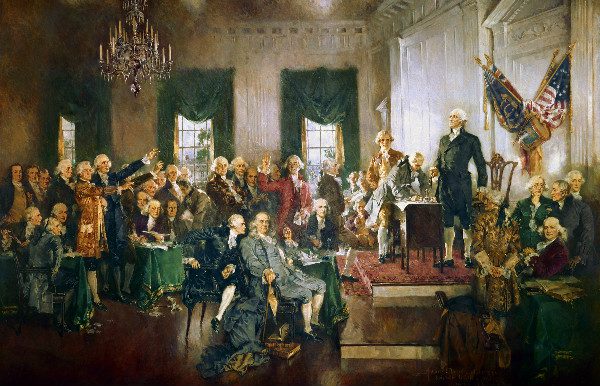
George Washington! Yeah!
Over the last few years the practice of American Civil Religion has become more and more pronounced. Many conservatives seem to see The Constitution as a near-religious document, second only to The Bible in terms of importance. While the whole point of the Constitution was that it could be changed and reinterpreted by succeeding generations, every line is now looked at as holy writ (at least when it’s convenient, no one talks much about counting some human beings as 3/5ths of a person), never mind that the Founding Fathers could not have imagined semi-automatic weapons or a healthcare system without leeches. In this way the Constitution is very much like The Bible, people pick and choose the things they want out of it, and ignore the parts that might stand in disagreement to their own positions (like the line “A well regulated Militia, being necessary to the security of a free State” in the Second Amendment).
The Constitution is not the only “scripture” at the heart of American Civil Religion. There are several other documents and speeches that carry nearly as much weight. The most obvious of those other scriptures is the Declaration of Independence. Containing the rhetorical flourishes of Jefferson and Franklin the Declaration is not just a letter proclaiming American independence, but a document outlining the rights and hopes of the American people (or at least white male landowners back in 1776).
There are several important Presidential addresses that are also seen by many as American Scripture. The first is Abraham Lincoln’s Gettysburg Address, a speech that was panned upon its initial delivery but is now looked at as the ten most eloquent sentences in the history of American discourse. Despite the best efforts of some, Franklin Roosevelt’s first inaugural address remains an important moment in American history, with people still recycling FDR’s “the only thing we have to fear is fear its self” line. Kennedy’s inaugural address retains a similar timelessness as does Eisenhower’s farewell address warning of “the military industrial complex.”
One does not have to be a sitting President in order for their words to be timeless and impactful. Martin Luther King’s “I Have a Dream” speech is (to my mind) the most powerful oratory by any American in our history. It’s also the most recent example of a speech becoming a part of American Civic Religion.
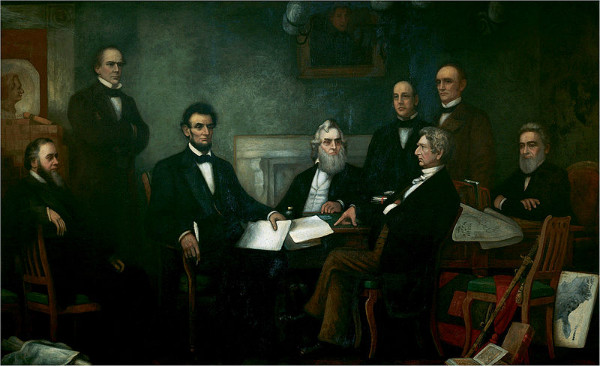
Abraham Lincoln! Yeah!
The Pledge of Allegiance is nearly a state-prayer, and to some a litmus test on patriotism. With the insertion of the phrase “under God” into the Pledge back in the 1950’s it’s recitation has become a religious and social exercise. In a sense, the Pledge turns America into the new Promised Land (Israel), Yahweh’s favorite shining city on a hill.
American Civil Religion goes beyond the scripture of documents and speeches, it also contains other symbols of a quasi-religious nature. The United States is a country of archetypes, with many of them containing a pronounced pagan flair. With her sword and scales Lady Justice is a symbol of the idea that there is “liberty and justice for all,” a founding principle of America’s judicial system.
The Statue of Liberty has become the archetype Lady Liberty, and it’s hard for me to think of her without hearing the words “give me your tired, your poor, Your huddled masses yearning to breathe free . . .” She’s the embodiment of being able to build a better life through the freedoms we have in the United States. The recent image of Ladies Justice and Liberty kissing is especially powerful as a symbol. With the end of DOMA, there is now even more liberty and justice in American society. Male archetypes abound as well. While sometimes overshadowed by his female peers, Uncle Sam remains a popular figure in America as a sort of Fourth of July Santa Claus.
Archetypes aren’t the only religious heroes associated with American Civil Religion. We’ve succeeded in turning a lot of our political (and military leaders) into near demi-gods*. Memorials for men like Jefferson, King, and Lincoln are temple-like in their grandeur and power. Not all cults are universal, one person’s deified hero might be someone else’s villain. Figures like Ronald Reagan and Cesar Chavez are hailed and scorned depending on certain political proclivities. Figures can also be regional or cultural in their appeal, as someone who grew up down South I can attest to just how many people admire General Robert E. Lee in the former Confederacy. (My personal choice here is Oglala Lakota leader Crazy Horse, he and Sitting Bull both deserve federal holidays.)
The heroes of American Religion are constantly being co-opted and misinterpreted for political gain. The deism of Thomas Jefferson has been overlooked by many who have attempted to insert an Evangelical Jesus into places where that messiah did not exist. Similarly, the Hellfire Club’s Benjamin Franklin has been romanticized to the point of caricature. Many of America’s deified heroes are now more myth than man; their failings ignored by a general populace that refuses to believe any of our “Founding Fathers” were capable of making mistakes.
America also has its own totem animals. The Bald Eagle, besides being our national bird, is also a symbol. To many it represents a certain ideal of American Freedom. To America’s first generation of leaders it was a symbolic link to the old (pagan) Roman Republic. Benjamin Franklin’s choice of national bird (the wild turkey) might not have won the day, but I’d argue that the turkey is our “other” national bird. As the Bald Eagle is celebrated on the Fourth of July (American Civil Religion’s most holy day), the turkey rules Thanksgiving as a symbol of abundance and as our national meal.
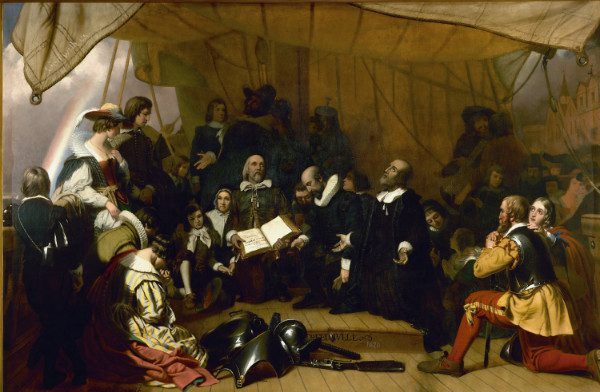
Pilgrims!?! OK I guess!
While having a great deal of respect and admiration for many of our national leaders and the documents and speeches that make up American Civil Religion, I am no fan of the institution. I love the symbolism of figures like Justice and Liberty, but the deification of words and men leads to a false sense of infallibility. America remains a great nation, but we also remain a nation capable of mistakes and a rigidness of thinking. The men who wrote the Constitution never thought that their words would be taken as holy writ. They were politicians and not prophets; men with flaws and limitations just like the rest of us. I think their humanity makes them more compelling and is worth remembering.
May you celebrate a safe and meaningful Fourth of July.
*Sadly we’ve turned far more men into demi-gods over the last two hundred and thirty odd years, but there are also several women who have also reached that exalted status. Betsy Ross, Susan B. Anthony, and Sakakawea (Sacagawea) are all examples of women who have come to be seen as nearly divine figures in American Civil Religion.
Previous Post

June 26, 2013
Deconstructing Stupid: Dumb Responses to the End of DOMA
Next Post
July 5, 2013 Shouldn't Rituals Be Entertaining?
Browse Our Archives
Select a Category Editorializing Gateways to Paganism Guest Posts Holiday Histories Led Zeppelin News and Views Occult Pagan Pagan TV Club Paganism polytheism Ramble On Reviews Ritual Strange Days Uncategorized
Select a Month August 2026 March 2026 February 2026 November 2025 September 2025 August 2025 April 2025 August 2024 April 2024 February 2024 December 2023 October 2023 August 2023 June 2023 May 2023 January 2023 October 2022 August 2022 July 2022 June 2022 May 2022 April 2022 March 2022 February 2022 January 2022 December 2021 November 2021 October 2021 September 2021 August 2021 July 2021 June 2021 April 2021 March 2021 February 2021 January 2021 December 2020 November 2020 October 2020 August 2020 July 2020 June 2020 May 2020 April 2020 March 2020 February 2020 January 2020 December 2019 November 2019 October 2019 September 2019 August 2019 July 2019 June 2019 May 2019 April 2019 March 2019 February 2019 January 2019 December 2018 November 2018 October 2018 September 2018 August 2018 July 2018 June 2018 May 2018 April 2018 March 2018 February 2018 January 2018 December 2017 November 2017 October 2017 September 2017 August 2017 July 2017 June 2017 May 2017 April 2017 March 2017 February 2017 January 2017 December 2016 November 2016 October 2016 September 2016 August 2016 July 2016 June 2016 May 2016 April 2016 March 2016 February 2016 January 2016 December 2015 November 2015 October 2015 September 2015 August 2015 July 2015 June 2015 May 2015 April 2015 March 2015 February 2015 January 2015 December 2014 November 2014 October 2014 September 2014 August 2014 July 2014 June 2014 May 2014 April 2014 March 2014 February 2014 January 2014 December 2013 November 2013 October 2013 September 2013 August 2013 July 2013 June 2013 May 2013 April 2013 March 2013 February 2013 January 2013 December 2012 November 2012 October 2012 September 2012 August 2012 July 2012 June 2012 April 2012 October 2011 September 2011 August 2011
Follow Us!
TAKE THE
Religious Wisdom Quiz
Which prophet was a shepherd and a sycamore-fig farmer?
Select your answer to see how you score.
Joel Amos Micah Daniel
Related posts from Raise the Horns


The Return of the Pagan Scapegoats


Magickal & Pagan Gathers: Some Thoughts
TRENDING AT PATHEOS Pagan

In "Irreplaceable," our book on vocation and technology, Trevor Sutton and I...

I was strolling through the top floor of the brand new Parthenon...

What Does Gêvâh Mean For Kimberley Guifoyle &...
This week, a lot of the news is focused on Kimberly Guilfoyle....

INNER CIRCLE: Profound Mystery (Of Christ In All...
Ephesians 5:31-32 “For this reason, a man will leave his father and...

Do Not Rejoice When Your Enemy Falls: The...
Turning an execution into a public spectacle is a disturbing expression of...

'The Chosen' S6 Trailer: The Passion Gets Very...
Not many watching 'The Chosen' worry about spoilers, but just because they...
view all Pagan blogs
Ad-Free & Subscriber Log-In Subscription Support
- About Us
- 2026 Calendar
- Videos
- Podcasts
- Library of World Religions
- Faith In Media Tracker
- Advertise With Us
- Write for Us
- Privacy Policy
- Terms of Service
- Do Not Sell My Data
- Contact Us
- Radiant Digital
- Manage Newsletter Subscriptions
- Unsubscribe From Notifications
- Sitemap
Copyright 2008-2026, Patheos. All rights reserved.
Subscription Support Ad-Free & Subscriber Log-In
Follow Patheos