
BuddhistCatholicContemplativeEvangelicalGeneral ChristianHinduJewishLatter-day SaintMuslimNew VisionsProgressive Christian
Beliefs
- Buddhist
- Catholic
- Contemplative
- Evangelical
- General Christian
- Hindu
- Jewish
- Latter-day Saint
- More Voices
- Muslim
- New Visions
- Pagan
- Progressive Christian
Topics
- Religion News
- Food and Religion
- Sports and Religion
- Religious Art
- Religious Music and Entertainment
- Religious Events
- History and Religion
- Style and Religion
- Politics and Religion
- Women in Religion
- Recreation Outdoors and Religion
- Business Finance and Religion
- Careers Workplace and Religion
- Education and Religion
- Family Parenting and Religion
- Health Fitness and Religion
- Home and Religion
- Relationships and Religion
- Technology and Religion
- Travel and Religion
Columnists
- Buddhist Columnists
- Business Finance and Religion Columnists
- Careers Workplace and Religion Columnists
- Catholic Columnists
- Contemplative Columnists
- Education and Religion Columnists
- Evangelists Columnists
- Family Parenting and Religion Columnists
- General Christian Columnists
- Health Fitness and Religion Columnists
- Hindu Columnists
- History and Religion Columnists
- Home and Religion Columnists
- Jewish Columnists
- More Voices Columnists
- Latter Day Columnists
- Muslim Columnists
- New Visions Columnists
- Nonreligious Columnists
- Pagan Columnists
- Politics and Religion Columnists
- Progressive Columnists
- Recreation Outdoors and Religion Columnists
- Relationships and Religion Columnists
- Religion News Columnists
- Religious Art Columnists
- Religious Events Columnists
- Religious Music and Entertainment Columnists
- Sports and Religion Columnists
- Style and Religion Columnists
- Technology and Religion Columnists
- Travel and Religion Columnists
- Women in Religion Columnists
Resource Library
- 2026 Calendar
- Library of World Religions
- The 100 Most Holy Places on Earth
- Patheos Answers
- Podcasts
- Videos
- Faith Leaders Database
- Anglican Episcopalian
- Bahai
- Baptist
- Buddhism
- Christianity
- Confucianism
- Eastern Orthodoxy
- Hinduism
- Holiness and Pentecostal
- ISKCON
- Islam
- Judaism
- Lutheran
- Methodist
- The Church of Jesus Christ of Latter-day Saints
- New Age
- Paganism
- Presbytarian and Reformed
- Protestantism
- Religion Behind the Scenes
- Roman Catholic
- Scientology
- Shia Islam
- Sikhism
- Sufism
- Sunni Islam
- Taoism
- Zen
- See all religions
Research Tools
 Ad-Free & Subscriber Log-In Subscription Support
Ad-Free & Subscriber Log-In Subscription Support
Follow Patheos 

- Trending:
- Forgiveness
- |
- Marriage
- |
- Consciousness
- |
- Death Penalty
- |
- Election
- |
- Halloween

- HOME
- Me and the Blog
- Defining Pagan
- Rituals & Holidays
- All Posts
- Blogroll
- Publications
- FREE NEWSLETTER
- Home
- Pagan
- A Hellenic-Style Ritual
A Hellenic-Style Ritual
Last updated on: July 10, 2013 at 5:55 am by Jason Mankey
A Hellenic-Style Ritual 2013-07-10T05:55:04-06:00 Jason Mankey
Patheos Explore the world's faith through different perspectives on religion and spirituality! Patheos has the views of the prevalent religions and spiritualities of the world.
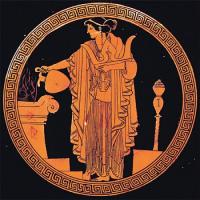 I’ve always felt drawn to the gods of the Ancient Greeks. When I was in elementary school I immersed myself in their myths, and in 9th grade art class I even constructed a (crappy) clay temple dedicated to Aphrodite. At our house my wife and I continue to keep the Greek Gods close. Aphrodite and Dionysus have a place of honor on our biggest house altar. Pan is currently occupying his own space on another one while Athena and Artemis guard our front door. The gods are a constant presence in our lives.
Several years ago I led a Greek Ritual (similar to this one) at the ConVocation festival near Detroit Michigan. Armed with Walter Burkert’s book Greek Religion I began piecing together my Hellenic Ritual. I decided not to consult any sources outside academia as I wanted to see what I could come up with mostly on my own. I think I succeeded, but I’m sure it’s not quite as authentic as it could be.
This past Spring a friend of mine approached me about leading/participating in a Greek Style Ritual at my house. He gave me a ritual outline from a mutual friend who often participates in and leads Hellenic Rites. After looking it over I was pleased to find that my version of a Hellenic-Style Ritual wasn’t that far off the mark when compared with his. I think mine probably has a few more modern flourishes, but there were more similarities than differences.
There aren’t a whole lot of materials needed for this ritual. Watered-wine, offerings to the gods, a few flowers, and altars to Dionysus and Aphrodite are all that’s needed. Ideally you’d have a fire to put your offerings in, but that’s always easier said than done. I also recommend the use of statues if you’ve got ’em.
I make no claim that this ritual is “authentic” or representative of what many Hellenic Reconstructionists do. This was simply my attempt at a Hellenic-Style rite.
Hand Washing
(The ritual begins with ceremonial cleansing. Everyone dips their hands into the bowl of water and dries them off with white towels. The water is lightly scented with oil. Once cleansed, the participants form a half circle around the altar of Aphrodite.)
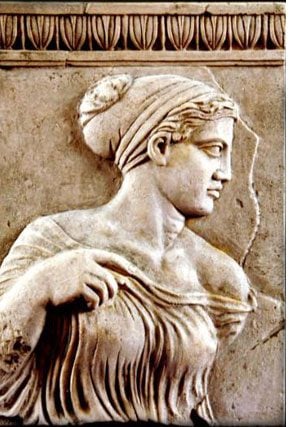 Homeric Hymn to Aphrodite
(The Homeric Hymns were basically the liturgies of public Greek rituals. Sadly, they are not always flattering, and sometimes they don’t flow like we would like them too. Don’t worry though, the gods are comfortable with these poems.)
“I will sing of stately Aphrodite, gold-crowned and beautiful, whose dominion spans from the heart of Cyprus to the hearts of all men. There in Cyprus the moist breath of the western wind wafted her over the waves of the loud-moaning sea in soft foam, and there she was greeted upon the shore by nymphs and dryads.”
“They clothed her with heavenly garments: on her head they put a fine, well-wrought crown of gold, and in her pierced ears they hung ornaments of diamonds and precious gold, and adorned her with golden necklaces over her soft neck and snow-white breasts, jewels which the nymphs and dryads wear themselves whenever they go to their father’s house to join the lovely dances of the gods. And when they had fully decked her, they brought her to the gods, who welcomed her when they saw her, giving her their hands. “
“Each one of them prayed that he might lead her home to be his wedded wife, so greatly were they amazed at the beauty of violet-crowned Aphrodite.”
“Hail, sweetly winning, coy-eyed goddess!”
“Of Aphrodite, born in Cyprus, I will sing. She gives kindly gifts to men: smiles are ever on her lovely face, and lovely is the brightness that plays over it.”
Sacrifice to Aphrodite
“Great Aphrodite to you we deliver this sacrifice. Taste of our fruit and our cakes, and accept our sacrifice if it pleases thee. Beautiful, gracious Goddess bless us with your gifts this night as honor and petition you. “
(A sacrifice of honey cakes, and seasonal fruit is placed on a plate for Aphrodite. When the ritual is over this may be taken outside and left for the Goddess. If you have the means, burning the sacrificial items would be truly ideal.)
Libation
“There is no petitioning of the gods without the sacred wine. We pour this wine for Mighty Aphrodite. Accept this gift knowing it comes from we who honor and adore you.”
(The libation of watered wine is poured into a bowl. At the conclusion of the ritual the water is poured upon the Earth in honor of Aphrodite.)
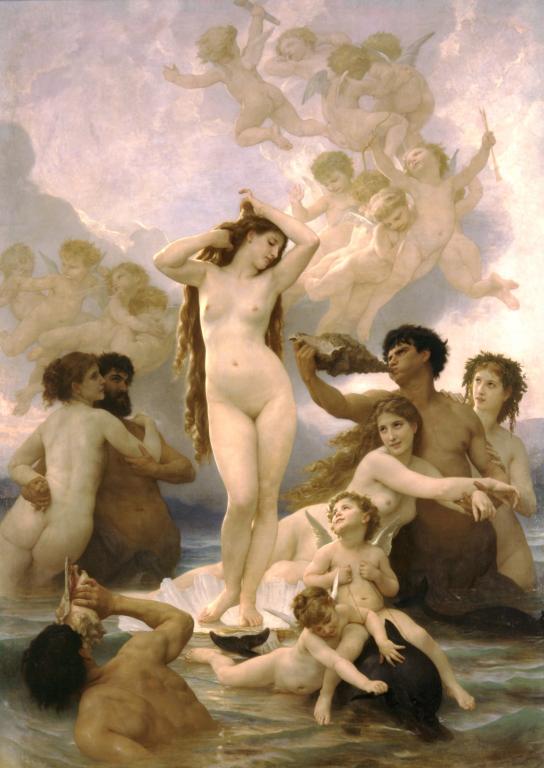 Prayer
(Prayers to the gods are done with hands outstretched over the head, or straight out from the body if an image of the gods is there to venerate.)
“She of joy, in lovliness she is clothed. She is adorned with sexuality, beauty and charm. Aphrodite of joy in lovliness she is clothed. She is adorned in sexuality beauty and charm. Her lips are sweet, life is in her mouth on her features blooms delight. She is glorous, lovliness covers her head. Beautiful are her colors, her eyes are many colored and iridescent.”
“Goddess Aphrodite we ask tonight that you hear our prayers. We hold the wine aloft in your honor. We utter our requests out loud or silently and then we take a sip of your wine. I ask O Great Goddess to bless my night with passion so that I might know you better. Come into my bed and into my heart so that I might adore thee. Hail Aphrodite!”
(The cup is passed around and prayers are said until all have spoken to the Goddess. The cup is refilled as needed.)
Flower Offering
(A flower is given to everyone in attendance at the ritual.)
“Much like thee O Aphrodite the flower is lovely and sweet. As we are a part of you, and you a part of us, that beauty lies within us all. Help us to realize our potential as beautiful, desirable beings. Let others see us as you see: as love-mates, as Priests and Priestesses of all things pleasurable. Let us see ourselves as you see us, individuals worthy of your love and your praise. Aphrodite of the Gardens, she of the flowers and green growing things, tonight we offer these gifts to you. As we lay these flowers upon your altar, kindle the fires of passion, longing, and love within our minds and hearts. “
Transition
(As the last flowers are laid upon the Aphrodite altar the congregants move towards the Dionysus altar. If you are not using a separate altar for Dionysus, then simply wait for the Aphrodite portion of the ritual to end before moving on towards the second part.)
Homeric Hymn to Dionysus
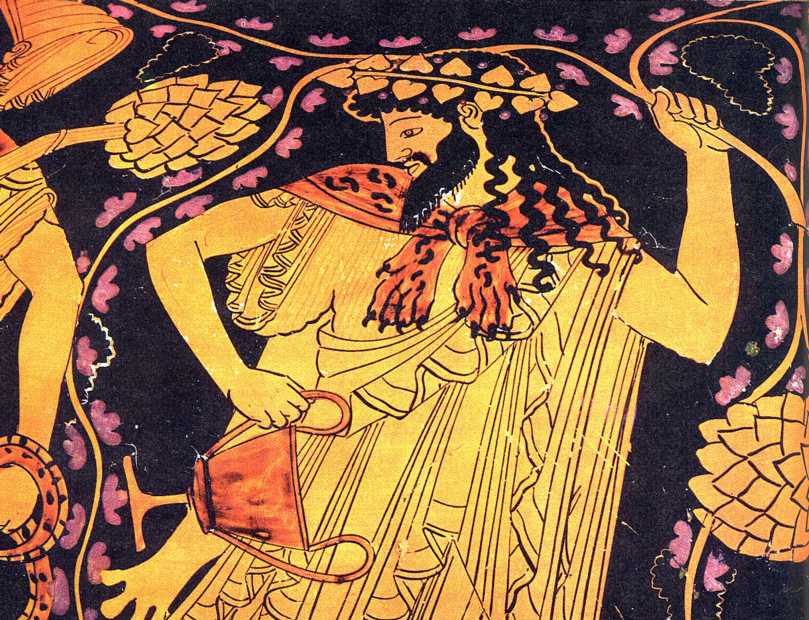 “I call upon loud-roaring and reveling Dionysos, primeval, two-natured, thrice-born, Bacchic lord, savage, ineffable, secretive, two-horned and two-shaped. Ivy-covered, bull-faced, warlike, howling, pure, you take raw flesh, you have triennial feasts, wrapt in foliage, decked with grape clusters. Resourceful Bacchus, immortal god sired by Zeus when he mated with Persephone in unspeakable union. Hearken to my voice, O blessed one, and with your fair-girdled nurses breathe on me in a spirit of perfect kindness.”
“Come, blessed Dionysos, bull-faced god conceived in fire, Bassareus and Bacchos, many-named master of all. You delight in bloody swords and in the holy Maenads, as you howl throughout Olympus, O roaring and frenzied Dionysus. Armed with thyrsus and wrathful in the extreme, you are honored by all the gods and by all the men who dwell upon the earth.”
“Come, blessed and leaping god, and bring much joy to all.”
Sacrifice
“Great Dionysus to you we offer this sacrifice. Accept our sacrifice of grapes that you may make sweet wine out of them upon Mighty Olympus.”
(Grapes are placed into a bowl and later left outside for the god, or ideally burned in a fire.)
“As the maenads of old traversed the wilds in honor of you, eating the raw flesh of your beasts so that they could know you, we too eat the flesh of beasts. May this meat remind of us your wild passions, your objection to conformity, and your will that we may be civilized yet pursue ecstasy in your name.”
(Meat of some sort is passed around, dried would probably be easiest.)
Libations
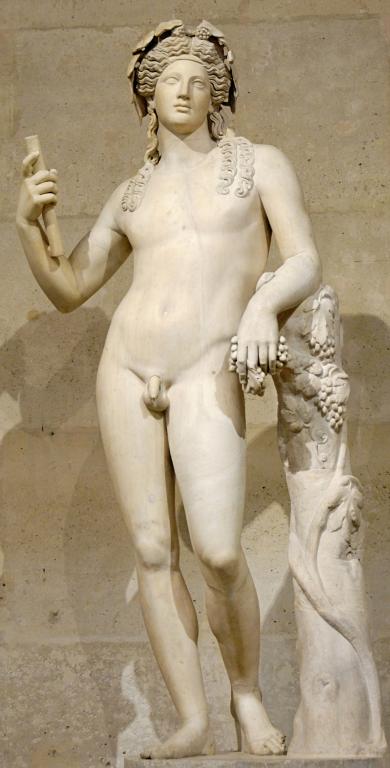
“This wine can only belong to you Great Dionysus! Your gift of the vine is ever present in our lives. It is the gift of joy, freedom, and lightness of spirit! It is the very gift of life its self. Without the blood of the grape, there is no blood of the people. We give this libation to you O Twice Born God, Hail Dionysus!”
(The mixed wine is poured into a libation bowl with the grapes, and notice that I wrote “mixed wine.” The traditional mix is three parts water to one part wine.)
 Prayer
“You are he whose gift is the vine, the never-ending chalice of intoxication. Your gifts are those of joy: wine, dance, and the freedom to be without care. We honor you with merriment and mirth, dance and song, lust and longing. Your only request of us is that we celebrate that joy with your name upon our lips. Your smile is our smile, your madness willingly embraced by those who follow you.”
“I utter this prayer this night, ask this one request, as I know my time here is fleeting. May I make tonight a night that will honor you, may I live as you would want me to live. Let me speak honeyed words, whisper your praises, and revel in ecstasy. May I know the sweetness of your gifts, this I pray O great Dionysus!”
(The cup is then passed around with everyone being allowed to say a prayer to Dionysus. When the cup has been passed to everyone in attendance all face the altar with arms outstretched towards a Dionysus statue, or with arms held above the head.)
“Here our prayers oh great god; let us know your ecstasy in our own lives. Fill our spirits as you fill our cups, let us drink deeply of the wine of life. Hail great Dionysus!”
Closing
“Our ritual is now at an end. To Aphrodite we bow, and to Dionysus we bow. Watch over us from eternal Mount Olympus as we go about our mortal days. Hail and farewell!”
Previous Post
July 5, 2013
Shouldn't Rituals Be Entertaining?
Next Post

July 11, 2013 Ramble On: Call of the Wild
Browse Our Archives
Select a Category Editorializing Gateways to Paganism Guest Posts Holiday Histories Led Zeppelin News and Views Occult Pagan Pagan TV Club Paganism polytheism Ramble On Reviews Ritual Strange Days Uncategorized
Select a Month August 2026 March 2026 February 2026 November 2025 September 2025 August 2025 April 2025 August 2024 April 2024 February 2024 December 2023 October 2023 August 2023 June 2023 May 2023 January 2023 October 2022 August 2022 July 2022 June 2022 May 2022 April 2022 March 2022 February 2022 January 2022 December 2021 November 2021 October 2021 September 2021 August 2021 July 2021 June 2021 April 2021 March 2021 February 2021 January 2021 December 2020 November 2020 October 2020 August 2020 July 2020 June 2020 May 2020 April 2020 March 2020 February 2020 January 2020 December 2019 November 2019 October 2019 September 2019 August 2019 July 2019 June 2019 May 2019 April 2019 March 2019 February 2019 January 2019 December 2018 November 2018 October 2018 September 2018 August 2018 July 2018 June 2018 May 2018 April 2018 March 2018 February 2018 January 2018 December 2017 November 2017 October 2017 September 2017 August 2017 July 2017 June 2017 May 2017 April 2017 March 2017 February 2017 January 2017 December 2016 November 2016 October 2016 September 2016 August 2016 July 2016 June 2016 May 2016 April 2016 March 2016 February 2016 January 2016 December 2015 November 2015 October 2015 September 2015 August 2015 July 2015 June 2015 May 2015 April 2015 March 2015 February 2015 January 2015 December 2014 November 2014 October 2014 September 2014 August 2014 July 2014 June 2014 May 2014 April 2014 March 2014 February 2014 January 2014 December 2013 November 2013 October 2013 September 2013 August 2013 July 2013 June 2013 May 2013 April 2013 March 2013 February 2013 January 2013 December 2012 November 2012 October 2012 September 2012 August 2012 July 2012 June 2012 April 2012 October 2011 September 2011 August 2011
Follow Us!
TAKE THE
Religious Wisdom Quiz
What Christian tradition has a worldwide leader known as the Ecumenical Patriarch?
Select your answer to see how you score.
Eastern Orthodox Anglican Lutheran Catholic
Related posts from Raise the Horns

What Makes a Good Ritualist? No Idea


The Return of the Pagan Scapegoats

TRENDING AT PATHEOS Pagan

In "Irreplaceable," our book on vocation and technology, Trevor Sutton and I...

I was strolling through the top floor of the brand new Parthenon...

What Does Gêvâh Mean For Kimberley Guifoyle &...
This week, a lot of the news is focused on Kimberly Guilfoyle....

INNER CIRCLE: Profound Mystery (Of Christ In All...
Ephesians 5:31-32 “For this reason, a man will leave his father and...

Do Not Rejoice When Your Enemy Falls: The...
Turning an execution into a public spectacle is a disturbing expression of...

'The Chosen' S6 Trailer: The Passion Gets Very...
Not many watching 'The Chosen' worry about spoilers, but just because they...
view all Pagan blogs
Ad-Free & Subscriber Log-In Subscription Support
- About Us
- 2026 Calendar
- Videos
- Podcasts
- Library of World Religions
- Faith In Media Tracker
- Advertise With Us
- Write for Us
- Privacy Policy
- Terms of Service
- Do Not Sell My Data
- Contact Us
- Radiant Digital
- Manage Newsletter Subscriptions
- Unsubscribe From Notifications
- Sitemap
Copyright 2008-2026, Patheos. All rights reserved.
Subscription Support Ad-Free & Subscriber Log-In
Follow Patheos