
BuddhistCatholicContemplativeEvangelicalGeneral ChristianHinduJewishLatter-day SaintMuslimNew VisionsProgressive Christian
Beliefs
- Buddhist
- Catholic
- Contemplative
- Evangelical
- General Christian
- Hindu
- Jewish
- Latter-day Saint
- More Voices
- Muslim
- New Visions
- Pagan
- Progressive Christian
Topics
- Religion News
- Food and Religion
- Sports and Religion
- Religious Art
- Religious Music and Entertainment
- Religious Events
- History and Religion
- Style and Religion
- Politics and Religion
- Women in Religion
- Recreation Outdoors and Religion
- Business Finance and Religion
- Careers Workplace and Religion
- Education and Religion
- Family Parenting and Religion
- Health Fitness and Religion
- Home and Religion
- Relationships and Religion
- Technology and Religion
- Travel and Religion
Columnists
- Buddhist Columnists
- Business Finance and Religion Columnists
- Careers Workplace and Religion Columnists
- Catholic Columnists
- Contemplative Columnists
- Education and Religion Columnists
- Evangelists Columnists
- Family Parenting and Religion Columnists
- General Christian Columnists
- Health Fitness and Religion Columnists
- Hindu Columnists
- History and Religion Columnists
- Home and Religion Columnists
- Jewish Columnists
- More Voices Columnists
- Latter Day Columnists
- Muslim Columnists
- New Visions Columnists
- Nonreligious Columnists
- Pagan Columnists
- Politics and Religion Columnists
- Progressive Columnists
- Recreation Outdoors and Religion Columnists
- Relationships and Religion Columnists
- Religion News Columnists
- Religious Art Columnists
- Religious Events Columnists
- Religious Music and Entertainment Columnists
- Sports and Religion Columnists
- Style and Religion Columnists
- Technology and Religion Columnists
- Travel and Religion Columnists
- Women in Religion Columnists
Resource Library
- 2026 Calendar
- Library of World Religions
- The 100 Most Holy Places on Earth
- Patheos Answers
- Podcasts
- Videos
- Faith Leaders Database
- Anglican Episcopalian
- Bahai
- Baptist
- Buddhism
- Christianity
- Confucianism
- Eastern Orthodoxy
- Hinduism
- Holiness and Pentecostal
- ISKCON
- Islam
- Judaism
- Lutheran
- Methodist
- The Church of Jesus Christ of Latter-day Saints
- New Age
- Paganism
- Presbytarian and Reformed
- Protestantism
- Religion Behind the Scenes
- Roman Catholic
- Scientology
- Shia Islam
- Sikhism
- Sufism
- Sunni Islam
- Taoism
- Zen
- See all religions
Research Tools
 Ad-Free & Subscriber Log-In Subscription Support
Ad-Free & Subscriber Log-In Subscription Support
Follow Patheos 

- Trending:
- Forgiveness
- |
- Marriage
- |
- Consciousness
- |
- Death Penalty
- |
- Election
- |
- Halloween

- HOME
- Me and the Blog
- Defining Pagan
- Rituals & Holidays
- All Posts
- Blogroll
- Publications
- FREE NEWSLETTER
- Home
- Pagan
- The Devil in Pagan Pants
The Devil in Pagan Pants
Last updated on: June 25, 2013 at 1:37 pm by Jason Mankey
The Devil in Pagan Pants 2013-06-25T13:37:07-06:00 Jason Mankey
Patheos Explore the world's faith through different perspectives on religion and spirituality! Patheos has the views of the prevalent religions and spiritualities of the world.
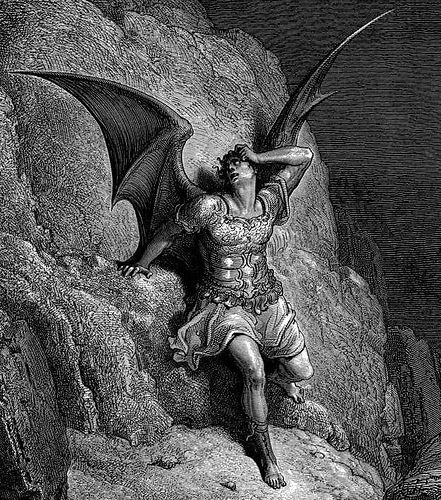 (This post was inspired by the Patheos series “What Do I Really Believe?”. Most of the questions in the series are geared towards Christians, but some of them are still rather interesting)
If you haven’t read John Beckett’s A Polytheistic Look at the Devil you should take a look at it before proceeding. A lot of what John says I completely agree with (which is usual, no offense to Jason Mankey but Under the Ancient Oaks is my favorite blog on Patheos Pagan), but Modern Paganism’s relationship with “The Devil” is far more complicated than John lets on. While the modern Devil is most certainly a Christian construction, he and his pseudonyms have occasionally made appearances in Modern Paganism.
Growing up I was terrified of the Devil. That fear came from several fronts. The Christian Church I attended sporadically outside of East Peoria Illinois had a very real belief in the Devil. He was an entity there, not a force, and lived to tempt, torment, and ruin. My fear of the Devil also arose independently of Christianity and was tied into the things I was reading in late adolesence. I was interested in the occult and the unexplained at a young age and my local library had a few books on such things, books geared to kids. By age ten I had read about how to sell your soul to the Devil in order to turn into a werewolf along with histories of the Devil as a fallen angel of Yahweh. While reading those kind of things I often felt a heavy presence in the room, as if something was looking over my shoulder. It was a spooky and not a comforting feeling.
Like John, as a polytheist I can’t completely dismiss the idea of the Devil. I’m of the opinion that if billions of people believe in something then that energy of belief goes into manufacturing whatever construct is on their minds. Do I believe in a devil with a pitchfork feeding the furnaces of hell? Certainly not, but I think there’s something that appears every time Satan is invoked. Luckily for us, the people invoking him are almost always Christians. If there’s a negative deity with influence on the world it’s due to the people who keep riling him up.
While Modern Paganism doesn’t have any room for Beelzebub in the circle, there are bits and pieces of our recent past with his hoof marks on them. The character of Lucifer makes an appearance in Charles Leland’s 1899 work Aradia: Gospel of the Witches. It should be noted that Lucifer was originally not a name of the Devil and simply referred to the morning star (Venus). Lucifer can also be interpreted as “light bringer,” and there were groups devoted to that principle in antiquity. Those groups (then and now) never thought of their Lucifer as an Old Testament satan (which basically means obstacle)*, but as a giver of knowledge.
Lucifer shows up at the very beginning of Aradia and seems to straddle the fence between the “cast out” devil figure found in The Book of Enoch and the light bringing morning star:
Diana greatly loved her brother Lucifer, the god of the Sun and of the Moon, the god of Light (Splendor), who was so proud of his beauty, and who for his pride was driven from Paradise.
Diana had by her brother a daughter, to whom they gave the name of Aradia [i.e. Herodias].
At the beginning of the passage Lucifer is a god of light, but the “who for his pride was driven from Paradise” line references the idea of Satan being thrown out of a heaven.
 The idea that Christian names could get attached to pagan religious figures is one of the tenets of Margaret Murray, whose books The Witch-Cult in Western Europe and The God of the Witches argue that “The Devil” of the Medieval (and Renaissance) Witch Trials was an ancient pagan horned god whose worship was corrupted and then driven underground. Murray wasn’t the first writer to suggest such a scenario, the idea first saw print in Jules Michelet’s The Sorcerer which was first published in 1862, with an English edition appearing the following year.
 Last Saturday I was talking to a friend about a band we both like that makes occasional references to Satan while also name-checking “the ancient gods” and the “old ways.” There’s a very Pagan-feel to the whole musical enterprise yet the Jack Scratch shout outs had left my friend feeling kind of uncomfortable. When I hear references to the Devil mixed with allusions to Medieval Witchcraft I’m instantly taken back to the ideas of Murray and Michelet, with my friend agreeing that was a good way to look at things.
In the 20th Century African paganisms were reinterpreted as being linked to the Devil. The idea of “selling your soul at the crossroads to the Devil” is a corruption of the worship of Eshu/Legba, the Yoruban god of the crossroads. The saying that the “gods of the old become the devils of the new” is not too far off the mark. Even when misunderstood it’s a testament to the power of Papa Legba that he still showed up when called upon. (His new forms and names were quite numerous too, sometimes the “black dog” showed up at the crossroads and at other times the “big black man.”)
Don’t get me wrong, Satan isn’t a part of Modern Paganism, but figures and names that can be interpreted as the Christian Devil are a part of our fairly recent past. Saying that Pagans simply “don’t believe in the Devil” is an easy out and doesn’t tell the whole story. Read some Murray and pick up Aradia just in case anyone asks you about the echoes of Old Scratch that occasionally turn up in Contemporary Paganism.
*The Origin of Satan by Elaine Pagels page 47
Previous Post

June 17, 2013
The Pagan Sandbox
Next Post
June 25, 2013 Remembering Why I am a Pagan
Browse Our Archives
Select a Category Editorializing Gateways to Paganism Guest Posts Holiday Histories Led Zeppelin News and Views Occult Pagan Pagan TV Club Paganism polytheism Ramble On Reviews Ritual Strange Days Uncategorized
Select a Month August 2026 March 2026 February 2026 November 2025 September 2025 August 2025 April 2025 August 2024 April 2024 February 2024 December 2023 October 2023 August 2023 June 2023 May 2023 January 2023 October 2022 August 2022 July 2022 June 2022 May 2022 April 2022 March 2022 February 2022 January 2022 December 2021 November 2021 October 2021 September 2021 August 2021 July 2021 June 2021 April 2021 March 2021 February 2021 January 2021 December 2020 November 2020 October 2020 August 2020 July 2020 June 2020 May 2020 April 2020 March 2020 February 2020 January 2020 December 2019 November 2019 October 2019 September 2019 August 2019 July 2019 June 2019 May 2019 April 2019 March 2019 February 2019 January 2019 December 2018 November 2018 October 2018 September 2018 August 2018 July 2018 June 2018 May 2018 April 2018 March 2018 February 2018 January 2018 December 2017 November 2017 October 2017 September 2017 August 2017 July 2017 June 2017 May 2017 April 2017 March 2017 February 2017 January 2017 December 2016 November 2016 October 2016 September 2016 August 2016 July 2016 June 2016 May 2016 April 2016 March 2016 February 2016 January 2016 December 2015 November 2015 October 2015 September 2015 August 2015 July 2015 June 2015 May 2015 April 2015 March 2015 February 2015 January 2015 December 2014 November 2014 October 2014 September 2014 August 2014 July 2014 June 2014 May 2014 April 2014 March 2014 February 2014 January 2014 December 2013 November 2013 October 2013 September 2013 August 2013 July 2013 June 2013 May 2013 April 2013 March 2013 February 2013 January 2013 December 2012 November 2012 October 2012 September 2012 August 2012 July 2012 June 2012 April 2012 October 2011 September 2011 August 2011
Follow Us!
TAKE THE
Religious Wisdom Quiz
Look to the LORD and his strength; seek his face, ____________.
Select your answer to see how you score.
Always Every Time Forever Eternally
Related posts from Raise the Horns


The Return of the Pagan Scapegoats


Magickal & Pagan Gathers: Some Thoughts
TRENDING AT PATHEOS Pagan

In "Irreplaceable," our book on vocation and technology, Trevor Sutton and I...

I was strolling through the top floor of the brand new Parthenon...

What Does Gêvâh Mean For Kimberley Guifoyle &...
This week, a lot of the news is focused on Kimberly Guilfoyle....

INNER CIRCLE: Profound Mystery (Of Christ In All...
Ephesians 5:31-32 “For this reason, a man will leave his father and...

Do Not Rejoice When Your Enemy Falls: The...
Turning an execution into a public spectacle is a disturbing expression of...

'The Chosen' S6 Trailer: The Passion Gets Very...
Not many watching 'The Chosen' worry about spoilers, but just because they...
view all Pagan blogs
Ad-Free & Subscriber Log-In Subscription Support
- About Us
- 2026 Calendar
- Videos
- Podcasts
- Library of World Religions
- Faith In Media Tracker
- Advertise With Us
- Write for Us
- Privacy Policy
- Terms of Service
- Do Not Sell My Data
- Contact Us
- Radiant Digital
- Manage Newsletter Subscriptions
- Unsubscribe From Notifications
- Sitemap
Copyright 2008-2026, Patheos. All rights reserved.
Subscription Support Ad-Free & Subscriber Log-In
Follow Patheos