
BuddhistCatholicContemplativeEvangelicalGeneral ChristianHinduJewishLatter-day SaintMuslimNew VisionsProgressive Christian
Beliefs
- Buddhist
- Catholic
- Contemplative
- Evangelical
- General Christian
- Hindu
- Jewish
- Latter-day Saint
- More Voices
- Muslim
- New Visions
- Pagan
- Progressive Christian
Topics
- Religion News
- Food and Religion
- Sports and Religion
- Religious Art
- Religious Music and Entertainment
- Religious Events
- History and Religion
- Style and Religion
- Politics and Religion
- Women in Religion
- Recreation Outdoors and Religion
- Business Finance and Religion
- Careers Workplace and Religion
- Education and Religion
- Family Parenting and Religion
- Health Fitness and Religion
- Home and Religion
- Relationships and Religion
- Technology and Religion
- Travel and Religion
Columnists
- Buddhist Columnists
- Business Finance and Religion Columnists
- Careers Workplace and Religion Columnists
- Catholic Columnists
- Contemplative Columnists
- Education and Religion Columnists
- Evangelists Columnists
- Family Parenting and Religion Columnists
- General Christian Columnists
- Health Fitness and Religion Columnists
- Hindu Columnists
- History and Religion Columnists
- Home and Religion Columnists
- Jewish Columnists
- More Voices Columnists
- Latter Day Columnists
- Muslim Columnists
- New Visions Columnists
- Nonreligious Columnists
- Pagan Columnists
- Politics and Religion Columnists
- Progressive Columnists
- Recreation Outdoors and Religion Columnists
- Relationships and Religion Columnists
- Religion News Columnists
- Religious Art Columnists
- Religious Events Columnists
- Religious Music and Entertainment Columnists
- Sports and Religion Columnists
- Style and Religion Columnists
- Technology and Religion Columnists
- Travel and Religion Columnists
- Women in Religion Columnists
Resource Library
- 2026 Calendar
- Library of World Religions
- The 100 Most Holy Places on Earth
- Patheos Answers
- Podcasts
- Videos
- Faith Leaders Database
- Anglican Episcopalian
- Bahai
- Baptist
- Buddhism
- Christianity
- Confucianism
- Eastern Orthodoxy
- Hinduism
- Holiness and Pentecostal
- ISKCON
- Islam
- Judaism
- Lutheran
- Methodist
- The Church of Jesus Christ of Latter-day Saints
- New Age
- Paganism
- Presbytarian and Reformed
- Protestantism
- Religion Behind the Scenes
- Roman Catholic
- Scientology
- Shia Islam
- Sikhism
- Sufism
- Sunni Islam
- Taoism
- Zen
- See all religions
Research Tools
 Ad-Free & Subscriber Log-In Subscription Support
Ad-Free & Subscriber Log-In Subscription Support
Follow Patheos 

- Trending:
- Forgiveness
- |
- Marriage
- |
- Consciousness
- |
- Death Penalty
- |
- Election
- |
- Halloween

- HOME
- Me and the Blog
- Defining Pagan
- Rituals & Holidays
- All Posts
- Blogroll
- Publications
- FREE NEWSLETTER
- Home
- Pagan
- Writing Samhain
Writing Samhain
Last updated on: October 26, 2015 at 2:45 pm by Jason Mankey
Writing Samhain 2015-10-26T14:45:57-06:00 Jason Mankey
Patheos Explore the world's faith through different perspectives on religion and spirituality! Patheos has the views of the prevalent religions and spiritualities of the world.
I’m in charge of a large Samhain ritual for a local Pagan group out here on the West Coast. With four official practices before the ritual (and two walk throughs the day of) it’s an undertaking that will consume a lot of my free time. That’s not a complaint, I knew that going into this, but since it will be consuming so much of my free time and is such a presence in my life I’ve decided to share some thoughts on it. My first post referencing this endeavor was back in August, but today I wanted to share some of my ritual writing process.
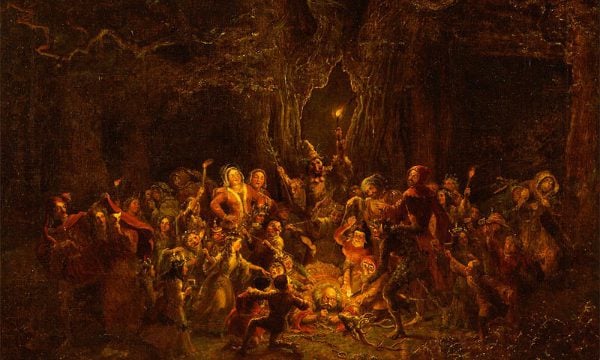
George Cruikshank – Herne’s Oak from ‘The Merry Wives of Windsor.
I have a few rules when it comes to writing sabbat rituals. These are my rules and I don’t expect everyone else to follow them. Do I think they are effective? Of course I do, but not everyone’s mind works like mine does.
1. Rituals have to make sense theologically. I need my rituals to tie into the Wheel of the Year and to reflect where we are on our yearly journey. If I’m writing a Yule ritual it needs to be readily identifiable as a Yule ritual even if I never say the word “Yule.” Some sabbats are more challenging in that regard, luckily for me Samhain is easy. It has several characteristics that most of us recognize: the thinning of the veil between the worlds, the late harvest, and the spirits of the dead. A Samhain Ritual would have to be really out of left field for anyone to confuse it with an Imbolc Ritual.
The gods are present in all of my rituals, but different rituals call for different gods. I’m not going to have a young Horned God chase the virgin Maiden at Samhain. In my personal theology I would prefer to work with Ariadne and Dionysus on Samhain, but the group I’m doing this ritual for prohibits the use of specific gods, so I had to go with something else. Eventually I settled upon a Lord and Lady of Death and the Summerlands, and Goddess and God as bringers of the harvest and abundance. Both sets of deity tie back into where we are on the Wheel and how most of us how view Samhain.
I believe that rituals should always be “balanced.” In my personal practice we worship Lord and Lady equally, so I’m always trying to make sure that the words I write reflect that belief. My desire for balance extends to quarter calls as well, no one is allowed to call a dragon in the South while someone else calls a Watchtower in the North. I’m so nit-picky about this process that I often make sure that my quarter calls contain an equal number of lines for each element. I don’t want West/Water to feel slighted and end up with a violent thunderstorm that ruins the ritual.
2. Rituals should involve everyone in the circle The biggest challenge at any large public ritual is figuring out a way to get everyone involved. When people attend a ritual they usually want “something to do.” That something can be as simple as performing the Spiral Dance and raising some energy, or giving everyone a chance to light a candle. What I always do my best to avoid is “talking at” people. Ritual should be interactive, it’s not something to engage in passively, the ritual working should find a way to give everyone a chance to participate.
I tend to find this the most difficult part of writing a ritual. It’s easier at certain sabbats; set up a Maypole in the middle of your circle at Beltane and the issue is taken care of, things are a little tricker on Imbolc and Lughnassa*. Samhain is easier than most because it’s usually pretty easy to come up with something relating to reuniting with ancestors or the souls of lost loved ones.
At my Samhain Ritual we are creating an “Avenue of the Dead” with pictures of departed loved ones and deceased Pagan elders (to me “Pagan Elders” also means Jim Morrison, John Lennon, Kirk Kurt Cobain, Bob Marley, Janis Joplin, MCA, and lots of others). I’ve got thirty minutes lined up for strolling the avenue, leaving offerings to lost dear ones, and receiving the blessing of the Dark Goddess. I don’t want to dictate people’s experiences, my goal is generally to set something up so people can have their own moments.
In addition to The Avenue, there’s a lot of food involved in the ritual. Before coming to the edge of the Summerlands there’s the “Food of the Dead” to eat, pomegranate seeds in this case. On the way back we are offering warm apple cider and honey cakes. I like adding a bit of the physical to ritual experiences, and involving as many senses as possible. Due to the myth of Demeter and Persephone pomegranate seeds have had a long association with death and inspire people to reflect upon that myth. Warm cider is a comforting presence in the fall and a very grounding association. Even my food choices are dictated by my first rule from up above.
Keep Control of The Ritual. It’s easy to get burned when putting together a ritual, I try to avoid this by creating ritual with a minimum of moving parts. My preference is always to get as many people involved as possible calling quarters, casting the circle, etc etc., but the more people you rely upon the bigger the chance that one or some of them might let you down. One of my local High Priestesses recently put together a lovely Mabon ritual, and that ritual called for a lot of music. On the day of the ritual her three drummers were no shows, her Maiden couldn’t get a ride to the ritual, and she had laryngitis. It wasn’t quite an unmitigated disaster, but it wasn’t the ideal.
Anything I write for large public consumption can be fixed on the fly. If my quarter caller in the North doesn’t show up I can fill in. When it comes to music I prefer to use my boombox instead of live performers (though for Samhain I have several people singing for me, since one of them is my “Second Wife” I feel well covered), or at least have it available as a back-up plan. I will walk into that Samhain Ritual with an extra ten copies of the script too, just in case.
Kate Rusby-Canaan’s Land (I’m using this in my Samhain Ritual.)
If I’m putting together a ritual with a large bunch of people I do like to get their input. My ritual next month calls for two sets of Priests and Priestesses and since that “second set” has a very big role I asked them to write their own calls to the Goddess and God. The things they say have to be true to themselves, and with their voices, so delegating in this case makes perfect sense. However as the director of the rite I did rewrite bits and pieces to reflect a consistent theology. I do like control, but I also don’t believe in writing ritual in a box, things have to be run by other folks.
There is only person I fully trust when doing ritual, and that’s my wife. We’ve shared many of the same experiences over the years, and like any long-standing couple we can often read each other’s thoughts without trying. She knows just when to take over a ritual and just when to take a step back. Having a dedicated working partner for the last fifteen years has made ritual much easier. I know that I’m blessed and that my situation is not one that can be shared by everyone, but if you do have that one person you trust implicitly, be sure to use them in ritual. My wife is not just someone I trust, she’s my sounding board. While I like control of my rituals, getting an outside opinion is always a good idea, it’s sometimes easier for other people to see the parts that might not work. My wife helps with staging and is an amazing script doctor often pointing out inconsistencies with my ideas.
Speaking of the script, I like to control the words in my large rituals as much as possible without becoming a complete control freak. The words of in my rituals are designed to evoke certain emotions and to make certain statements about the gods and the season at hand. A good ritual is a lot like a good term paper. You present a thesis statement at the beginning and use the rest of your paper or ritual to back up that idea. I don’t want to get off on a tangent in the middle of the ritual, everything in the ritual was created to back up the original Statement of Intent. In this case my SoI is:
“We gather here tonight to celebrate the passing of the Old Year and to welcome in the new. We are here to celebrate Samhain, the final harvest, that time when the veil between the world’s is at its thinnest and those that have departed this world may return to it once more. We journey this sacred night to the edge of the Summerlands to honor our ancestors and our dearly departed dead. So mote it be.”
Good ritual is often about creating a mood. My mood for Samhain is “creepy.” We are using traditional sounding language all the way through, and keeping the lights dim. I don’t usually use words like “Ye” but slipping them into the ritual signifies that what we are doing is different from the everyday. I want the words we speak to signify a break with the mundane. I don’t want to sugarcoat the Lord and Lady here either. The Goddess appears as the Lady of Death, and my God is the Dread Lord of Shadows. I certainly don’t think ritual should be terrifying, but it’s hard to create an atmosphere that encourages reunion with the Dead if the Goddess is surrounded by fresh flowers and the lights are on. Certain experiences call for low-light and an honest accounting of the gods, even when that accounting is a side of them many of us don’t readily acknowledge.
One of the most difficult parts of the ritual writing process is simply finding the inspiration that allows you to come up with something different. Yes, there are numerous rituals online that you can pilfer and adapt, but the best bits often come from some spark inside of ourselves. My process often involves going through past rituals in my head and reviewing what did and didn’t work. Sometimes I’ll find an idea that I don’t think was fully developed previously and nurture it a bit. I do comb through books on occasion, but mostly to find the thing the author forgot to do. Rituals can be like puzzles sometimes, and when you notice that the corner piece has been left out you’ve often found a good “hook” for ritual.
When I run into a bump in the ritual writing process I find that it’s usually the simplest thing that gets me over the rough patch. A moment of grounding, a piece of ritual I’ve used in the past that I know is effective, and words that are familiar (even when I don’t use Valiente’s Charge of the Goddess I often find myself using phrases and ideas found within it) tend to get me back on track. When in doubt I try to make sure whatever I’m doing in ritual lines up with my original Statement of Intent and follows my big three rules outlined above. Writing Ritual is a process, and when it does all come together that process is truly magickal.
(Like what you read on Raise the Horns? Then be sure to share it with your friends. Hate what you read? That’s fine too, share it anyways and complain about it with others. You can like Raise the Horns on Facebook, or go a step further and like Jason’s Facebook Page.)
*I’ve always found these the two hardest sabbat rituals to write. The other six are a piece of cake, but I don’t do well with this pair.
Previous Post

October 3, 2012
Election Fatigue
Next Post
October 14, 2012 Honoring The Ancestors (Or Not)
Browse Our Archives
Select a Category Editorializing Gateways to Paganism Guest Posts Holiday Histories Led Zeppelin News and Views Occult Pagan Pagan TV Club Paganism polytheism Ramble On Reviews Ritual Strange Days Uncategorized
Select a Month August 2026 March 2026 February 2026 November 2025 September 2025 August 2025 April 2025 August 2024 April 2024 February 2024 December 2023 October 2023 August 2023 June 2023 May 2023 January 2023 October 2022 August 2022 July 2022 June 2022 May 2022 April 2022 March 2022 February 2022 January 2022 December 2021 November 2021 October 2021 September 2021 August 2021 July 2021 June 2021 April 2021 March 2021 February 2021 January 2021 December 2020 November 2020 October 2020 August 2020 July 2020 June 2020 May 2020 April 2020 March 2020 February 2020 January 2020 December 2019 November 2019 October 2019 September 2019 August 2019 July 2019 June 2019 May 2019 April 2019 March 2019 February 2019 January 2019 December 2018 November 2018 October 2018 September 2018 August 2018 July 2018 June 2018 May 2018 April 2018 March 2018 February 2018 January 2018 December 2017 November 2017 October 2017 September 2017 August 2017 July 2017 June 2017 May 2017 April 2017 March 2017 February 2017 January 2017 December 2016 November 2016 October 2016 September 2016 August 2016 July 2016 June 2016 May 2016 April 2016 March 2016 February 2016 January 2016 December 2015 November 2015 October 2015 September 2015 August 2015 July 2015 June 2015 May 2015 April 2015 March 2015 February 2015 January 2015 December 2014 November 2014 October 2014 September 2014 August 2014 July 2014 June 2014 May 2014 April 2014 March 2014 February 2014 January 2014 December 2013 November 2013 October 2013 September 2013 August 2013 July 2013 June 2013 May 2013 April 2013 March 2013 February 2013 January 2013 December 2012 November 2012 October 2012 September 2012 August 2012 July 2012 June 2012 April 2012 October 2011 September 2011 August 2011
Follow Us!
TAKE THE
Religious Wisdom Quiz
How many chapters are in the Book of Romans?
Select your answer to see how you score.
16 18 12 14
Related posts from Raise the Horns

What Makes a Good Ritualist? No Idea

Yule is Also a Time for the Dead
The Embers (September-December)

TRENDING AT PATHEOS Pagan

The First Eucharistic Controversy: Christ’s Real Presence
For Catholics, the Eucharist is the source and summit of the Christian...

How to Make a Decision When You Can't...
Main point: It’s much more valuable to stay close to God so...

Archdiocese Hosts Military Marriage Retreat in Germany
RASTATT, Germany — The transient military lifestyle, with its frequent deployments and...

Nearly every morning, I make the drive to Detroit with my high-school-age...

The Real AI Story Is Adoption Without Trust
Artificial intelligence has crossed a political threshold. It is no longer a...

A new article, written by Jeff Lindsay and Gale L. Pooley,...
view all Pagan blogs
Ad-Free & Subscriber Log-In Subscription Support
- About Us
- 2026 Calendar
- Videos
- Podcasts
- Library of World Religions
- Faith In Media Tracker
- Advertise With Us
- Write for Us
- Privacy Policy
- Terms of Service
- Do Not Sell My Data
- Contact Us
- Radiant Digital
- Manage Newsletter Subscriptions
- Unsubscribe From Notifications
- Sitemap
Copyright 2008-2026, Patheos. All rights reserved.
Subscription Support Ad-Free & Subscriber Log-In
Follow Patheos