
BuddhistCatholicContemplativeEvangelicalGeneral ChristianHinduJewishLatter-day SaintMuslimNew VisionsProgressive Christian
Beliefs
- Buddhist
- Catholic
- Contemplative
- Evangelical
- General Christian
- Hindu
- Jewish
- Latter-day Saint
- More Voices
- Muslim
- New Visions
- Pagan
- Progressive Christian
Topics
- Religion News
- Food and Religion
- Sports and Religion
- Religious Art
- Religious Music and Entertainment
- Religious Events
- History and Religion
- Style and Religion
- Politics and Religion
- Women in Religion
- Recreation Outdoors and Religion
- Business Finance and Religion
- Careers Workplace and Religion
- Education and Religion
- Family Parenting and Religion
- Health Fitness and Religion
- Home and Religion
- Relationships and Religion
- Technology and Religion
- Travel and Religion
Columnists
- Buddhist Columnists
- Business Finance and Religion Columnists
- Careers Workplace and Religion Columnists
- Catholic Columnists
- Contemplative Columnists
- Education and Religion Columnists
- Evangelists Columnists
- Family Parenting and Religion Columnists
- General Christian Columnists
- Health Fitness and Religion Columnists
- Hindu Columnists
- History and Religion Columnists
- Home and Religion Columnists
- Jewish Columnists
- More Voices Columnists
- Latter Day Columnists
- Muslim Columnists
- New Visions Columnists
- Nonreligious Columnists
- Pagan Columnists
- Politics and Religion Columnists
- Progressive Columnists
- Recreation Outdoors and Religion Columnists
- Relationships and Religion Columnists
- Religion News Columnists
- Religious Art Columnists
- Religious Events Columnists
- Religious Music and Entertainment Columnists
- Sports and Religion Columnists
- Style and Religion Columnists
- Technology and Religion Columnists
- Travel and Religion Columnists
- Women in Religion Columnists
Resource Library
- 2026 Calendar
- Library of World Religions
- The 100 Most Holy Places on Earth
- Patheos Answers
- Podcasts
- Videos
- Faith Leaders Database
- Anglican Episcopalian
- Bahai
- Baptist
- Buddhism
- Christianity
- Confucianism
- Eastern Orthodoxy
- Hinduism
- Holiness and Pentecostal
- ISKCON
- Islam
- Judaism
- Lutheran
- Methodist
- The Church of Jesus Christ of Latter-day Saints
- New Age
- Paganism
- Presbytarian and Reformed
- Protestantism
- Religion Behind the Scenes
- Roman Catholic
- Scientology
- Shia Islam
- Sikhism
- Sufism
- Sunni Islam
- Taoism
- Zen
- See all religions
Research Tools
 Ad-Free & Subscriber Log-In Subscription Support
Ad-Free & Subscriber Log-In Subscription Support
Follow Patheos 

- Trending:
- Forgiveness
- |
- Marriage
- |
- Consciousness
- |
- Death Penalty
- |
- Election
- |
- Halloween

- HOME
- Me and the Blog
- Defining Pagan
- Rituals & Holidays
- All Posts
- Blogroll
- Publications
- FREE NEWSLETTER
- Home
- Pagan
- Pagan Orthodoxy (and the Wife of Jesus)
Pagan Orthodoxy (and the Wife of Jesus)
Last updated on: September 20, 2012 at 10:33 am by Jason Mankey
Pagan Orthodoxy (and the Wife of Jesus) 2012-09-20T10:33:38-06:00 Jason Mankey
Patheos Explore the world's faith through different perspectives on religion and spirituality! Patheos has the views of the prevalent religions and spiritualities of the world.
 You’ve probably already stumbled across the New York Times article making the rounds about a papyrus fragment containing the words “Jesus said to them, ‘My wife …'” It’s an exciting discovery, not because it proves that Jesus had a wife (it doesn’t), but because it speaks to the diversity in the emerging Christian movement 1800 years ago.
When I talk to my Evangelical friends about their faith they always describe it as “unchanged” since the time of Jesus, Peter, and Paul, but that’s simply not true. I’d argue that the religion of Jesus is only marginally similar to the religion of Paul, and that both of those gentlemen carried distinct and different messages. In antiquity there were dozens, perhaps hundreds, of different and competing Christianities. It took nearly four hundred years before there was anything approaching an Orthodox Christianity, and much of what was declared party line emerged as the result of violence and councils held by Roman Emperors.

Yahweh and his Asherah
Orthodoxy in any religion takes a great deal of time to develop. The ancient Hebrews shared a belief in one Supreme Male God, but many of them also worshipped his wife Asherah (and perhaps other deities as well). It took centuries for the worship of Asherah by the Hebrews to wither and die, and again, much of that came as the result of violence. As the book of Exodus says “Break down their altars, smash their sacred stones and cut down their Asherah poles.” Delightful.
I’ve always been fascinated by early Christianity and it’s development. The Church (or probably more accurately “The Churches”) of the year 100 has almost nothing in common with most Christian groups in 2012. Some of that is certainly cultural, but a lot of it is because beliefs and orthodoxy had yet to develop. In the year 100 of the Common Era (seventy years or so after the death of Jesus) there was no “New Testament” and the Gospel of John might not have even been written yet. Coincidently, the Modern Pagan movement is only about seventy years old.*
Periodically you’ll hear shouts in the Pagan blogosphere for some sort of “orthodoxy.” It would be nice if we could all agree on the definition of “Pagan” (or even agree on whether or not it should be capitalized), let alone orthodoxy, but give it some time. We’ve only been using the word “Pagan” for about forty years. Mormonism is similar in age to Modern Paganism and that faith continues to go through growing pains (African-American males weren’t allowed to be priests in the Mormon Church until 1978), why should we be any different? If history is doomed to be repeated, we are a long way from any sort of orthodoxy.
That doesn’t mean it’s not coming. We have become more orthodox over the last forty years, though it’s not always painfully obvious. Star wrote an insightful little post last week about The Problem of Personal Experience. Buried in the comments section were some brilliant insights that spoke of the lack of orthodoxy in Modern Paganism and how we are growing towards it, even without realizing it. Decades ago, before rituals were really printed in books, people “called the quarters” in configurations that might seem odd to many of us today (think Earth in the West), but with the availability of ritual material that has changed. In some ways, books have made us less eclectic, because the majority of us agree on a certain system of correspondences. Even if you hold onto an alternative construction in private ritual, doing anything outside of that basically requires you to equate East with Air.
Eclecticism (and especially Eclectic Wicca) has brought a certain orthodoxy with it. Before there were 1,194 (not the real number) books on the subject, different “Wiccan Traditions” could conceivably use dozens of different ritual structures, techniques, deities, and correspondences. I’m sure that the explosion of Eclectic Wicca has done little to change those things inside actual traditions, but outside of those traditions, it has given lots of Pagans (but certainly not all) a language and a system that’s generally agreed upon in public and large group settings. Due to Eclectic Wicca** being the most dominant form of Western Paganism, it’s a system that is at least familiar to most Pagans. Go to a “Pagan Festival” and you’ll get an opening ritual with someone calling four quarters, casting a circle, invoking a Goddess and God . . . . . . ya know, Eclectic Style Wicca.
While some Pagan groups have moved away from the “Gardnarian Magnet,” they still speak in language familiar to most Pagans. I can walk into a room full of ADF Druids and have more than enough in common with them that we are capable of arguing talking for several hours about a common belief system. Sure, we don’t do the same types of rituals, and we may not worship/honor the same gods (and the deities honored in ADF vary from grove to grove, no sweat there), but we read the same books and blogs, and go to the same festivals. That’s all a part of the move to some sort of orthodoxy within the Pagan movement as a whole.
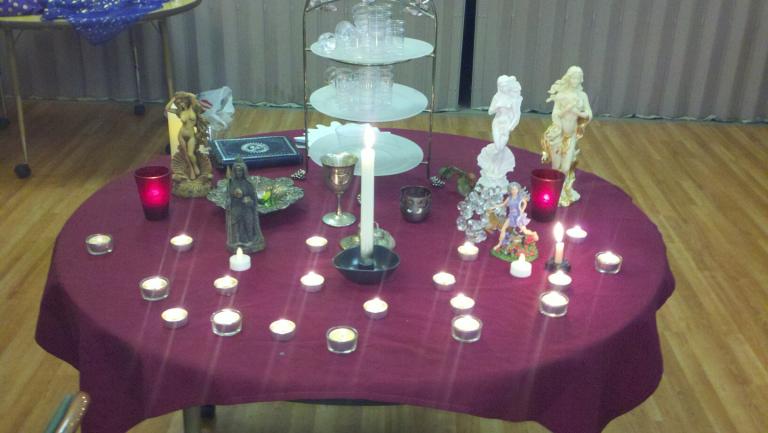 It’s true that we are basically a bunch of smaller self-sustaining groups, but that doesn’t mean our demise is imminent, or even likely to happen anytime soon (or far in the future). Christianity began roughly the same way, with people meeting around a kitchen table sharing wine and bread, there was no church structure seventy years in, and just as many people thought Paul was a jackass as thought he was an apostle. The fact that we can band together to send Patrick McCollum to Italy speaks to how far we’ve come in a very short period of time. Yes the National (or International) Federation of Pagans is a long way off, but we are starting to get to a place where we at least recognize a good spokesperson.
It often feels like Modern Paganism is rapidly moving away from any sort of orthodoxy, even as I argue that it’s not. Ten years ago I probably would have argued that most Pagans were polytheists, now there are a lot of Atheist Pagans, even as some things change, I still think that we are continuing to find common ground amongst ourselves. In the last few weeks I’ve witnessed two civil conversations that I thought would become heated, but our community was able to rise up and discuss Humanist Paganism and Are Satanists Pagan? with grace and civility. Much of that is because of the shared languages and experiences common to so many of us, the things that pave the way towards some sort of orthodoxy.
Does the idea of a Pagan Orthodoxy frighten me? If our recent past is any indication, not particularly. As we move forward defining Modern Paganism, my guess is that we will do it without violence or shouting, and we that we will figure out a way to make Modern Paganism a very big tent. I also have a hunch that we won’t be arguing the marital status of our gods 1800 years after the fact.
*I tend to date the official start of Modern Paganism to 1939, the year Gerald Gardner was initiated into a coven of witches in New Forest England. Were there people doing things we might recognize as Modern Pagan before 1939? Most certainly. There were also groups that looked a lot like early Christianity before the birth of Jesus. Nothing just emerges out of a vacuum, and religious movements are often the result of impulses that have built up over time, Paganism, like Christianity, is a good example of this phenomenon.
**I have no numbers to back this up, but I’m going to bet it’s true. Even initiated Witches often participate in large group rituals, which generally involve Eclectic Wiccan Style ritual.
Previous Post

September 18, 2012
Mercury Retrowhat? Oh Astrology . . . . .
Next Post
September 21, 2012 Reflections on the Autumn Equinox
Browse Our Archives
Select a Category Editorializing Gateways to Paganism Guest Posts Holiday Histories Led Zeppelin News and Views Occult Pagan Pagan TV Club Paganism polytheism Ramble On Reviews Ritual Strange Days Uncategorized
Select a Month August 2026 March 2026 February 2026 November 2025 September 2025 August 2025 April 2025 August 2024 April 2024 February 2024 December 2023 October 2023 August 2023 June 2023 May 2023 January 2023 October 2022 August 2022 July 2022 June 2022 May 2022 April 2022 March 2022 February 2022 January 2022 December 2021 November 2021 October 2021 September 2021 August 2021 July 2021 June 2021 April 2021 March 2021 February 2021 January 2021 December 2020 November 2020 October 2020 August 2020 July 2020 June 2020 May 2020 April 2020 March 2020 February 2020 January 2020 December 2019 November 2019 October 2019 September 2019 August 2019 July 2019 June 2019 May 2019 April 2019 March 2019 February 2019 January 2019 December 2018 November 2018 October 2018 September 2018 August 2018 July 2018 June 2018 May 2018 April 2018 March 2018 February 2018 January 2018 December 2017 November 2017 October 2017 September 2017 August 2017 July 2017 June 2017 May 2017 April 2017 March 2017 February 2017 January 2017 December 2016 November 2016 October 2016 September 2016 August 2016 July 2016 June 2016 May 2016 April 2016 March 2016 February 2016 January 2016 December 2015 November 2015 October 2015 September 2015 August 2015 July 2015 June 2015 May 2015 April 2015 March 2015 February 2015 January 2015 December 2014 November 2014 October 2014 September 2014 August 2014 July 2014 June 2014 May 2014 April 2014 March 2014 February 2014 January 2014 December 2013 November 2013 October 2013 September 2013 August 2013 July 2013 June 2013 May 2013 April 2013 March 2013 February 2013 January 2013 December 2012 November 2012 October 2012 September 2012 August 2012 July 2012 June 2012 April 2012 October 2011 September 2011 August 2011
Follow Us!
TAKE THE
Religious Wisdom Quiz
What was the first plague on Egypt?
Select your answer to see how you score.
Nile turned to Blood Lice Death of the Firstborn Hail
Related posts from Raise the Horns


The Return of the Pagan Scapegoats


Magickal & Pagan Gathers: Some Thoughts
TRENDING AT PATHEOS Pagan

Emotion in Early Christianity by Andrew Crislip
Andrew Crislip’s Emotion in Early Christianity examines an often overlooked dimension of...

16 Spiritual Touchstones for a More Grounded Life
After decades of spiritual study, here are 16 principles I try...

Catholic Evangelization: Sharing Your Faith Every Day
Welcome back to the Graceful Awakening mini-series called, “From Faith to Mission.” ...

The Pillar of the Boatmen: the Ancient Monument...
The Pillar of the Boatmen is a Romano-Gaulish sculpture that dates from...

In one sense walking into Westminster Abbey is like walking down the...

'Super Scam Me' Exposes AI Jon Bon Jovi...
Leslie Pickett believed she was in a relationship with Jon Bon Jovi....
view all Pagan blogs
Ad-Free & Subscriber Log-In Subscription Support
- About Us
- 2026 Calendar
- Videos
- Podcasts
- Library of World Religions
- Faith In Media Tracker
- Advertise With Us
- Write for Us
- Privacy Policy
- Terms of Service
- Do Not Sell My Data
- Contact Us
- Radiant Digital
- Manage Newsletter Subscriptions
- Unsubscribe From Notifications
- Sitemap
Copyright 2008-2026, Patheos. All rights reserved.
Subscription Support Ad-Free & Subscriber Log-In
Follow Patheos