
BuddhistCatholicContemplativeEvangelicalGeneral ChristianHinduJewishLatter-day SaintMuslimNew VisionsProgressive Christian
Beliefs
- Buddhist
- Catholic
- Contemplative
- Evangelical
- General Christian
- Hindu
- Jewish
- Latter-day Saint
- More Voices
- Muslim
- New Visions
- Pagan
- Progressive Christian
Topics
- Religion News
- Food and Religion
- Sports and Religion
- Religious Art
- Religious Music and Entertainment
- Religious Events
- History and Religion
- Style and Religion
- Politics and Religion
- Women in Religion
- Recreation Outdoors and Religion
- Business Finance and Religion
- Careers Workplace and Religion
- Education and Religion
- Family Parenting and Religion
- Health Fitness and Religion
- Home and Religion
- Relationships and Religion
- Technology and Religion
- Travel and Religion
Columnists
- Buddhist Columnists
- Business Finance and Religion Columnists
- Careers Workplace and Religion Columnists
- Catholic Columnists
- Contemplative Columnists
- Education and Religion Columnists
- Evangelists Columnists
- Family Parenting and Religion Columnists
- General Christian Columnists
- Health Fitness and Religion Columnists
- Hindu Columnists
- History and Religion Columnists
- Home and Religion Columnists
- Jewish Columnists
- More Voices Columnists
- Latter Day Columnists
- Muslim Columnists
- New Visions Columnists
- Nonreligious Columnists
- Pagan Columnists
- Politics and Religion Columnists
- Progressive Columnists
- Recreation Outdoors and Religion Columnists
- Relationships and Religion Columnists
- Religion News Columnists
- Religious Art Columnists
- Religious Events Columnists
- Religious Music and Entertainment Columnists
- Sports and Religion Columnists
- Style and Religion Columnists
- Technology and Religion Columnists
- Travel and Religion Columnists
- Women in Religion Columnists
Resource Library
- 2026 Calendar
- Library of World Religions
- The 100 Most Holy Places on Earth
- Patheos Answers
- Podcasts
- Videos
- Faith Leaders Database
- Anglican Episcopalian
- Bahai
- Baptist
- Buddhism
- Christianity
- Confucianism
- Eastern Orthodoxy
- Hinduism
- Holiness and Pentecostal
- ISKCON
- Islam
- Judaism
- Lutheran
- Methodist
- The Church of Jesus Christ of Latter-day Saints
- New Age
- Paganism
- Presbytarian and Reformed
- Protestantism
- Religion Behind the Scenes
- Roman Catholic
- Scientology
- Shia Islam
- Sikhism
- Sufism
- Sunni Islam
- Taoism
- Zen
- See all religions
Research Tools
 Ad-Free & Subscriber Log-In Subscription Support
Ad-Free & Subscriber Log-In Subscription Support
Follow Patheos 

- Trending:
- Forgiveness
- |
- Marriage
- |
- Consciousness
- |
- Death Penalty
- |
- Election
- |
- Halloween

- HOME
- Me and the Blog
- Defining Pagan
- Rituals & Holidays
- All Posts
- Blogroll
- Publications
- FREE NEWSLETTER
- Home
- Pagan
- Cakes and Wine . . . A Little Bit About Alcohol in History and Ritual
Cakes and Wine . . . A Little Bit About Alcohol in History and Ritual
Last updated on: September 9, 2016 at 2:32 pm by Jason Mankey
Cakes and Wine . . . A Little Bit About Alcohol in History and Ritual 2016-09-09T14:32:55-06:00 Jason Mankey
Patheos Explore the world's faith through different perspectives on religion and spirituality! Patheos has the views of the prevalent religions and spiritualities of the world.
“Quickly, bring me a beaker of wine, so that I may wet my mind and say something clever.” -Aristophanes
To me, alcohol is a sacred substance. I’m well aware that it can be abused, probably more aware than most. My mother is an alcoholic and her alcoholism is the reason we haven’t spoken to one another in nearly thirty years. I can still picture one evening where my mother refused to leave a party with my father, brother and I. She chose drinking over me. I will never forget that heartbreaking moment for as long as I live. I love my cider and I love my scotch, but I do not do so flippantly or without pausing to reflect on the problems that alcohol can cause. Just because alcohol is something I see as sacred does not mean that I’m blind to its more destructive properties.
All of that being said, alcohol has been seen as sacred by many for thousands of years. It’s completely possible that alcohol is the reason for civilization. 10,000 years ago humans began leaving behind their hunter-gatherer ways for an agricultural, sedentary existence. We take it for granted that an agricultural life-style is more desirable than a hunter-gatherer one, but 10,000 years ago that wasn’t the case. Our hunter-gatherer ancestors lived a life of abundance with a varied diet and a great deal of leisure time. In contrast, planting crops was a recipe for malnourishment, hunger, and a lot more work. With no apparent benefits, why did people start farming when the alternative seems so much more attractive? One of the various and competing theories is that people began farming because they enjoyed alcohol.
Think about the things that people farmed 10,000 years ago, it was all generally grains. People didn’t leave their hunter-gather lifestyle behind to grow zucchini, they grew cereal crops; crops that stored well and tended to turn fizzy and sweet when left undisturbed in a little water. Leave a plate of gruel on the dining room table for a few days and it will turn into an early version of beer. Not only was early beer pleasant to the taste buds it was also packed full of calories and vitamins, most notably Vitamin B which until the rise of agricultural had been obtained though meat. Beer kept people healthy and the people knew it, and eventually they thanked the gods for it and gave praise.
In addition to inspiring people to settle down, alcohol might well be responsible for a whole host of other things. What did people store in their earliest attempts at pottery? Beer. In ancient Sumer beer was used as a form of payment and people were paid in it. The earliest cuneiform (the Sumerian writing system) tablets contain a pictograph for beer, a pictograph that was later refined into something like a letter. In Sumer beer was seen as a civilizing force, and a sociable activity. Early beer tended to have a lot of things floating in it so it was consumed through straws to minimize the chances of swallowing a stick. As methods for crafting beer increased in complexity the debris that formerly plagued the drink was removed, but people still used straws to retain the social aspect. As brewing beer became more sophisticated the beer began to be boiled, making it the safest drink around.
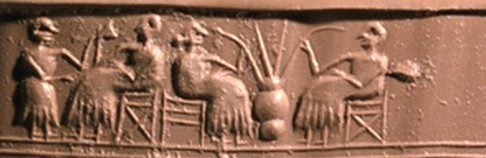
Ancient Sumerians drinking beer out of straws. I think we should bring this back.
The Sumerians weren’t alone in their love of drink. Many of the early great civilizations were drinking cultures. In Egypt the lower classes loaded up on beer while the pharaohs and their courts consumed wine. The Greeks were the first great wine culture, and their love of the drink influenced the Romans to become the second. The Vikings had their mead halls, and in the 18th Century the English consumed nearly as much gin as they did tea. Most of these cultures didn’t walk around inebriated the majority of the time. Greek wine was generally watered down, and early beer had a pretty low proof. There were probably a lot of buzzed folks, but very few sloppy drunks.
In my own personal practice the mini-ceremony known as Cakes and Wine** is called Cakes and Wine for a very specific reason, because you are supposed to use some sort of cake and wine. When I lift up my chalice full of wine (or cider) during ritual, or plunge an athame into its red waters, I often stop to think about the substance it contains. My chalice is full of alcohol because it honors my gods and my pagan ancestors. Wine is a gift from the divine, and gifts from the gods are not to be taken lightly.
Alcohol is a gift with a dangerous, even fatal, edge. It may have helped create society, but it’s also destroyed families and lives. It is a sacred substance not to be trifled with, and as such, it has enormous meaning to me. I don’t drink wine during ritual just because “it tastes good,” I drink it because it’s a part of my faith.

Modern Paganism has a long history of alcohol use and endorsement. It shows up in 1899 in Leyland’s Aradia where the drinking of wine is described as a sacred act: “I drink the blood of Diana, Since from wine it has changed into her blood, And spread its self through my growing vines” and then a bit later in the same passage the idea is repeated “If drinking from this horn I drink the blood-the blood of great Diana” Perhaps a bit more Christian Communion-like than I might prefer, but I still appreciate the sentiment.
Aleister Crowley once wrote “The Law of Thelema definitely enjoins us, as a necessary act of religion, to drink sweet wines and wines that foam. Any free man or woman who resides in any community where this is verboten has a choice between duties: insurrection and emigration.” Gardner celebrated “Cakes and Wine,” and you can find mention of it in books by nearly every prominent Pagan writer since. A High Priestess once told me that “wine is alive” and in a literal way because of the yeast within it. To me, it doesn’t get much more sacred than that.
I have been to some amazing rituals where all that’s in the chalice is sparkling grape juice*** and my world didn’t come to an end. The gods still showed up and one could still feel energy radiating from the circle. But when an alcohol free ritual is over, I always feel the need to get away for a little while and toast the gods with what I believe is sacred. Like so many who came before me, I praise the gods with good cheer and wine and beer.
(You can like Raise the Horns on Facebook, or go a step further and like Jason’s Facebook Page), not that anyone’s begging or anything, and even if I did I doubt it would help.)
*This number keeps getting moved back, with some scholars now saying the dawn of the agricultural age began almost 13,000 years ago.
**Or “Cakes and Ale,” which is an old English expression meaning “the good things in life.” The term Cakes and Ale was even used in Shakespeare’s (or deVere’s) 12th Night, “Dost thou think, because thou art virtuous, there shall be no more cakes and ale?”
***And I whole heartedly believe that when it’s possible all groups should provide both sides of the coin.
Previous Post
September 25, 2012
In Praise of Johnny Appleseed
Next Post

September 28, 2012 Gateways to Paganism: Tori Amos
Browse Our Archives
Select a Category Editorializing Gateways to Paganism Guest Posts Holiday Histories Led Zeppelin News and Views Occult Pagan Pagan TV Club Paganism polytheism Ramble On Reviews Ritual Strange Days Uncategorized
Select a Month August 2026 March 2026 February 2026 November 2025 September 2025 August 2025 April 2025 August 2024 April 2024 February 2024 December 2023 October 2023 August 2023 June 2023 May 2023 January 2023 October 2022 August 2022 July 2022 June 2022 May 2022 April 2022 March 2022 February 2022 January 2022 December 2021 November 2021 October 2021 September 2021 August 2021 July 2021 June 2021 April 2021 March 2021 February 2021 January 2021 December 2020 November 2020 October 2020 August 2020 July 2020 June 2020 May 2020 April 2020 March 2020 February 2020 January 2020 December 2019 November 2019 October 2019 September 2019 August 2019 July 2019 June 2019 May 2019 April 2019 March 2019 February 2019 January 2019 December 2018 November 2018 October 2018 September 2018 August 2018 July 2018 June 2018 May 2018 April 2018 March 2018 February 2018 January 2018 December 2017 November 2017 October 2017 September 2017 August 2017 July 2017 June 2017 May 2017 April 2017 March 2017 February 2017 January 2017 December 2016 November 2016 October 2016 September 2016 August 2016 July 2016 June 2016 May 2016 April 2016 March 2016 February 2016 January 2016 December 2015 November 2015 October 2015 September 2015 August 2015 July 2015 June 2015 May 2015 April 2015 March 2015 February 2015 January 2015 December 2014 November 2014 October 2014 September 2014 August 2014 July 2014 June 2014 May 2014 April 2014 March 2014 February 2014 January 2014 December 2013 November 2013 October 2013 September 2013 August 2013 July 2013 June 2013 May 2013 April 2013 March 2013 February 2013 January 2013 December 2012 November 2012 October 2012 September 2012 August 2012 July 2012 June 2012 April 2012 October 2011 September 2011 August 2011
Follow Us!
TAKE THE
Religious Wisdom Quiz
In 2 Corinthians, Paul describes a man being caught up to the third heaven. How many years before writing did this happen?
Select your answer to see how you score.
Twelve years Fourteen years Ten years Seven years
Related posts from Raise the Horns


The Return of the Pagan Scapegoats


Magickal & Pagan Gathers: Some Thoughts
TRENDING AT PATHEOS Pagan

Pope Leo Celebrates Mass for Nurses & Docs...
I don't have any idea how he did it, but Pope Leo...

The Sermon on the Mount, Part I: Matthew...
The Sermon on the Mount, Part I (Matthew 4:12-5:12) St. Matthew moves...

What's up from Crossway: Reviewing some of their latest A few weeks...

Janie Learns the Way of the Cross: A...
Teaching children about Jesus' Passion can be challenging. Many parents and educators...

Looking For Good Catholic Writing - October 2026
He alone extends the heavens, and he walks upon the waves of...

In "Irreplaceable," our book on vocation and technology, Trevor Sutton and I...
view all Pagan blogs
Ad-Free & Subscriber Log-In Subscription Support
- About Us
- 2026 Calendar
- Videos
- Podcasts
- Library of World Religions
- Faith In Media Tracker
- Advertise With Us
- Write for Us
- Privacy Policy
- Terms of Service
- Do Not Sell My Data
- Contact Us
- Radiant Digital
- Manage Newsletter Subscriptions
- Unsubscribe From Notifications
- Sitemap
Copyright 2008-2026, Patheos. All rights reserved.
Subscription Support Ad-Free & Subscriber Log-In
Follow Patheos