
BuddhistCatholicContemplativeEvangelicalGeneral ChristianHinduJewishLatter-day SaintMuslimNew VisionsProgressive Christian
Beliefs
- Buddhist
- Catholic
- Contemplative
- Evangelical
- General Christian
- Hindu
- Jewish
- Latter-day Saint
- More Voices
- Muslim
- New Visions
- Pagan
- Progressive Christian
Topics
- Religion News
- Food and Religion
- Sports and Religion
- Religious Art
- Religious Music and Entertainment
- Religious Events
- History and Religion
- Style and Religion
- Politics and Religion
- Women in Religion
- Recreation Outdoors and Religion
- Business Finance and Religion
- Careers Workplace and Religion
- Education and Religion
- Family Parenting and Religion
- Health Fitness and Religion
- Home and Religion
- Relationships and Religion
- Technology and Religion
- Travel and Religion
Columnists
- Buddhist Columnists
- Business Finance and Religion Columnists
- Careers Workplace and Religion Columnists
- Catholic Columnists
- Contemplative Columnists
- Education and Religion Columnists
- Evangelists Columnists
- Family Parenting and Religion Columnists
- General Christian Columnists
- Health Fitness and Religion Columnists
- Hindu Columnists
- History and Religion Columnists
- Home and Religion Columnists
- Jewish Columnists
- More Voices Columnists
- Latter Day Columnists
- Muslim Columnists
- New Visions Columnists
- Nonreligious Columnists
- Pagan Columnists
- Politics and Religion Columnists
- Progressive Columnists
- Recreation Outdoors and Religion Columnists
- Relationships and Religion Columnists
- Religion News Columnists
- Religious Art Columnists
- Religious Events Columnists
- Religious Music and Entertainment Columnists
- Sports and Religion Columnists
- Style and Religion Columnists
- Technology and Religion Columnists
- Travel and Religion Columnists
- Women in Religion Columnists
Resource Library
- 2026 Calendar
- Library of World Religions
- The 100 Most Holy Places on Earth
- Patheos Answers
- Podcasts
- Videos
- Faith Leaders Database
- Anglican Episcopalian
- Bahai
- Baptist
- Buddhism
- Christianity
- Confucianism
- Eastern Orthodoxy
- Hinduism
- Holiness and Pentecostal
- ISKCON
- Islam
- Judaism
- Lutheran
- Methodist
- The Church of Jesus Christ of Latter-day Saints
- New Age
- Paganism
- Presbytarian and Reformed
- Protestantism
- Religion Behind the Scenes
- Roman Catholic
- Scientology
- Shia Islam
- Sikhism
- Sufism
- Sunni Islam
- Taoism
- Zen
- See all religions
Research Tools
 Ad-Free & Subscriber Log-In Subscription Support
Ad-Free & Subscriber Log-In Subscription Support
Follow Patheos 

- Trending:
- Forgiveness
- |
- Marriage
- |
- Consciousness
- |
- Death Penalty
- |
- Election
- |
- Halloween
 Pagan Tama
- Home
- Pagan
- Why prayers and parliament shouldn’t mix
Why prayers and parliament shouldn’t mix
Last updated on: January 22, 2019 at 8:35 pm by Megan Manson
Why prayers and parliament shouldn’t mix 2019-01-22T20:35:39+00:00 Megan Manson
Patheos Explore the world's faith through different perspectives on religion and spirituality! Patheos has the views of the prevalent religions and spiritualities of the world.
The US constitution provides a wall between state and church, but in the UK no such wall exists. Prayers are a daily part of many state establishments, including the Houses of Parliament. But a group of MPs are trying to change this, and UK-based readers can help.
Like many others who follow a spiritual path, I pray as part of my daily practice. My prayer times are important to me. They are my personal communion with the divine.
Because prayers are so personal, I acknowledge there’s a time and a place for them. And I don’t think our political institutions are those places.

The US courts agree. In 2017, an appeals court found the way the Rowan County Commission prayed before public meetings unconstitutional. This was described as an “important victory for the rights of all people to be free from religious coercion by government officials” by Chris Brook of American Civil Liberties Union of North Carolina. He added: “People who attend public meetings should not have to fear that government officials may force them to participate in a prayer—or discriminate against them if they don’t.”
But across the pond in the UK, things are quite different. While the US enjoys constitutional separation of church and state, giving considerable protection to secular democracy, the UK has an established church. The Church of England enjoys a level of privilege afforded to no other religion or belief group. Its head, the Queen, is also the head of state. It has 26 spaces reserved especially for its bishops in the House of Lords, the upper house of parliament.
And it gets to have its own prayers in parliament.
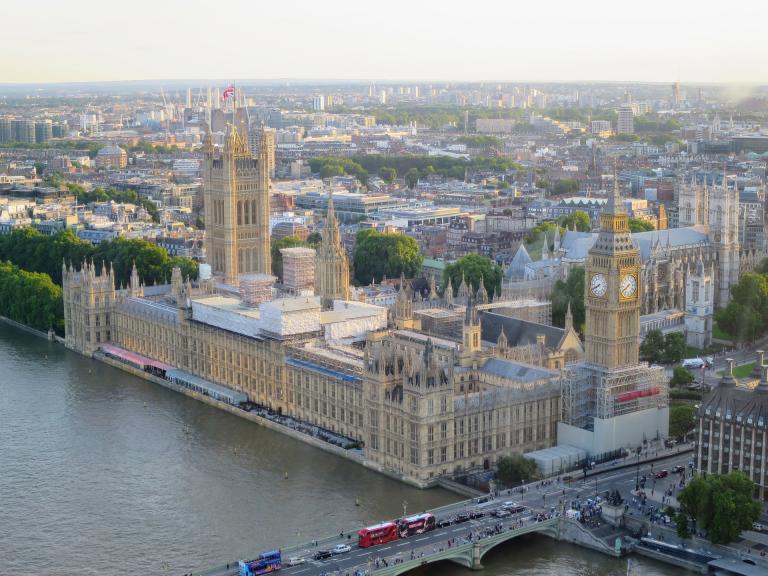
Sittings in both houses of parliament (the House of Commons and the House of Lords) begin with prayers. In the House of Commons they are read by the Speaker’s Chaplain, and in the Lords the job goes to one of the 26 bishops. They are a strictly secretive affair. The doors to the House are locked before they can begin. They aren’t even filmed; although the UK has its own TV channel dedicated to what’s going on in parliament (BBC Parliament), the prayers are never broadcast. This means few members of the public have ever seen the prayers.
Perhaps this is to avoid the public making fun of our politicians, because to many the prayers would look rather bizarre. The members of the House turn and face the wall while the prayers are intoned. According to some of those who have witnessed the prayers, the whole scene, with a chaplain or bishop reading prayers in the ancient chambers while the members stand facing the wall, seems incongruous to the business of parliament. It looks like something that belongs in a place of worship.
That’s precisely because it does belong in a place of worship, not in a place of politics.
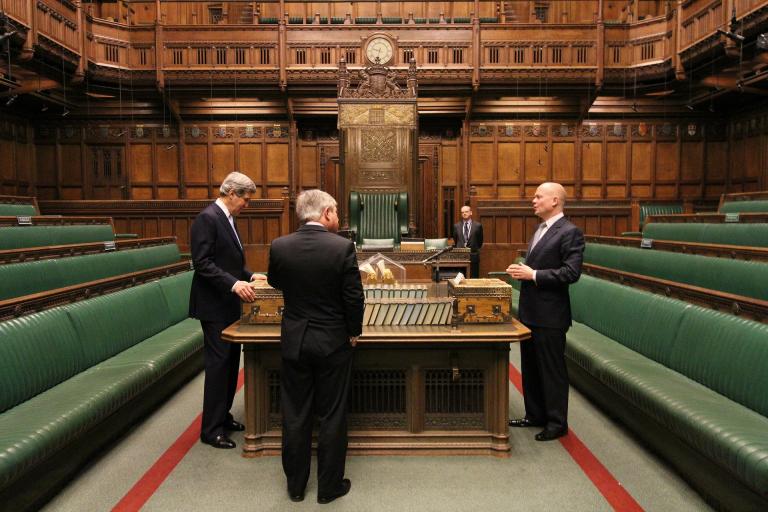
The House of Commons. Going to the prayers may be the only way for MPs to reserve their seat on busy days.
Technically, attending the prayers is not compulsory. But in practice, MPs and peers have to attend them during busy times in order to reserve their seats. No praying, no seat. So while attendance is optional, it’s clear that beginning every sitting with prayers privileges Anglicans, and disadvantages everyone else to whom Anglican prayers have no meaning. Crispin Blunt, a Conservative Party MP who is also a Humanist, said that it makes him “uncomfortable” having to take part in prayers in order to secure his place in parliament.
Parliament isn’t the only state establishment where praying takes place as an official order of business. Local council meetings may also start with prayers, which again can create an unwelcoming environment for some councillors. Then there are the bizarre judges’ services; Anglican services that take place for judges every year to pray for guidance. Finally, every state school in the UK, regardless of whether it has a religious ethos or not, must have a daily session of “broadly Christian” collective worship. Prescribing Anglican worship in the centre of our democracy has the knock-on effect of institutionalising prayer in many other state establishments.
Parliamentary prayers are an inappropriate use of our MPs’ and peers’ time and are incompatible with the right to freedom of religion and conscience. They reinforce the unfair privilege afforded to the Church of England, and make our parliament less welcoming and inclusive to people of all faiths and none.
That’s why a group of MPs, led by Crispin Blunt, have tabled an Early Day Motion (EDM) to end parliamentary prayers. The MPs represent a variety of parties: Conservatives, Labour, Liberal Democrats, Scottish National Party and independent MPs so far have signed the motion.
UK readers can help speak out for a more welcoming parliament for people of all faiths in none.
If you’re in the UK, you can help! Please write to your MP and ask him or her to sign EDM #1967, the Early Day Motion to end parliamentary prayers.
Stuck for time? You can send a prewritten, customisable email to your MP in a matter of minutes via the National Secular Society’s website. And please let others know about this EDM.
Let’s tell our representatives that it’s time for a 21st century parliament. It’s time to end parliamentary prayers.
Secularism, Politics & Human Rights
Previous Post

January 20, 2019
Pagan & Shinto News: Japan celebrates Coming of Age Day
Browse Our Archives
Select a Category Art, Craft & Expression Musings & Miscellaneous Nature & Science News & Reviews Ritual & Festivals Secularism, Politics & Human Rights Shinto & Japanese Religion Uncategorized
Select a Month August 2023 July 2023 June 2023 May 2023 April 2023 March 2023 February 2023 January 2023 December 2022 November 2022 October 2022 September 2022 August 2022 July 2022 June 2022 May 2022 April 2022 March 2022 February 2022 January 2022 December 2021 November 2021 October 2021 September 2021 August 2021 July 2021 June 2021 May 2021 April 2021 March 2021 February 2021 January 2021 December 2020 November 2020 October 2020 September 2020 August 2020 July 2020 June 2020 May 2020 April 2020 March 2020 February 2020 January 2020 December 2019 November 2019 October 2019 September 2019 August 2019 July 2019 June 2019 May 2019 April 2019 March 2019 February 2019 January 2019 December 2018 November 2018 October 2018 September 2018 August 2018 July 2018 June 2018 May 2018 April 2018 March 2018 February 2018 January 2018 December 2017 August 2017 July 2017 June 2017 May 2017 April 2017 March 2017 February 2017 January 2017 December 2016 November 2016 October 2016 September 2016 August 2016 July 2016 June 2016 May 2016 April 2016 March 2016 February 2016 January 2016
Follow Us!
TAKE THE
Religious Wisdom Quiz
In the Parable of the Good Samaritan, who ignored the injured man before the Samaritan helped?
Select your answer to see how you score.
A priest and a Levite A farmer and a shepherd A fisherman and a tax collector A Roman soldier and a scribe
Related posts from Pagan Tama
Three reasons why Pagans should support equality for...
Opposing Religious Discrimination At Schools: A (Mixed) Success
Garden Rituals: What Do Pagans Think?
Why I Don't Do Rituals In My Garden...
TRENDING AT PATHEOS Pagan

I was recently chatting with someone on Instagram. She asked me what...

While there are many people who share their results, the end of...

On July 23, I saw Christopher Nolan's The Odyssey which is Homer’s...

As I write this two big events have just finished up. One...

Restoring the Watershed of Divine Love
Perhaps cooperation is not something we manufacture through legislation, ideology, or moral...

Many UUs don’t pray because of bad experiences in a previous religion,...
view all Pagan blogs
Ad-Free & Subscriber Log-In Subscription Support
- About Us
- 2026 Calendar
- Videos
- Podcasts
- Library of World Religions
- Faith In Media Tracker
- Advertise With Us
- Write for Us
- Privacy Policy
- Terms of Service
- Do Not Sell My Data
- Contact Us
- Radiant Digital
- Manage Newsletter Subscriptions
- Unsubscribe From Notifications
- Sitemap
Copyright 2008-2026, Patheos. All rights reserved.
Subscription Support Ad-Free & Subscriber Log-In
Follow Patheos