
BuddhistCatholicContemplativeEvangelicalGeneral ChristianHinduJewishLatter-day SaintMuslimNew VisionsProgressive Christian
Beliefs
- Buddhist
- Catholic
- Contemplative
- Evangelical
- General Christian
- Hindu
- Jewish
- Latter-day Saint
- More Voices
- Muslim
- New Visions
- Pagan
- Progressive Christian
Topics
- Religion News
- Food and Religion
- Sports and Religion
- Religious Art
- Religious Music and Entertainment
- Religious Events
- History and Religion
- Style and Religion
- Politics and Religion
- Women in Religion
- Recreation Outdoors and Religion
- Business Finance and Religion
- Careers Workplace and Religion
- Education and Religion
- Family Parenting and Religion
- Health Fitness and Religion
- Home and Religion
- Relationships and Religion
- Technology and Religion
- Travel and Religion
Columnists
- Buddhist Columnists
- Business Finance and Religion Columnists
- Careers Workplace and Religion Columnists
- Catholic Columnists
- Contemplative Columnists
- Education and Religion Columnists
- Evangelists Columnists
- Family Parenting and Religion Columnists
- General Christian Columnists
- Health Fitness and Religion Columnists
- Hindu Columnists
- History and Religion Columnists
- Home and Religion Columnists
- Jewish Columnists
- More Voices Columnists
- Latter Day Columnists
- Muslim Columnists
- New Visions Columnists
- Nonreligious Columnists
- Pagan Columnists
- Politics and Religion Columnists
- Progressive Columnists
- Recreation Outdoors and Religion Columnists
- Relationships and Religion Columnists
- Religion News Columnists
- Religious Art Columnists
- Religious Events Columnists
- Religious Music and Entertainment Columnists
- Sports and Religion Columnists
- Style and Religion Columnists
- Technology and Religion Columnists
- Travel and Religion Columnists
- Women in Religion Columnists
Resource Library
- 2026 Calendar
- Library of World Religions
- The 100 Most Holy Places on Earth
- Patheos Answers
- Podcasts
- Videos
- Faith Leaders Database
- Anglican Episcopalian
- Bahai
- Baptist
- Buddhism
- Christianity
- Confucianism
- Eastern Orthodoxy
- Hinduism
- Holiness and Pentecostal
- ISKCON
- Islam
- Judaism
- Lutheran
- Methodist
- The Church of Jesus Christ of Latter-day Saints
- New Age
- Paganism
- Presbytarian and Reformed
- Protestantism
- Religion Behind the Scenes
- Roman Catholic
- Scientology
- Shia Islam
- Sikhism
- Sufism
- Sunni Islam
- Taoism
- Zen
- See all religions
Research Tools
 Ad-Free & Subscriber Log-In Subscription Support
Ad-Free & Subscriber Log-In Subscription Support
Follow Patheos 

- Trending:
- Forgiveness
- |
- Marriage
- |
- Consciousness
- |
- Death Penalty
- |
- Election
- |
- Halloween
 Pagan Tama
- Home
- Pagan
- Japan’s Secularism Defended By…Catholics?!
Japan’s Secularism Defended By…Catholics?!
Last updated on: March 25, 2018 at 10:17 am by Megan Manson
Japan’s Secularism Defended By…Catholics?! 2018-03-25T10:17:27+00:00 Megan Manson
Patheos Explore the world's faith through different perspectives on religion and spirituality! Patheos has the views of the prevalent religions and spiritualities of the world.
Japan is a constitutionally secular state. Article 20 of Japan’s 1947 states, “Freedom of religion is guaranteed to all. No religious organization shall receive any privileges from the State, nor exercise any political authority.”
This makes a lot of sense, when you consider Japan’s history and the Shinto religion. No-one (apart from ultranationalists) wants to see a return of State Shinto and all the militarism that goes with it.
In general, Japan takes its secularism pretty seriously. That’s one reason why Shinto shrines need to place an emphasis on monetary donations – without state support, they struggle to survive without contributions from the community.
But there are a few times occasions when Japan’s secularism becomes the topic of national discussion. And with Emperor Akihito’s abdication and Crown Prince Naruhito’s accession coming up next year, now is one of those times.
Royalty & Religion
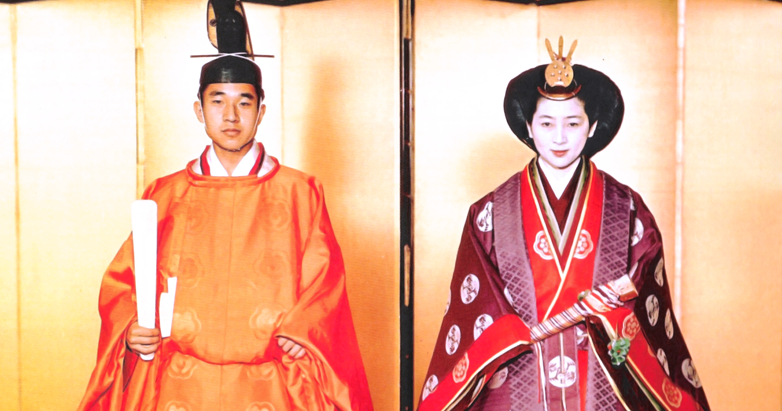
Crown Prince Akihito & Michiko Shoda at their wedding in 1959. By 宮内庁 (主婦と生活社「白樺」より、投稿者がスキャン) [Public domain], via Wikimedia Commons
Japan’s imperial family still has intimate ties with Shinto. Being a Brit myself, the picture looks quite familiar. Our royal family is more or less inseparable from the Church of England in its current state. The Queen is officially the Head of the Church and “defender of the faith,” and rituals surrounding the royal family (including the coronation) are steeped in Anglican tradition. The Queen herself is deeply religious, and by many accounts she believes that ruling the country is literally a God-given responsibility. Considering that the monarch is still officially Head of State in the UK, this is not without controversy.
Similarly, Japan’s imperial family are principle figures in Shinto. Since ancient times, Japanese nobility have been closely linked with shamanism and links to the kami. Traditionally, the Emperor is believed to be descended from Amaterasu Ōmikami, the Sun Goddess and commonly regarded as the most important Shinto deity. Although the imperial family refuted this belief after World War II, the links between the imperial family and Shinto remain strong. Nowhere can this be seen more than at Ise Grand Shrine, the central shrine in Shinto. The chief priest or priestess of Ise Shrine must come from the Imperial House of Japan; the current high priestess is Emperor Akihito’s daughter. Entry to its inner sanctum is forbidden to all save members of the imperial family and select priests.
Imperial Accession: The Rite of Great Tasting
Similarly to the British monarch’s coronation, Japan’s imperial enthronement rites have long been surrounded by religion and mysticism. The current emperor Akihito’s final accession rite took place in 1990. This rite is known as the daijōsai (大嘗祭), or “Rite of Great Tasting,” and it is in this rite that the connection between the Emperor and the kami Amaterasu is affirmed. John Breen and Mark Teeuwen describe the ceremony in A New History of Shinto:
“On the night of November 22 the emperor, enveloped in the garment known as ame-no-hagoromo (‘the heavenly robe of feathers’), purified himself in the hot waters of the Kairyū Hall before proceeding to the Yuki Pavilion. He took chopsticks in his hands and offered rice and other fruits of the land and sea to the sun-goddess before partaking of them himself. He then repeated the procedure at the Suki Pavilion. He emerged at dawn the next day, his transformation from crown prince into emperor now complete.”
The performance of the rite caused controversy, not only because to many it reaffirmed the Emperor’s link to Amaterasu (after his father Hirohito had publicly renounced claims that he was a living kami in 1946), but also because it was funded by taxpayers. What’s more, it was attended by the heads of the three branches of government – legislative, executive and judicial. It was therefore seen as potentially unconstitutional, as it contradicted the provisions of Article 20 forbidding religious organisations receiving privilege from the state.
The Catholics Enter The Foray
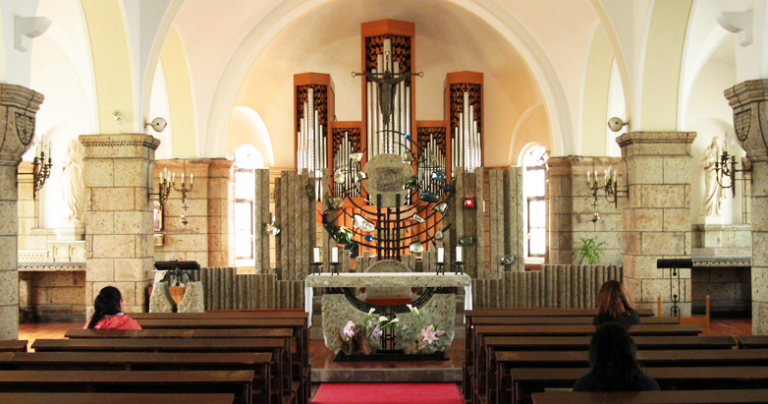
Matsugamine Catholic Church, Japan. By Nheyob (Own work) [CC BY-SA 3.0 (https://creativecommons.org/licenses/by-sa/3.0)], via Wikimedia Commons
In December 2017, the Japanese government announced that Emperor Akihito will abdicate on April 30th 2019, to be succeeded by Crown Prince Naruhito on May 1st (Pagans will no doubt find this timing significant). Reports suggest that the accession ceremony will include a traditional daijōsai.
This has once again opened up questions about Japan’s secularism. And this time, voices in defence of Article 20 come from a religious organisation: the Catholic church.
UCA News reported on March 2nd that Japan’s bishops have written to Prime Minister Shinzo Abe demanding strict observance of the constitutional separation of state-sponsored ceremonies and the imperial family’s private religious ones when it comes to the imperial abdication and accession rites in 2019. During their annual plenary session in Tokyo, the 16 bishops put forward a petition entitled “Request on separation of state and religion upon the emperors’ abdication and installation.”
“In the ceremonies for the emperors’ abdication and accession, [we hope the government] will strictly observe the principle of separation of state and religion prescribed by the Constitution of Japan and clarify the distinction between national acts and the imperial family’s private ritual events,” the bishops said.
They also said that the plans to hold religious rites for the accession “do not correspond to the principle of separation of state and religion provided by the Constitution of Japan,” and that “The Japanese government has a responsibility to never forget that unfortunate history and to not follow the same pattern.”
What I find fascinating about the bishops’ protest is that it demonstrates the power of secularism to protect the religious. In this particular case, the cries to protect Japan’s secular constitution are coming not from atheists, but from influential leaders of a minority religious group. I also find it ironic that while the Catholic church in the UK shows utter disdain for secularism through its lobbying for Catholic-only schools, in Japan (where its position is not as strong) it defends secularism with all the passion of a staunch atheist.
Freedom of religion is just as important as freedom from religion in secularism. As demonstrated by the Catholic church’s protest against the daijōsai*,* these two freedoms are often one and the same. Freedom from state-sponsored Shinto helps to protect the freedom of Catholics within Japanese society.
I am a Shintoist who has rejected my Catholic heritage. Yet on this matter, I agree with the Catholics. While I find the daijōsai fascinating, I do not think that Japanese taxpayers should pay for it. It should be privately funded in the same manner as other aspect of Shinto in Japan. And I only hope one day, we will see a similar attitude towards religion and state in my country too.
Secularism, Politics & Human Rights
Previous Post

March 8, 2018
A Comedian And A Goddess: The Latest Victims Of Facebook Censorship
Next Post

March 13, 2018 Group Ritual And Playreading for Ostara
Browse Our Archives
Select a Category Art, Craft & Expression Musings & Miscellaneous Nature & Science News & Reviews Ritual & Festivals Secularism, Politics & Human Rights Shinto & Japanese Religion Uncategorized
Select a Month August 2023 July 2023 June 2023 May 2023 April 2023 March 2023 February 2023 January 2023 December 2022 November 2022 October 2022 September 2022 August 2022 July 2022 June 2022 May 2022 April 2022 March 2022 February 2022 January 2022 December 2021 November 2021 October 2021 September 2021 August 2021 July 2021 June 2021 May 2021 April 2021 March 2021 February 2021 January 2021 December 2020 November 2020 October 2020 September 2020 August 2020 July 2020 June 2020 May 2020 April 2020 March 2020 February 2020 January 2020 December 2019 November 2019 October 2019 September 2019 August 2019 July 2019 June 2019 May 2019 April 2019 March 2019 February 2019 January 2019 December 2018 November 2018 October 2018 September 2018 August 2018 July 2018 June 2018 May 2018 April 2018 March 2018 February 2018 January 2018 December 2017 August 2017 July 2017 June 2017 May 2017 April 2017 March 2017 February 2017 January 2017 December 2016 November 2016 October 2016 September 2016 August 2016 July 2016 June 2016 May 2016 April 2016 March 2016 February 2016 January 2016
Follow Us!
TAKE THE
Religious Wisdom Quiz
How many chapters does the book of Judges have?
Select your answer to see how you score.
19 23 21 25
Related posts from Pagan Tama

Three reasons why Pagans should support equality for...
Protest Plans To Demolish 'Ghibli' Shinto Shrine To...
My Weather Wishes For The Tanabata Star Festival

Connecting With Shinto Kami Overseas
TRENDING AT PATHEOS Pagan

I was recently chatting with someone on Instagram. She asked me what...

While there are many people who share their results, the end of...

On July 23, I saw Christopher Nolan's The Odyssey which is Homer’s...

As I write this two big events have just finished up. One...

Restoring the Watershed of Divine Love
Perhaps cooperation is not something we manufacture through legislation, ideology, or moral...

Many UUs don’t pray because of bad experiences in a previous religion,...
view all Pagan blogs
Ad-Free & Subscriber Log-In Subscription Support
- About Us
- 2026 Calendar
- Videos
- Podcasts
- Library of World Religions
- Faith In Media Tracker
- Advertise With Us
- Write for Us
- Privacy Policy
- Terms of Service
- Do Not Sell My Data
- Contact Us
- Radiant Digital
- Manage Newsletter Subscriptions
- Unsubscribe From Notifications
- Sitemap
Copyright 2008-2026, Patheos. All rights reserved.
Subscription Support Ad-Free & Subscriber Log-In
Follow Patheos