
BuddhistCatholicContemplativeEvangelicalGeneral ChristianHinduJewishLatter-day SaintMuslimNew VisionsProgressive Christian
Beliefs
- Buddhist
- Catholic
- Contemplative
- Evangelical
- General Christian
- Hindu
- Jewish
- Latter-day Saint
- More Voices
- Muslim
- New Visions
- Pagan
- Progressive Christian
Topics
- Religion News
- Food and Religion
- Sports and Religion
- Religious Art
- Religious Music and Entertainment
- Religious Events
- History and Religion
- Style and Religion
- Politics and Religion
- Women in Religion
- Recreation Outdoors and Religion
- Business Finance and Religion
- Careers Workplace and Religion
- Education and Religion
- Family Parenting and Religion
- Health Fitness and Religion
- Home and Religion
- Relationships and Religion
- Technology and Religion
- Travel and Religion
Columnists
- Buddhist Columnists
- Business Finance and Religion Columnists
- Careers Workplace and Religion Columnists
- Catholic Columnists
- Contemplative Columnists
- Education and Religion Columnists
- Evangelists Columnists
- Family Parenting and Religion Columnists
- General Christian Columnists
- Health Fitness and Religion Columnists
- Hindu Columnists
- History and Religion Columnists
- Home and Religion Columnists
- Jewish Columnists
- More Voices Columnists
- Latter Day Columnists
- Muslim Columnists
- New Visions Columnists
- Nonreligious Columnists
- Pagan Columnists
- Politics and Religion Columnists
- Progressive Columnists
- Recreation Outdoors and Religion Columnists
- Relationships and Religion Columnists
- Religion News Columnists
- Religious Art Columnists
- Religious Events Columnists
- Religious Music and Entertainment Columnists
- Sports and Religion Columnists
- Style and Religion Columnists
- Technology and Religion Columnists
- Travel and Religion Columnists
- Women in Religion Columnists
Resource Library
- 2026 Calendar
- Library of World Religions
- The 100 Most Holy Places on Earth
- Patheos Answers
- Podcasts
- Videos
- Faith Leaders Database
- Anglican Episcopalian
- Bahai
- Baptist
- Buddhism
- Christianity
- Confucianism
- Eastern Orthodoxy
- Hinduism
- Holiness and Pentecostal
- ISKCON
- Islam
- Judaism
- Lutheran
- Methodist
- The Church of Jesus Christ of Latter-day Saints
- New Age
- Paganism
- Presbytarian and Reformed
- Protestantism
- Religion Behind the Scenes
- Roman Catholic
- Scientology
- Shia Islam
- Sikhism
- Sufism
- Sunni Islam
- Taoism
- Zen
- See all religions
Research Tools
 Ad-Free & Subscriber Log-In Subscription Support
Ad-Free & Subscriber Log-In Subscription Support
Follow Patheos 

- Trending:
- Forgiveness
- |
- Marriage
- |
- Consciousness
- |
- Death Penalty
- |
- Election
- |
- Halloween
 Pagan Tama
- Home
- Pagan
- Facebook Censorship: Contributing To Cultural Erasure
Facebook Censorship: Contributing To Cultural Erasure
Last updated on: March 25, 2018 at 10:18 am by Megan Manson
Facebook Censorship: Contributing To Cultural Erasure 2018-03-25T10:18:10+00:00 Megan Manson
Patheos Explore the world's faith through different perspectives on religion and spirituality! Patheos has the views of the prevalent religions and spiritualities of the world.
I’m sure some Pagans reading this have occasionally fallen foul of Facebook’s image policies. Pagans tend to be pretty body-positive. We’re quite well-known for performing rituals naked, and our iconography is full of sexual symbols and full-figured goddesses.
This means that there are some aspects of our practice that we cannot share on Facebook – specifically, anything involving nudity. The social media’s community standards are so rigid that even pictures featuring female nipples, menstruation and plus-sized women have been regularly removed.
One can argue that these policies are illiberal, discriminatory and misogynistic. But Pagans and other body-positive people are generally willing to tow the line and obey these policies in order to use the service. Some of these images would be banned from many other public spaces too. And Facebook has backed down on some of its more ridiculous policies.
But there are still some cases where Facebook’s censorship goes too far. So far that it ends up silencing those who need to be seen and heard most of all on social media.
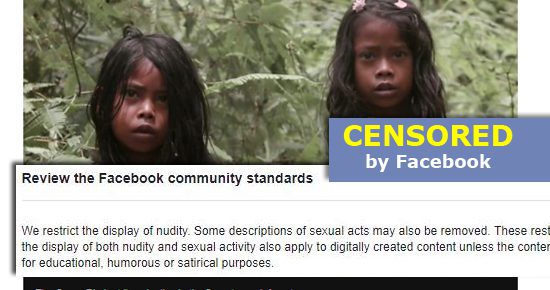
From BBC. Fair use.
Last week, a member of a Facebook group I manage tried to share this BBC News piece. It’s a revealing, harrowing article about the Orang Rimba people of the Sumatran rainforest. Their homes are being destroyed to make way for palm oil plantations, and they are being forced to convert from their animistic, nature-based religion to Islam.
A story that the world needs to know.
But much of the world won’t know, thanks to Facebook’s bizarre censorship. The group member told me that Facebook had removed the preview image for the link, on the grounds that it violates Facebook’s community standards.
What was the terrible content of the preview image? Orang Rimba children.
The two young children in the photo, in accordance with their culture, have bare tops and accessories around their necks and in their hair. The image is cropped from the waist down; in fact, if you watch the video from which this still is taken, you’ll see that they are wearing sarongs. The children stare at the camera with uneasy curiosity. It’s an arresting picture of people from another culture – a culture that is being systematically destroyed.
Remember, the BBC chose this photo. BBC News are world-renowned for integrity and sensitivity. They aren’t in the habit of regularly posting offensive or disturbing pictures for shock value. But this photo was apparently too shocking for Facebook.
I couldn’t quite believe what had happened, so I tried posting the link with the preview photo myself. And sure enough, within seconds, the picture had been removed, and my account was locked until I acknowledged the following message:
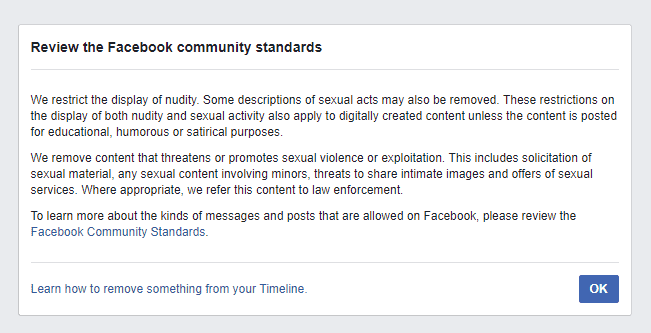
I then had to go through a process of proving that I didn’t have any other nude pictures on my account before I was allowed to use it again.
Both myself and the group member complained to Facebook about this incident. I’m still waiting for my reply, but my friend reported that she received the following message:
“We reviewed your post again and confirmed that it doesn’t follow our Community Standards. We understand that you may not have known about the standards, so we encourage you to learn more about what you can share on Facebook”
So there we are. The initial removal of the image may have been the result of an over-zealous algorithm, but there’s no excuse for then failing to restore the picture once the complaint has been issued.
You may ask, why does this matter? So what if Facebook’s a bit prudish about nudity of tribal people?
It matters a lot. This kind of censorship is contributing to the demise of the Orang Rimba, and other indigenous cultures, for these reasons:
1 Facebook is erasing their presence
The Orang Rimba face two forms of persecution: physical genocide through the destruction of their forest homes, and cultural genocide by being forced to adopt a new religion and way of life. Their spiritual and cultural traditions are not recognised by the state, and they are seen as subhuman by many of the surrounding population. These people are being squeezed out of existence.
By censoring pictures of Orang Rimba, Facebook is further contributing to their erasure from the world. They are lending their persecutors a hand in wiping their presence from our knowledge.
2. Facebook is imposing Western cultural standards
The BBC story featuring the picture tells of how the Orang Rimba are having alien modesty standards imposed on them – the strict codes of Islam that force them to cover up. To most of us in the West, this seems shocking and appalling. But Facebook is doing the same thing when it censors picture of the Orang Rimba dressed traditionally.
Facebook has decided that, because these children dress differently to Western children, their photo is offensive. By not accepting pictures of children dressing according to tribal traditions, Facebook is saying that their culture is less valid than Western culture. It’s saying that children should conform to our modesty standards, and it is simultaneously validating the practices of the Islamists who force them to cover up.
(Don’t forget, the original photo already had been cropped to censor the bottom half of the children. It was only their top half that was visible. We can’t even tell whether or not the children are wearing anything from the waist down).
3. Facebook is taking away their voice
By removing the striking preview image from the link to the BBC story, Facebook is dramatically reducing the story’s visibility among crowded Facebook feeds. It also discourages users from sharing the story – no-one wants to go through the process of being treated like a sinner for sharing something that Facebook decides to block, and furthermore risk greater penalisation.
The result is that the voice of the Orang Rimba, already marginalised, is further silenced. They may well disappear without ever even being visible to most of the online world.
4. Facebook is sexualising their children
Look at the Facebook community standards again. They strongly equate nudity with sexuality.
These are prepubescent children in the photo. There is nothing whatsoever sexual about their bodies. The fact that Facebook suggests that their bodies are sexual is, to say the least, disturbing.
Censoring tribal people on social media in this manner not only damages them. It damages us. It insulates us all in our cultural bubbles, preventing and discouraging us from experiencing cultures and values different from our own. It restricts the information we have about the world, and tells us that we, too, should be ashamed of our bodies, and our children’s bodies.
If you experience similar issues, please complain to Facebook and let them know why their community standards need to change so that marginalised cultures experience no further erasure by our hands.
Secularism, Politics & Human Rights
Previous Post

August 5, 2017
Dealing With Japan's Sacred Deer
Next Post
December 23, 2017 Facebook's Tribal Culture Censorship Update: A Small Victory
Browse Our Archives
Select a Category Art, Craft & Expression Musings & Miscellaneous Nature & Science News & Reviews Ritual & Festivals Secularism, Politics & Human Rights Shinto & Japanese Religion Uncategorized
Select a Month August 2023 July 2023 June 2023 May 2023 April 2023 March 2023 February 2023 January 2023 December 2022 November 2022 October 2022 September 2022 August 2022 July 2022 June 2022 May 2022 April 2022 March 2022 February 2022 January 2022 December 2021 November 2021 October 2021 September 2021 August 2021 July 2021 June 2021 May 2021 April 2021 March 2021 February 2021 January 2021 December 2020 November 2020 October 2020 September 2020 August 2020 July 2020 June 2020 May 2020 April 2020 March 2020 February 2020 January 2020 December 2019 November 2019 October 2019 September 2019 August 2019 July 2019 June 2019 May 2019 April 2019 March 2019 February 2019 January 2019 December 2018 November 2018 October 2018 September 2018 August 2018 July 2018 June 2018 May 2018 April 2018 March 2018 February 2018 January 2018 December 2017 August 2017 July 2017 June 2017 May 2017 April 2017 March 2017 February 2017 January 2017 December 2016 November 2016 October 2016 September 2016 August 2016 July 2016 June 2016 May 2016 April 2016 March 2016 February 2016 January 2016
Follow Us!
TAKE THE
Religious Wisdom Quiz
What is the correct order of 'these three' that remain, as mentioned in 1 Corinthians 13?
Select your answer to see how you score.
Hope, faith, love Faith, hope, love Love, faith, hope Faith, love, hope
Related posts from Pagan Tama
Three reasons why Pagans should support equality for...

Holy Well Pilgrimage: The Hidden Wells of St...

Holy Well Pilgrimage: The Mysterious Face Of St...

Opposing Religious Discrimination At Schools: A (Mixed) Success
TRENDING AT PATHEOS Pagan

I was recently chatting with someone on Instagram. She asked me what...

While there are many people who share their results, the end of...

On July 23, I saw Christopher Nolan's The Odyssey which is Homer’s...

As I write this two big events have just finished up. One...

Restoring the Watershed of Divine Love
Perhaps cooperation is not something we manufacture through legislation, ideology, or moral...

Many UUs don’t pray because of bad experiences in a previous religion,...
view all Pagan blogs
Ad-Free & Subscriber Log-In Subscription Support
- About Us
- 2026 Calendar
- Videos
- Podcasts
- Library of World Religions
- Faith In Media Tracker
- Advertise With Us
- Write for Us
- Privacy Policy
- Terms of Service
- Do Not Sell My Data
- Contact Us
- Radiant Digital
- Manage Newsletter Subscriptions
- Unsubscribe From Notifications
- Sitemap
Copyright 2008-2026, Patheos. All rights reserved.
Subscription Support Ad-Free & Subscriber Log-In
Follow Patheos