
BuddhistCatholicContemplativeEvangelicalGeneral ChristianHinduJewishLatter-day SaintMuslimNew VisionsProgressive Christian
Beliefs
- Buddhist
- Catholic
- Contemplative
- Evangelical
- General Christian
- Hindu
- Jewish
- Latter-day Saint
- More Voices
- Muslim
- New Visions
- Pagan
- Progressive Christian
Topics
- Religion News
- Food and Religion
- Sports and Religion
- Religious Art
- Religious Music and Entertainment
- Religious Events
- History and Religion
- Style and Religion
- Politics and Religion
- Women in Religion
- Recreation Outdoors and Religion
- Business Finance and Religion
- Careers Workplace and Religion
- Education and Religion
- Family Parenting and Religion
- Health Fitness and Religion
- Home and Religion
- Relationships and Religion
- Technology and Religion
- Travel and Religion
Columnists
- Buddhist Columnists
- Business Finance and Religion Columnists
- Careers Workplace and Religion Columnists
- Catholic Columnists
- Contemplative Columnists
- Education and Religion Columnists
- Evangelists Columnists
- Family Parenting and Religion Columnists
- General Christian Columnists
- Health Fitness and Religion Columnists
- Hindu Columnists
- History and Religion Columnists
- Home and Religion Columnists
- Jewish Columnists
- More Voices Columnists
- Latter Day Columnists
- Muslim Columnists
- New Visions Columnists
- Nonreligious Columnists
- Pagan Columnists
- Politics and Religion Columnists
- Progressive Columnists
- Recreation Outdoors and Religion Columnists
- Relationships and Religion Columnists
- Religion News Columnists
- Religious Art Columnists
- Religious Events Columnists
- Religious Music and Entertainment Columnists
- Sports and Religion Columnists
- Style and Religion Columnists
- Technology and Religion Columnists
- Travel and Religion Columnists
- Women in Religion Columnists
Resource Library
- 2026 Calendar
- Library of World Religions
- The 100 Most Holy Places on Earth
- Patheos Answers
- Podcasts
- Videos
- Faith Leaders Database
- Anglican Episcopalian
- Bahai
- Baptist
- Buddhism
- Christianity
- Confucianism
- Eastern Orthodoxy
- Hinduism
- Holiness and Pentecostal
- ISKCON
- Islam
- Judaism
- Lutheran
- Methodist
- The Church of Jesus Christ of Latter-day Saints
- New Age
- Paganism
- Presbytarian and Reformed
- Protestantism
- Religion Behind the Scenes
- Roman Catholic
- Scientology
- Shia Islam
- Sikhism
- Sufism
- Sunni Islam
- Taoism
- Zen
- See all religions
Research Tools
 Ad-Free & Subscriber Log-In Subscription Support
Ad-Free & Subscriber Log-In Subscription Support
Follow Patheos 

- Trending:
- Forgiveness
- |
- Marriage
- |
- Consciousness
- |
- Death Penalty
- |
- Election
- |
- Halloween
 Pagan Tama
- Home
- Pagan
- Is UNESCO Enabling Discrimination? The Case Of Okinoshima
Is UNESCO Enabling Discrimination? The Case Of Okinoshima
Last updated on: March 25, 2018 at 10:18 am by Megan Manson
Is UNESCO Enabling Discrimination? The Case Of Okinoshima 2018-03-25T10:18:51+00:00 Megan Manson
Patheos Explore the world's faith through different perspectives on religion and spirituality! Patheos has the views of the prevalent religions and spiritualities of the world.
It’s official: the Japanese island of Okinoshima has been declared a UNESCO world heritage site.
But half of the world’s population are banned from setting a foot on this island, simply on account of not being men.
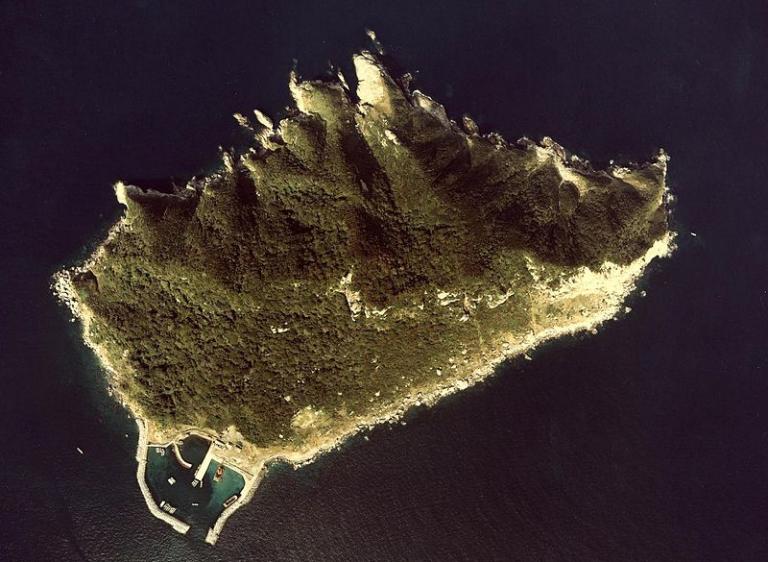

The island of Okinoshima off the coast of Fukuoka in Japan is an ancient, sacred Shinto site. Between the 4th – 9th centuries, rituals and prayers to promote safe ocean voyages were conducted there. To this day, Okinoshima is considered kami. In the 17th century a Shinto shrine, Okitsu, was built at one of the sites of ancient worship on the island. This shrine is dedicated to the kami Tagorihime, who is one of the three daughters of Susanoo, the kami of the ocean and storms.
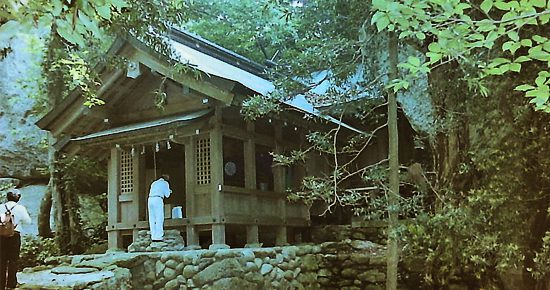
Okitsu Shrine on Okinoshima. Indiana jo, CC Wikimedia Commons.

As is perhaps befitting of such a sacred place, there are strict rules regarding human presence on Okinoshima. Access to the island is largely limited to the Shinto priests serving Munakata Taisha (the group of three shrines to which Okitsu Shrine belongs) and up to 200 men once a year to honour sailors who died in a nearby naval battle during the 1904-05 Russo-Japanese war. Before setting foot on Okinoshima, visitors must strip naked and undergo misogi (ritual purification) by bathing in the sea. They are also prohibited from taking anything from the island – even something small like a pebble – and furthermore, they must not disclose any information about what occurs on the island during their visit.
But what is perhaps most controversial about Okinoshima is that women are completely barred from visiting the island under any circumstances.
Women in Shinto: Empowered or Impure?
It seems particularly strange that a site sacred to a goddess would prohibit women. But this taboo on women can be found throughout Shinto today. Although women can serve as Shinto priests, they remain rare; within Shinto institutions, women far more commonly serve as miko, who are assistants to the priests. Women are barred from serving in the higher ranks of some of the most important shrines in Japan, including Ise Grand Shrine. This again is ironic, since the main kami enshrined at Ise is Amaterasu Ōmikami, the Sun Goddess and widely considered the most important kami of all. Women are also prohibited from other sacred sites, including the top of Mt. Omine (another Unesco World Heritage site) and from dohyō (Sumo wrestling rings).
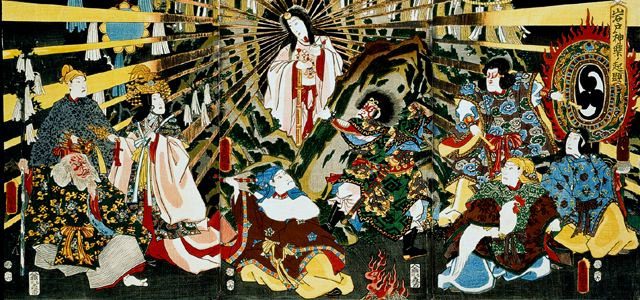
Amaterasu, the Shinto kami of the Sun. Public domain / Wikimedia Commons
Why are women banned from fully participating in certain aspects of Shinto? For the simple reason that they menstruate. This natural process makes women impure in conservative Shinto thinking. In other words, they think women are dirty.
The subordination of women was apparently not always inherent to Shinto. Putting aside the fact that the supreme Shinto kami Amaterasu is herself female, women were once able to attain high status in ancient Japanese religion. One of the earliest rulers in Japan that we know of, Himiko, was a shaman, and even today this legacy continues with the majority of shamans in Japan being female. It has been theorised that the decline of power of women in Shinto was due to the introduction of the Confucianism and Buddhism in Japan in the Heian period, as these two belief systems were more patriarchal in nature.
UNESCO: Promoting gender equality?
As a secularist, I am opposed to any religion being given the right to discriminate against people due to their gender when other institutions are prohibited by law from doing so. But my main contention in the case of Okinoshima is the fact that UNESCO sanctions this discrimination.
According to the dedicated “Gender equality” section on UNESCO’s website, “UNESCO considers gender equality as a fundamental human right, a building block for social justice and an economic necessity. It is a critical factor for the achievement of all internationally agreed development goals as well as a goal in and of itself.”
If that is the case, why is UNESCO awarding World Heritage Status to sites that are acting in direct opposition to their goal of promoting gender equality?
Okinoshima and Mt. Omine are not the sites practising gender discrimination that UNESCO has granted its prestigious World Heritage Status. There’s also Mt. Athos in Greece that prohibits women, Haji Ali in India that bans women from entering the inner sanctum, and the Ayyappa Temple in Sabarimala which forbids women on its annual pilgrimage, to name a few.
I believe that if UNESCO is truly sincere in its statement that it considers gender equality a fundamental human right, it should stop awarding its World Heritage Status to places that actively prohibit people from participating in them on the basis of their gender. Doing so not only sanctions the continued sexual discrimination within those sites themselves, but also gives the green light to sexism on a broader scale. It is a message that sexual discrimination is acceptable and permissible within religion. According to its World Heritage website, UNESCO “…seeks to encourage the identification, protection and preservation of cultural and natural heritage around the world considered to be of outstanding value to humanity.” Can a place truly be considered “outstanding value to humanity” if it bans 50% of humanity from entering on the basis of their gender?
If UNESCO were to withhold its World Heritage Status from sites that practise gender discrimination, it would send a clear signal that it is committed to its goal of promoting gender equality and, what’s more, it may encourage some of these religious institutions to become more progressive and inclusive.
UPDATE 16/07: Apparently, Okinoshima will ban all visitors who are not Shinto priests from 2018. However, according to a spokesperson from Munataka Taisha, academics will be allowed to enter the island for research and preservation purposes. I wonder if this includes female academics?
Sources and further reading:
Ambros, Barbara R (2015). Women in Japanese Religions
Katu, Genchi. A Study of Shinto: The Religion of the Japanese Nation
Okano, Haruko (1993). “Women and Sexism in Shinto”. Japan Christian Review.
“Japanese sacred island where women are banned gets Unesco world heritage listing,” The Guardian
“The Heritage Of Not Including Women,” GoUnesco
The Sacred Island of Okinoshima and Associated Sites in the Munakata Region
Wikipedia, “Okinoshima (Fukuoka),” “Women In Shinto“
Secularism, Politics & Human Rights
Previous Post

July 9, 2017
Celebrating The Tanabata Star Festival in London
Next Post

July 22, 2017 We Are Wild And We Are Free: Paganism And Liberty
Browse Our Archives
Select a Category Art, Craft & Expression Musings & Miscellaneous Nature & Science News & Reviews Ritual & Festivals Secularism, Politics & Human Rights Shinto & Japanese Religion Uncategorized
Select a Month August 2023 July 2023 June 2023 May 2023 April 2023 March 2023 February 2023 January 2023 December 2022 November 2022 October 2022 September 2022 August 2022 July 2022 June 2022 May 2022 April 2022 March 2022 February 2022 January 2022 December 2021 November 2021 October 2021 September 2021 August 2021 July 2021 June 2021 May 2021 April 2021 March 2021 February 2021 January 2021 December 2020 November 2020 October 2020 September 2020 August 2020 July 2020 June 2020 May 2020 April 2020 March 2020 February 2020 January 2020 December 2019 November 2019 October 2019 September 2019 August 2019 July 2019 June 2019 May 2019 April 2019 March 2019 February 2019 January 2019 December 2018 November 2018 October 2018 September 2018 August 2018 July 2018 June 2018 May 2018 April 2018 March 2018 February 2018 January 2018 December 2017 August 2017 July 2017 June 2017 May 2017 April 2017 March 2017 February 2017 January 2017 December 2016 November 2016 October 2016 September 2016 August 2016 July 2016 June 2016 May 2016 April 2016 March 2016 February 2016 January 2016
Follow Us!
TAKE THE
Religious Wisdom Quiz
True or False: According to 1 John, God is love, and whoever abides in love abides in God.
Select your answer to see how you score.
TRUE FALSE
Related posts from Pagan Tama

Three reasons why Pagans should support equality for...
Protest Plans To Demolish 'Ghibli' Shinto Shrine To...
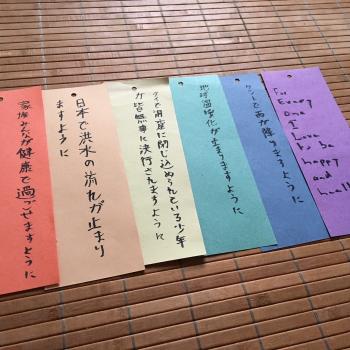
My Weather Wishes For The Tanabata Star Festival
Connecting With Shinto Kami Overseas
TRENDING AT PATHEOS Pagan

I was recently chatting with someone on Instagram. She asked me what...

While there are many people who share their results, the end of...

On July 23, I saw Christopher Nolan's The Odyssey which is Homer’s...

As I write this two big events have just finished up. One...

Restoring the Watershed of Divine Love
Perhaps cooperation is not something we manufacture through legislation, ideology, or moral...

Many UUs don’t pray because of bad experiences in a previous religion,...
view all Pagan blogs
Ad-Free & Subscriber Log-In Subscription Support
- About Us
- 2026 Calendar
- Videos
- Podcasts
- Library of World Religions
- Faith In Media Tracker
- Advertise With Us
- Write for Us
- Privacy Policy
- Terms of Service
- Do Not Sell My Data
- Contact Us
- Radiant Digital
- Manage Newsletter Subscriptions
- Unsubscribe From Notifications
- Sitemap
Copyright 2008-2026, Patheos. All rights reserved.
Subscription Support Ad-Free & Subscriber Log-In
Follow Patheos