
BuddhistCatholicContemplativeEvangelicalGeneral ChristianHinduJewishLatter-day SaintMuslimNew VisionsProgressive Christian
Beliefs
- Buddhist
- Catholic
- Contemplative
- Evangelical
- General Christian
- Hindu
- Jewish
- Latter-day Saint
- More Voices
- Muslim
- New Visions
- Pagan
- Progressive Christian
Topics
- Religion News
- Food and Religion
- Sports and Religion
- Religious Art
- Religious Music and Entertainment
- Religious Events
- History and Religion
- Style and Religion
- Politics and Religion
- Women in Religion
- Recreation Outdoors and Religion
- Business Finance and Religion
- Careers Workplace and Religion
- Education and Religion
- Family Parenting and Religion
- Health Fitness and Religion
- Home and Religion
- Relationships and Religion
- Technology and Religion
- Travel and Religion
Columnists
- Buddhist Columnists
- Business Finance and Religion Columnists
- Careers Workplace and Religion Columnists
- Catholic Columnists
- Contemplative Columnists
- Education and Religion Columnists
- Evangelists Columnists
- Family Parenting and Religion Columnists
- General Christian Columnists
- Health Fitness and Religion Columnists
- Hindu Columnists
- History and Religion Columnists
- Home and Religion Columnists
- Jewish Columnists
- More Voices Columnists
- Latter Day Columnists
- Muslim Columnists
- New Visions Columnists
- Nonreligious Columnists
- Pagan Columnists
- Politics and Religion Columnists
- Progressive Columnists
- Recreation Outdoors and Religion Columnists
- Relationships and Religion Columnists
- Religion News Columnists
- Religious Art Columnists
- Religious Events Columnists
- Religious Music and Entertainment Columnists
- Sports and Religion Columnists
- Style and Religion Columnists
- Technology and Religion Columnists
- Travel and Religion Columnists
- Women in Religion Columnists
Resource Library
- 2026 Calendar
- Library of World Religions
- The 100 Most Holy Places on Earth
- Patheos Answers
- Podcasts
- Videos
- Faith Leaders Database
- Anglican Episcopalian
- Bahai
- Baptist
- Buddhism
- Christianity
- Confucianism
- Eastern Orthodoxy
- Hinduism
- Holiness and Pentecostal
- ISKCON
- Islam
- Judaism
- Lutheran
- Methodist
- The Church of Jesus Christ of Latter-day Saints
- New Age
- Paganism
- Presbytarian and Reformed
- Protestantism
- Religion Behind the Scenes
- Roman Catholic
- Scientology
- Shia Islam
- Sikhism
- Sufism
- Sunni Islam
- Taoism
- Zen
- See all religions
Research Tools
 Ad-Free & Subscriber Log-In Subscription Support
Ad-Free & Subscriber Log-In Subscription Support
Follow Patheos 

- Trending:
- Forgiveness
- |
- Marriage
- |
- Consciousness
- |
- Death Penalty
- |
- Election
- |
- Halloween
 Pagan Tama
- Home
- Pagan
- Celebrating The Tanabata Star Festival in London
Celebrating The Tanabata Star Festival in London
Last updated on: July 9, 2017 at 9:48 pm by Megan Manson
Celebrating The Tanabata Star Festival in London 2017-07-09T21:48:56+00:00 Megan Manson
Patheos Explore the world's faith through different perspectives on religion and spirituality! Patheos has the views of the prevalent religions and spiritualities of the world.
July 7th is Tanabata, the Japanese “Star Festival” celebrating the reunion of the astral lovers Orihime (Vega) and Hikoboshi (Altair). And on Friday, members of Shinto In The UK gathered at Lincoln’s Inn Fields park in central London to commemorate the festival with an evening of Shinto and Japanese cultural activities.
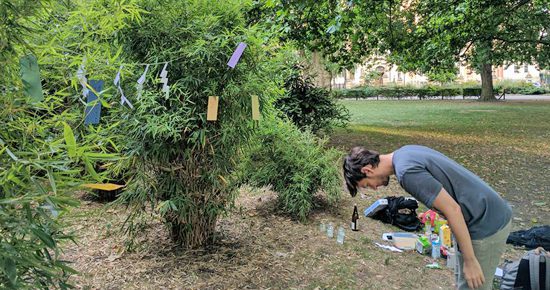
Nestled within the park is a small grove of bamboo, and this is where we gathered for our celebrations.
We began by making shide. Shide are paper strips, folded into zigzags looking like lightening bolts. Shide are used to represent sacred spaces and the presence of kami. Shide are usually attached to straw ropes, called shimenawa. Shide are fairly simple to make; you can see how to make one here.
After making the shide, we attached them to some biodegradable string (the type used in horticulture), and tied this makeshift shimenawa to two of the bamboo – forming something similar to a shime-style torii. This we used as a temporary shrine.

After this, we held the most famous Tanabata tradition: making tanzaku. Tanzaku are coloured strips of paper upon which you write a wish. You then hang the tanzaku on bamboo, and the wind carries the wishes up into the heavens where, if you’re lucky, the gods will listen to them and grant them.

After hanging our wishes, we held a small ritual. I placed an offering of sake on the ground by the bamboo, and then we prayed before the shimenawa in the Shinto way (we bowed twice, clapped our hands twice, made a silent prayer and bowed again).
I poured a little sake at the base of each tree, and then we shared the sake with each other, passing round the cup. This is more of a Neopagan tradition than a Shinto one. It’s often the case that where rituals that are 100% Shinto not feasible to perform (which is almost always the case in the UK), adding Pagan-style elements as a substitute really works well.
 Following this, it was starting to get dark; a perfect time to begin playing a modified version of the Japanese game hyaku-monogatari. Meaning “one hundred stories,” hyaku-monogatari is a way of telling ghost stories. Traditionally, you light one hundred candles and tell one hundred ghost stories, blowing out a candle each time you tell a story. Once you tell the final story and blow out the last candle, a ghost is supposed to appear. Why did we play this game? Because in Japan, ghosts are associated with summer, rather than autumn as they tend to be in the west.
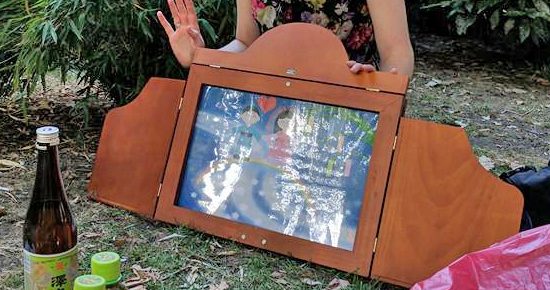
We were only a small group, so there was no way we could tell one hundred stories. But we did light some candles and tell a story each. There were traditional Japanese ghost stories, original modern ghost stories, and stories taken from real life experiences. I didn’t actually tell a ghost story; instead I told the story of Tanabata using kami-shibai. Meaning “paper stage,” kami-shibai is a traditional method of telling stories through pictures, which are slotted into a wooden frame.
Needless to say, a ghost didn’t appear! But it was still quite fun and launched lots of interesting talk about ghosts, alien abductions, and other supernatural experiences.
Once we had all finished, we removed the shimenawa and the tanzaku from the bamboo (it could potentially be harmful to the bamboo and any other wildlife.
This is the first time members of Shinto In The UK have come together for a Shinto celebration, and it was a wonderful, friendly, spiritual occasion. We were particularly lucky to have Taishi Kato, our resident Shinto priest, with us to provide guidance and advice in our practises. Sadly, Taishi will be returning to Japan in the autumn – we hope we can continue the growing enthusiasm and interest in Shinto that he’s started since coming to the UK!
If you would like to participate in Shinto activities in the UK, please do join the Shinto In The UK Facebook page.
Previous Post

June 25, 2017
If You Break The Law To Stop Free Expression, You're Just Being Lazy
Next Post

July 14, 2017 Is UNESCO Enabling Discrimination? The Case Of Okinoshima
Browse Our Archives
Select a Category Art, Craft & Expression Musings & Miscellaneous Nature & Science News & Reviews Ritual & Festivals Secularism, Politics & Human Rights Shinto & Japanese Religion Uncategorized
Select a Month August 2023 July 2023 June 2023 May 2023 April 2023 March 2023 February 2023 January 2023 December 2022 November 2022 October 2022 September 2022 August 2022 July 2022 June 2022 May 2022 April 2022 March 2022 February 2022 January 2022 December 2021 November 2021 October 2021 September 2021 August 2021 July 2021 June 2021 May 2021 April 2021 March 2021 February 2021 January 2021 December 2020 November 2020 October 2020 September 2020 August 2020 July 2020 June 2020 May 2020 April 2020 March 2020 February 2020 January 2020 December 2019 November 2019 October 2019 September 2019 August 2019 July 2019 June 2019 May 2019 April 2019 March 2019 February 2019 January 2019 December 2018 November 2018 October 2018 September 2018 August 2018 July 2018 June 2018 May 2018 April 2018 March 2018 February 2018 January 2018 December 2017 August 2017 July 2017 June 2017 May 2017 April 2017 March 2017 February 2017 January 2017 December 2016 November 2016 October 2016 September 2016 August 2016 July 2016 June 2016 May 2016 April 2016 March 2016 February 2016 January 2016
Follow Us!
TAKE THE
Religious Wisdom Quiz
Which Christian principle is in "Do unto others as you would have them do unto you"?
Select your answer to see how you score.
Always judge Keep to yourself The Golden Rule Never forgive
Related posts from Pagan Tama
Protest Plans To Demolish 'Ghibli' Shinto Shrine To...
My Weather Wishes For The Tanabata Star Festival

Connecting With Shinto Kami Overseas

Garden Rituals: What Do Pagans Think?
TRENDING AT PATHEOS Pagan

When we talk about Greek religion, we often begin with the dodekatheion—the...

I was recently chatting with someone on Instagram. She asked me what...

While there are many people who share their results, the end of...

On July 23, I saw Christopher Nolan's The Odyssey which is Homer’s...

As I write this two big events have just finished up. One...

Restoring the Watershed of Divine Love
Perhaps cooperation is not something we manufacture through legislation, ideology, or moral...
view all Pagan blogs
Ad-Free & Subscriber Log-In Subscription Support
- About Us
- 2026 Calendar
- Videos
- Podcasts
- Library of World Religions
- Faith In Media Tracker
- Advertise With Us
- Write for Us
- Privacy Policy
- Terms of Service
- Do Not Sell My Data
- Contact Us
- Radiant Digital
- Manage Newsletter Subscriptions
- Unsubscribe From Notifications
- Sitemap
Copyright 2008-2026, Patheos. All rights reserved.
Subscription Support Ad-Free & Subscriber Log-In
Follow Patheos