
BuddhistCatholicContemplativeEvangelicalGeneral ChristianHinduJewishLatter-day SaintMuslimNew VisionsProgressive Christian
Beliefs
- Buddhist
- Catholic
- Contemplative
- Evangelical
- General Christian
- Hindu
- Jewish
- Latter-day Saint
- More Voices
- Muslim
- New Visions
- Pagan
- Progressive Christian
Topics
- Religion News
- Food and Religion
- Sports and Religion
- Religious Art
- Religious Music and Entertainment
- Religious Events
- History and Religion
- Style and Religion
- Politics and Religion
- Women in Religion
- Recreation Outdoors and Religion
- Business Finance and Religion
- Careers Workplace and Religion
- Education and Religion
- Family Parenting and Religion
- Health Fitness and Religion
- Home and Religion
- Relationships and Religion
- Technology and Religion
- Travel and Religion
Columnists
- Buddhist Columnists
- Business Finance and Religion Columnists
- Careers Workplace and Religion Columnists
- Catholic Columnists
- Contemplative Columnists
- Education and Religion Columnists
- Evangelists Columnists
- Family Parenting and Religion Columnists
- General Christian Columnists
- Health Fitness and Religion Columnists
- Hindu Columnists
- History and Religion Columnists
- Home and Religion Columnists
- Jewish Columnists
- More Voices Columnists
- Latter Day Columnists
- Muslim Columnists
- New Visions Columnists
- Nonreligious Columnists
- Pagan Columnists
- Politics and Religion Columnists
- Progressive Columnists
- Recreation Outdoors and Religion Columnists
- Relationships and Religion Columnists
- Religion News Columnists
- Religious Art Columnists
- Religious Events Columnists
- Religious Music and Entertainment Columnists
- Sports and Religion Columnists
- Style and Religion Columnists
- Technology and Religion Columnists
- Travel and Religion Columnists
- Women in Religion Columnists
Resource Library
- 2026 Calendar
- Library of World Religions
- The 100 Most Holy Places on Earth
- Patheos Answers
- Podcasts
- Videos
- Faith Leaders Database
- Anglican Episcopalian
- Bahai
- Baptist
- Buddhism
- Christianity
- Confucianism
- Eastern Orthodoxy
- Hinduism
- Holiness and Pentecostal
- ISKCON
- Islam
- Judaism
- Lutheran
- Methodist
- The Church of Jesus Christ of Latter-day Saints
- New Age
- Paganism
- Presbytarian and Reformed
- Protestantism
- Religion Behind the Scenes
- Roman Catholic
- Scientology
- Shia Islam
- Sikhism
- Sufism
- Sunni Islam
- Taoism
- Zen
- See all religions
Research Tools
 Ad-Free & Subscriber Log-In Subscription Support
Ad-Free & Subscriber Log-In Subscription Support
Follow Patheos 

- Trending:
- Forgiveness
- |
- Marriage
- |
- Consciousness
- |
- Death Penalty
- |
- Election
- |
- Halloween
 Pagan Tama
- Home
- Pagan
- Rocks, Trees and Foxes – The Inari Faith Around The World
Rocks, Trees and Foxes – The Inari Faith Around The World
Last updated on: February 8, 2017 at 7:19 am by Megan Manson
Rocks, Trees and Foxes – The Inari Faith Around The World 2017-02-08T07:19:50+00:00 Megan Manson
Patheos Explore the world's faith through different perspectives on religion and spirituality! Patheos has the views of the prevalent religions and spiritualities of the world.
February 12th this year is Hatsuuma, “First Horse Day Festival.” It’s an important observance for devotees of the Shinto deity Inari Ōkami, the kami associated with rice, prosperity and foxes. It celebrates the decent of Inari Ōkami to Inari Mountain in Kyoto, and special ceremonies will be held at Inari shrines throughout Japan, not least at Fushimi Inari Grand Shrine which is located at the foot of Inari Mountain.
To commemorate this day, I would like to share the stories of five Inari devotees from around the world. These devotees are all members of the Inari Faith International Facebook group, which has become a central hub of international Inari followers.
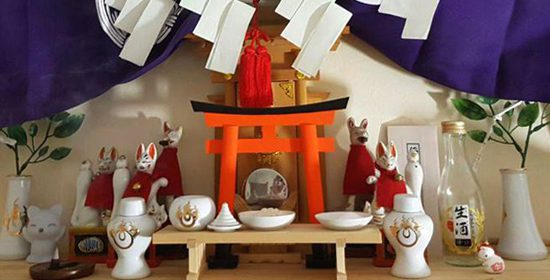
Matthew’s kamidana for Inari. You can read all about Matt’s path at FoxOfInari.com
Matthew, UK: “The best part of Shinto is how much it reminds me to express gratitude for the little things on a daily basis”
“I have been a follower of Inari Ōkami for over 10 years now. I very much believe that they reached out to me in the form of dreams, symbols and blessings, years before I formally began to venerate them. Over the years, I slowly was able to put together a kamidana [Shinto home shrine] for Inari Ōkami and it is now the centrepiece of my room and a sacred space I make daily prayers (norito) and offerings at. Shinto to me is very much about being in touch with nature, the kami, the yearly cycles, as well as the overall condition and development of the human species. Being in the UK it can be difficult being Shinto because of the distance from the faiths home country and the language barrier, but also being taken seriously as a Shintoist due to out of date opinions that non-Japanese cannot practice it. For me, the best part of Shinto is how much it reminds me to express gratitude for the little things on a daily basis and that negative energy is not something to ruin our lives, but is something that can be dealt with and cleansed.”
(You can read more about Matthew’s path at his website, Fox of Inari)
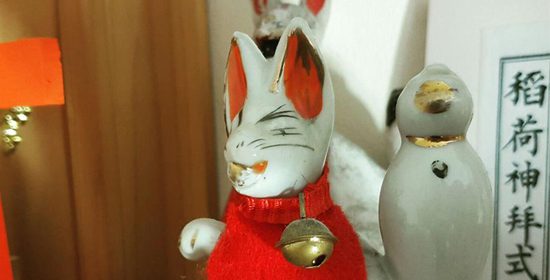
One of the fox statues on Matthew’s kamidana for Inari. You can read all about Matt’s path at FoxOfInari.com
Bella, Australia: “I love that Inari doesn’t have a defined form”
“I live on a farm between Sydney and Canberra. I first learnt about Shinto when I was in High School (about 30 years ago). I don’t know why but it really resonated with me. I don’t belong to any particular shine. There are none near me! In fact I don’t know if there are any in Australia. I suppose I follow a very nature based version of Shinto. Around my property there are lots of large boulders. Some of them feel special. I often sit at the rocks and watch the sunset or the sky, the hills around me and talk or give gratitude to the kami. I have a small shine, not really a proper kamidana*.* But I leave offerings. Inari Ōkami is important to me as the forces controlling agriculture. I love that Inari doesn’t have a defined form. And …. well I just love foxes!”
Katriel, USA: “Sometimes Inari shows us the difference between what we know and what we think we know”
“I am a multi-faith practitioner due to venerating the God of my ancestors who is Source, and venerating spirits (such as spirits of places, or over particular actions / domains – trickster /wisdom archetypes in my case specifically). So within this, I honour Inari. But the way I conceptualize Inari is very similar to Kannon (a Buddhist deity). This is an entity who can teach us to seek compassion and to enact compassion in our lives, who listens to things like needs (shelter, companionship) and desires both. I just happen to think that this entity I call Inari also changes form and takes the form that would be most useful to teach, and sometimes Inari shows us the difference between what we know and what we think we know.
As such, I try to seek knowledge. I also try to explain what I know in terms a more Western audience might understand. I do presentations on aspects of Japanese culture when I can, largely at animation conventions, but well sourced. My liturgy is respect and compassion, of listening and conversation. In my practice telling the kami of your intentions and plans is great but having a conversation with your neighbor is great too.”
Alexander, Brazil: “Love, live, learn”
“My own devotion to Inari Ōkami is far from standard. I talk to her (or think I talk, from a more sceptical point of view), and follow her teachings. And since I have this direct access to her, I don’t feel the need for a kamidana, although at some point I might get one. She teaches me on how to act towards myself and others in my life, as well as about practical matters, from history to magic, and once summed up her teachings thus: ‘Love, live, learn’ and ‘always forgive.'”

Michael’s depiction of his Shamanic encounter with Inari Okami
Michael, UK: “I decided to go on a Shamanic Journey to meet Inari Ōkami in person”
“I had been doing some soul searching, looking around for a faith that fit me. I had tried many worldviews and none of them particularly stuck for me, but during my search I looked into Shinto, and the more I saw the more I liked it. But it was when I saw that there was actually a small scene of Shintoists outside of Japan that were also non-Japanese, that I turned to it. I had always liked the sound of it, but I had also always thought it was a ‘closed religion’, the sort that only certain people could become. But to hear that even non-Japanese people could get in on this very interesting and very beautiful religion was what clinched it for me.
So when I discovered how much Shinto resonated with me, I started looking into how I could practice it. I come from an occult background, so rituals are very important to me. But first I had to decide what Kami to venerate. And that is when I found Inari Ōkami. A kami of mystery, of prosperity, of industry, which would be especially useful to me as I was going into the working world from university when I discovered Them. So I got myself an Inari ofuda, set it up in my Kamidana and started praying and offering to it.
After a while, as I felt more and more comfortable praying to Inari Ōkami, I got the idea to use some of my previous occult experience in my practice: I decided to go on a Shamanic Journey to meet Inari Ōkami in person. Shamanic Journeying is a new-age concept that I had a lot of previous experience with, that can be summed up as a sort of guided meditation where you visualise entering another world and opening yourself up to encountering characters in this visualisation that are interpreted as spirits. So, I designed a journey to meet Inari Ōkami, which involved a visualisation of walking up a long winding stairway lined with red torii gates, which ended up leading to a large clearing surrounded by dark trees, and a small Inari shrine in front of a small pond. I did not stay long, and while I did not see or hear Inari Ōkami, I certainly did feel their presence; a sort of heavy, deep, slightly ominous feeling that I was being watched. Not really a dangerous or scary feeling, but certainly a feeling of being in the presence of something extremely old and powerful. So in the vision, I made my offerings, made a prayer to the kami to be with me in my life and made my exit. And to this day I consider that journey and that experience as my self-initiation into the mysteries of Inari Ōkami. And someday when I have the time and the drive, I hope to return to that mysterious grove of trees and its lonely shrine, and experience Inari Ōkami’s presence again.”
Pagan Tama would like to thank Matthew, Bella, Katriel, Alexander and Michael for taking the time to share their stories and pictures! If you are interested in Shinto in the UK, please join the Inari Faith International Facebook Group. You can also like the Pagan Tama Facebook page to keep up to updates on this blog.
Previous Post

January 30, 2017
Pagan, Shinto & Spiritual Book Reviews January 2017
Next Post

February 27, 2017 Pagan, Shinto & Spiritual Book Reviews February 2017
Browse Our Archives
Select a Category Art, Craft & Expression Musings & Miscellaneous Nature & Science News & Reviews Ritual & Festivals Secularism, Politics & Human Rights Shinto & Japanese Religion Uncategorized
Select a Month August 2023 July 2023 June 2023 May 2023 April 2023 March 2023 February 2023 January 2023 December 2022 November 2022 October 2022 September 2022 August 2022 July 2022 June 2022 May 2022 April 2022 March 2022 February 2022 January 2022 December 2021 November 2021 October 2021 September 2021 August 2021 July 2021 June 2021 May 2021 April 2021 March 2021 February 2021 January 2021 December 2020 November 2020 October 2020 September 2020 August 2020 July 2020 June 2020 May 2020 April 2020 March 2020 February 2020 January 2020 December 2019 November 2019 October 2019 September 2019 August 2019 July 2019 June 2019 May 2019 April 2019 March 2019 February 2019 January 2019 December 2018 November 2018 October 2018 September 2018 August 2018 July 2018 June 2018 May 2018 April 2018 March 2018 February 2018 January 2018 December 2017 August 2017 July 2017 June 2017 May 2017 April 2017 March 2017 February 2017 January 2017 December 2016 November 2016 October 2016 September 2016 August 2016 July 2016 June 2016 May 2016 April 2016 March 2016 February 2016 January 2016
Follow Us!
TAKE THE
Religious Wisdom Quiz
What does "Siloam" mean in Hebrew?
Select your answer to see how you score.
Peace Refreshing Sent Cleansing
Related posts from Pagan Tama
Protest Plans To Demolish 'Ghibli' Shinto Shrine To...
My Weather Wishes For The Tanabata Star Festival

Connecting With Shinto Kami Overseas
Women In Shinto & Sumo: Are The Times...
TRENDING AT PATHEOS Pagan

I was recently chatting with someone on Instagram. She asked me what...

While there are many people who share their results, the end of...

On July 23, I saw Christopher Nolan's The Odyssey which is Homer’s...

As I write this two big events have just finished up. One...

Restoring the Watershed of Divine Love
Perhaps cooperation is not something we manufacture through legislation, ideology, or moral...

Many UUs don’t pray because of bad experiences in a previous religion,...
view all Pagan blogs
Ad-Free & Subscriber Log-In Subscription Support
- About Us
- 2026 Calendar
- Videos
- Podcasts
- Library of World Religions
- Faith In Media Tracker
- Advertise With Us
- Write for Us
- Privacy Policy
- Terms of Service
- Do Not Sell My Data
- Contact Us
- Radiant Digital
- Manage Newsletter Subscriptions
- Unsubscribe From Notifications
- Sitemap
Copyright 2008-2026, Patheos. All rights reserved.
Subscription Support Ad-Free & Subscriber Log-In
Follow Patheos