
BuddhistCatholicContemplativeEvangelicalGeneral ChristianHinduJewishLatter-day SaintMuslimNew VisionsProgressive Christian
Beliefs
- Buddhist
- Catholic
- Contemplative
- Evangelical
- General Christian
- Hindu
- Jewish
- Latter-day Saint
- More Voices
- Muslim
- New Visions
- Pagan
- Progressive Christian
Topics
- Religion News
- Food and Religion
- Sports and Religion
- Religious Art
- Religious Music and Entertainment
- Religious Events
- History and Religion
- Style and Religion
- Politics and Religion
- Women in Religion
- Recreation Outdoors and Religion
- Business Finance and Religion
- Careers Workplace and Religion
- Education and Religion
- Family Parenting and Religion
- Health Fitness and Religion
- Home and Religion
- Relationships and Religion
- Technology and Religion
- Travel and Religion
Columnists
- Buddhist Columnists
- Business Finance and Religion Columnists
- Careers Workplace and Religion Columnists
- Catholic Columnists
- Contemplative Columnists
- Education and Religion Columnists
- Evangelists Columnists
- Family Parenting and Religion Columnists
- General Christian Columnists
- Health Fitness and Religion Columnists
- Hindu Columnists
- History and Religion Columnists
- Home and Religion Columnists
- Jewish Columnists
- More Voices Columnists
- Latter Day Columnists
- Muslim Columnists
- New Visions Columnists
- Nonreligious Columnists
- Pagan Columnists
- Politics and Religion Columnists
- Progressive Columnists
- Recreation Outdoors and Religion Columnists
- Relationships and Religion Columnists
- Religion News Columnists
- Religious Art Columnists
- Religious Events Columnists
- Religious Music and Entertainment Columnists
- Sports and Religion Columnists
- Style and Religion Columnists
- Technology and Religion Columnists
- Travel and Religion Columnists
- Women in Religion Columnists
Resource Library
- 2026 Calendar
- Library of World Religions
- The 100 Most Holy Places on Earth
- Patheos Answers
- Podcasts
- Videos
- Faith Leaders Database
- Anglican Episcopalian
- Bahai
- Baptist
- Buddhism
- Christianity
- Confucianism
- Eastern Orthodoxy
- Hinduism
- Holiness and Pentecostal
- ISKCON
- Islam
- Judaism
- Lutheran
- Methodist
- The Church of Jesus Christ of Latter-day Saints
- New Age
- Paganism
- Presbytarian and Reformed
- Protestantism
- Religion Behind the Scenes
- Roman Catholic
- Scientology
- Shia Islam
- Sikhism
- Sufism
- Sunni Islam
- Taoism
- Zen
- See all religions
Research Tools
 Ad-Free & Subscriber Log-In Subscription Support
Ad-Free & Subscriber Log-In Subscription Support
Follow Patheos 

- Trending:
- Forgiveness
- |
- Marriage
- |
- Consciousness
- |
- Death Penalty
- |
- Election
- |
- Halloween
 Pagan Tama
- Home
- Pagan
- Brigid and Jizo – Saint, Goddess, Kami
Brigid and Jizo – Saint, Goddess, Kami
Last updated on: January 26, 2017 at 7:48 pm by Megan Manson
Brigid and Jizo – Saint, Goddess, Kami 2017-01-26T19:48:36+00:00 Megan Manson
Patheos Explore the world's faith through different perspectives on religion and spirituality! Patheos has the views of the prevalent religions and spiritualities of the world.
Paganism and Christianity tend to avoid each other these days. Although Christian-Pagans, also known as Christo-Pagans, do exist, they are in the minority. A rather persecuted minority at that, as they tend to attract negativity from some individuals within Christianity and Paganism alike.
It can indeed be hard to see how the eclectic, spontaneous, nature-orientated polytheism of Paganism could blend with the rule-bound, human-orientated monotheism of Christianity. And that’s without considering the bitter history between the two.

St Brigids Well Cullion. Laineylee, CC Wikimedia Commons.

But when you get two religions living side by side, it’s inevitable that there will be some blending. All Pagans are aware that there are countless “relics” of old Pagan beliefs lurking within Christian tradition and iconography. I would also argue that the Christian-orientated society in which most Western Pagans live also has an effect on their beliefs and practices. For example, elements of the typical Neopagan ritual, such as the “simple feast” of cakes and ale towards the end of the rite, mirror those found in Catholicism. It’s difficult to say which came first. I tend to think that neither did; that both rituals have copied and borrowed from each other over time.
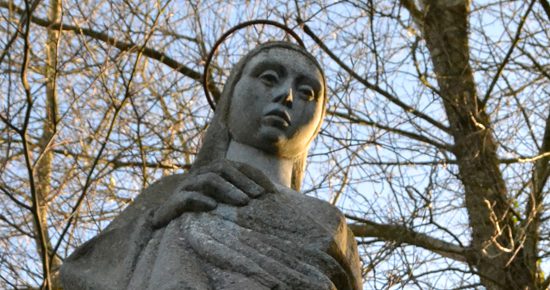
Statue of St. Brigid. Laineylee, CC Wikimedia Commons

A good example of syncretism that exists between Paganism and Christianity is Brigid. To Pagans, she is a Celtic goddess of fire, wells, arts and medicine. To Christians, she is the Irish St Brigit of Kildare, an abbess who founded a school of art and performed many domestic miracles. Both Christians and Pagans use her symbol, Brigid’s Cross (which resembles the ancient Sun Wheel design) and both celebrate her on or around February 1st (called Imbolc by Pagans, Candlemas or St Brigit’s Day by Christians). She is a sacred figure of two different religions.
But examples of syncretic deities in Britain (and other western countries) like this are subtle. In Japan, it is far more explicit. A great number of deities in Japan have both Shinto and Buddhist incarnations. This includes the kami I honour, Inari Ōkami, who is identified with the Buddhist deity Dakiniten. Syncretism reflects the (mostly) harmonious relationship between Shinto and Buddhism in Japan. Although they have experienced times of conflict in Japanese history, they generally get on fairly well today. You’ll very often see both Shinto and Buddhist symbols and shrines in the same place. Indeed, it’s common for a small Shinto shrine to be located within a Buddhist temple complex.
Aside from sharing a general respect for living things, Shinto and Buddhism are in essence as different from each other as Paganism and Christianity. Shinto is a mysterious and eclectic mix of folk beliefs that originated mainly within Japan itself and is centred on the veneration of numerous invisible nature spirits. Buddhism is for the most part a highly philosophical collection of teachings originally by an Indian prince, which came to Japan via China. Despite their differences, the two religions are really quite inseparable in Japan – you cannot talk in depth about one without also referring to the other at some point.
Perhaps the most popular syncretic deity in Japan is Jizō, also referred to as O-Jizō-sama or Jizō Bosatsu. Jizō was originally a Bodhisattva (Buddhist saint) called Ksitigarbha, although some say his origins may go back even further to the Hindu earth goddess Prthivi. In Japan, Jizō is believed to be an ever-merciful and benevolent guardian of the souls of the dead. It is said that Jizō vowed not to attain Buddhahood until Hell is empty of all souls. He is particularly associated with the souls of children trapped in “limbo” and protects them from danger, hence he has become the guardian of children in the living world, and the patron of those who have died young.
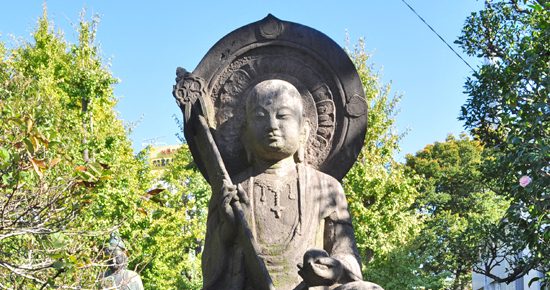
A traditional Jizō statue at Senso-ji temple, Asakusa, Japan. Joe Mabel, CC Wikimedia Commons

In older, classical images of Jizō, he is a more typically Buddhist figure. He is depicted as a mature Buddhist monk in robes and generally realistically proportioned. This establishes him very much as a “human” entity rather than a deity. Much like the Christian saints, this Jizō is more of a person – although a sacred and divine person – but not truly a spirit or a god.
But looking at later depictions of Jizō, this line between “saint” and “god” seems to get increasingly blurred. Like many divinities charged with the protection of souls in the afterlife, Jizō also became associated with living people making journeys. In this way, he has become conflated with dōsojin – the kami that guard travellers.
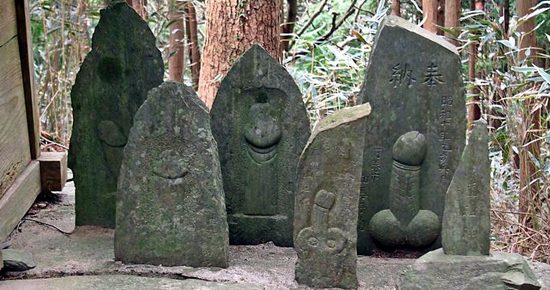
Phallic dosojin in Japan. Bachstelze, CC Wikimedia Commons

Although comparatively overlooked in writings about Shinto, dōsojin are an important part of Japanese folk spirituality. Their presence is usually indicated by an upright rock, which may have the characters for “dōsojin” or specific kami classified as dōsojin carved into it. There are also dōsojin rocks that depict a man and a woman, called Jō and Uba – quite a rare example of an actual depiction of a minor kami. Some dōsojin are distinctly phallic. These dōsojin markers can be found everywhere in Japan, from country paths to beside busy highways to graveyards; usually, places associated with travel in some way. And among these dōsojin, you will often find Jizō.
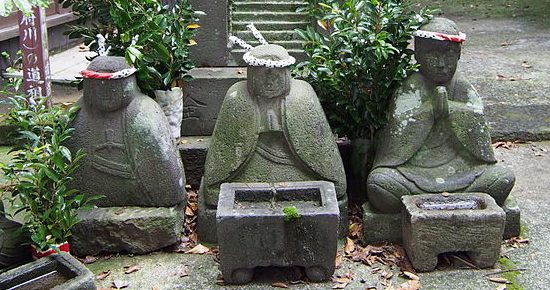
A trio of dosojin, including Jizo. Tadill, CC Wikimedia Commons

Dōsojin would appear to be very much a Shinto concept. The clue is in the characters for “dōsojin,” 道祖神. That final character 神 is kami, the same kami character used in the word for Shinto, 神道. By being classified among the dōsojin, Jizō is also being classified as kami, thus placing him in within the Shinto sphere.
That Jizō can be regarded as a deity that exists in the Shinto world as well as the Buddhist is also evidenced in his changing physical depiction. Jizō as a dōsojin can look quite different to Jizō as a classical Bodhisattva. For one thing, the dōsojin-type Jizō is usually diminished in size and detail; he may only be a foot or two high. His shape too often resembles the archetypal dōsojin rock; upright and rounded, even a little phallic.
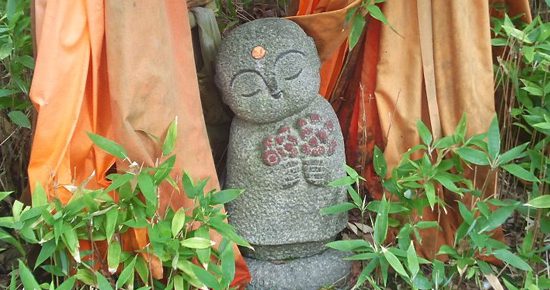
The modern Jizo. Yanajin33, CC Wikimedia Commons

The most modern incarnation of Jizō is particularly suggestive of the fact that Jizō has transformed from a solemn Buddhist saint to a deity of a folksy blend of Shinto and Buddhist spirituality. Modern artists now often depict Jizō with an oversized head and tiny limbs, highly suggestive of an infant, which reflects his role as a guardian of children. He is often given a cartoonish, smiling face and his features are greatly simplified. In essence, he is less “human” and more “supernatural” – a saint that has transformed into something more greatly resembling a spirit. Add to this fact that you’ll often find him in a natural setting such as a forest or garden, and he becomes something very much resembling a pixie or sprite of European folklore. It is very interesting toconsider that these “wee folk” of European legend were sometimes thought to be the souls of deceased children, echoing Jizō’s connection with the departed spirits of those who have died young.
A Pagan Goddess who became a Christian saint, and a Buddhist saint who became a Shinto spirit. These examples of syncretic deities from two very separate cultures remind us how complex the picture of religion can be, and how there can never be one “true” way. It gives me hope that even the most different of religious paths can not only exist harmoniously side by side, but also learn and borrow from each other to the benefit of both beliefs.
Previous Post
January 22, 2017
Anatomy of a Kamidana (Shinto Home Shrine)
Next Post

January 26, 2017 A Group Imbolc Ritual And Candlelit Meditation
Browse Our Archives
Select a Category Art, Craft & Expression Musings & Miscellaneous Nature & Science News & Reviews Ritual & Festivals Secularism, Politics & Human Rights Shinto & Japanese Religion Uncategorized
Select a Month August 2023 July 2023 June 2023 May 2023 April 2023 March 2023 February 2023 January 2023 December 2022 November 2022 October 2022 September 2022 August 2022 July 2022 June 2022 May 2022 April 2022 March 2022 February 2022 January 2022 December 2021 November 2021 October 2021 September 2021 August 2021 July 2021 June 2021 May 2021 April 2021 March 2021 February 2021 January 2021 December 2020 November 2020 October 2020 September 2020 August 2020 July 2020 June 2020 May 2020 April 2020 March 2020 February 2020 January 2020 December 2019 November 2019 October 2019 September 2019 August 2019 July 2019 June 2019 May 2019 April 2019 March 2019 February 2019 January 2019 December 2018 November 2018 October 2018 September 2018 August 2018 July 2018 June 2018 May 2018 April 2018 March 2018 February 2018 January 2018 December 2017 August 2017 July 2017 June 2017 May 2017 April 2017 March 2017 February 2017 January 2017 December 2016 November 2016 October 2016 September 2016 August 2016 July 2016 June 2016 May 2016 April 2016 March 2016 February 2016 January 2016
Follow Us!
TAKE THE
Religious Wisdom Quiz
Who taught Apollos about the gospel of Jesus Christ.
Select your answer to see how you score.
Aquila and Priscilla Paul Timothy Barnabas
Related posts from Pagan Tama

Three reasons why Pagans should support equality for...

Holy Well Pilgrimage: The Hidden Wells of St...
Holy Well Pilgrimage: The Mysterious Face Of St...

Protest Plans To Demolish 'Ghibli' Shinto Shrine To...
TRENDING AT PATHEOS Pagan

I was recently chatting with someone on Instagram. She asked me what...

While there are many people who share their results, the end of...

On July 23, I saw Christopher Nolan's The Odyssey which is Homer’s...

As I write this two big events have just finished up. One...

Restoring the Watershed of Divine Love
Perhaps cooperation is not something we manufacture through legislation, ideology, or moral...

Many UUs don’t pray because of bad experiences in a previous religion,...
view all Pagan blogs
Ad-Free & Subscriber Log-In Subscription Support
- About Us
- 2026 Calendar
- Videos
- Podcasts
- Library of World Religions
- Faith In Media Tracker
- Advertise With Us
- Write for Us
- Privacy Policy
- Terms of Service
- Do Not Sell My Data
- Contact Us
- Radiant Digital
- Manage Newsletter Subscriptions
- Unsubscribe From Notifications
- Sitemap
Copyright 2008-2026, Patheos. All rights reserved.
Subscription Support Ad-Free & Subscriber Log-In
Follow Patheos