
BuddhistCatholicContemplativeEvangelicalGeneral ChristianHinduJewishLatter-day SaintMuslimNew VisionsProgressive Christian
Beliefs
- Buddhist
- Catholic
- Contemplative
- Evangelical
- General Christian
- Hindu
- Jewish
- Latter-day Saint
- More Voices
- Muslim
- New Visions
- Pagan
- Progressive Christian
Topics
- Religion News
- Food and Religion
- Sports and Religion
- Religious Art
- Religious Music and Entertainment
- Religious Events
- History and Religion
- Style and Religion
- Politics and Religion
- Women in Religion
- Recreation Outdoors and Religion
- Business Finance and Religion
- Careers Workplace and Religion
- Education and Religion
- Family Parenting and Religion
- Health Fitness and Religion
- Home and Religion
- Relationships and Religion
- Technology and Religion
- Travel and Religion
Columnists
- Buddhist Columnists
- Business Finance and Religion Columnists
- Careers Workplace and Religion Columnists
- Catholic Columnists
- Contemplative Columnists
- Education and Religion Columnists
- Evangelists Columnists
- Family Parenting and Religion Columnists
- General Christian Columnists
- Health Fitness and Religion Columnists
- Hindu Columnists
- History and Religion Columnists
- Home and Religion Columnists
- Jewish Columnists
- More Voices Columnists
- Latter Day Columnists
- Muslim Columnists
- New Visions Columnists
- Nonreligious Columnists
- Pagan Columnists
- Politics and Religion Columnists
- Progressive Columnists
- Recreation Outdoors and Religion Columnists
- Relationships and Religion Columnists
- Religion News Columnists
- Religious Art Columnists
- Religious Events Columnists
- Religious Music and Entertainment Columnists
- Sports and Religion Columnists
- Style and Religion Columnists
- Technology and Religion Columnists
- Travel and Religion Columnists
- Women in Religion Columnists
Resource Library
- 2026 Calendar
- Library of World Religions
- The 100 Most Holy Places on Earth
- Patheos Answers
- Podcasts
- Videos
- Faith Leaders Database
- Anglican Episcopalian
- Bahai
- Baptist
- Buddhism
- Christianity
- Confucianism
- Eastern Orthodoxy
- Hinduism
- Holiness and Pentecostal
- ISKCON
- Islam
- Judaism
- Lutheran
- Methodist
- The Church of Jesus Christ of Latter-day Saints
- New Age
- Paganism
- Presbytarian and Reformed
- Protestantism
- Religion Behind the Scenes
- Roman Catholic
- Scientology
- Shia Islam
- Sikhism
- Sufism
- Sunni Islam
- Taoism
- Zen
- See all religions
Research Tools
 Ad-Free & Subscriber Log-In Subscription Support
Follow Patheos 

- Trending:
- Advent
- |
- Forgiveness
- |
- Thanksgiving
- |
- Election
- |
- Seasonal Holidays
- |
- Marriage
 Pagan Tama
- Home
- Pagan
- Obtaining and Displaying a Kamidana (Shinto Home Shrine)
Obtaining and Displaying a Kamidana (Shinto Home Shrine)
Last updated on: January 15, 2017 at 1:06 pm by Megan Manson
Obtaining and Displaying a Kamidana (Shinto Home Shrine) 2017-01-15T13:06:05+00:00 Megan Manson
Patheos Explore the world's faith through different perspectives on religion and spirituality! Patheos has the views of the prevalent religions and spiritualities of the world.
2. Preparation
Now that I had my mind set on getting a kamidana, I knew I had to make some preparation for taking on this big commitment. I thought it was especially important to do as much research on kamidana custodianship as possible, especially as, unlike many Japanese people, I have no direct experience of having a kamidana in the home. In addition to consulting the global English-speaking Shinto community via the Facebook groups Shinto Religion of the Forest and Inari Faith International, I bought the Japanese guidebook Kokoro ga yasuragu kamidana sutairu, which was perfect for someone like me who hasn’t grown up within a Shinto culture and for whom Japanese is a second language. You can read my review of this excellent book here.

The book Kokoro ga yasuragu kamidana sutairu
I also changed my habits a little at my current altar. I tried to be more diligent in my offerings, making an effort to pray at the altar and offer fresh water every day, and fresh rice and salt every week. I knew that this would be an especially important habit to keep up once the ofuda was in my home.
3. Procurement
Once I’d finished my research, it was time to purchase the kamidana. In my experience the ofuda, and the enclosing omiya and other items for venerating the ofuda, must be purchased separately. I decided to purchase the ofuda first. While the kamidana and accessories are available in high street shops in Japan, ofuda can only be obtained from a Shinto shrine. So it was perhaps surprising that I found the ofuda, the easiest item to obtain. I managed to buy one originating from Fushimi Inari Taisha, the most important shrine to Inari Ōkami, from the ebay store Yappari Japan. It cost me about $20.00. It was delivered promptly and was well-packaged; when buying from Japan, one thing you can always rely on is excellent service!

The ofuda, from Yappari Japan
I decided to display the ofuda on my makeshift altar, but I kept it wrapped up in its cellophane packaging. I thought that this would be more respectful until the rest of the kamidana arrived and keep it in good condition.
The other parts of the kamidana took a little more time and effort. There are number of important things to bear in mind when buying a kamidana. Some of the most important are:
- Size, and specifically, the size of the compartment where the ofuda will go. It’s not uncommon for some types of ofuda to be larger than the space in the kamidana, so make sure you check all the measurements of the kamidana carefully!
- Overall design. Some designs are more suitable for some types of kami than others. For example, my kamidana was intended to venerate Inari Ōkami, a kami that the priests say should be enshrined in His own kamidana, and not in one that also enshrines ancestral kami (which is another common type).
- Whether or not accessories are included. You generally have the option of purchasing an omiya and the other accessories (offering vessels, vases etc.) separately, or together as a set. I generally found that sets work out cheaper, although be careful; this isn’t always the case.
- Shipping costs. Buying from Japan can be an expensive process with lots of “hidden” costs involved (like customs duties)
Because this was such an important matter for me, I wanted to put a lot of thought and invest a little extra money in order to get a kamidana that was right for me. I therefore didn’t go for the cheaper options that are available on ebay; among the kamidana options that I could reasonably afford, none of them really “spoke” to me. So I decided to broaden my search on Amazon Japan; being able to read and write Japanese really helped here!
Eventually, the kamidana set I found that really stood out was this one. Being advertised as a “modern kamidana,” what is particularly striking is its dark colour. Most kamidana are made from pale, unstained wood, and kamidana specific to Inari are often painted vermilion red (this pushes the price right up). But this kamidana ha been treated to give it an “ebony” appearance. I thought this made it look really attractive. It reminded me of what old Shinto shrines look like in Japan after the rain; their wood darkens and looks just like this.
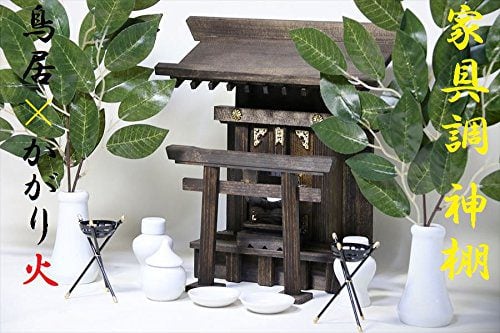
The “modern” kamidana, which I eventually chose, from Amazon Japan
This isn’t a very traditional kamidana. In addition to its unusual dark colour, I noticed from the Amazon photos that nails had been used in its construction. Traditionally, kamidana (like Shinto shrines themselves) should not use nails; they should be slotted together using wooden pegs. But then I thought, I am not a traditional Shintoist! Perhaps a kamidana that is a little different from the norm is particularly appropriate for me. And what’s more, the use of nails probably reduced production costs, so that this kamidana is a good compromise between tradition and economising. To top it off, this kamidana comes with a full set of accessories: chinaware for offerings, artificial sakaki leaves (a type of sacred tree that grows in Japan and is a traditional Shinto offering), candle holders, a sacred mirror (shinkyō), candle holders and a torii gate. That last item is a particularly important one for Inari kamidana and not all sets include one, so that was a big plus. It didn’t come with the fox statues that are most commonly associated with Inari shrines, but that didn’t matter as I already had a pair! All the items were made to coordinate with the dark colour of the omiya and I thought the price for the entire set was quite reasonable. I was sold.
There was now one last problem – the company supplying this kamidana wouldn’t ship to the UK! I therefore had to use a proxy service to buy it and get it shipped. The most well-known proxy buying company for purchasing goods from Japan is probably White Rabbit Express, who were exceptionally helpful. They purchase items for you on your behalf in Japan (which is particularly useful if you can’t read Japanese), and then you reimburse them the purchase and shipping costs, together with a reasonable service fee. They were very prompt at answering my questions and although they couldn’t give me an exact quote for the shipping fee before the transaction for the kamidana had gone through, their rough estimate was fairly accurate.
I chose the cheapest shipping method to get the kamidana to me, so it did take a while. And right at the end, there was a customs duty to pay as well. So yes, in total it was an expensive purchase. But when the kamidana finally arrived, carefully and diligently packaged, I was not disappointed…
Next page: Setting up the kamidana
Previous Post

January 8, 2017
2017: The Year of the Red Fire Chicken
Next Post

January 22, 2017 Anatomy of a Kamidana (Shinto Home Shrine)
Browse Our Archives
Select a Category Art, Craft & Expression Musings & Miscellaneous Nature & Science News & Reviews Ritual & Festivals Secularism, Politics & Human Rights Shinto & Japanese Religion Uncategorized
Select a Month August 2023 July 2023 June 2023 May 2023 April 2023 March 2023 February 2023 January 2023 December 2022 November 2022 October 2022 September 2022 August 2022 July 2022 June 2022 May 2022 April 2022 March 2022 February 2022 January 2022 December 2021 November 2021 October 2021 September 2021 August 2021 July 2021 June 2021 May 2021 April 2021 March 2021 February 2021 January 2021 December 2020 November 2020 October 2020 September 2020 August 2020 July 2020 June 2020 May 2020 April 2020 March 2020 February 2020 January 2020 December 2019 November 2019 October 2019 September 2019 August 2019 July 2019 June 2019 May 2019 April 2019 March 2019 February 2019 January 2019 December 2018 November 2018 October 2018 September 2018 August 2018 July 2018 June 2018 May 2018 April 2018 March 2018 February 2018 January 2018 December 2017 August 2017 July 2017 June 2017 May 2017 April 2017 March 2017 February 2017 January 2017 December 2016 November 2016 October 2016 September 2016 August 2016 July 2016 June 2016 May 2016 April 2016 March 2016 February 2016 January 2016
Follow Us!
TAKE THE
Religious Wisdom Quiz
Who walked on water besides Jesus?
Select your answer to see how you score.
Paul Elijah Peter Moses
Related posts from Pagan Tama
Protest Plans To Demolish 'Ghibli' Shinto Shrine To...
My Weather Wishes For The Tanabata Star Festival

Connecting With Shinto Kami Overseas

Women In Shinto & Sumo: Are The Times...
TRENDING AT PATHEOS Pagan

To help with the upcoming holiday season, I'm introducing the Holiday Helper...

10 years of the Power Sigil & Moving...
Last week while reorganizing my studio space, I found the sketchbook that...

Why are younger seekers drawn to Paganism and...
One of the things I've noticed the most is that I'm far...

When we talk about Greek religion, we often begin with the dodekatheion—the...

I was recently chatting with someone on Instagram. She asked me what...

On July 23, I saw Christopher Nolan's The Odyssey which is Homer’s...
view all Pagan blogs
Ad-Free & Subscriber Log-In Subscription Support
- About Us
- 2026 Calendar
- Videos
- Podcasts
- Library of World Religions
- Faith In Media Tracker
- Advertise With Us
- Write for Us
- Privacy Policy
- Terms of Service
- Do Not Sell My Data
- Contact Us
- Radiant Digital
- Manage Newsletter Subscriptions
- Unsubscribe From Notifications
- Sitemap
Copyright 2008-2026, Patheos, part of the Radiant Digital network of media brands. All rights reserved.
Subscription Support Ad-Free & Subscriber Log-In
Follow Patheos