
BuddhistCatholicContemplativeEvangelicalGeneral ChristianHinduJewishLatter-day SaintMuslimNew VisionsProgressive Christian
Beliefs
- Buddhist
- Catholic
- Contemplative
- Evangelical
- General Christian
- Hindu
- Jewish
- Latter-day Saint
- More Voices
- Muslim
- New Visions
- Pagan
- Progressive Christian
Topics
- Religion News
- Food and Religion
- Sports and Religion
- Religious Art
- Religious Music and Entertainment
- Religious Events
- History and Religion
- Style and Religion
- Politics and Religion
- Women in Religion
- Recreation Outdoors and Religion
- Business Finance and Religion
- Careers Workplace and Religion
- Education and Religion
- Family Parenting and Religion
- Health Fitness and Religion
- Home and Religion
- Relationships and Religion
- Technology and Religion
- Travel and Religion
Columnists
- Buddhist Columnists
- Business Finance and Religion Columnists
- Careers Workplace and Religion Columnists
- Catholic Columnists
- Contemplative Columnists
- Education and Religion Columnists
- Evangelists Columnists
- Family Parenting and Religion Columnists
- General Christian Columnists
- Health Fitness and Religion Columnists
- Hindu Columnists
- History and Religion Columnists
- Home and Religion Columnists
- Jewish Columnists
- More Voices Columnists
- Latter Day Columnists
- Muslim Columnists
- New Visions Columnists
- Nonreligious Columnists
- Pagan Columnists
- Politics and Religion Columnists
- Progressive Columnists
- Recreation Outdoors and Religion Columnists
- Relationships and Religion Columnists
- Religion News Columnists
- Religious Art Columnists
- Religious Events Columnists
- Religious Music and Entertainment Columnists
- Sports and Religion Columnists
- Style and Religion Columnists
- Technology and Religion Columnists
- Travel and Religion Columnists
- Women in Religion Columnists
Resource Library
- 2026 Calendar
- Library of World Religions
- The 100 Most Holy Places on Earth
- Patheos Answers
- Podcasts
- Videos
- Faith Leaders Database
- Anglican Episcopalian
- Bahai
- Baptist
- Buddhism
- Christianity
- Confucianism
- Eastern Orthodoxy
- Hinduism
- Holiness and Pentecostal
- ISKCON
- Islam
- Judaism
- Lutheran
- Methodist
- The Church of Jesus Christ of Latter-day Saints
- New Age
- Paganism
- Presbytarian and Reformed
- Protestantism
- Religion Behind the Scenes
- Roman Catholic
- Scientology
- Shia Islam
- Sikhism
- Sufism
- Sunni Islam
- Taoism
- Zen
- See all religions
Research Tools
 Ad-Free & Subscriber Log-In Subscription Support
Ad-Free & Subscriber Log-In Subscription Support
Follow Patheos 

- Trending:
- Forgiveness
- |
- Marriage
- |
- Consciousness
- |
- Death Penalty
- |
- Election
- |
- Halloween
 Pagan Tama
- Home
- Pagan
- 2017: The Year of the Red Fire Chicken
2017: The Year of the Red Fire Chicken
Last updated on: January 8, 2017 at 1:11 am by Megan Manson
2017: The Year of the Red Fire Chicken 2017-01-08T01:11:43+00:00 Megan Manson
Patheos Explore the world's faith through different perspectives on religion and spirituality! Patheos has the views of the prevalent religions and spiritualities of the world.
Akemashite omedetō gozaimasu – Happy New Year!
Although they now follow the Western calendar rather than the Chinese lunar calendar, the Japanese hold the Chinese zodiac in equally high regard. Japan is currently celebrating the beginning of the year of the tori; commonly known as the Year of the Rooster in English-speaking countries (or Year of the Cockerel/Cock here in the UK). However, in Japan tori does not specifically a male or female bird, and so you’ll see representations of both roosters and hens for this year. It would perhaps be more accurate to call this year the Year of the Chicken, or more specifically, the Red Fire Chicken.

At the beginning of 2016, the Year of the Red Fire Monkey, I explored the symbolism of the monkey and what sort of guidance it can give us for the year ahead. I would now like to explore the symbolism of the Red Fire Chicken, and what message this creature may bring to us in 2017.
War and Conflict
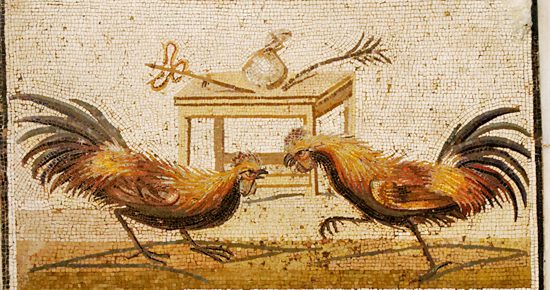
Roman mosaic depicting fighting cocks.
Chickens, and particularly roosters, are creatures of complex symbolism. The rooster is territorial and aggressive towards other roosters, hence its use in cockfighting in cultures throughout the world. Roosters can therefore stand for war and military power. The Hindu war god Kartikeya carries a rooster emblem on his flag. Cockfights have been staged as a form of sacrificial ritual in some south east Asian spiritual traditions. At Ragnarök itself, the Norse narrative of the end of the world, it will be a cock’s crow that signifies the beginning of the apocalyptic battle of the gods.
The colours red and fire, the respective colour and element of 2017, are likewise associated with conflict. Red is the colour of passion, anger and bloodshed; fire, a symbol of destruction and violence.
With political uncertainty facing many superpowers across the word, coupled with ongoing territorial disputes and terrorist atrocities, war and bloodshed are no doubt among the worries facing many people at the start of 2017.
Light and Hope
But by on large, the chicken is a positive symbol. The rooster is well known for its habit of crowing at dawn, possibly as a way of asserting its dominance over its territory. The fact that the rooster seems to welcome the Sun each morning meant that it was only natural that it became regarded as a solar animal – and by extension, a symbol of the triumph of light over darkness. It is sacred to a number of solar deities, including the Greco-Roman Apollo, the Mesopotamian god Nergal and the Celtic god Lugh. The reverence for the rooster is not limited to the Pagan faiths; it is a sacred symbol in Christianity and Islam too, probably due to its connection with the dawn and light.
Additionally, the chicken represents hope through creation. Roosters are also known for their high sexual activity, and this, coupled by the resemblance of the rooster’s beak and wattles to the male genitalia, has also made them a symbol of male sexuality. These associations can be seen in modern slang; the word “cock” is a taboo term for the penis. The female chicken, the hen, is arguably even more closely associated with fertility. The hen’s egg is one of the most profound symbol of birth and creation, while the hen itself has long been associated with motherhood from ancient times right up to present day. Consider the expression “mother hen” and “broody,” both of which use the hen as a metaphor for the maternal instinct.
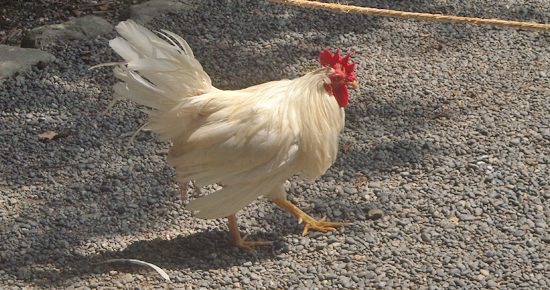
Sacred chicken at Ise Jingu, Japan
The chicken is a highly revered animal in Shinto. It represents Amaterasu Ōmikami – kami of the Sun and the most important kami in the Shinto pantheon. If you visit Ise Jingu, the main shrine to Amaterasu, you will see lots of white chickens running loose in the shrine complex; these are Amaterasu’s sacred birds. As an earlier post at Patheos by Liz Fisher recently pointed out, Amaterasu’s emergence from darkness to light brings a powerful message of life and hope.
Amaterasu is connected with the two other symbols mentioned previously – red and fire. In Japan, red represents the Sun itself, and so it is a sacred colour of life and joy in Shinto. Fire too is revered in Shinto. It is the giver of light and warmth, and has the power to purify.
Our message for 2017
The chicken, the fire, the colour red. They can be interpreted in two different ways which at first seem opposing, but are in fact firmly connected. The aggressive rooster can symbolise war – but this aggression is the same territorial instinct that drives the rooster’s habit of crowing at sunrise. The same fire that can cause devastating destruction also forms civilisation’s most basic roots. The same red that represents blood shed also represents the vitality of blood, the source of life.
All three are essentially symbols of power. And they point to one overall symbol, the Sun itself – the ultimate source of all power on Earth, with the ability to give life through its light and warmth, and destroy life through drought and harmful radiation.
In 2017, we will be all be wrestling with things of great power – politics, ideology, technology, religion. Whether or not we wield these things as weapons bringing pain and death, or tools bringing healing and life, is up to us. We need to tread with carefully and respectfully always.
Previous Post

December 30, 2016
Top 10 Pagan Books Of 2016
Next Post

January 15, 2017 Obtaining and Displaying a Kamidana (Shinto Home Shrine)
Browse Our Archives
Select a Category Art, Craft & Expression Musings & Miscellaneous Nature & Science News & Reviews Ritual & Festivals Secularism, Politics & Human Rights Shinto & Japanese Religion Uncategorized
Select a Month August 2023 July 2023 June 2023 May 2023 April 2023 March 2023 February 2023 January 2023 December 2022 November 2022 October 2022 September 2022 August 2022 July 2022 June 2022 May 2022 April 2022 March 2022 February 2022 January 2022 December 2021 November 2021 October 2021 September 2021 August 2021 July 2021 June 2021 May 2021 April 2021 March 2021 February 2021 January 2021 December 2020 November 2020 October 2020 September 2020 August 2020 July 2020 June 2020 May 2020 April 2020 March 2020 February 2020 January 2020 December 2019 November 2019 October 2019 September 2019 August 2019 July 2019 June 2019 May 2019 April 2019 March 2019 February 2019 January 2019 December 2018 November 2018 October 2018 September 2018 August 2018 July 2018 June 2018 May 2018 April 2018 March 2018 February 2018 January 2018 December 2017 August 2017 July 2017 June 2017 May 2017 April 2017 March 2017 February 2017 January 2017 December 2016 November 2016 October 2016 September 2016 August 2016 July 2016 June 2016 May 2016 April 2016 March 2016 February 2016 January 2016
Follow Us!
TAKE THE
Religious Wisdom Quiz
What food did God provide for Israel in the wilderness?
Select your answer to see how you score.
Bread Fish Milk Manna
Related posts from Pagan Tama

Protest Plans To Demolish 'Ghibli' Shinto Shrine To...
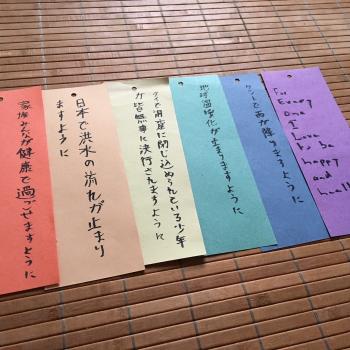
My Weather Wishes For The Tanabata Star Festival

Connecting With Shinto Kami Overseas

Garden Rituals: What Do Pagans Think?
TRENDING AT PATHEOS Pagan

I was recently chatting with someone on Instagram. She asked me what...

While there are many people who share their results, the end of...

On July 23, I saw Christopher Nolan's The Odyssey which is Homer’s...

As I write this two big events have just finished up. One...

Restoring the Watershed of Divine Love
Perhaps cooperation is not something we manufacture through legislation, ideology, or moral...

Many UUs don’t pray because of bad experiences in a previous religion,...
view all Pagan blogs
Ad-Free & Subscriber Log-In Subscription Support
- About Us
- 2026 Calendar
- Videos
- Podcasts
- Library of World Religions
- Faith In Media Tracker
- Advertise With Us
- Write for Us
- Privacy Policy
- Terms of Service
- Do Not Sell My Data
- Contact Us
- Radiant Digital
- Manage Newsletter Subscriptions
- Unsubscribe From Notifications
- Sitemap
Copyright 2008-2026, Patheos. All rights reserved.
Subscription Support Ad-Free & Subscriber Log-In
Follow Patheos