
BuddhistCatholicContemplativeEvangelicalGeneral ChristianHinduJewishLatter-day SaintMuslimNew VisionsProgressive Christian
Beliefs
- Buddhist
- Catholic
- Contemplative
- Evangelical
- General Christian
- Hindu
- Jewish
- Latter-day Saint
- More Voices
- Muslim
- New Visions
- Pagan
- Progressive Christian
Topics
- Religion News
- Food and Religion
- Sports and Religion
- Religious Art
- Religious Music and Entertainment
- Religious Events
- History and Religion
- Style and Religion
- Politics and Religion
- Women in Religion
- Recreation Outdoors and Religion
- Business Finance and Religion
- Careers Workplace and Religion
- Education and Religion
- Family Parenting and Religion
- Health Fitness and Religion
- Home and Religion
- Relationships and Religion
- Technology and Religion
- Travel and Religion
Columnists
- Buddhist Columnists
- Business Finance and Religion Columnists
- Careers Workplace and Religion Columnists
- Catholic Columnists
- Contemplative Columnists
- Education and Religion Columnists
- Evangelists Columnists
- Family Parenting and Religion Columnists
- General Christian Columnists
- Health Fitness and Religion Columnists
- Hindu Columnists
- History and Religion Columnists
- Home and Religion Columnists
- Jewish Columnists
- More Voices Columnists
- Latter Day Columnists
- Muslim Columnists
- New Visions Columnists
- Nonreligious Columnists
- Pagan Columnists
- Politics and Religion Columnists
- Progressive Columnists
- Recreation Outdoors and Religion Columnists
- Relationships and Religion Columnists
- Religion News Columnists
- Religious Art Columnists
- Religious Events Columnists
- Religious Music and Entertainment Columnists
- Sports and Religion Columnists
- Style and Religion Columnists
- Technology and Religion Columnists
- Travel and Religion Columnists
- Women in Religion Columnists
Resource Library
- 2026 Calendar
- Library of World Religions
- The 100 Most Holy Places on Earth
- Patheos Answers
- Podcasts
- Videos
- Faith Leaders Database
- Anglican Episcopalian
- Bahai
- Baptist
- Buddhism
- Christianity
- Confucianism
- Eastern Orthodoxy
- Hinduism
- Holiness and Pentecostal
- ISKCON
- Islam
- Judaism
- Lutheran
- Methodist
- The Church of Jesus Christ of Latter-day Saints
- New Age
- Paganism
- Presbytarian and Reformed
- Protestantism
- Religion Behind the Scenes
- Roman Catholic
- Scientology
- Shia Islam
- Sikhism
- Sufism
- Sunni Islam
- Taoism
- Zen
- See all religions
Research Tools
 Ad-Free & Subscriber Log-In Subscription Support
Ad-Free & Subscriber Log-In Subscription Support
Follow Patheos 

- Trending:
- Forgiveness
- |
- Marriage
- |
- Consciousness
- |
- Death Penalty
- |
- Election
- |
- Halloween
 Pagan Tama
- Home
- Pagan
- Shinto In Britain: Stories from UK Shintoists
Shinto In Britain: Stories from UK Shintoists
Last updated on: December 10, 2016 at 5:43 pm by Megan Manson
Shinto In Britain: Stories from UK Shintoists 2016-12-10T17:43:21+00:00 Megan Manson
Patheos Explore the world's faith through different perspectives on religion and spirituality! Patheos has the views of the prevalent religions and spiritualities of the world.
If online communities such as Facebook are anything to go by, Shinto is growing in popularity outside of Japan. And today’s Shinto enthusiasts are not restricted to academics and specialists in Japanese culture or beliefs. They are ordinary members of the public who are exploring Shinto not just out of curiosity, but because they believe Shinto offers a spiritual path relevant to people of all races, all nationalities and all walks of life.
The United Kingdom is one of the countries where participation in Shinto appears to be blossoming. Unlike the USA or the Netherlands, the UK does not have much of an official Shinto presence; it does not, for example, have any recognised, public Shinto shrines (as yet). But it does have a long, rich history of promoting and developing esoteric and Pagan religions, often drawing from Asian beliefs. This provides the UK with fertile grounds for Shinto to develop, if with its own distinctive, British flavour.
In recognition of the fact that UK residents with an interest in Shinto are increasingly expressing the need to network and communicate with each other, myself and three other UK-based Shintoists created a new Facebook group, Shinto in the UK, for anybody from any country and any walk of life interested in this topic.
I thought it would be interesting to share some of these members’ stories, so readers from all over the world can understand what drew them to Shinto, how they practise Shinto, and what it’s like to be a Shintoist in the UK.

Alex: “Through Shinto, I gained a fair amount of guidance in my life.”
“I became a part of Shinto around 6 months ago after feeling spiritually drained because of a series of events. I went and researched a great deal, and came to the conclusion that Shinto was the right faith for me. Initially, I was content just knowing that was what I believe in, but I soon learnt that I needed to be connected to the community. Although this allowed me to communicate with others, I found that I wasn’t actually doing anything as a part of Shinto. So I began going out into my local forest, researching all I could. My knowledge grew, and through Shinto, I gained a fair amount of guidance in my life. I’m in the process of putting together a small kamidana (small household Shinto shrine), and later on to construct a more permanent one. So for anyone who is looking into this and any religion, the best day to find out is to research and learn, explore the world.”

Fox cub at Rixton Clay Pits nature reserve, England. Galatas, CC Wikimedia Commons

Emily: “I have the fortune of being able to still label my worship under the Pagan flag whilst I truly get to grips with Shinto customs, and in truth decide if Shinto is the right label for me.”
“I have been followed by foxes my whole life. Growing up in the British countryside that’s not a surprise, but that has meant that I have had to help them evade hunting parties. They became exceedingly special, and began to occur as symbols when I entered into spiritual practices in my late teens trying to find my path. I discovered the Shinto kami Inari through research, and it fit perfectly: Not only did she have a connection to foxes, but the first image I saw of her was of a goddess rather than the old man (another of Inari’s depictions), and I had always felt that whatever god watched over me, it was one of a motherly presence. I was fortunate enough to live in Japan a year after and I continued to learn more and grow closer to Inari-Sama. I made a kamidana for my apartment and visited my local shrine as close to daily as I could, and climbed Mount Inari in Kyoto on special occasions.
Now I am back in England, I find that whilst it is not harder to worship Inari-Sama, it is harder to find the resources to learn more. As as close as I feel to Inari-Sama when I pray at my Kamidana, it will always feel more distant than Fushimi Inari Grand Shrine (the most important shrine to Inari in Japan). To add to these troubles it is expensive to import much needed materials from Japan for proper worship. This is more so the case with the current unstable political climate affecting the stock exchange. However, although you may think that Japan is a better place for meeting others that worship Inari, for a person starting out in both her spiritual path and Japanese, England is a much more accessible culture to meet like-minded individuals. I have the fortune of being able to still label my worship under the Pagan flag whilst I truly get to grips with Shinto customs, and in truth decide if Shinto is the right label for me. I can also combine labels and thus worship without much resistance, resistance I felt I would have found in Japan.
I am really hoping to have the opportunity to meet not just more Inari worshippers in person one day, but also those who worship other Japanese gods. Currently I owe my ability to socialise in such a way purely to the internet and the Inari International Faith International Facebook group. Not only is it my haven to discuss my religious path freely with like-minded worshippers, but it also provides me with advice and resources to continue learning outside Japan.”

Aikido is a martial art with close Shinto links; note the kamidana in the background. By Kenji Lee, Chris Mikkelson, CC Wikimedia Commons

David: “I like Shinto and the kami because they are born of a sense of goodness in everything”
“I follow the Edo/post-Edo Period Shinto ideas that pertain to Japanese fighting arts. Dave Lowry wrote a lovely book discussing the matter. I like Shinto and the kami because they are born of a sense of goodness in everything and there is no weirdo Christianity-type controlling element. A subtle religion that you can make of what you wish is a lovely thing if that’s what you require within yourself. I personally don’t fall on religion to steady myself but I do like to read/decipher/understand the metaphors from any of the Japanese religions that were woven into the fighting arts.”
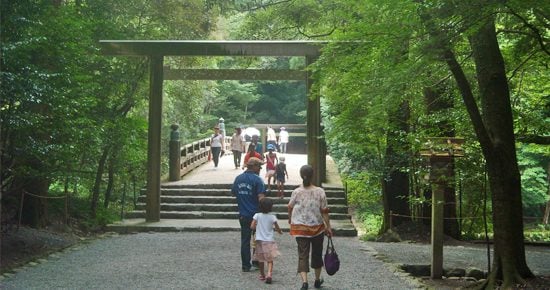
The approach to Ise Jingu
Christopher: “The times when I feel most connected to the Kami is when I am outside in nature.”
“My connection with Shinto started years back when I lived in Japan during a hatsumode (New Year pilgrimage) to Ise Grand Shrine (one of the most important sites of Shinto worship). Whilst praying, a sudden and strong wind blew towards us from the direction of the Honden (main shrine building) making the noren curtains billow in our direction. I felt an immense presence that filled the building, watching us. The wind or ‘breath’, as people mentioned, was a blessing to us all and a privilege. The feeling was so spiritual that I went home with a great sense of awe. Living in Japan it was easy to visit shrines and purchase ofuda and omamori talismans, but living in the UK it’s quite difficult. I have set up a simple kamidana with ofuda I purchased in Japan. Every day I change the water and pray for happiness, misfortune to be removed and unity with the earth and the Kami. I thank them for their intervention in my life. I also change clean and change the salt and rice once a month. Around the home (particularly around water) I have placed small salt pyramids that help to purify and protect the home. But the times when I feel most connected to the Kami is when I am outside in nature. There are some very old trees and forests near me where I offer a prayer and coin to spirits of the land, thanking them for the beautiful world I live in. At first it felt difficult or somehow inauthentic to practice Shinto in the UK. But as time has passed, and I have continued to show reverence, it has become easier and has grown in my heart. The best thing is, I’m not a rich person, and I haven’t lived the easiest of lives, but praying to the Kami have given me a sense of thankfulness, of wonder and of compassion.”
Thank you to Alex, Emily, David and Christopher for sharing their stories. If you are interested in Shinto in the UK, please join the Shinto in the UK Facebook Group. You can also like the Pagan Tama Facebook page to keep up to updates on this blog.
Previous Post

November 29, 2016
Pagan, Shinto & Spiritual Book Reviews November 2016
Next Post

December 13, 2016 Divination Rune Cookies for Yule
Browse Our Archives
Select a Category Art, Craft & Expression Musings & Miscellaneous Nature & Science News & Reviews Ritual & Festivals Secularism, Politics & Human Rights Shinto & Japanese Religion Uncategorized
Select a Month August 2023 July 2023 June 2023 May 2023 April 2023 March 2023 February 2023 January 2023 December 2022 November 2022 October 2022 September 2022 August 2022 July 2022 June 2022 May 2022 April 2022 March 2022 February 2022 January 2022 December 2021 November 2021 October 2021 September 2021 August 2021 July 2021 June 2021 May 2021 April 2021 March 2021 February 2021 January 2021 December 2020 November 2020 October 2020 September 2020 August 2020 July 2020 June 2020 May 2020 April 2020 March 2020 February 2020 January 2020 December 2019 November 2019 October 2019 September 2019 August 2019 July 2019 June 2019 May 2019 April 2019 March 2019 February 2019 January 2019 December 2018 November 2018 October 2018 September 2018 August 2018 July 2018 June 2018 May 2018 April 2018 March 2018 February 2018 January 2018 December 2017 August 2017 July 2017 June 2017 May 2017 April 2017 March 2017 February 2017 January 2017 December 2016 November 2016 October 2016 September 2016 August 2016 July 2016 June 2016 May 2016 April 2016 March 2016 February 2016 January 2016
Follow Us!
TAKE THE
Religious Wisdom Quiz
How many chapters are in the book of Hebrews?
Select your answer to see how you score.
10 13 15 16
Related posts from Pagan Tama

Three reasons why Pagans should support equality for...
Holy Well Pilgrimage: The Hidden Wells of St...

Holy Well Pilgrimage: The Mysterious Face Of St...

Protest Plans To Demolish 'Ghibli' Shinto Shrine To...
TRENDING AT PATHEOS Pagan

I was recently chatting with someone on Instagram. She asked me what...

While there are many people who share their results, the end of...

On July 23, I saw Christopher Nolan's The Odyssey which is Homer’s...

As I write this two big events have just finished up. One...

Restoring the Watershed of Divine Love
Perhaps cooperation is not something we manufacture through legislation, ideology, or moral...

Many UUs don’t pray because of bad experiences in a previous religion,...
view all Pagan blogs
Ad-Free & Subscriber Log-In Subscription Support
- About Us
- 2026 Calendar
- Videos
- Podcasts
- Library of World Religions
- Faith In Media Tracker
- Advertise With Us
- Write for Us
- Privacy Policy
- Terms of Service
- Do Not Sell My Data
- Contact Us
- Radiant Digital
- Manage Newsletter Subscriptions
- Unsubscribe From Notifications
- Sitemap
Copyright 2008-2026, Patheos. All rights reserved.
Subscription Support Ad-Free & Subscriber Log-In
Follow Patheos