
BuddhistCatholicContemplativeEvangelicalGeneral ChristianHinduJewishLatter-day SaintMuslimNew VisionsProgressive Christian
Beliefs
- Buddhist
- Catholic
- Contemplative
- Evangelical
- General Christian
- Hindu
- Jewish
- Latter-day Saint
- More Voices
- Muslim
- New Visions
- Pagan
- Progressive Christian
Topics
- Religion News
- Food and Religion
- Sports and Religion
- Religious Art
- Religious Music and Entertainment
- Religious Events
- History and Religion
- Style and Religion
- Politics and Religion
- Women in Religion
- Recreation Outdoors and Religion
- Business Finance and Religion
- Careers Workplace and Religion
- Education and Religion
- Family Parenting and Religion
- Health Fitness and Religion
- Home and Religion
- Relationships and Religion
- Technology and Religion
- Travel and Religion
Columnists
- Buddhist Columnists
- Business Finance and Religion Columnists
- Careers Workplace and Religion Columnists
- Catholic Columnists
- Contemplative Columnists
- Education and Religion Columnists
- Evangelists Columnists
- Family Parenting and Religion Columnists
- General Christian Columnists
- Health Fitness and Religion Columnists
- Hindu Columnists
- History and Religion Columnists
- Home and Religion Columnists
- Jewish Columnists
- More Voices Columnists
- Latter Day Columnists
- Muslim Columnists
- New Visions Columnists
- Nonreligious Columnists
- Pagan Columnists
- Politics and Religion Columnists
- Progressive Columnists
- Recreation Outdoors and Religion Columnists
- Relationships and Religion Columnists
- Religion News Columnists
- Religious Art Columnists
- Religious Events Columnists
- Religious Music and Entertainment Columnists
- Sports and Religion Columnists
- Style and Religion Columnists
- Technology and Religion Columnists
- Travel and Religion Columnists
- Women in Religion Columnists
Resource Library
- 2026 Calendar
- Library of World Religions
- The 100 Most Holy Places on Earth
- Patheos Answers
- Podcasts
- Videos
- Faith Leaders Database
- Anglican Episcopalian
- Bahai
- Baptist
- Buddhism
- Christianity
- Confucianism
- Eastern Orthodoxy
- Hinduism
- Holiness and Pentecostal
- ISKCON
- Islam
- Judaism
- Lutheran
- Methodist
- The Church of Jesus Christ of Latter-day Saints
- New Age
- Paganism
- Presbytarian and Reformed
- Protestantism
- Religion Behind the Scenes
- Roman Catholic
- Scientology
- Shia Islam
- Sikhism
- Sufism
- Sunni Islam
- Taoism
- Zen
- See all religions
Research Tools
 Ad-Free & Subscriber Log-In Subscription Support
Ad-Free & Subscriber Log-In Subscription Support
Follow Patheos 

- Trending:
- Forgiveness
- |
- Marriage
- |
- Consciousness
- |
- Death Penalty
- |
- Election
- |
- Halloween
 Pagan Tama
- Home
- Pagan
- Grief Is A Personal Matter
Grief Is A Personal Matter
Last updated on: March 25, 2018 at 10:19 am by Megan Manson
Grief Is A Personal Matter 2018-03-25T10:19:31+00:00 Megan Manson
Patheos Explore the world's faith through different perspectives on religion and spirituality! Patheos has the views of the prevalent religions and spiritualities of the world.
This Sunday is Remembrance Day in the UK and the Commonwealth, when we commemorating members of the armed forces who have died in war. In the run up to Remembrance Sunday, many of people buy and wear poppy symbols sold by the Royal British Legion charity which supports soldiers and their families. I usually buy a poppy or two every year; last year, I laid one on the grave of a solider who died just days before the end of the Second World War at my local cemetery when I visited to give Samhain offerings.
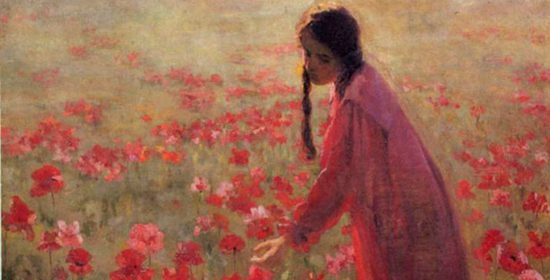
S. Blonskaya oil “Poppies.” Public Domain, Wikimedia Commons

The poppy is a very powerful symbol for people in Britain, and like Remembrance Sunday itself it means different things to different people. For some, it expresses pride in the British military. For others, it is a patriotic symbol, expressing Britain’s endurance through military struggles. And for many more, it expresses grief at the loss of countless lives of men and women who have died to protect the people of their country. But the nature of the poppy as a symbol of death and mourning pre-dates its use by the Royal British Legion by thousands of years. Its blood-red colour, together with its association with opium which brings on a deathly trance in the user, means that the poppy has long been associated with the ancient gods of death, including Persephone and Thanatos. It’s also a Lammas symbol, as its appearance at the beginning of the harvest remind us of the sacrifice of the Corn King, the spirit of the fields, who falls beneath the scythe so that we can use it as food. Neopagans may use the poppy when honouring the spirits and deities of death and sacrifice, as well as their own ancestors. The close proximity of Samhain with Remembrance Sunday in Britain gives the poppy added significance as a death symbol for some UK Pagans.
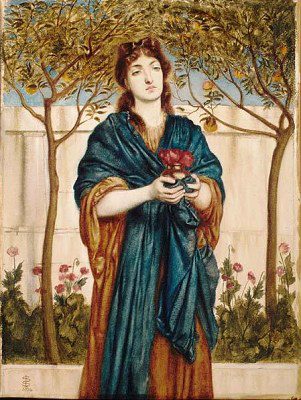
“Priestess Offering Poppies”, (1864) by Simeon Solomon (British, 1840-1905). Public domain, Wikimedia Commons

But like all powerful symbols, the poppy is not without controversy. There are many in the UK who choose not to wear a poppy for a number of reasons. Some do not wear a poppy because they believe this pretty flower glamorises the brutality of war, wrongly turning something horrific into something beautiful (I find it revealing that while so many people love the poppy, a supermarket faced heavy criticism last year for incorporating what the poppy actually represents into its remembrance display – the figure of a dead soldier). For others, the poppy is less of a public symbol and more of a political one (the football association FIFA certainly thinks so), and that by glorifying former wars we forget the mistakes and atrocities committed by soldiers on all sides. Some do not like the fact that the Royal British Legion dominates over other charities in the UK as theirs is usually the only symbol that TV producers will encourage presenters to wear – compare with the pink Breast Cancer Awareness ribbon, for example, which we do not see nearly as often. And for many pacifists in the UK, the poppy is simply a reminder of militarism and conflict, which they believe should receive less focus than endeavouring towards a more peaceful world (these people may choose to wear a white poppy instead, which stands for peace and is not produced by the Royal British Legion).
There are excellent reasons to wear the poppy. There are also excellent reasons not to wear one. The matter should therefore be a personal one, down to that particular individual.
I am therefore saddened to see so much bullying surrounding the poppy these days. Celebrities and other public figures who, for whatever reason, have appeared on camera not wearing the red poppy have been subject to questioning, criticism and abuse for not wearing one. Variously labelled “unpatrotic,” “unsupportive” and “ungrateful,” these individuals have been expected to explain themselves, and justify their decisions to the media. On the flip side, there are those who have branded all people who choose to wear a poppy as “ultra-nationalist” or “racist;” perhaps because in recent years some far-right groups have appropriated the poppy symbol.
It saddens me because these petty arguments show that something tragic has happened to the poppy – that some people are now more concerned with the symbol itself rather than the meaning behind the symbol.
It saddens me because the attention on who is and isn’t wearing a poppy eclipses the attention that should be focused on the people who have suffered in war.
It saddens me because too many people now wear the poppy in order to conform with others, out of fear of being criticised and labelled “un-patrotic” or “unsupportive” if they do not – rather than wearing the poppy because they genuinely want to show their remembrance and respect of fallen soldiers. And it saddens me that, on the opposite side, there are those who choose not to wear the poppy because of its misuse by the far right.
And it saddens me because of the bitter irony of it all. The poppy symbolises those who sacrificed themselves so that we could live in a free society, where we can express ourselves without fear of persecution.
Ultimately, Remembrance Day is about grief. It is about mourning the extremely sad loss of lives, too many of which were so short. Just like grieving for friends or relatives, grieving for the war dead should be a personal and private matter – by which, I do not mean that there shouldn’t be public services and ceremonies, but that we respect those who choose to grieve in their own private way. If they prefer to mourn in a manner that does not involve the red poppy, that is their choice. Even in the increasingly secular landscape of Britain, death remains one the domains where ritual and religious imagery still play an extremely important role. And in the same way that we respect religion as an individual, personal matter, so too should we respect grief in the same way, be it for individuals or for the millions who have died in war.
Secularism, Politics & Human Rights
Previous Post

November 6, 2016
A Tribute to Pocahontas
Next Post

November 14, 2016 What is Shinto? A Shinto Priest Explains
Browse Our Archives
Select a Category Art, Craft & Expression Musings & Miscellaneous Nature & Science News & Reviews Ritual & Festivals Secularism, Politics & Human Rights Shinto & Japanese Religion Uncategorized
Select a Month August 2023 July 2023 June 2023 May 2023 April 2023 March 2023 February 2023 January 2023 December 2022 November 2022 October 2022 September 2022 August 2022 July 2022 June 2022 May 2022 April 2022 March 2022 February 2022 January 2022 December 2021 November 2021 October 2021 September 2021 August 2021 July 2021 June 2021 May 2021 April 2021 March 2021 February 2021 January 2021 December 2020 November 2020 October 2020 September 2020 August 2020 July 2020 June 2020 May 2020 April 2020 March 2020 February 2020 January 2020 December 2019 November 2019 October 2019 September 2019 August 2019 July 2019 June 2019 May 2019 April 2019 March 2019 February 2019 January 2019 December 2018 November 2018 October 2018 September 2018 August 2018 July 2018 June 2018 May 2018 April 2018 March 2018 February 2018 January 2018 December 2017 August 2017 July 2017 June 2017 May 2017 April 2017 March 2017 February 2017 January 2017 December 2016 November 2016 October 2016 September 2016 August 2016 July 2016 June 2016 May 2016 April 2016 March 2016 February 2016 January 2016
Follow Us!
TAKE THE
Religious Wisdom Quiz
What city did Paul visit where the people worshiped "an unknown god"?
Select your answer to see how you score.
Corinth Rome Ephesus Athens
Related posts from Pagan Tama

Three reasons why Pagans should support equality for...

Opposing Religious Discrimination At Schools: A (Mixed) Success

Garden Rituals: What Do Pagans Think?
Why I Don't Do Rituals In My Garden...
TRENDING AT PATHEOS Pagan

I was recently chatting with someone on Instagram. She asked me what...

While there are many people who share their results, the end of...

On July 23, I saw Christopher Nolan's The Odyssey which is Homer’s...

As I write this two big events have just finished up. One...

Restoring the Watershed of Divine Love
Perhaps cooperation is not something we manufacture through legislation, ideology, or moral...

Many UUs don’t pray because of bad experiences in a previous religion,...
view all Pagan blogs
Ad-Free & Subscriber Log-In Subscription Support
- About Us
- 2026 Calendar
- Videos
- Podcasts
- Library of World Religions
- Faith In Media Tracker
- Advertise With Us
- Write for Us
- Privacy Policy
- Terms of Service
- Do Not Sell My Data
- Contact Us
- Radiant Digital
- Manage Newsletter Subscriptions
- Unsubscribe From Notifications
- Sitemap
Copyright 2008-2026, Patheos. All rights reserved.
Subscription Support Ad-Free & Subscriber Log-In
Follow Patheos