
BuddhistCatholicContemplativeEvangelicalGeneral ChristianHinduJewishLatter-day SaintMuslimNew VisionsProgressive Christian
Beliefs
- Buddhist
- Catholic
- Contemplative
- Evangelical
- General Christian
- Hindu
- Jewish
- Latter-day Saint
- More Voices
- Muslim
- New Visions
- Pagan
- Progressive Christian
Topics
- Religion News
- Food and Religion
- Sports and Religion
- Religious Art
- Religious Music and Entertainment
- Religious Events
- History and Religion
- Style and Religion
- Politics and Religion
- Women in Religion
- Recreation Outdoors and Religion
- Business Finance and Religion
- Careers Workplace and Religion
- Education and Religion
- Family Parenting and Religion
- Health Fitness and Religion
- Home and Religion
- Relationships and Religion
- Technology and Religion
- Travel and Religion
Columnists
- Buddhist Columnists
- Business Finance and Religion Columnists
- Careers Workplace and Religion Columnists
- Catholic Columnists
- Contemplative Columnists
- Education and Religion Columnists
- Evangelists Columnists
- Family Parenting and Religion Columnists
- General Christian Columnists
- Health Fitness and Religion Columnists
- Hindu Columnists
- History and Religion Columnists
- Home and Religion Columnists
- Jewish Columnists
- More Voices Columnists
- Latter Day Columnists
- Muslim Columnists
- New Visions Columnists
- Nonreligious Columnists
- Pagan Columnists
- Politics and Religion Columnists
- Progressive Columnists
- Recreation Outdoors and Religion Columnists
- Relationships and Religion Columnists
- Religion News Columnists
- Religious Art Columnists
- Religious Events Columnists
- Religious Music and Entertainment Columnists
- Sports and Religion Columnists
- Style and Religion Columnists
- Technology and Religion Columnists
- Travel and Religion Columnists
- Women in Religion Columnists
Resource Library
- 2026 Calendar
- Library of World Religions
- The 100 Most Holy Places on Earth
- Patheos Answers
- Podcasts
- Videos
- Faith Leaders Database
- Anglican Episcopalian
- Bahai
- Baptist
- Buddhism
- Christianity
- Confucianism
- Eastern Orthodoxy
- Hinduism
- Holiness and Pentecostal
- ISKCON
- Islam
- Judaism
- Lutheran
- Methodist
- The Church of Jesus Christ of Latter-day Saints
- New Age
- Paganism
- Presbytarian and Reformed
- Protestantism
- Religion Behind the Scenes
- Roman Catholic
- Scientology
- Shia Islam
- Sikhism
- Sufism
- Sunni Islam
- Taoism
- Zen
- See all religions
Research Tools
 Ad-Free & Subscriber Log-In Subscription Support
Follow Patheos 

- Trending:
- Advent
- |
- Forgiveness
- |
- Thanksgiving
- |
- Election
- |
- Seasonal Holidays
- |
- Marriage
 Pagan Tama
- Home
- Pagan
- Shinto’s Summer Solstice
Shinto’s Summer Solstice
Last updated on: June 16, 2017 at 1:37 am by Megan Manson
Shinto’s Summer Solstice 2017-06-16T01:37:29+00:00 Megan Manson
Patheos Explore the world's faith through different perspectives on religion and spirituality! Patheos has the views of the prevalent religions and spiritualities of the world.
The Summer Solstice is not celebrated much in Shinto, at least when compared with Neopaganism. This is a little surprising for two reasons. One is that Shinto festivals, much like Neopagan ones, tend to follow the astronomical calendar; the spring and autumn equinoxes, and even the cross-quarter day known as Imbolc in Neopaganism, are all commemorated in Japan. Even the winter solstice, Tōji, does not go unmarked in Japan, even if it is small-scale – the most well-known activity at Tōji is taking a bath with a type of citrus called yuzu in the water. Yet summer solstice, or Geshi as it’s called in Japan, passes relatively unnoticed.
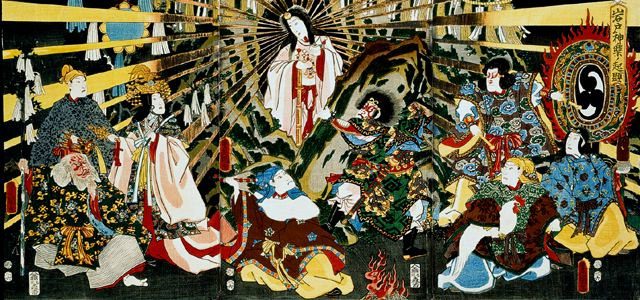
Amaterasu Ōmikami, depicted in a key legend in which she emerges from a cave Public domain / Wikimedia Commons

The second reason why it’s strange for Geshi to pass relatively unmarked is that Shinto is very much a solar religion. The most important kami (deity) in the Shinto pantheon is usually recognised as Amaterasu Ōmikami, the Sun Goddess. She is traditionally considered the ancestor of the Japanese people (and, for many international Shintoists like myself, all people) and her main place of worship, Ise Grand Shrine, is perhaps Shinto’s most sacred site. The Sun is featured on the flag of Japan, and even the word for Japan in Japanese, Nihon or Nippon, literally means “Origin of the Sun.”
Considering how important the Sun is in Japanese culture, it seems odd that the Summer Solstice, the Sun’s longest day in the sky, is barely paid any attention in Shinto. The reason could be similar to why Japan doesn’t celebrate Easter, despite embracing other Western festivals like Christmas and Halloween: just as spring in Japan is already rather full of festivals, leaving little room for Easter, it may that be the Summer Solstice is eclipsed by the popularity of the huge number of other summer festivals, including the Tanabata “Star Festival” and Obon, the festival of the dead.
But that’s not to say that the Summer Solstice is entirely ignored in Japan. There is one spot in particular where it is celebrated – and that spot is not too far from Ise Grand Shrine. What’s particularly interesting about this spot for Neopagans is its similarities with Stonehenge, a site that also has strong Solstice connections.
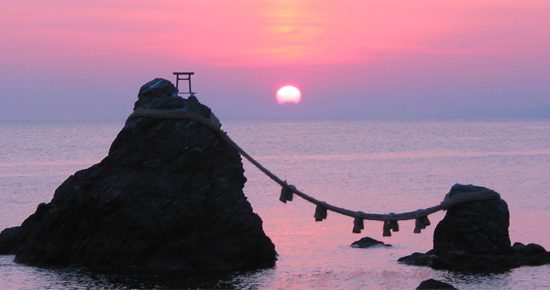
The Meoto Iwa rocks at dawn on Summer Solstice. By Tawashi2006 via Wikimedia Commons

The Meoto Iwa (“Married Couple Rocks”) are two giant rock stacks on the sea shore of Futami, Ise. The larger rock, measuring 30 x 131ft, is known as o-iwa (“male rock”), and the smaller one is called me-iwa (“female rock”). Unlike Stonehenge, these rocks are natural formations. But like Stonehenge, they have deep spiritual significance. They are linked by a huge shimenawa straw rope (which weighs over a ton and has to be replaced several times a year) and o-iwa is topped with a torii gate. Both of these things represent that the Meoto Iwa belong to the world of kami. Linked together in this way, o-iwa and me-iwa symbolise the primordial couple Izanagi and Izanami, the kami who gave birth to the land and other important deities, including Amaterasu.
It is at Summer Solstice that we can see the link between Meoto Iwa and Amaterasu. Around this time, the Sun appears to rise right between o-iwa and me-iwa, as shown in the photograph above. It is as if the Sun Goddess is born from the ocean surrounding the rocks – just as Amaterasu was born from the left eye of Izanagi when he purified himself in the sea after visiting the underworld.
The Meoto Iwa have been venerated in Japan for centuries; one print depicting the rocks bound by a shimenawa dates to the 14th century. It was perhaps this natural alignment with the rising sun at the Summer Solstice that caught the attention of ancient Japanese and inspired them to worship the site, just as the prehistoric Britons constructed Stonehenge in alignment with the Summer Solstice sunrise. And just like Stonehenge, the Meoto Iwa are the site of rituals at Summer Solstice even today. At daybreak, hundreds of pilgrims enter the ocean as the sun rises between the rocks in a ceremony called Geshisai – literally, “Summer Solstice Rite.” Participants of this ceremony are re-enacting the story of Izanagi’s purification, washing away all spiritual stains, imperfections and regrets they may have. You can read accounts with some wonderful photos of the ceremony at Green Shinto here and here.
It is really inspiring to think that, a few hours before the thousands of Neopagans and other pilgrims gather at Stonehenge and other sacred sites all over the world to celebrate the rising Sun on June 20th, hundreds of Shintoists will also greet the Sun before the great rocks of Meoto Iwa. It reminds me that despite our differences in race, culture and religion, we are all truly children of the Sun, that same Sun that rises and sets over every nation, and gives light, warmth and life to all peoples and all creatures of Earth.
References and further reading
Joseph Cali, Shinto Shrines of Japan: The Blog Guide, “Futami Okitama Jinja”
John Dougill, Green Shinto, “Happy summer solstice,” “Summer solstive”
Only Native Japan, “The sunrise on “geshi”, the summer solstice, worshipped at a purification ritual”
Wikimedia Commons, “Meoto Iwa,”
Previous Post
June 12, 2016
A Shinto Prayer for Beginners
Next Post
June 19, 2016 “Choosing” Gods Verses “Being Chosen”
Browse Our Archives
Select a Category Art, Craft & Expression Musings & Miscellaneous Nature & Science News & Reviews Ritual & Festivals Secularism, Politics & Human Rights Shinto & Japanese Religion Uncategorized
Select a Month August 2023 July 2023 June 2023 May 2023 April 2023 March 2023 February 2023 January 2023 December 2022 November 2022 October 2022 September 2022 August 2022 July 2022 June 2022 May 2022 April 2022 March 2022 February 2022 January 2022 December 2021 November 2021 October 2021 September 2021 August 2021 July 2021 June 2021 May 2021 April 2021 March 2021 February 2021 January 2021 December 2020 November 2020 October 2020 September 2020 August 2020 July 2020 June 2020 May 2020 April 2020 March 2020 February 2020 January 2020 December 2019 November 2019 October 2019 September 2019 August 2019 July 2019 June 2019 May 2019 April 2019 March 2019 February 2019 January 2019 December 2018 November 2018 October 2018 September 2018 August 2018 July 2018 June 2018 May 2018 April 2018 March 2018 February 2018 January 2018 December 2017 August 2017 July 2017 June 2017 May 2017 April 2017 March 2017 February 2017 January 2017 December 2016 November 2016 October 2016 September 2016 August 2016 July 2016 June 2016 May 2016 April 2016 March 2016 February 2016 January 2016
Follow Us!
TAKE THE
Religious Wisdom Quiz
What was the primary economic system in Biblical times?
Select your answer to see how you score.
Barter Taxation Silver coins Gold standard
Related posts from Pagan Tama

Three reasons why Pagans should support equality for...

Holy Well Pilgrimage: The Hidden Wells of St...
Holy Well Pilgrimage: The Mysterious Face Of St...
Protest Plans To Demolish 'Ghibli' Shinto Shrine To...
TRENDING AT PATHEOS Pagan

To help with the upcoming holiday season, I'm introducing the Holiday Helper...

10 years of the Power Sigil & Moving...
Last week while reorganizing my studio space, I found the sketchbook that...

Why are younger seekers drawn to Paganism and...
One of the things I've noticed the most is that I'm far...

When we talk about Greek religion, we often begin with the dodekatheion—the...

I was recently chatting with someone on Instagram. She asked me what...

On July 23, I saw Christopher Nolan's The Odyssey which is Homer’s...
view all Pagan blogs
Ad-Free & Subscriber Log-In Subscription Support
- About Us
- 2026 Calendar
- Videos
- Podcasts
- Library of World Religions
- Faith In Media Tracker
- Advertise With Us
- Write for Us
- Privacy Policy
- Terms of Service
- Do Not Sell My Data
- Contact Us
- Radiant Digital
- Manage Newsletter Subscriptions
- Unsubscribe From Notifications
- Sitemap
Copyright 2008-2026, Patheos, part of the Radiant Digital network of media brands. All rights reserved.
Subscription Support Ad-Free & Subscriber Log-In
Follow Patheos