
BuddhistCatholicContemplativeEvangelicalGeneral ChristianHinduJewishLatter-day SaintMuslimNew VisionsProgressive Christian
Beliefs
- Buddhist
- Catholic
- Contemplative
- Evangelical
- General Christian
- Hindu
- Jewish
- Latter-day Saint
- More Voices
- Muslim
- New Visions
- Pagan
- Progressive Christian
Topics
- Religion News
- Food and Religion
- Sports and Religion
- Religious Art
- Religious Music and Entertainment
- Religious Events
- History and Religion
- Style and Religion
- Politics and Religion
- Women in Religion
- Recreation Outdoors and Religion
- Business Finance and Religion
- Careers Workplace and Religion
- Education and Religion
- Family Parenting and Religion
- Health Fitness and Religion
- Home and Religion
- Relationships and Religion
- Technology and Religion
- Travel and Religion
Columnists
- Buddhist Columnists
- Business Finance and Religion Columnists
- Careers Workplace and Religion Columnists
- Catholic Columnists
- Contemplative Columnists
- Education and Religion Columnists
- Evangelists Columnists
- Family Parenting and Religion Columnists
- General Christian Columnists
- Health Fitness and Religion Columnists
- Hindu Columnists
- History and Religion Columnists
- Home and Religion Columnists
- Jewish Columnists
- More Voices Columnists
- Latter Day Columnists
- Muslim Columnists
- New Visions Columnists
- Nonreligious Columnists
- Pagan Columnists
- Politics and Religion Columnists
- Progressive Columnists
- Recreation Outdoors and Religion Columnists
- Relationships and Religion Columnists
- Religion News Columnists
- Religious Art Columnists
- Religious Events Columnists
- Religious Music and Entertainment Columnists
- Sports and Religion Columnists
- Style and Religion Columnists
- Technology and Religion Columnists
- Travel and Religion Columnists
- Women in Religion Columnists
Resource Library
- 2026 Calendar
- Library of World Religions
- The 100 Most Holy Places on Earth
- Patheos Answers
- Podcasts
- Videos
- Faith Leaders Database
- Anglican Episcopalian
- Bahai
- Baptist
- Buddhism
- Christianity
- Confucianism
- Eastern Orthodoxy
- Hinduism
- Holiness and Pentecostal
- ISKCON
- Islam
- Judaism
- Lutheran
- Methodist
- The Church of Jesus Christ of Latter-day Saints
- New Age
- Paganism
- Presbytarian and Reformed
- Protestantism
- Religion Behind the Scenes
- Roman Catholic
- Scientology
- Shia Islam
- Sikhism
- Sufism
- Sunni Islam
- Taoism
- Zen
- See all religions
Research Tools
 Ad-Free & Subscriber Log-In Subscription Support
Ad-Free & Subscriber Log-In Subscription Support
Follow Patheos 

- Trending:
- Forgiveness
- |
- Marriage
- |
- Consciousness
- |
- Death Penalty
- |
- Election
- |
- Halloween
 Pagan Tama
- Home
- Pagan
- Is Shinto Truly a Religion for All?
Is Shinto Truly a Religion for All?
Last updated on: March 25, 2018 at 10:20 am by Megan Manson
Is Shinto Truly a Religion for All? 2018-03-25T10:20:55+00:00 Megan Manson
Patheos Explore the world's faith through different perspectives on religion and spirituality! Patheos has the views of the prevalent religions and spiritualities of the world.
In Japan’s Mie prefecture, there exists an enigmatic shrine. It is visited by 8.5 million pilgrims and sightseers every year, but its central building is hidden from the public. It was established over 2,000 years ago, yet its main structures are never any older than 20 years. It is perhaps the most sacred Shinto site of all, yet is currently surrounded by controversy. Welcome to Ise Jingu, also known as Ise Grand Shrine, where the G7 summit is currently taking place.
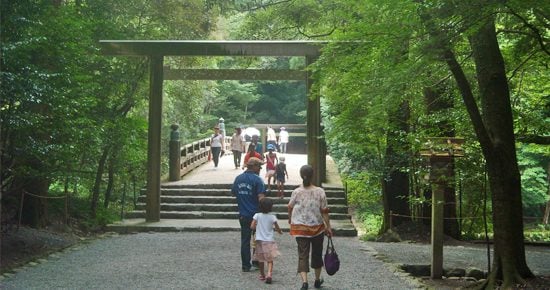
Visitors pass under a torii at Ise jingu. By author.
The Heart of Japanese Spirituality
There are two unique features of the Ise Jingu shrine complex that make it so significant. The first feature is the rite of Shikinen Sengū in which every 20 years, the main Naikū and Gekū shrines, together with the 100 metre long Uji bridge, are demolished and re-built again, representing Shinto’s emphasis on renewal and the cycle of life. Shikinen Sengū also has the practical purpose of ensuring the techniques of building the shrine are not forgotten by passing them from one generation to the next.
Secondly, Ise Jingu is believed to house one of the Three Sacred Treasures of Japan: A mirror said to have been brought to Earth by the ancestral kami (deity) of the imperial family. According to Shinto mythology, this mirror (called Yata no Kagami) was used to lure the sun goddess Amaterasu Ōmikami from the cave where she was hiding from the storm god. Ise Jingu is therefore primarily dedicated to Amaterasu, who is arguably the most important kami in the Shinto pantheon.
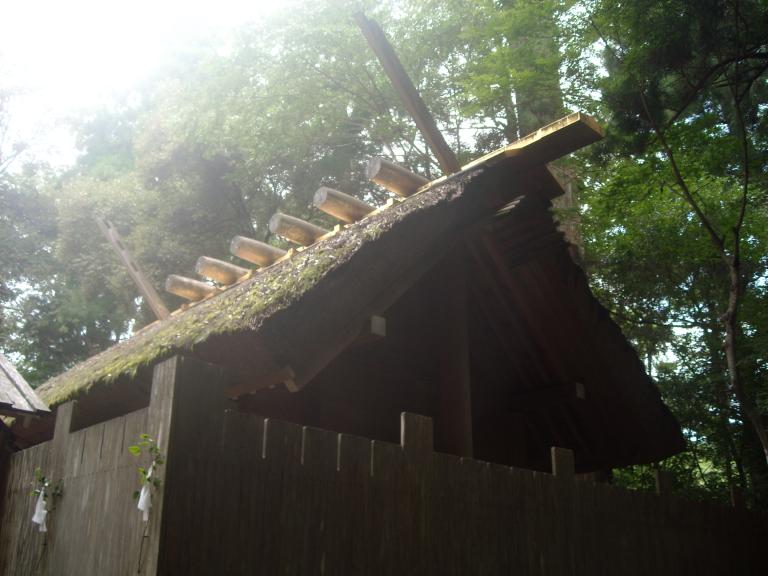
One of the main shrine buildings, hidden from view by a fence. By author.
Knowing that Ise Jingu is such an important piece of Japanese religion, history and architecture, I made a point of visiting there. I have to admit that while it was a very worthwhile pilgrimage, I found myself a little disappointed. My favourite sacred places in Japan, such as Fushimi Inari Taisha (the main shrine to my patron deity Inari Ōkami), are wild and wonderful sanctuaries, set deep in mountain forests and filled with lots of little shrines, old moss-covered stoneware and offerings of candles and statues by pilgrims. But Ise Jingu was quite different. To me, everything felt very neat, precise, austere and somewhat unnatural. What’s more, I couldn’t even see the most important structures like Kotaijingu where the mirror is kept; such buildings are considered so sacred that they are kept hidden from the profane eyes of common folk by high fences.
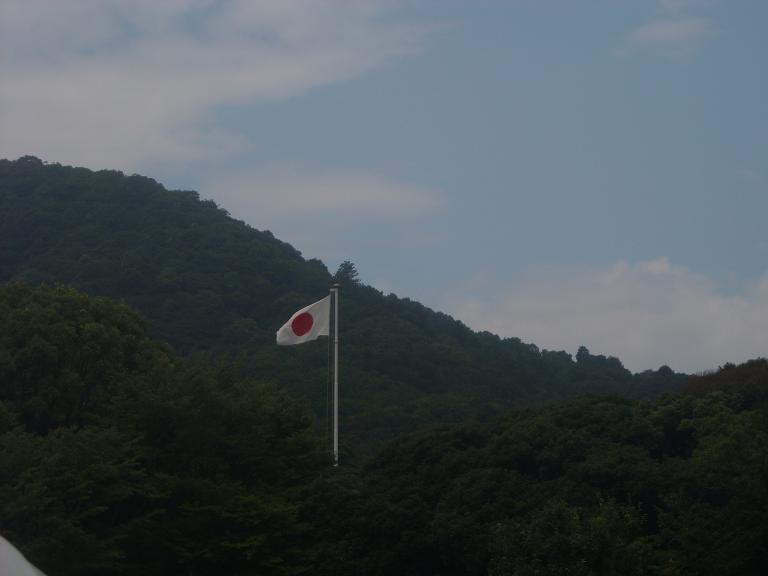
Japanese flag flying at Ise Jingu. By author.
It also struck me how much patriotism surrounds Ise Jingu. As I crossed the Uji bridge, I saw an enormous Japanese flag flying over the treetops. This does make sense; not only is Ise Jingu at the heart of Japan’s cultural heritage due to its links with the Imperial family, but the flag itself represents the Sun, Amaterasu herself.
Too Japanese?
It is this link with patriotism, and some would say nationalism, that has made some people uncomfortable recently. The presence of the shrine is precisely why the Japanese government selected Ise-shima as the site for the G7 summit and as a recent Guardian article highlights, this choice of location has attracted criticism:
“Abe and most members of his cabinet are members of the Shinto Seiji Renmei (Shinto Association of Spiritual Leadership), an influential lobbying group that counts more than 300 MPs among its members. The association has called for the removal of pacifist elements from Japan’s US-authored constitution – a key Abe policy goal – increased reverence for the emperor, and a state-sponsored ceremony to honour Japan’s war dead at Yasukuni, a controversial war shrine in Tokyo.”
– Justin McCurry, “G7 in Japan: concern over world leaders’ tour of nationalistic shrine,” The Guardian, 25th May 2016
Sophia University politics professor Koichi Nakano goes even further to condemn the Shinto religion itself as a kind of tribal ideology:
“Shinto is not a universal religion, and it’s inherently nationalistic. I already felt rather uncomfortable when Barack Obama was taken to Meiji Shrine last time he visited Japan, and it would be no less disturbing to see the G7 leaders being used to legitimise Shinto, given its reactionary and nationalistic positions on so many issues.”
– Koichi Nakano, quoted in “G7 in Japan: concern over world leaders’ tour of nationalistic shrine,”The Guardian, 25th May 2016
If Shinto cannot be universal religion, as Nakano claims, this is quite a blow for non-Japanese like me who follow it. But is it actually true that Shinto is not a form spirituality that can be practised by anyone regardless of race or nationality?
Secularism, Politics & Human Rights
Previous Post

May 25, 2016
Tokonoma – Japan’s “Secular Altars”
Next Post

May 30, 2016 Pagan, Shinto & Spiritual Book Reviews May 2016
Browse Our Archives
Select a Category Art, Craft & Expression Musings & Miscellaneous Nature & Science News & Reviews Ritual & Festivals Secularism, Politics & Human Rights Shinto & Japanese Religion Uncategorized
Select a Month August 2023 July 2023 June 2023 May 2023 April 2023 March 2023 February 2023 January 2023 December 2022 November 2022 October 2022 September 2022 August 2022 July 2022 June 2022 May 2022 April 2022 March 2022 February 2022 January 2022 December 2021 November 2021 October 2021 September 2021 August 2021 July 2021 June 2021 May 2021 April 2021 March 2021 February 2021 January 2021 December 2020 November 2020 October 2020 September 2020 August 2020 July 2020 June 2020 May 2020 April 2020 March 2020 February 2020 January 2020 December 2019 November 2019 October 2019 September 2019 August 2019 July 2019 June 2019 May 2019 April 2019 March 2019 February 2019 January 2019 December 2018 November 2018 October 2018 September 2018 August 2018 July 2018 June 2018 May 2018 April 2018 March 2018 February 2018 January 2018 December 2017 August 2017 July 2017 June 2017 May 2017 April 2017 March 2017 February 2017 January 2017 December 2016 November 2016 October 2016 September 2016 August 2016 July 2016 June 2016 May 2016 April 2016 March 2016 February 2016 January 2016
Follow Us!
TAKE THE
Religious Wisdom Quiz
What was the name of the man who suffered great loss but remained faithful to God?
Select your answer to see how you score.
Noah Job Elijah Abraham
Related posts from Pagan Tama

Three reasons why Pagans should support equality for...

Holy Well Pilgrimage: The Hidden Wells of St...

Holy Well Pilgrimage: The Mysterious Face Of St...
Protest Plans To Demolish 'Ghibli' Shinto Shrine To...
TRENDING AT PATHEOS Pagan

When we talk about Greek religion, we often begin with the dodekatheion—the...

I was recently chatting with someone on Instagram. She asked me what...

While there are many people who share their results, the end of...

On July 23, I saw Christopher Nolan's The Odyssey which is Homer’s...

As I write this two big events have just finished up. One...

Restoring the Watershed of Divine Love
Perhaps cooperation is not something we manufacture through legislation, ideology, or moral...
view all Pagan blogs
Ad-Free & Subscriber Log-In Subscription Support
- About Us
- 2026 Calendar
- Videos
- Podcasts
- Library of World Religions
- Faith In Media Tracker
- Advertise With Us
- Write for Us
- Privacy Policy
- Terms of Service
- Do Not Sell My Data
- Contact Us
- Radiant Digital
- Manage Newsletter Subscriptions
- Unsubscribe From Notifications
- Sitemap
Copyright 2008-2026, Patheos. All rights reserved.
Subscription Support Ad-Free & Subscriber Log-In
Follow Patheos