
BuddhistCatholicContemplativeEvangelicalGeneral ChristianHinduJewishLatter-day SaintMuslimNew VisionsProgressive Christian
Beliefs
- Buddhist
- Catholic
- Contemplative
- Evangelical
- General Christian
- Hindu
- Jewish
- Latter-day Saint
- More Voices
- Muslim
- New Visions
- Pagan
- Progressive Christian
Topics
- Religion News
- Food and Religion
- Sports and Religion
- Religious Art
- Religious Music and Entertainment
- Religious Events
- History and Religion
- Style and Religion
- Politics and Religion
- Women in Religion
- Recreation Outdoors and Religion
- Business Finance and Religion
- Careers Workplace and Religion
- Education and Religion
- Family Parenting and Religion
- Health Fitness and Religion
- Home and Religion
- Relationships and Religion
- Technology and Religion
- Travel and Religion
Columnists
- Buddhist Columnists
- Business Finance and Religion Columnists
- Careers Workplace and Religion Columnists
- Catholic Columnists
- Contemplative Columnists
- Education and Religion Columnists
- Evangelists Columnists
- Family Parenting and Religion Columnists
- General Christian Columnists
- Health Fitness and Religion Columnists
- Hindu Columnists
- History and Religion Columnists
- Home and Religion Columnists
- Jewish Columnists
- More Voices Columnists
- Latter Day Columnists
- Muslim Columnists
- New Visions Columnists
- Nonreligious Columnists
- Pagan Columnists
- Politics and Religion Columnists
- Progressive Columnists
- Recreation Outdoors and Religion Columnists
- Relationships and Religion Columnists
- Religion News Columnists
- Religious Art Columnists
- Religious Events Columnists
- Religious Music and Entertainment Columnists
- Sports and Religion Columnists
- Style and Religion Columnists
- Technology and Religion Columnists
- Travel and Religion Columnists
- Women in Religion Columnists
Resource Library
- 2026 Calendar
- Library of World Religions
- The 100 Most Holy Places on Earth
- Patheos Answers
- Podcasts
- Videos
- Faith Leaders Database
- Anglican Episcopalian
- Bahai
- Baptist
- Buddhism
- Christianity
- Confucianism
- Eastern Orthodoxy
- Hinduism
- Holiness and Pentecostal
- ISKCON
- Islam
- Judaism
- Lutheran
- Methodist
- The Church of Jesus Christ of Latter-day Saints
- New Age
- Paganism
- Presbytarian and Reformed
- Protestantism
- Religion Behind the Scenes
- Roman Catholic
- Scientology
- Shia Islam
- Sikhism
- Sufism
- Sunni Islam
- Taoism
- Zen
- See all religions
Research Tools
 Ad-Free & Subscriber Log-In Subscription Support
Ad-Free & Subscriber Log-In Subscription Support
Follow Patheos 

- Trending:
- Forgiveness
- |
- Marriage
- |
- Consciousness
- |
- Death Penalty
- |
- Election
- |
- Halloween
 Pagan Tama
- Home
- Pagan
- Inari, Japan’s “Fox God”
Inari, Japan’s “Fox God”
Last updated on: August 29, 2016 at 10:22 am by Megan Manson
Inari, Japan’s “Fox God” 2016-08-29T10:22:49+00:00 Megan Manson
Patheos Explore the world's faith through different perspectives on religion and spirituality! Patheos has the views of the prevalent religions and spiritualities of the world.
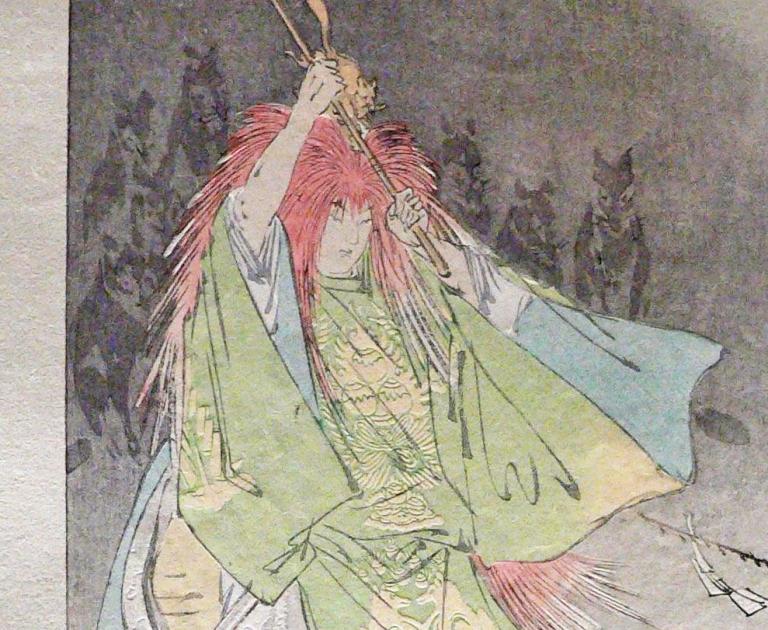
Inari depicted as a man surrounded by shadowy foxes. From a 10th woodcut Ogata Gekkō. Public domain via Wikimedia Commons
3. Inari is not actually a fox. Probably.
Although the fox (especially a white fox) is one of the most common images associated with Inari, Shinto priests are usually keen to stress that Inari is not actually a fox. Foxes should be considered Inari’s messengers, rather than Inari Herself. Why Inari is closely associated with foxes is not clear, but my favourite theory is that it is because foxes would have been a welcome sight for rice farmers of old, as they would have kept pests like mice away from the fields. Foxes would have been seen as defenders of the sacred and life-giving grain, and therefore sacred beings themselves.
So how is Inari depicted? In art or in descriptions of visions and dreams in which He appears, Inari has been perceived as an old man, a young woman similar to the Buddhist deity Dakiniten (with whom Inari is often identified), a dragon, a snake, or even something as abstract as a flaming jewel. But despite all this, the fox remains Inari’s most enduring symbol, and the image that most people in Japan have in their mind when they hear the word “Inari.” It could be that priests discourage the idea that Inari is a fox because foxes usually have a negative image in modern Japan, where they are considered sinister tricksters and shape-shifters that bring misfortune and madness. I have to admit that I myself am fond of foxes, and when I prayer to Inari, I find myself visualising a white fox more than any other image.
Previous Post

January 31, 2016
When Hitler Stole Our Symbols
Next Post

February 3, 2016 Year of the Monkey
Browse Our Archives
Select a Category Art, Craft & Expression Musings & Miscellaneous Nature & Science News & Reviews Ritual & Festivals Secularism, Politics & Human Rights Shinto & Japanese Religion Uncategorized
Select a Month August 2023 July 2023 June 2023 May 2023 April 2023 March 2023 February 2023 January 2023 December 2022 November 2022 October 2022 September 2022 August 2022 July 2022 June 2022 May 2022 April 2022 March 2022 February 2022 January 2022 December 2021 November 2021 October 2021 September 2021 August 2021 July 2021 June 2021 May 2021 April 2021 March 2021 February 2021 January 2021 December 2020 November 2020 October 2020 September 2020 August 2020 July 2020 June 2020 May 2020 April 2020 March 2020 February 2020 January 2020 December 2019 November 2019 October 2019 September 2019 August 2019 July 2019 June 2019 May 2019 April 2019 March 2019 February 2019 January 2019 December 2018 November 2018 October 2018 September 2018 August 2018 July 2018 June 2018 May 2018 April 2018 March 2018 February 2018 January 2018 December 2017 August 2017 July 2017 June 2017 May 2017 April 2017 March 2017 February 2017 January 2017 December 2016 November 2016 October 2016 September 2016 August 2016 July 2016 June 2016 May 2016 April 2016 March 2016 February 2016 January 2016
Follow Us!
TAKE THE
Religious Wisdom Quiz
In 2 Timothy, what did Paul leave with Carpus at Troas?
Select your answer to see how you score.
His cloak and scrolls His letters His tent-making tools His money
Related posts from Pagan Tama

Three reasons why Pagans should support equality for...

Holy Well Pilgrimage: The Hidden Wells of St...

Holy Well Pilgrimage: The Mysterious Face Of St...

Protest Plans To Demolish 'Ghibli' Shinto Shrine To...
TRENDING AT PATHEOS Pagan

When we talk about Greek religion, we often begin with the dodekatheion—the...

I was recently chatting with someone on Instagram. She asked me what...

While there are many people who share their results, the end of...

On July 23, I saw Christopher Nolan's The Odyssey which is Homer’s...

As I write this two big events have just finished up. One...

Restoring the Watershed of Divine Love
Perhaps cooperation is not something we manufacture through legislation, ideology, or moral...
view all Pagan blogs
Ad-Free & Subscriber Log-In Subscription Support
- About Us
- 2026 Calendar
- Videos
- Podcasts
- Library of World Religions
- Faith In Media Tracker
- Advertise With Us
- Write for Us
- Privacy Policy
- Terms of Service
- Do Not Sell My Data
- Contact Us
- Radiant Digital
- Manage Newsletter Subscriptions
- Unsubscribe From Notifications
- Sitemap
Copyright 2008-2026, Patheos. All rights reserved.
Subscription Support Ad-Free & Subscriber Log-In
Follow Patheos