
BuddhistCatholicContemplativeEvangelicalGeneral ChristianHinduJewishLatter-day SaintMuslimNew VisionsProgressive Christian
Beliefs
- Buddhist
- Catholic
- Contemplative
- Evangelical
- General Christian
- Hindu
- Jewish
- Latter-day Saint
- More Voices
- Muslim
- New Visions
- Pagan
- Progressive Christian
Topics
- Religion News
- Food and Religion
- Sports and Religion
- Religious Art
- Religious Music and Entertainment
- Religious Events
- History and Religion
- Style and Religion
- Politics and Religion
- Women in Religion
- Recreation Outdoors and Religion
- Business Finance and Religion
- Careers Workplace and Religion
- Education and Religion
- Family Parenting and Religion
- Health Fitness and Religion
- Home and Religion
- Relationships and Religion
- Technology and Religion
- Travel and Religion
Columnists
- Buddhist Columnists
- Business Finance and Religion Columnists
- Careers Workplace and Religion Columnists
- Catholic Columnists
- Contemplative Columnists
- Education and Religion Columnists
- Evangelists Columnists
- Family Parenting and Religion Columnists
- General Christian Columnists
- Health Fitness and Religion Columnists
- Hindu Columnists
- History and Religion Columnists
- Home and Religion Columnists
- Jewish Columnists
- More Voices Columnists
- Latter Day Columnists
- Muslim Columnists
- New Visions Columnists
- Nonreligious Columnists
- Pagan Columnists
- Politics and Religion Columnists
- Progressive Columnists
- Recreation Outdoors and Religion Columnists
- Relationships and Religion Columnists
- Religion News Columnists
- Religious Art Columnists
- Religious Events Columnists
- Religious Music and Entertainment Columnists
- Sports and Religion Columnists
- Style and Religion Columnists
- Technology and Religion Columnists
- Travel and Religion Columnists
- Women in Religion Columnists
Resource Library
- 2026 Calendar
- Library of World Religions
- The 100 Most Holy Places on Earth
- Patheos Answers
- Podcasts
- Videos
- Faith Leaders Database
- Anglican Episcopalian
- Bahai
- Baptist
- Buddhism
- Christianity
- Confucianism
- Eastern Orthodoxy
- Hinduism
- Holiness and Pentecostal
- ISKCON
- Islam
- Judaism
- Lutheran
- Methodist
- The Church of Jesus Christ of Latter-day Saints
- New Age
- Paganism
- Presbytarian and Reformed
- Protestantism
- Religion Behind the Scenes
- Roman Catholic
- Scientology
- Shia Islam
- Sikhism
- Sufism
- Sunni Islam
- Taoism
- Zen
- See all religions
Research Tools
 Ad-Free & Subscriber Log-In Subscription Support
Ad-Free & Subscriber Log-In Subscription Support
Follow Patheos 

- Trending:
- Forgiveness
- |
- Marriage
- |
- Consciousness
- |
- Death Penalty
- |
- Election
- |
- Halloween
 Pagan Tama
- Home
- Pagan
- When Hitler Stole Our Symbols
When Hitler Stole Our Symbols
Last updated on: March 25, 2018 at 10:22 am by Megan Manson
When Hitler Stole Our Symbols 2018-03-25T10:22:22+00:00 Megan Manson
Patheos Explore the world's faith through different perspectives on religion and spirituality! Patheos has the views of the prevalent religions and spiritualities of the world.
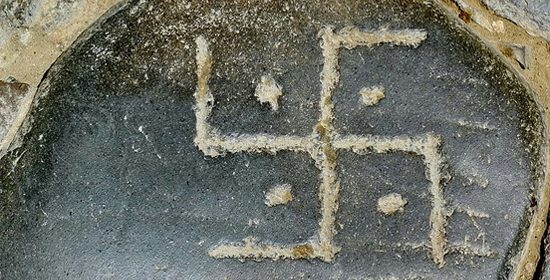
Hindu/Buddhist swastika motif © Michel Royon / Wikimedia Commons
Japan has been busy preparing itself for an influx of overseas visitors as its 2020 Olympic games draw closer. As part of the process, Japanese tourist authorities have been re-examining the standard icons it uses on maps, and proposing replacements to make the symbols more understandable for tourists. One of the icons lined up for reform is the manji, a symbol used to denote Buddhist temples, and more commonly known in the West as the swastika.
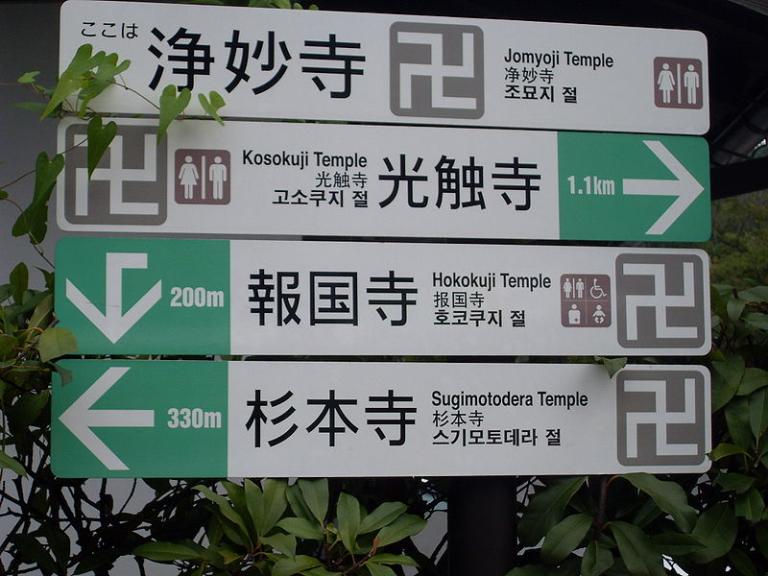
Manji (swastika) used on Japanese signpost to signify Buddhist temples. Public domain/Wikipedia Commons
One can understand why the manji is under scrutiny in this project. The fact is, the majority of Westerners associate this symbol with Nazism and related far-right groups. For first-time tourists to Japan, it can be a bit of a shock to see this symbol all over maps and signs, and most visitors from countries outside Asia are unlikely to realise that it is a standard symbol for Buddhism. It seems natural therefore, as part of a wider project to overhaul all Japanese map icons whose meanings are not immediately obvious to tourists, to consider replacing the manji with a stylised pagoda, whose meaning is perhaps a little clearer to non-Asians. When you consider some of the other changes proposed, such as changing the symbol for a post office from 〒 (a stylised form of the character テ, “te”, standing for teishin or “communications”) to one of an envelope, changing the manji to a pagoda seems reasonable.
Yet the proposal to scrap the manji is not without controversy. Makoto Watanabe of Hokkaido Bunkyo University states in a recent Telegraph interview,
“We have been using this symbol for thousands of years before it was incorporated into the Nazi flag, so I believe it would be better for us to keep it on our maps and ask others to understand its true meaning…I think it would serve a good purpose if people from abroad see the symbol, ask what it means and where it originated. That might help to get rid of some of the negative impressions associated with the ‘manji.'”
He’s not the only one protesting the proposal. Members of the UFO religion Raëlism have also voiced their opposition. It should be noted that the Raëlians also changed their symbol, which was originally a Star of David interlocked with a swastika, to one without a swastika in 1991 due to public protest (Raëlians reverted to using the old swastika symbol again in 2007). Their reasoning is that the swastika has been used for thousands of years in Asia, as well as in Europe, as a sacred symbol of fortune and peace, and that employing the swastika in the context of its original meaning helps to erase the Nazi stigma.
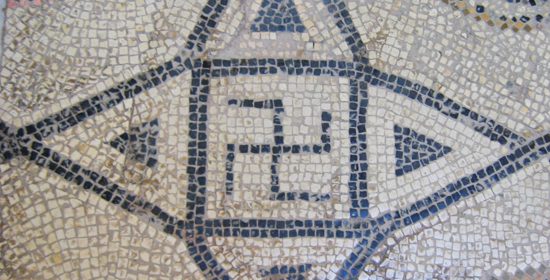
2nd Century Roman mosaic / Wikimedia Commons
All of these opponents of the proposal to replace the manji icon have a very good point. Hitler and other extremist politicians have appropriated ancient, sacred folk symbols because they knew that these images evoke strong feelings, particularly those associated with cultural identity. By using these symbols, fascists could portray themselves as defenders of the people’s cultural and spiritual heritage. Essentially, they stole folk symbols and twisted them into emblems of hate and suffering for their own purposes. The swastika is a classic example. It can be found in ancient Greco-Roman, Celtic, Germanic and Slavic art and architecture, where it is believed to symbolise the Sun. In Germanic art, it may also symbolise Thor’s hammer. Other wheel-shaped Pagan symbols, including the triskelion and Brigid’s Cross, probably derive from the swastika. Being so ancient and widespread, the swastika would have originally evoked a sense of nostalgia and tribal identity – and the Nazis capitalised on this. They succeeded, too: Westerners now find it very difficult to use the swastika openly as a religious symbol, because it is too closely associated with the evils of fascism, white supremacy and genocide. I find it bitterly ironic that far-right groups, who usually claim to be defending “indigenous” traditions and culture by ridding their country from the influence of foreigners and minorities, actually do far more damage to their culture than these “outsiders” ever will by perverting their culture’s age-old symbols.
Secularism, Politics & Human Rights
Previous Post

January 28, 2016
Setsubun - "Japan's Imbolc"
Next Post

February 1, 2016 Inari, Japan's "Fox God"
Browse Our Archives
Select a Category Art, Craft & Expression Musings & Miscellaneous Nature & Science News & Reviews Ritual & Festivals Secularism, Politics & Human Rights Shinto & Japanese Religion Uncategorized
Select a Month August 2023 July 2023 June 2023 May 2023 April 2023 March 2023 February 2023 January 2023 December 2022 November 2022 October 2022 September 2022 August 2022 July 2022 June 2022 May 2022 April 2022 March 2022 February 2022 January 2022 December 2021 November 2021 October 2021 September 2021 August 2021 July 2021 June 2021 May 2021 April 2021 March 2021 February 2021 January 2021 December 2020 November 2020 October 2020 September 2020 August 2020 July 2020 June 2020 May 2020 April 2020 March 2020 February 2020 January 2020 December 2019 November 2019 October 2019 September 2019 August 2019 July 2019 June 2019 May 2019 April 2019 March 2019 February 2019 January 2019 December 2018 November 2018 October 2018 September 2018 August 2018 July 2018 June 2018 May 2018 April 2018 March 2018 February 2018 January 2018 December 2017 August 2017 July 2017 June 2017 May 2017 April 2017 March 2017 February 2017 January 2017 December 2016 November 2016 October 2016 September 2016 August 2016 July 2016 June 2016 May 2016 April 2016 March 2016 February 2016 January 2016
Follow Us!
TAKE THE
Religious Wisdom Quiz
True or False: Romans teaches that we are justified by works of the law.
Select your answer to see how you score.
TRUE FALSE
Related posts from Pagan Tama

Three reasons why Pagans should support equality for...

Holy Well Pilgrimage: The Hidden Wells of St...

Holy Well Pilgrimage: The Mysterious Face Of St...

Protest Plans To Demolish 'Ghibli' Shinto Shrine To...
TRENDING AT PATHEOS Pagan

I was recently chatting with someone on Instagram. She asked me what...

While there are many people who share their results, the end of...

On July 23, I saw Christopher Nolan's The Odyssey which is Homer’s...

As I write this two big events have just finished up. One...

Restoring the Watershed of Divine Love
Perhaps cooperation is not something we manufacture through legislation, ideology, or moral...

Many UUs don’t pray because of bad experiences in a previous religion,...
view all Pagan blogs
Ad-Free & Subscriber Log-In Subscription Support
- About Us
- 2026 Calendar
- Videos
- Podcasts
- Library of World Religions
- Faith In Media Tracker
- Advertise With Us
- Write for Us
- Privacy Policy
- Terms of Service
- Do Not Sell My Data
- Contact Us
- Radiant Digital
- Manage Newsletter Subscriptions
- Unsubscribe From Notifications
- Sitemap
Copyright 2008-2026, Patheos. All rights reserved.
Subscription Support Ad-Free & Subscriber Log-In
Follow Patheos