
BuddhistCatholicContemplativeEvangelicalGeneral ChristianHinduJewishLatter-day SaintMuslimNew VisionsProgressive Christian
Beliefs
- Buddhist
- Catholic
- Contemplative
- Evangelical
- General Christian
- Hindu
- Jewish
- Latter-day Saint
- More Voices
- Muslim
- New Visions
- Pagan
- Progressive Christian
Topics
- Religion News
- Food and Religion
- Sports and Religion
- Religious Art
- Religious Music and Entertainment
- Religious Events
- History and Religion
- Style and Religion
- Politics and Religion
- Women in Religion
- Recreation Outdoors and Religion
- Business Finance and Religion
- Careers Workplace and Religion
- Education and Religion
- Family Parenting and Religion
- Health Fitness and Religion
- Home and Religion
- Relationships and Religion
- Technology and Religion
- Travel and Religion
Columnists
- Buddhist Columnists
- Business Finance and Religion Columnists
- Careers Workplace and Religion Columnists
- Catholic Columnists
- Contemplative Columnists
- Education and Religion Columnists
- Evangelists Columnists
- Family Parenting and Religion Columnists
- General Christian Columnists
- Health Fitness and Religion Columnists
- Hindu Columnists
- History and Religion Columnists
- Home and Religion Columnists
- Jewish Columnists
- More Voices Columnists
- Latter Day Columnists
- Muslim Columnists
- New Visions Columnists
- Nonreligious Columnists
- Pagan Columnists
- Politics and Religion Columnists
- Progressive Columnists
- Recreation Outdoors and Religion Columnists
- Relationships and Religion Columnists
- Religion News Columnists
- Religious Art Columnists
- Religious Events Columnists
- Religious Music and Entertainment Columnists
- Sports and Religion Columnists
- Style and Religion Columnists
- Technology and Religion Columnists
- Travel and Religion Columnists
- Women in Religion Columnists
Resource Library
- 2026 Calendar
- Library of World Religions
- The 100 Most Holy Places on Earth
- Patheos Answers
- Podcasts
- Videos
- Faith Leaders Database
- Anglican Episcopalian
- Bahai
- Baptist
- Buddhism
- Christianity
- Confucianism
- Eastern Orthodoxy
- Hinduism
- Holiness and Pentecostal
- ISKCON
- Islam
- Judaism
- Lutheran
- Methodist
- The Church of Jesus Christ of Latter-day Saints
- New Age
- Paganism
- Presbytarian and Reformed
- Protestantism
- Religion Behind the Scenes
- Roman Catholic
- Scientology
- Shia Islam
- Sikhism
- Sufism
- Sunni Islam
- Taoism
- Zen
- See all religions
Research Tools
 Ad-Free & Subscriber Log-In Subscription Support
Ad-Free & Subscriber Log-In Subscription Support
Follow Patheos 

- Trending:
- Forgiveness
- |
- Marriage
- |
- Consciousness
- |
- Death Penalty
- |
- Election
- |
- Halloween
 Pagan In Paradise
- Home
- Pagan
- “ON CARE FOR OUR COMMON HOME”, THIS PAGAN IS STUNNED
“ON CARE FOR OUR COMMON HOME”, THIS PAGAN IS STUNNED
Last updated on: June 19, 2015 at 6:16 pm by Peter Dybing
“ON CARE FOR OUR COMMON HOME”, THIS PAGAN IS STUNNED 2015-06-19T18:16:00-06:00 Peter Dybing
Patheos Explore the world's faith through different perspectives on religion and spirituality! Patheos has the views of the prevalent religions and spiritualities of the world.
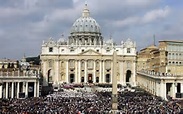
Maybe the word that best describes my reaction upon reading the recent statement from Pope Francis entitled “ON CARE FOR OUR COMMON HOME” is stunned. The statement is laced with the language of progressive social, environmental and economic justice. Reporting on such a profound document and its’ implications upon future inter religious dialogue can at best only scratch the surface of this game changing statement. Let me urge everyone to set aside time to read the entire document:
Upon my first reading I was struck with language that seemed to denounce the long-standing doctrine of the church that has fuled extremist environmental dominionism over our planet. It was this passage that got me to thinking about the profound change in church thinking
“If we approach nature and the environment without this openness to awe and wonder, if we no longer speak the language of fraternity and beauty in our relationship with the world, our attitude will be that of masters, consumers, ruthless exploiters, unable to set limits on their immediate needs.”
Pope Francis further cites the eastern orthodox churches leader in support of his stance:
“Patriarch Bartholomew has spoken in particular of the need for each of us to repent of the ways we have harmed the planet, for “inasmuch as we all generate small ecological damage”, we are called to acknowledge “our contribution, smaller or greater, to the disfigurement and destruction of creation”.[14]He has repeatedly stated this firmly and persuasively, challenging us to acknowledge our sins against creation”
This departure from conservative religious dogma is enough all by itself to convince me of the importance of the document; but there was more to come. Pope Francis goes on to acknowledge how acceleration of change affects us all and coins a term to describe his opinion. In support of his point he goes on to implicitly recognize “biological evolution”, my eyes became very large while reading is:
“The continued acceleration of changes affecting humanity and the planet is coupled today with a more intensified pace of life and work which might be called “rapidification”. Although change is part of the working of complex systems, the speed with which human activity has developed contrasts with the naturally slow pace of biological evolution.
The social dimensions of global change include the effects of technological innovations on employment, social exclusion, an inequitable distribution and consumption of energy and other services, social breakdown, increased violence and a rise in new forms of social aggression, drug trafficking, growing drug use by young people, and the loss of identity. These are signs that the growth of the past two centuries has not always led to an integral development and an improvement in the quality of life. Some of these signs are also symptomatic of real social decline, the silent rupture of the bonds of integration and social cohesion.
As I read further it becames clear that this Pope understands the role that consumerism and unbridled capitalism plays in oppression around the world
“It needs to be said that, generally speaking, there is little in the way of clear awareness of problems which especially affect the excluded. Yet they are the majority of the planet’s population, billions of people. These days, they are mentioned in international political and economic discussions, but one often has the impression that their problems are brought up as an afterthought,
To blame population growth instead of extreme and selective consumerism on the part of some is one way of refusing to face the issues.
Yet it would also be mistaken to view other living beings as mere objects subjected to arbitrary human domination. When nature is viewed solely as a source of profit and gain, this has serious consequences for society. This vision of “might is right” has engendered immense inequality, injustice and acts of violence against the majority of humanity, since resources end up in the hands of the first comer or the most powerful: the winner takes all”
“Just as I begin to think that I have grasped the totality of this statement Pope Francis goes on to embrace cultural sensitivity and denounce the cultural and physical destruction of indigenous cultures. My sense of what the Roman church stands for has been decimated. I am stunned!
A sense of deep communion with the rest of nature cannot be real if our hearts lack tenderness, compassion and concern for our fellow human beings. It is clearly inconsistent to combat trafficking in endangered species while remaining completely indifferent to human trafficking, unconcerned about the poor.
Ecology, then, also involves protecting the cultural treasures of humanity in the broadest sense. More specifically, it calls for greater attention to local cultures when studying environmental problems, favouring a dialogue between scientific-technical language and the language of the people. Culture is more than what we have inherited from the past; it is also, and above all, a living, dynamic and participatory present reality, which cannot be excluded as we rethink the relationship between human beings and the environment.
In this sense, it is essential to show special care for indigenous communities and their cultural traditions. They are not merely one minority among others, but should be the principal dialogue partners, especially when large projects affecting their land are proposed. For them, land is not a commodity but rather a gift from God and from their ancestors who rest there, a sacred space with which they need to interact if they are to maintain their identity and values. When they remain on their land, they themselves care for it best. Nevertheless, in various parts of the world, pressure is being put on them to abandon their homelands to make room for agricultural or mining projects which are undertaken without regard for the degradation of nature and culture.”
In an acknowledgement on the responsibility that western consumer societies have for the damage being done to our collective home he makes a good point about our cultural attachment to consumerism.
In those countries which should be making the greatest changes in consumer habits, young people have a new ecological sensitivity and a generous spirit, and some of them are making admirable efforts to protect the environment. At the same time, they have grown up in a milieu of extreme consumerism and affluence which makes it difficult to develop other habits. We are faced with an educational challenge.
A number of pages are devoted to making his case to Catholics via Christian doctrine and biblical passages. Just as I begin to sense that I have grasped the totality of the statement he adds this description of Mary that is as eloquent an acknowledgment of the divine feminine as I have ever encountered coming from any Christian, much less a Pontiff.
Mary, the Mother who cared for Jesus, now cares with maternal affection and pain for this wounded world. Just as her pierced heart mourned the death of Jesus, so now she grieves for the sufferings of the crucified poor and for the creatures of this world laid waste by human power. Completely transfigured, she now lives with Jesus, and all creatures sing of her fairness. She is the Woman, “clothed in the sun, with the moon under her feet, and on her head a crown of twelve stars
Am I going to run out and become Catholic? Not a chance. There remain wide areas of disagreement that prevent me from fully endorsing the beliefs of the Roman Church. That being said, this is a profound document. When an ancient institution culpable in the worldwide spread of Patriarchy, and environmental and social genocide reverses course it is a victory for rational thought among our planetary community. The intersections of mutual interest with the Vatican have just grown ten fold. I look forward to working with the church in seeking environmental, social and economic justice. Just the mere fact that the church now sees these things as connected may establish this as the most important religious publication of our lifetimes.
There is so much more to this document, these are the things that impacted me upon a first reading. I would love to hear how it impacted others in the community. Please let me know in the comments section.
Previous Post

June 16, 2015
PSG, Blessed By Our Collective Ethic Of Mutual Aid
Next Post
June 20, 2015 The Racist In Me
Browse Our Archives
Select a Category 2016 election Activisim America American Pride Antifa Antifa Fire Chief Black Lives Matter Dallas Violence Democratic left Homeless Denver Homophobia July Fourth Orlando Violence Peter Dybing Social Justice TERF Transgender rights Trauma Uncategorized
Select a Month September 2017 February 2017 January 2017 November 2016 October 2016 September 2016 August 2016 July 2016 June 2016 March 2016 January 2016 December 2015 November 2015 October 2015 September 2015 August 2015 July 2015 June 2015 May 2015 April 2015 March 2015 February 2015 January 2015 December 2014 November 2014 October 2014 September 2014 August 2014 July 2014 May 2014 March 2014 February 2014 January 2014 December 2013 November 2013 October 2013 September 2013 August 2013 July 2013 June 2013 May 2013 April 2013 March 2013 February 2013 January 2013 December 2012 November 2012 October 2012 September 2012 August 2012 July 2012 June 2012 May 2012 March 2012 February 2012 January 2012 December 2011 November 2011 October 2011 September 2011 August 2011 July 2011 June 2011 May 2011 April 2011 March 2011 February 2011 January 2011 December 2010 November 2010 October 2010
Follow Us!
TAKE THE
Religious Wisdom Quiz
Who was the ruler of Egypt during Joseph's time?
Select your answer to see how you score.
Cyrus Nebuchadnezzar Caesar Pharaoh
Related posts from Pagan In Paradise

Fire Chief Comes Out As Antifa

Alt-Right, Dragging Liberals into the Fight


Dear Democrats, An Invitation Home
TRENDING AT PATHEOS Pagan

I was recently chatting with someone on Instagram. She asked me what...

While there are many people who share their results, the end of...

On July 23, I saw Christopher Nolan's The Odyssey which is Homer’s...

As I write this two big events have just finished up. One...

Restoring the Watershed of Divine Love
Perhaps cooperation is not something we manufacture through legislation, ideology, or moral...

Many UUs don’t pray because of bad experiences in a previous religion,...
view all Pagan blogs
Ad-Free & Subscriber Log-In Subscription Support
- About Us
- 2026 Calendar
- Videos
- Podcasts
- Library of World Religions
- Faith In Media Tracker
- Advertise With Us
- Write for Us
- Privacy Policy
- Terms of Service
- Do Not Sell My Data
- Contact Us
- Radiant Digital
- Manage Newsletter Subscriptions
- Unsubscribe From Notifications
- Sitemap
Copyright 2008-2026, Patheos. All rights reserved.
Subscription Support Ad-Free & Subscriber Log-In
Follow Patheos