
BuddhistCatholicContemplativeEvangelicalGeneral ChristianHinduJewishLatter-day SaintMuslimNew VisionsProgressive Christian
Beliefs
- Buddhist
- Catholic
- Contemplative
- Evangelical
- General Christian
- Hindu
- Jewish
- Latter-day Saint
- More Voices
- Muslim
- New Visions
- Pagan
- Progressive Christian
Topics
- Religion News
- Food and Religion
- Sports and Religion
- Religious Art
- Religious Music and Entertainment
- Religious Events
- History and Religion
- Style and Religion
- Politics and Religion
- Women in Religion
- Recreation Outdoors and Religion
- Business Finance and Religion
- Careers Workplace and Religion
- Education and Religion
- Family Parenting and Religion
- Health Fitness and Religion
- Home and Religion
- Relationships and Religion
- Technology and Religion
- Travel and Religion
Columnists
- Buddhist Columnists
- Business Finance and Religion Columnists
- Careers Workplace and Religion Columnists
- Catholic Columnists
- Contemplative Columnists
- Education and Religion Columnists
- Evangelists Columnists
- Family Parenting and Religion Columnists
- General Christian Columnists
- Health Fitness and Religion Columnists
- Hindu Columnists
- History and Religion Columnists
- Home and Religion Columnists
- Jewish Columnists
- More Voices Columnists
- Latter Day Columnists
- Muslim Columnists
- New Visions Columnists
- Nonreligious Columnists
- Pagan Columnists
- Politics and Religion Columnists
- Progressive Columnists
- Recreation Outdoors and Religion Columnists
- Relationships and Religion Columnists
- Religion News Columnists
- Religious Art Columnists
- Religious Events Columnists
- Religious Music and Entertainment Columnists
- Sports and Religion Columnists
- Style and Religion Columnists
- Technology and Religion Columnists
- Travel and Religion Columnists
- Women in Religion Columnists
Resource Library
- 2026 Calendar
- Library of World Religions
- The 100 Most Holy Places on Earth
- Patheos Answers
- Podcasts
- Videos
- Faith Leaders Database
- Anglican Episcopalian
- Bahai
- Baptist
- Buddhism
- Christianity
- Confucianism
- Eastern Orthodoxy
- Hinduism
- Holiness and Pentecostal
- ISKCON
- Islam
- Judaism
- Lutheran
- Methodist
- The Church of Jesus Christ of Latter-day Saints
- New Age
- Paganism
- Presbytarian and Reformed
- Protestantism
- Religion Behind the Scenes
- Roman Catholic
- Scientology
- Shia Islam
- Sikhism
- Sufism
- Sunni Islam
- Taoism
- Zen
- See all religions
Research Tools
 Ad-Free & Subscriber Log-In Subscription Support
Ad-Free & Subscriber Log-In Subscription Support
Follow Patheos 

- Trending:
- Forgiveness
- |
- Marriage
- |
- Consciousness
- |
- Death Penalty
- |
- Election
- |
- Halloween
 Pagan Families
- Home
- Pagan
- Family, Parenting and Religion
- Flash Points: Birthing the Mother-Writer
Flash Points: Birthing the Mother-Writer
Last updated on: June 6, 2014 at 6:13 pm by Priestess Molly
Flash Points: Birthing the Mother-Writer 2014-06-06T18:13:03-04:00 Priestess Molly
Patheos Explore the world's faith through different perspectives on religion and spirituality! Patheos has the views of the prevalent religions and spiritualities of the world.
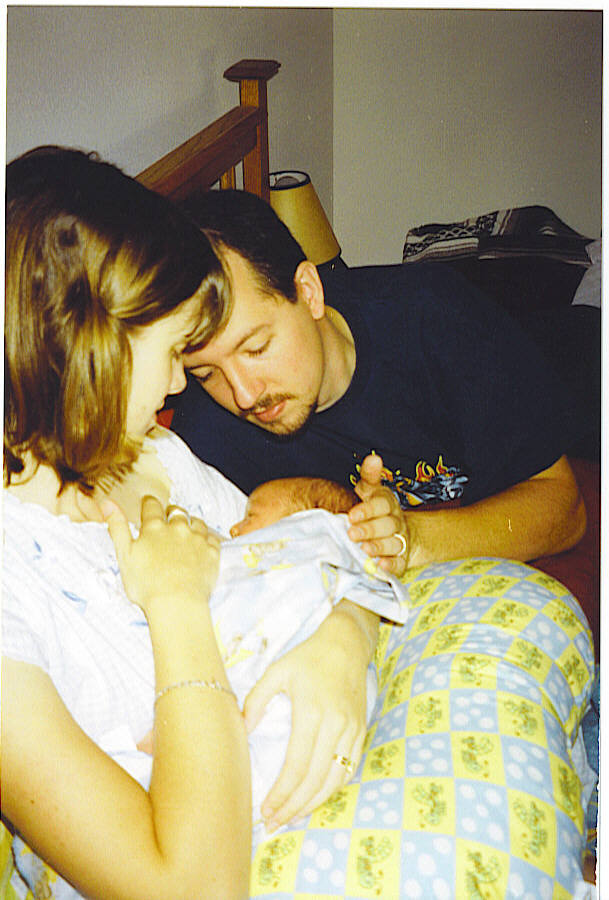
Fresh new baby, 2003
This post is part of our June Pagan Flash Points series on “Beyond Mommy Blogging.”
After my first son was born in 2003, I felt silenced. Stifled. Shut down. Squelched. Denied. Invisible. Dissolved. Muted. I felt suffocated, chewed up and my bones spit out, erased, deconstructed, worthless, and useless. In hindsight, I see the PPD-ish glint behind these feelings, though some of these feelings also featured in my pre-motherhood neuroses, and the postpartum time following my first baby’s birth remains one the most vivid and painful transition points of my life.
I felt slapped in the face by postpartum. I was triumphant and empowered in birth, but diminished, insecure, and wounded postpartum. I had a difficult physical recovery due to unusual labial tearing that was not repaired. I hypothesize that perhaps this contributed to my difficult adjustment to early motherhood. I’ve long tried to analyze the difficulty, concluding that it is not uncommon in the least, but wondering why/how others survive without mentioning this pain. How is anyone doing this? I would wonder, concluding that I must not be “cut out for this” and that I was the only one feeling alone, stifled, shut down, and unheard. As a consistently overachieving type, it was humbling as well as psychologically painful to not “get an A” on this new “assignment,” my baby. Each time he cried, I felt it was evidence of failure, failure, failure. I would see women and couples without children and think, “it isn’t too late for you” and, “if only you knew.” When I would see women who were pregnant I would feel a sense of grief for them, “Just wait. You have NO idea what is coming.”
I felt a duality in motherhood for which I was completely unprepared. How is it possible to feel simultaneously so captivated and yet also so captive? I would wonder. Bonded and also bound.
Maybe these feelings mean I was egocentric, selfish, or immature (I certainly lectured and berated myself about that!), but they were my reality at the time. The experience was so scarring to me that for about 18 months after my first baby was born I considered not having any more children; not because I couldn’t handle pregnancy, birth, or even the mothering of a baby and toddler, but because I could not stand the idea of experiencing postpartum again. I came to realize that my only regret about these days of early motherhood was not in how I related to my baby,  or in how I took care of him, or loved him, or appreciated him, or marveled at him. My regret is that I was so very mean to myself the whole time I did those things—in reality, I was actually fairly skillfully learning how to mother. I was responsive, nurturing, kind, and loving and I took delight in my baby, but I was cruel to myself almost the entire time and failed to appreciate or notice any worth I had as a person or to accept and have patience for my birth as a mother.
When my first son was almost one, I wrote in my journal:
I feel like I have no one to talk to. I feel like no one understands me. I feel like I cannot express what I really feel inside. I feel like no one believes me. I do not feel accepted. I feel like my needs are not being met. I feel burned out. I feel drained. I feel angry. I feel sad. I feel desperately unhappy. I feel guilty. I feel wrong. I feel alone. I feel unworthy. I feel like I am not good. I feel invisible. I feel ignored. I feel small. I feel bad. I feel like I cannot say what I mean and actually be heard. I feel like I can’t explain my “bad” feelings. I feel trapped. I feel suffocated. I feel stressed. I feel overloaded. I feel like snapping. I feel mean. I feel unfair. I feel selfish. I feel disconnected.
I miss Mark. I miss our relationship. I miss feeling right in our marriage. I miss being alone together.
I feel like I am not enjoying motherhood the way I am “supposed” to. I feel confused. I feel conflicted. I feel torn. I feel low. I feel resentful. I feel worried about the future. I feel anxious about being good enough. I feel stretched. I feel taut. I feel like changing.
What helped me a great deal during this time were the voices of other women. Not women face-to-face, though I had begun building a network of wonderful female friends, because it seemed too painful or dark to broach the question with them—-Do you hate this sometimes too? And I couldn’t really bear to voice my feelings to my own mother, also a tremendous source of support for me, because to risk hearing her say, “Yes, sometimes I did feel tortured by YOU” was not really what I needed. She also has a well-meaning, but frustrating tendency to meet genuine expressions of despair with comments that imply I should put on a happy face. Instead, it was the voices of women reaching off the printed page that met my hunger for contact. For truth. For rawness and a look at the “ugly.” I gobbled up books about motherhood and women’s experiences of mothering and have a permanent place in my heart for the “momoir.”
A quote that served as a recurrent guidepost (or almost obsession) in my life was, “Don’t die with your music still in you” (Wayne Dyer). During my abovementioned painful transition to motherhood I couldn’t shake the feeling that I wasn’t letting my “music” out. Then, following the birth of my second son in 2006, sort of accidentally, I began writing again and in earnest this time (articles, essays, blog posts, journals) and later realized that I no longer have any fear about dying with my music still in me. And, I don’t feel depressed, invisible, worthless, or muted anymore either. During my original fretting over this phrase, I felt like it was another type of “music” that I needed to let out, mainly the social service work that I had been groomed for in graduate school, not words necessarily. However, I finally realized that it was literally my words dying in me that gave me that feeling and that fretfulness. They needed to get out. I’ve spent a lifetime writing various essays in my head, nearly every day, but those words always “died” in me before they ever got out onto paper. After spending a full three years letting other women’s voices reach me through books and essays, and then six more years birthing the mother-writer within, I continue to feel an almost physical sense of relief and release whenever I sit down to write and to let my own voice be heard.
 —
—
*title of post inspired by Literary Mama.
Previously posted on Talk Birth.
Previous Post

June 6, 2014
Flash Points: Beyond Mommy Blogging
Next Post

June 9, 2014 Top Ten Tips for Writing with Babies at Home
Browse Our Archives
Select a Category abortion Adoption birth Birth Guardians birth stories breastfeeding Contraception divorce Flash Points From the Editor's Desk grandparenting home infertility marriage menstruation Miscarriage Pagan Families Parenting poetry postpartum pregnancy review ritual sex education Uncategorized Wednesday Wisdom
Select a Month September 2015 August 2015 July 2015 June 2015 May 2015 April 2015 March 2015 February 2015 January 2015 December 2014 November 2014 October 2014 September 2014 August 2014 July 2014 June 2014 May 2014 April 2014 March 2014 February 2014 January 2014 December 2013 November 2013 October 2013 September 2013 August 2013 July 2013 June 2013 May 2013 April 2013 March 2013 February 2013 January 2013 December 2012 November 2012 October 2012 September 2012 August 2012 July 2012 June 2012 May 2012 April 2012 March 2012 February 2012 January 2012 December 2011 November 2011 October 2011 September 2011 August 2011 July 2011 June 2011 May 2011
Follow Us!
TAKE THE
Religious Wisdom Quiz
Who prayed three times a day facing Jerusalem?
Select your answer to see how you score.
Jonah Micah Daniel Ezekiel
Related posts from Pagan Families

Sharing Our Spiritual Path With Our Children, Part...
Sharing Our Spiritual Path With Our Children, Part...

Birth Guardians: Catherine Rivera

Sharing Our Spiritual Path With Our Children, Part...
TRENDING AT PATHEOS Pagan

I was recently chatting with someone on Instagram. She asked me what...

While there are many people who share their results, the end of...

On July 23, I saw Christopher Nolan's The Odyssey which is Homer’s...

As I write this two big events have just finished up. One...

Restoring the Watershed of Divine Love
Perhaps cooperation is not something we manufacture through legislation, ideology, or moral...

Many UUs don’t pray because of bad experiences in a previous religion,...
view all Pagan blogs
Ad-Free & Subscriber Log-In Subscription Support
- About Us
- 2026 Calendar
- Videos
- Podcasts
- Library of World Religions
- Faith In Media Tracker
- Advertise With Us
- Write for Us
- Privacy Policy
- Terms of Service
- Do Not Sell My Data
- Contact Us
- Radiant Digital
- Manage Newsletter Subscriptions
- Unsubscribe From Notifications
- Sitemap
Copyright 2008-2026, Patheos. All rights reserved.
Subscription Support Ad-Free & Subscriber Log-In
Follow Patheos